- Trump had threatened Insurrection Act to control protests against ICE
- Minnesota governor mobilizes National Guard amid rising tensions
- 11th Airborne Division soldiers in Alaska on standby, reports say
- Confrontations high after ICE agent killed Renee Good
Washington
Pentagon readies 1,500 troops to possibly deploy to Minnesota, US media say


Jan 18 (Reuters) – The Pentagon has ordered about 1,500 active-duty soldiers to prepare for a possible deployment to Minnesota, the site of large protests against the government’s deportation drive, U.S. media reported on Sunday.
The army placed the units on prepare-to-deploy orders in case violence in the northern state escalates, the Washington Post reported, citing unnamed defense officials, adding that it is not clear whether any of them will be sent.
Sign up here.
The White House told the Post in a statement that it is typical for the Pentagon “to be prepared for any decision the President may or may not make.” The Pentagon and the White House did not immediately respond to requests from Reuters for comment.
President Donald Trump threatened on Thursday to use the Insurrection Act to deploy military forces if officials in the state do not stop protesters from targeting immigration officials after a surge in Immigration and Customs Enforcement agents.
THREAT OF TROOPS FOLLOWS SURGE OF IMMIGRATION AGENTS
“If the corrupt politicians of Minnesota don’t obey the law and stop the professional agitators and insurrectionists from attacking the Patriots of I.C.E., who are only trying to do their job, I will institute the INSURRECTION ACT,” Trump posted on his Truth Social platform.
The soldiers subject to deployment specialize in cold-weather operations and are assigned to two U.S. Army infantry battalions under the 11th Airborne Division, which is based in Alaska, the Post and ABC News reported.
Confrontations between residents and federal officers have become increasingly tense in Minneapolis, Minnesota’s most-populous city, after an ICE agent fatally shot Renee Good, a U.S. citizen and mother of three, on January 7 as she was driving away after being ordered to exit her car.
Trump, a Republican, has sent nearly 3,000 federal agents from ICE and Border Patrol to Minneapolis and neighboring St. Paul since early last week, as part of a wave of interventions, mostly to cities run by Democratic politicians.
He has said troop deployments in Los Angeles, Chicago, Washington, D.C., Memphis and Portland, Oregon, are necessary to fight crime and protect federal property and personnel from protesters. But this month he said he was removing the National Guard from Chicago, Los Angeles and Portland, which have faced legal setbacks and challenges.
Local leaders have accused the president of federal overreach and of exaggerating isolated episodes of violence to justify sending in troops.
Minnesota Governor Tim Walz, against whom the Justice Department has opened a criminal investigation, has mobilized the state’s National Guard to support local law enforcement and emergency management agencies, the state Department of Public Safety posted on X on Saturday.
Trump has repeatedly invoked a scandal around the theft of federal funds intended for social-welfare programs in Minnesota as a rationale for sending immigration agents in. The president and administration officials have repeatedly singled out the state’s community of Somali immigrants.
The Insurrection Act is a federal law that gives the president the power to deploy the military or federalize National Guard troops inside the U.S. to quell domestic uprisings.
The law can be invoked when there are “unlawful obstructions, combinations or assemblages or rebellion” against federal authority. If the president deems those conditions have been met, he may use the armed forces to take actions “to enforce those laws or suppress the rebellion.
Reporting by Chandni Shah in Bengaluru; Editing by Tom Hogue and William Mallard
Our Standards: The Thomson Reuters Trust Principles.



Washington
Washington law says to alert the public when doctors are accused of misconduct. It can take months

This story describes detailed allegations of sexual violence and other sexual misconduct.
This article was produced for ProPublica’s Local Reporting Network in partnership with KUOW. Sign up for Dispatches to get ProPublica’s stories in your inbox every week.
Experts on laws protecting patient safety give Washington state high marks for the types of information it is willing to disclose about doctors accused of wrongdoing.
Like other states, Washington lets patients look up doctors by name online to read any state allegations against them. But decades ago, Washington lawmakers created a separate pathway that doesn’t leave the homework to patients, mandating that regulators issue a press release whenever an investigation results in formal allegations being filed against a doctor. Washington is alone in legally requiring such proactive outreach to the news media, the Federation of State Medical Boards says.
Yet an examination of Washington discipline records by KUOW and ProPublica found that regardless of what the law calls for, Washington fails to reliably call the public’s attention to serious misconduct allegations against doctors who have been allowed to keep practicing while their cases proceed.
Announcements can take months to go out — and may not go out at all until after the case is resolved.
Take the case of Brooks Watson, a Richland, Washington, doctor who the state medical board accused of making nonconsensual sexual contact, unwanted sexual advances or inappropriate sexual remarks to five of his coworkers over the course of five years.
During one encounter in 2023, Washington Medical Commission records allege, Watson isolated a subordinate in his office and, without her consent, kissed her, touched her breasts, put his hands down her pants, groped her vagina and exposed his penis.
The commission sent Watson a “statement of charges” alleging sexual misconduct and unprofessional conduct on Aug. 19, 2025, and it amended the charges in June to include an allegation that Watson had assaulted someone at his home.
Yet the commission issued no public announcement about Watson’s case for more than nine months after first filing allegations.
Watson remains licensed to practice, and an online provider database run by the state shows no final decision on his case has been made as of July 6.
The attorney defending him in the criminal case stemming from the incident at his home said that Watson disputes the allegations and that he pleaded not guilty to the misdemeanor assault charge against him. The attorney referred further questions to another lawyer who he said represented Watson in workplace matters; that person acknowledged a request for comment sent by email but did not answer emailed questions or respond to voicemails.
Watson did not answer emails or phone messages seeking his response to the medical commission’s claims. Meeting materials on the commission’s website say Watson had a hearing scheduled in April.
KUOW and ProPublica began examining how and when Washington tells the public about doctors facing discipline following the case of Mark Mulholland, an eastern Washington OB-GYN accused last year of conducting irregular pelvic exams and making inappropriate remarks.
A Washington OB-GYN was repeatedly accused of sexual misconduct. The state medical board let him keep practicing
He initially kept seeing patients, and at least one has accused Mulholland in court of abuse and negligence that she says occurred during the time between when the commission filed formal charges and when it announced them. The woman alleges Mulholland “shoved his fingers into her rectum” and “said to her with confidence that she had a nice-looking and tight vagina.”
More than 80 lawsuits related to Mulholland’s alleged misconduct have been filed against the doctor himself, his former employer Kadlec or its affiliate, the Providence hospital chain.
(Mulholland has not responded to requests for comment, but the doctor or his attorney told the commission previously that he strives to be gentle and respectful with cervical exams and denied conducting them in ways that patients described. In the civil litigation, which remains ongoing, the doctor, Providence and Kadlec all deny wrongdoing. In the state disciplinary case, which remains open, Mulholland signed an interim order agreeing to restrictions on his license.)
As with many announcements of charges against doctors whose licenses remained unrestricted, the commission did not first publish a notice about Mulholland on the press release section of its website, but rather in a subscribers-only email that said nothing about what he was accused of. It came six weeks after charges were filed.
The list is supposed to go out quarterly, a schedule that guarantees many charges stay off the radar for months — or even longer when the board fails to keep to its publication schedule. At least 269 days passed recently without subscribers receiving an email announcing charges being filed against a doctor and without the commission announcing charges in an online press release.
Some cases still have not been publicized.
Presented by KUOW and ProPublica with questions about how it notifies the public, the commission issued a written statement saying it plans to alter its practices to make allegations against doctors more visible.
Although the commission believes its current practices meet the law’s notification requirement, the statement said, the agency “is always looking for ways to grow.”
“Technology and public accessibility standards continue to evolve since the statute was written,” the statement said. The medical commission “recognizes the value in refining our processes and establishing new best practices to enhance transparency.”
A Seattle doctor was investigated for fertility fraud. The case highlights tension between patient, physician rights
On May 29, the same day the commission sent its statement, it sent four email notices announcing initial or updated allegations against licensees who were not immediately suspended — the first such emails subscribers received since June 2025.
Washington state Rep. Gerry Pollet, a Seattle Democrat and outspoken advocate for disclosure and accountability, said the medical commission was “absolutely not complying with the law.”
“The Legislature clearly said, ‘You have to inform the public quickly, and you should do that through a news release,’” Pollet said. “That’s one of the mechanisms. And the implication of a news release is you have to put it out while it’s still news. And waiting months to put something on a limited listserv doesn’t meet the spirit, much less the letter, of the law.”
Pollet said he plans to ask other legislators to join him in contacting the medical commission and asking for more prompt and public notifications.
And if that doesn’t work, he said, “ What we might need is direction in the budget to demand that they follow the law.”
The letter of the law
The Washington Medical Commission has a well established process for looking into the roughly 2,000 allegations of provider misconduct it receives each year.
If an investigation finds evidence that a doctor violated the law, the medical commission issues a statement of charges. The doctor has a right to contest these before a health law judge or the commission issues a final order spelling out any disciplinary action or dropping the case. Months can go by in the interim.
Washington law directs the medical commission to report both statements of charges and final orders to interested parties: the person whose complaint triggered an investigation, certain professional organizations and the public.
Specifically, the law says public notification “shall include press releases to appropriate local news media and the major news wire services.”
Two legal experts said the availability of the state’s email list notifying subscribers of “legal actions,” which requires journalists and others to opt in, conceivably meets the law’s requirements. But Seth Rosenberg, an administrative and employment law attorney, said by email that the fact that it gives only names, dates and locations — not a description of the charges doctors face — arguably means “it is bereft of meaningful detail.”
Whether or not the emails convey enough information, KUOW and ProPublica’s review found that they often are not issued for a long time.
The review focused on charges against doctors whose licenses remained untouched while they awaited a disciplinary decision. It turned up 13 emails or press releases from May 2024 through July 6 that announced charges while the case was still open, five of which were not sent for more than two months after charges were brought.
In another 12 cases, the commission did not send out public notifications until after it resolved charges against the doctor, often months after the physician was put on notice. Three of these cases were shared by way of the agency’s quarterly newsletter, which doesn’t necessarily go to subscribers on the legal actions list.
Four doctors accused last year or in January still have yet to appear in an email, press release or newsletter noting their charges as of July 6.
All told, the commission has gone 100, 200 or even 300 days — in the case of Watson, the Richland doctor accused of sexual misconduct with coworkers — without either publicizing charges or taking away a doctor’s license.
It’s unclear how many of the physicians identified in KUOW and ProPublica’s review continued practicing while waiting for their cases to be resolved, but they had the legal ability to do so.
The commission did not respond when asked to verify that it had failed to publicize cases against doctors for whom no email bulletins could be found from early in the disciplinary process. Executive Director Kyle Karinen said the commission has consistently attached charges to doctors’ entries in an online database and listed charged doctors in commission meeting materials online.
The Washington Department of Health, a related agency that handles sexual misconduct allegations against doctors when the investigations do not require medical expertise, acknowledged that it failed to publish any bulletins on 30 enforcement actions since 2016 but said it has recently fixed the problem.
The medical commission’s delayed or or nonexistent notifications encompass a range of alleged doctor misconduct.
Kareematulai Arogundade was accused in August of failing to undergo a mental examination that the commission required. The physician, who did not respond when contacted by KUOW and ProPublica by email and phone, first appeared more than 120 days later in the commission’s winter newsletter after his license was indefinitely suspended.
Sophie Gomez was accused in October of failing to respond to a request for information about a complaint filed with the board, and her license was indefinitely suspended in February, after which the commission issued a press release. (Gomez declined to comment when contacted by KUOW and ProPublica.)
The commission did announce charges prior to resolving the case against Jonathan Wynn Hemmert, who oversaw clinical operations at three Washington clinics that used a device called Cryoskin, a temperature-controlled wand that manufacturers say can remove unwanted fat cells when it’s rubbed against a patient’s skin.
The state agency said clinic staffers had clients sign a personal injury waiver, which the commission said was unenforceable, against public policy and deceptive and dishonest. The commission said he also failed to ensure the device was approved by the Food and Drug Administration and failed to supervise staff using the device on patients.
Hemmert signed a settlement agreeing to address the concerns, but the commission in November filed formal allegations that he had breached it. (Hemmert did not respond when asked to comment on the allegations, which have not yet been adjudicated.)
A press release was posted to the commission’s website in March, 112 days after he was charged with breaching the settlement. Two months after that, a listserv notice went out.
‘A right to know’
The 1984 Washington state law that requires public notification was passed as part of the Uniform Disciplinary Act, a set of guidelines for state medical boards and commissions that license providers and investigate complaints.
Among the sponsors was then-state legislator Mike Kreidler, a Democrat and optometrist who served 16 years in the Legislature and 24 as insurance commissioner.
Kreidler said he doesn’t recall the details of how the 1984 law came together. But looking back at it, Kreidler, now 82, said he believes the public notification requirement fulfilled an important function. He said to get to the point where the commission completes an investigation and files charges means a complaint has enough evidence behind it to proceed toward disciplinary action.
“They’re not going to be frivolous in any fashion, and therefore the public certainly does have a right to know,” he said.
‘Such a violation’: Patients of former UW doctor accused of fertility fraud grapple with uncertainty, tough choices
Presented with KUOW and ProPublica’s findings, people who support policies favoring disclosure to patients said the commission’s interpretation of the 1984 notification law falls short.
Patricia Kelmar, senior director of healthcare campaigns at PIRG, a nonprofit advocacy organization for consumers, said the commission should be expansive in discharging its duty to notify the public as the law requires, contacting not only reporters but also a doctor’s current and former patients.
“ We should not be hoping that we stumble across the information that’s going to protect us from a doctor who’s dangerous,” Kelmar said.
Lisa McGiffert, patient safety activist with the Patient Safety Action Network, said the commission’s frequent delay in notifying the public does not fulfill the spirit of Washington’s law, which in her interpretation necessitates a quick release of information.
“ There’s nothing preventing Washington state from saying these have to be sent out to the news media within four or five working days,” McGiffert said.
Local media outlets have paid attention in the occasional cases where the medical commission has announced an action via the press release section of its website. A review of news releases about in-state doctors accused of conduct unrelated to their mental health shows that, more often than not, relevant media outlets have published stories afterward.
A news tip to a local journalist, not the commission’s email list, prompted the first media coverage of the case against Mulholland last June — nearly two months after the commission formally charged the gynecologist with misconduct involving three patients.
The woman who later accused Mulholland of performing an uncomfortable rectal exam and saying her vagina looked nice said the actions occurred at an appointment on May 1, 2025, or just days after the commission filed formal allegations.
The woman told KUOW and ProPublica that she was angry that she heard no news about the commission’s existing allegations before she saw Mulholland.
“I’d never heard anything bad about him,” she said in an interview with KUOW and ProPublica.
Had she known, she wouldn’t have gone, she said.
Washington
Judge tosses Trump Media’s $3.8 billion defamation suit against The Washington Post | CNN Business

Another one of President Donald Trump’s lawsuits against a news organization has fizzled out.
This time, it is a defamation lawsuit that the Trump Media and Technology Group brought against The Washington Post in 2023 over a story titled “Trust linked to porn-friendly bank could gain a stake in Trump’s Truth Social.”
A federal judge in Florida has thrown out the suit, saying that Trump Media “failed to present evidence that would allow a jury to find by clear and convincing evidence” that The Post “published the allegedly defamatory statements with actual malice.”
US District Judge Thomas Barber’s conclusion came during the summary judgment phase of the case, when a judge can evaluate evidence and make a determination before proceeding to trial.
The Post’s lawyers argued that Trump Media could not prove “actual malice,” the high legal standard that public figures must meet to prevail in a defamation case. It means that the defendant either knew a claim was false or displayed “reckless disregard of whether it was false or not.”
The Post’s reporter who wrote the story in question, Drew Harwell, “thoroughly investigated” the subject and “had confidence in the article’s accuracy at the time of publication,” the newspaper’s lawyers wrote.
In a summary docket entry last week, first reported by Reason magazine, Barber sided with the Post. He said he would issue a full opinion later.
The Post itself reported on the legal victory on Tuesday. “We are pleased with the court’s decision and look forward to reviewing its written order upon release,” a spokesperson told CNN.
A spokesperson for Trump Media did not immediately respond to CNN’s request for comment, but the company told The Post, “We believe a jury should decide whether these falsehoods were actionable and will evaluate whether to appeal last week’s ruling in due course. We will also continue to hold the media accountable.”
Trump Media positions itself as an opponent of, and an alternative to, traditional tech and media companies. It is best known for operating Truth Social, a relatively small social network favored by the president.
The publicly traded company has been losing money for years; it made less than $1 million in revenue in the first quarter of this year, according to public filings.
The company has repeatedly filed lawsuits over news coverage it deemed false. A defamation lawsuit against The Guardian and other defendants was thrown out by a different Florida judge last November. Trump Media initially filed an amended complaint, but then dropped the matter altogether in April.
Trump Media’s suit against the Post accused the newspaper of a “conspiracy” to harm the company and sought $3.8 billion in damages.
The lawsuit lawyers succeeded in narrowing the case considerably and asserted that Truth Media could not satisfy the “heavy burden” of the actual malice standard.
In May, while awaiting the judge’s ruling, The Post published a correction to the 2023 story stating that “discovery in the ongoing litigation has established” that two assertions in the story were incorrect. But the correction emphasized that the assertions were “based on The Post’s reporting at the time of publication.”
Trump and his businesses have a long history of getting publicity from lawsuits, only to see judges later throw them out.
In April, a federal judge dismissed Trump’s defamation lawsuit against The Wall Street Journal over its reporting on a lewd birthday letter to Jeffrey Epstein bearing his name. Trump refiled that suit in May. He also has pending litigation against the BBC, The New York Times and the Des Moines Register.
-
 Business2 minutes ago
California soccer fans sue StubHub after it fails to deliver expensive World Cup tickets
-
 Entertainment5 minutes ago
Lucas Museum to give free annual passes to South L.A. neighbors, host community preview day
-
 Lifestyle10 minutes ago
Meow Wolf taps famed L.A. animation house for its new Los Angeles venue
-
Politics17 minutes ago
Column: Trump decries ‘communism’ while his government takes ownership of companies
-
 Science20 minutes ago
‘I’d rather my house burn down than get cancer’: Herbicide use upends California’s fight to save forests
-
 Sports25 minutes ago
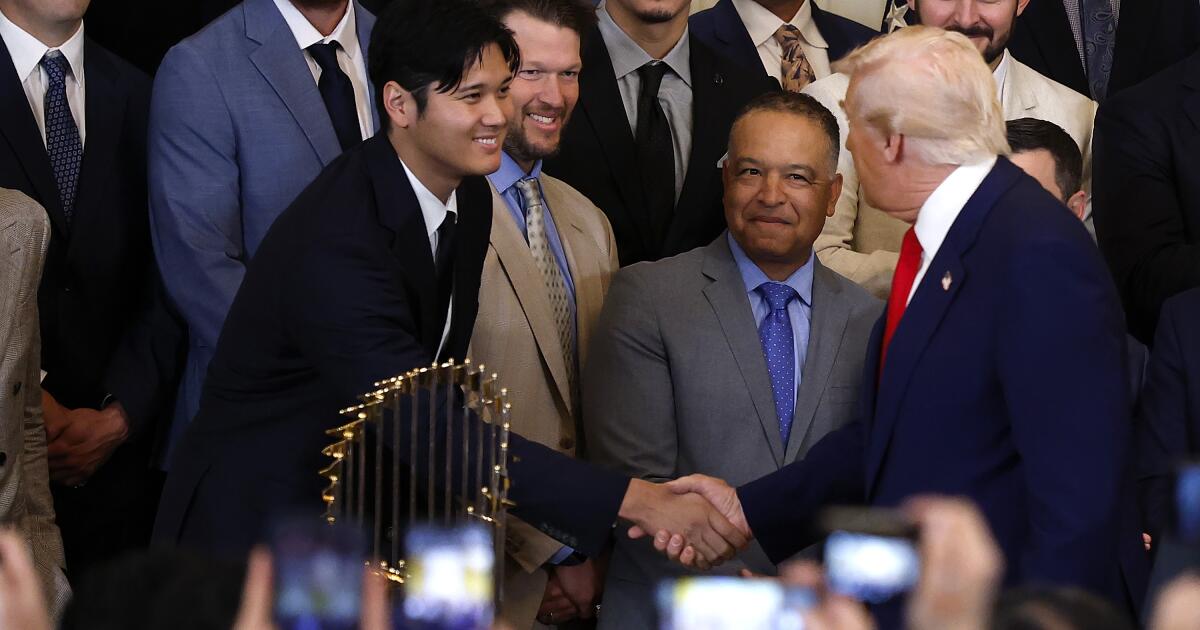
Dodgers scheduled to visit White House in late July to celebrate 2025 World Series win
-

 World35 minutes ago
Former US Olympian pleads not guilty in DC reflecting pool vandalism case
-
 News1 hour ago
Former Olympian pleads not guilty in reflecting pool vandalism charges


