Washington
Long-term forecast predicts increased forest fire activity in Oregon and Washington’s dampest areas


Hotter and more intense fires are likely coming to the Pacific Northwestâs cooler and wetter forests. Thatâs from new research led by an Oregon State University scientist.
Parts of the Cascades Region of Washington and Oregon are going to become increasingly susceptible to increased fire activity in the coming decades, according to new research.
Brian Bull / KLCC
Comprehensive wildfire simulations for over a 23-million acre stretch of forest show that for a 30-year period beginning in 2035, Oregonâs western Cascades and Washingtonâs north Cascades â as well as the Puget Lowlands and Olympic Mountains â could see at least twice as much fire activity as seen in the last 30 years.
âItâs time to start thinking about things that could counteract those climate effects,â said Alex Dye. Heâs a research associate with OSUâs College of Forestry, and the lead author on the study published in the latest edition of JGR Biogeosciences.
âAs we move forward into this research, the logical next steps are to explore those other pieces like ignition and vegetation changes, and how that can all interact with climate to further refine these future fire risk projections,â added Dye.
To many residents of the Pacific Northwest, these predictions may be surprising given the dense lushness of these areas. But researchers say modeling indicates that as the climate continues to get warmer and drier, fires in these cool and wet spaces will increase in probability, size, and number.
âThose forests are so ingrained in the natural history and the socioeconomics and the lived experience of being in the western PNW,â Dye told KLCC. âSo adding in more fire that affects those resources from a variety of directions is a big deal and is something to think about as we move into the next 30 years.â
Dye said that it can be challenging to assess fire probability in an environment where there isnât much empirical information about the fire history to build models. And the comparative infrequency of fire makes it easy for the general public to regard the PNW âWestsideâ as a low-risk area. But recent conflagrations like those observed around Labor Day 2020 – which also led to Oregonâs worst wildfire season no record â can show what can happen when fires do erupt in these areas.
Affected resources range from drinking water to timber, as well as residents and wildlife.
Dyeâs work is a collaboration with Matt Reilly, Karin Riley, John Kim, and Becky Kerns of the U.S. Forest Service, and OSU co-researchers Andy McEvoy and Rebecca Lemons. The U.S.F.S team members work at the Western Wildland Environmental Threat Assessment Center, the Pacific Northwest Research Station, or the Rocky Mountain Research Center.
The Western Wildland Environmental Threat Assessment Center and the Pacific Northwest Research Station Westside Fire Initiative supported the research.
Copyright 2024, KLCC.



Trinity Rodman signs record deal with Washington Spirit
USWNT forward Trinity Rodman signed a three-year deal with the NWSL’s Washington Spirit. The deal makes Rodman the highest-paid female footballer in the world.
unbranded – Sport
Washington Spirit goalkeeper Aubrey Kingsbury has announced that she and her husband Matt are expecting a baby in July.
The couple made the announcement in a video on the Spirit’s social media channels, holding a baby goalkeeper jersey on the pitch at Audi Field.
Kingsbury becomes the most recent Spirit star to go on maternity leave, following defender Casey Krueger, midfielder Andi Sullivan and forward Ashley Hatch.
Sullivan gave birth to daughter Millie in July, while Hatch welcomed her son Leo in January.
Krueger announced she was pregnant with her second child in October.
Kingsbury has served as the Spirit’s starting goalkeeper since 2018, and has been named the NWSL Goalkeeper of the Year twice (2019 and 2021).
The 34-year-old has two caps with the U.S. women’s national team, and was named to the 2023 World Cup roster.
The club captain will leave a major void for the Spirit, who have finished as NWSL runner-up in back-to-back seasons.
Sandy MacIver and Kaylie Collins are expected to compete for the starting role while Kingsbury is on maternity leave.
The Spirit kick off their 2026 campaign on March 13 against the Portland Thorns.

YAKIMA, Wash. — Yakima could soon take a major step toward redesigning Sixth Avenue after the Washington State Public Works Board awarded the city a $985,600 loan.
The loan was approved for the design engineering phase of the Sixth Avenue project. The funding can also be used along Sixth Avenue for utility replacement and updated ADA use.
The Yakima City Council must decide whether to accept the award. If the council accepts it, the city’s engineering work will move forward with the design of Sixth Avenue.
The cost of installing trolley lines is excluded from the plan. The historic trolleys would need to raise the funds required to add trolley lines.
The award is scheduled to be discussed during next week’s City Council meeting.

Microsoft will ramp up its investment in the University of Washington.
Brad Smith, the company’s president, made the announcement at a press conference with University of Washington President Robert Jones on Tuesday.
That means hiring more UW graduates as interns at Microsoft, he said.
And he said all students, faculty, and researchers should have access to free, or at least deeply-discounted, AI.
“ Some of it is compute that Microsoft is donating, and some of it is pursuant to an agreement where, believe me, we give the University of Washington probably the best pricing that anybody’s gonna find anywhere,” Smith said. He assured the small group of reporters present that it would be “many millions of dollars of additional computational resources.”
The announcement today didn’t include any specific numbers.
But Smith said Microsoft has already invested $165 million in the UW over several decades.
He pointed to Jones’ vision to spur “radical collaborations with businesses and communities to advance positive change,” and eliminate “any artificial barriers between the university and the communities it serves.”
Microsoft’s goal is for AI to help UW researchers solve some of the world’s biggest problems without introducing new ones.
At Tuesday’s announcement, several research students were present to demonstrate how AI supports their work.
Amelia Keyser-Gibson is an environmental scientist at the UW. She’s using AI to analyze photographs of vines, to find which adapt best to climate change.
It’s a paradox: AI produces carbon emissions. At the same time, it’s also a new tool to help reduce them.
So how do those things square for Keyser-Gibson?
“ That’s a great question, and honestly, I don’t know the answer to that,” she said. “I’m highly aware that there’s a lot of environmental impact of using AI, but what I can say is that this has allowed us to make research innovations that wouldn’t have been possible otherwise.”
“If we had had to manually annotate every single image that would’ve been an undergrad doing that for hours,” Keyser-Gibson continued. “And we didn’t have the budget. We didn’t have the manpower to do that.”
“AI exists. If we don’t use it as researchers, we’re gonna fall behind.”
Microsoft reports on its own carbon emissions. But like most AI companies, it doesn’t reveal everything.
That’s one reason another UW student named Zhihan Zhang is using AI to estimate how much energy AI is using.
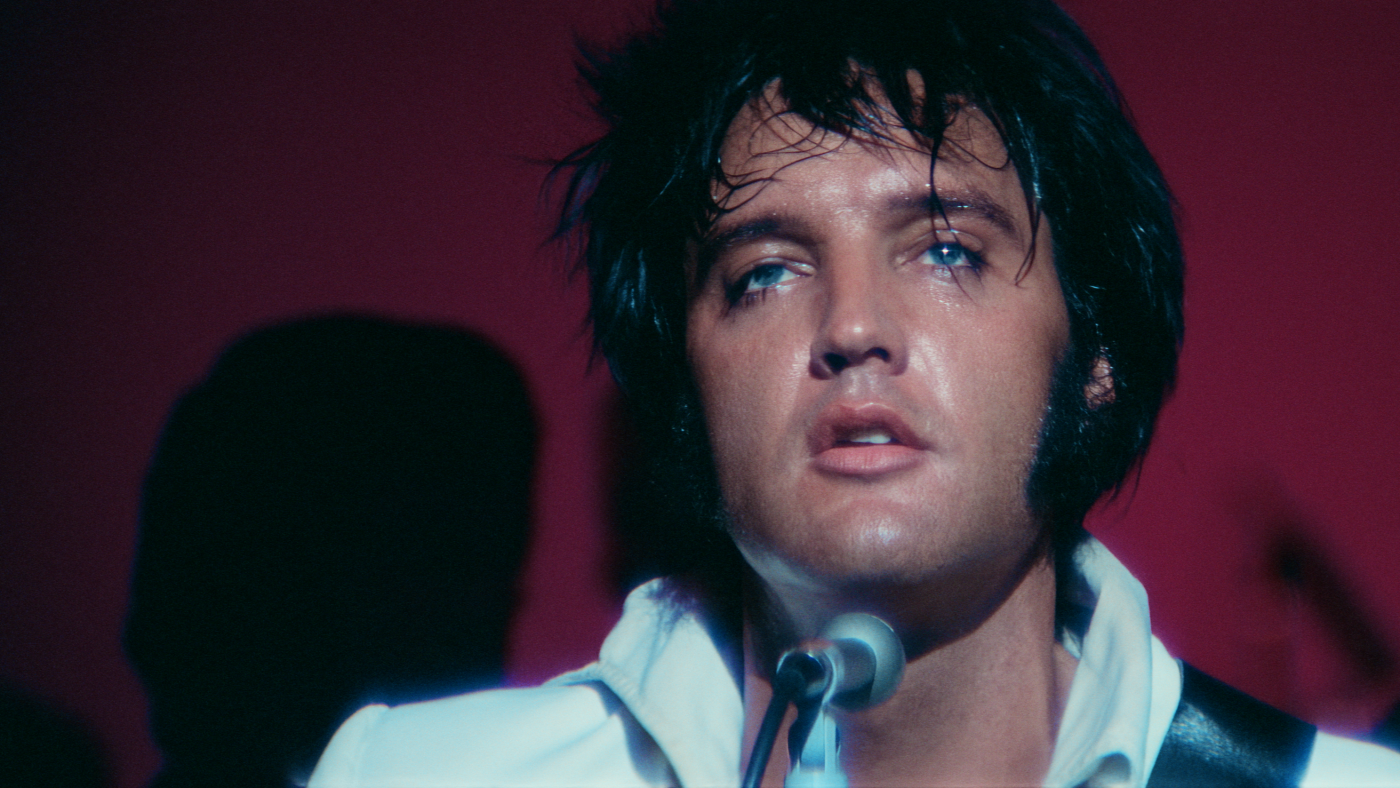
Baz Luhrmann will make you fall in love with Elvis Presley

Here’s your first look at Kratos in Amazon’s God of War show

State Dept authorizes non-essential US Embassy personnel in Jerusalem to depart ahead of possible Iran strikes

Where Iran’s ballistic missiles can reach — and how close they are to the US

Heart disease threat projected to climb sharply for key demographic

Florida High School Football Rankings: Top 25 teams – Oct. 21

Cleary's 21 help Le Moyne down Central Connecticut State 69-64 in OT

How old is Bo Nix? What to know about Oregon quarterback ahead of 2024 NFL Draft

99th annual Pony Swim held in Virginia

Indiana Members Credit Union announced as new anchor tenant at Bottleworks District
Where Iran’s ballistic missiles can reach — and how close they are to the US

Has India’s influence in Afghanistan grown under the Taliban?

Bill Clinton to testify before House committee investigating Epstein links

Read Judge Schiltz’s Order

Vulnerable House Dem lashes out at Trump’s ‘racist’ SOTU challenge: ‘That was uncomfortable’
-

 World1 day ago
Exclusive: DeepSeek withholds latest AI model from US chipmakers including Nvidia, sources say
-

 Massachusetts2 days ago
Mother and daughter injured in Taunton house explosion
-

 Montana1 week ago
2026 MHSA Montana Wrestling State Championship Brackets And Results – FloWrestling
-

 Oklahoma1 week ago
Wildfires rage in Oklahoma as thousands urged to evacuate a small city
-

 Louisiana4 days ago
Wildfire near Gum Swamp Road in Livingston Parish now under control; more than 200 acres burned
-

 Technology6 days ago
YouTube TV billing scam emails are hitting inboxes
-

 Denver, CO2 days ago
10 acres charred, 5 injured in Thornton grass fire, evacuation orders lifted
-

 Technology6 days ago
Stellantis is in a crisis of its own making