SAINT-DENIS, France — Filled with the savory scent of kebab shops and the lilting sounds of foreign-accented French, this sprawling suburb north of Paris is the hometown of a not-so-proud son: Jordan Bardella. In scathing critiques, the 28-year-old seeking to be this country’s youngest prime minister cites the multiculturalism here as an example of everything that is wrong with today’s France.
Washington
France’s Jordan Bardella, the immigrant’s son who would target migrants


“I grew up in a humble project where I experienced, to my very core, the feeling of becoming a foreigner in my own country,” Bardella told French media last month. “I’ve experienced the Islamization of my neighborhood. I’ve experienced the insecurity. I’ve experienced the search-and-frisk when you enter your building and you’re confronted with drug trafficking.”
Bardella is now the youthful face of the resurgent National Rally — a once-toxic anti-immigrant movement that posted a first-place finish in last weekend’s legislative vote. If his party can sufficiently expand its support in Sunday’s runoff, Bardella — who has pledged to bar dual citizens from sensitive posts and hold a national referendum on migration — would become France’s first far-right head of government since World War II.
“This is the time to give Jordan Bardella an absolute majority in the French Parliament,” Bardella’s boss, French nationalist Marine Le Pen, told supporters.
A victory could see Bardella, under Le Pen’s guidance, turn France into a laboratory in the heart of Western Europe for aggressive anti-migration policies, including accelerating deportations and making citizenship harder to obtain. His words suggest he separates immigrants into two camps: desirable ones, like those of his own predominantly Italian family, who assimilate, learn French and love their adopted nation; and those — particularly from Islamic countries — he views as rejecting French values, language and culture.
The Bardella who appears at campaign rallies and poses for selfies with adoring fans is the product of media trainers and party mentors who fashioned him as the smiling, besuited subordinate of Le Pen — a political figure he came to know as he dated young women in her orbit.
Le Monde assessed that he had an “ideal son-in-law profile.” For National Rally, he is an ideal spokesman: a TikTok-friendly, postmodern politician passionate about his party’s issues who can talk firsthand about the ills of immigrant-dominated neighborhoods. At the same time, he is young enough not to bear the taint of open racism that defined the party in the past.
But several people who know him — including a childhood friend and a former political mentor — say that image does not tell the whole Bardella story. They wonder how a son of immigrants became so anti-immigrant himself and call him a chameleon who changes his colors to suit the political mood.
“The man I see talking now does not seem like the Jordan I knew,” said Chloe, a 28-year-old of mixed race who went to school with Bardella. She spoke on the condition that her last name be withheld, because her job as a civil servant requires political neutrality.
A photo she recently posted on X shows the two of them at McDonald’s during her 6th-birthday party. In an interview, she recalled visits to the small apartment in the drab urban housing bloc where Bardella lived with his divorced mother, an Italian who had arrived in France as a child. Bardella would also sometimes stay with his father, an entrepreneur who reportedly paid for his son’s private education.
She remembers the studious, even shy boy at Saint Vincent de Paul elementary, a private school for more-privileged children in the neighborhood. She said Bardella began to bloom once they transferred to Jean Baptiste de La Salle middle school. He played soccer, cracked jokes.
They were in primary school in 2005 when riots exploded in their department of Seine-Saint-Denis after the deaths of two Muslim boys hiding from police in a power substation. She had lost touch with Bardella by the time the ringleader of the 2015 Paris terrorist attacks was gunned down by police here. But in all the years she knew him, she said, she couldn’t recall him uttering a single negative word about the multicultural world they lived in.
“In Saint-Denis, there were Arabic people, Italian people, Portuguese people, people from everywhere, and we were all friends,” Chloe said. “So I cannot believe it when I hear him talk now. I thought at first he was just playing a role, like he wanted to belong and find a place where he could be loved. I just didn’t believe that he was thinking like this, saying these things. But I have started to believe he has really changed.”
Lea, 28, who is also a civil servant and asked that her last name be withheld, offered a different view. She said she spent ages 12 to 14 in class with Bardella and recalled an incident in which a teacher scolded her and took away her cellphone after it went off during a lesson. As she began to cry, she said, Bardella leaned forward from the desk behind her and whispered, “You deserved it.”
“He was always the one respecting the rules without an understanding of others,” she said.
Bardella, through a spokesman, denied a request for an interview. He has been remarkably opaque in his public accounts of his background.
He has called himself a Frenchman who is “75 percent Italian,” but rarely talks in specifics about his family history. Jean-Louis Beaucarnot, a lineage expert considered the “Pope of Genealogy” in France, said his research showed that of Bardella’s eight great-grandparents, six were Italian, one was French and one — a paternal great-grandfather — was Algerian.
For a leader and party that promote degrees of Frenchness, his background could seemingly pose a hurdle. He has in the past glossed over his roots. But Bardella has recently begun emphasizing them, portraying his Italian family as living proof that culturally compatible immigrants can seamlessly become “French.”
“He is first and foremost a Frenchman; we don’t consider him to be a son of immigrants,” said Edouard Bourgeault, who runs National Rally’s youth league in Paris. “He is European, and that is important to say, because Europeans share the same culture and are welcome.”
Bardella, who did not attend university, has often demurred when asked about his party’s early years as a magnet for Nazi apologists. It was co-founded in 1972 by Le Pen’s father, Jean-Marine Le Pen, who was repeatedly convicted of hate speech and of dismissing the Holocaust as a “detail” of history.
Bardella has said that he does not think the elder Le Pen was antisemitic, retorting to an interviewer last year that questions about the party’s past are “about a time I never knew.”
Bardella joined the National Rally — then known as the National Front — in 2012 at age 16. By then, Marine Le Pen had taken over as party president. But within the movement, her father remained an idolized figure known to young militants like Bardella as “Papi” — grandfather.
Pierre-Stéphane Fort, who wrote a book on Bardella, quotes a photographer who took a photo of an 18-year-old Bardella with Jean-Marine Le Pen in December 2013, a time when the elder Le Pen’s polemics were well known. The photo was taken at an event in which young party activists patiently lined up in the Paris cold for two hours for the chance of a Le Pen memento.
“You have to remember that for all the young militants, Jean-Marie Le Pen was an icon,” the photographer, Anthony Micallef, recalled in the book. “He embodied the FN, they’d all seen him on TV, they’d grown up with him. In fact, they all affectionately called him “papi” (grandpa). Often, these were young people lacking family reference points; they found in the FN a substitute family, they felt they belonged to something.”
In his book, Fort also claims that Bardella kept a secret Twitter (now X) account that spewed racist, homophobic content. Bardella has denied any link to the account.
His introduction to Marine Le Pen, the doyenne of French nationalism, was initially uneventful. Florian Philippot, a former National Rally vice president and now head of a rival nationalist party called the Patriots, recalls a meet-and-greet “in a corridor somewhere at party headquarters” in Paris in 2013. But Philippot saw a spark in the clean-cut and earnest Bardella — who had a face the camera loved — and opted to promote his career.
Bardella would receive professional media training. But Philippot also coached him, scheduling him for a first TV interview on a late-night news show. Philippot remembers calling the young man and offering him a detailed critique. The upshot: Smile more, sharpen your points. Bardella gratefully absorbed the advice and promised to do better.
So much so that by 2016, Philippot hand-selected Bardella to serve as the head of a party collective to rally backers in the suburbs under the slogan “Muslims maybe, but French first.”
At the same time, Bardella was growing closer to Le Pen, a woman he honored on election night last weekend by wearing a “marine blue” suit during a public address. Philippot recalls Bardella dating the daughter of Frédéric Chatillon, a longtime Le Pen adviser who was president of a now-disbanded far-right youth group known for spewing xenophobic and racist vitriol. Later, Bardella began dating Le Pen’s niece.
Philippot said he began to sour on Bardella, especially as he saw him shed his support for France leaving the European Union — a change backed by Le Pen to broaden her party’s appeal. Philippot saw the shift as a betrayal of French nationalist roots.
“He was very sovereigntist, but that only lasted for a while,” Philippot said. “And then I quickly realized that he was a chameleon. He was a good politician, but he didn’t have many convictions.”
By 2019, Bardella had “arrived” — elected as a member of the European Parliament at age 23. He became interim president of National Rally during Le Pen’s failed presidential run in 2022, and he received the title permanently after a party ballot in which he won 85 percent of the vote.
Now he could be prime minister. This week, more than 200 centrist and left-wing candidates in three-way races with National Rally pulled out of Sunday’s runoff, hoping to consolidate support against the far right. Yet keeping it out of government might also allow the far right to thrive in opposition, giving Le Pen momentum in the 2027 presidential race. Should she win, she is likely to name her young protégé as prime minister herself.
Bardella would prefer not to wait.
“The time is now to put at the head of our country leaders who understand you, who respect you and love you as much as they love France,” Bardella said Sunday night in a Parisian venue that bills itself as a throwback to the 1930s. “Victory is possible, and change is within our grasp.”
Virgile Demoustier and Elie Petit contributed to this report.


Much of Western Washington University’s queer community gathered on campus Thursday, June 4 to celebrate the institution’s third annual Lavender Graduation.
The 2025 ceremony was canceled due to a strike by the university’s operational student employees following more than a year of failed negotiations with WWU. This year, though, about 60 graduates walked the stage inside Viking Union
. Multiple keynote and student speakers took to the podium to congratulate the university’s outgoing students on reaching an academic milestone, and touted the importance of community building during a time when shifts in the country’s social and political fabric have negatively affected minority communities.
Still, the ceremony was filled with joy as those same speakers recounted how the friends and family they’d fostered on campus changed their lives for the better. During the event, four Western Washington University graduates took the time to speak with Cascadia Daily News and reflect on their growth while in school.
Their responses have been edited for brevity and clarity.
Juleyana Cabrera
What did you learn outside of the classroom during your time at WWU?
I think it’s more like another thing I just kind of survived. I’ve lived a really rough life, and I’m the first generation in my family to graduate from any college. So there’s a lot of pressure, but there is also the knowledge within myself that I’ll probably be okay no matter what happens after this. I learned a lot on campus about myself and how I adapt to things.
What does queerness mean to you?
Queerness means to me, it means community, it means family, it means the thing that saved my life. I’m just kind of more grateful than anything. My first ex-girlfriend is the whole reason I moved to town. Rest in peace, she’s not with us anymore, but I don’t know where I’d be without my queer fam.
Did you find WWU to be a welcoming space for you?
There are certain pockets that are OK but there are certain teachers that were straight-up transphobic that I absolutely hate.
Do you have any words of advice for queer students who are about to start the next step of their education at WWU?
Remember to get full sleep. Don’t forget to stay hydrated. Avoid the drama if you can avoid it. Figure out what works best for you and keeps you safe and sane, because keeping yourself safe and sane while navigating all of this is the most important thing.
Joshua Riley

What did you learn outside of the classroom during your time at WWU?
Even as you build community with people, you have to put yourself first. I think that’s the biggest step in building community. When you put yourself first, you can be your most authentic form, and I think that that’s really helped me accept who I am and be happy with who I am.
Do you have any words of advice for queer students who are about to start the next step of their education at WWU?
Go to all of the events you can, talk to all the people you can. Showing up really is the best thing you can do. It helped me get integrated and find my people a lot faster. The events are great and they’re there for you. You should attend them.
Did you find WWU to be a welcoming space for you?
Yes, Western was very welcoming. They talked a little bit about intersectionality (during Lavender Graduation), and my experience as a queer person has been really great. My experience as a person of color has been less great. So that comes together in ways that are sometimes not great and then sometimes really great because you get spaces like Black LGBTQ+ Thriving as well.
I would say ultimately yes, especially as a queer person. Even as I talk about the struggles of being a person of color in these predominantly white spaces, I have been more accepted here than a lot of the white spaces I have been in prior.
What does queerness mean to you?
It means accepting alternate truths and realities, I suppose. There is a heteronormative standard set in place, and when you break that, you accept queerness. To me, that means having pride and joy in the person that you are, no matter who you are and what you bring to the table. Like I said, you kind of put yourself first and learn yourself and love yourself.
Casper Suter

What did you learn outside of the classroom during your time at WWU?
I learned a lot about community. I spent the three-and-a-half years that I was here as a part of the drag campus club on campus. I was a part of it from the day it started. Prior to that, I didn’t have a whole lot of friends or even people within the queer community that I knew at home, so I learned a lot about other people and how they fit into the community and how we all interact together.
What does queerness mean to you?
Being yourself, even through adversity. When I first came to Western, I presented myself very differently than I do now because I felt like it was how I had to be in order to be valid in my identity, and now I feel a lot more comfortable in both my identity and also how I present, regardless of how they overlap.
Do you have any words of advice for queer students who are about to start the next step of their education at WWU?
Find your people. One of my best friends is someone I met the day I moved into the dorms and we’ve stuck together ever since. I know people who went through all of college without really knowing anyone in their community. It took me until my third year to meet other people in my major, so just like finding your people and having people around you so you’re not alone.
Gabriel Diaz-Kelly

What did you learn outside of the classroom during your time at WWU?
I think Western really taught me to listen to people. I came in thinking that I was the only person with my experience. When I came into college, I thought that I knew the most about everything and that no one else could relate to me, and this made me special in a lot of ways. I learned that uniqueness doesn’t really come necessarily from the identities that I hold, but the experiences that I get to share with people.
I was really lucky to be able to find such wonderful queer friendships here. Queer professors, queer mentors and even just in general, college has really forced me to take uncomfortability and turn it into lessons and education.
Did you find WWU to be a welcoming space for you?
I came out as trans super, super young, when I was 13, which is younger than most people my age. One of the main reasons I picked Western is because of their gender-neutral housing. I remember very specifically a call that we gave to Western when I was going through universities calling and asking, “Hey, what is it like to find a dorm when you’re trans,” and they had all of these systems already in place, and I remember me and my mom in the car together becuase she was so worried that her kid wasn’t going to be safe in college.
But I did find a lot of gaps. It wasn’t necessarily because people weren’t working hard enough; it’s just that there weren’t enough people or positions. So it was very easy for me to find a community and support network when it came to my personal life, but when it came to the broader structures of Western, there was kind of a gap that I was lucky enough to fill when I was working as the advocacy and education co-coordinator (for LGBTQ+ Western).
I am leaving this with the full knowledge that my co-coordinator, my other employees, my supervisors have my back 100% of the way, and they’re going to have the next person’s back.
Do you have any words of advice for queer students who are about to start the next step of their education at WWU?
Shut up and listen. I love to talk, I love to get to know people, but you really have to just be on the sidelines to get to know people. Be the dumb person in class, ask the questions, don’t wait for someone to tell you what you’re supposed to know.
Take every opportunity, look up every resource. We have 1,001 resources here at Western. Most students don’t know that we have free audio editing and sewing machines, and we take students out to Mount Baker and we have gender-affirming resources. Say hi to everyone you can say hi to and talk to the people that you don’t think you’d like, because chances are you’re probably going to like them at least a little bit.
What does queerness mean to you?
I think queerness is a way for me to show other people that I want to love them in a very kind way. If I’m alone, I don’t think of myself as queer and trans; those are labels I give to the outside world so that they get some glimpse into what I am.
I don’t need anyone to tell me that I’m valid, I don’t need anyone to tell me that I’m enough because I know that, I’m very secure in that. So what I have in the label “queer” is a billboard to everyone else that says, “I want to love you back. I want to talk to you, I want to get to know you.”
Santiago Ochoa is a CDN visual journalist; reach him at santiagoochoa@cascadiadaily.com; 360-922-3090 ext. 105.

A group of Northeast Texas Community College travelers recently returned from an unforgettable travel study experience in Washington, D.C., where they spent several days exploring the history, government, and culture of the nation’s capital.
The trip provided participants with a unique opportunity to experience many of the places and institutions they have studied and read about over the years. Highlights included a guided tour of the U.S. Capitol led by a member of Congressman Nathaniel Moran’s staff, a tour of the White House, and visits to several Smithsonian museums, including the National Museum of Natural History and the National Museum of American History.
The group also visited some of America’s most recognizable landmarks and historic sites, including the Jefferson Memorial, Lincoln Memorial, Washington Monument, and Mount Vernon, the home of George Washington. Along the way, travelers gained practical experience navigating the city by mastering the D.C. Metro system and exploring the capital like locals.
“The trip was a great opportunity to connect classroom learning with real places, real institutions, and real history,” said Matt Homer, NTCC instructor and trip coordinator. “From government and politics to culture and historical preservation, participants were able to experience concepts they have studied in a much more meaningful way.”
In addition to the educational experiences, the trip offered plenty of opportunities for discussion, reflection, and fellowship among participants.
NTCC offers a travel study course each summer that allows students, employees, and community members to explore a different destination while earning college credit. For more information about future travel study opportunities, contact Matt Homer at thomer@ntcc.edu.

WASHINGTON (7News) — Police are investigating the fatal shooting in Southeast Washington, D.C. that left a 14-year-old girl dead around 6:54 p.m., authorities said Saturday.
According to sources, kids found a gun while exploring and shot the girl in the head while they were playing with it
7News has a crew on the scene, reporting a major police presence in the area.
WATCH LIVE BELOW:
A press conference is forthcoming, and this story will be updated as information becomes available.
ALSO SEE | ‘They shot my son’: Family distraught after teen killed near food truck in Northeast DC
So far, the Metropolitan Police Department said that officers are conducting a shooting investigation in the 900 block of Barnaby Street, in the Washington Highlands neighborhood.
In a social media post, the department said, “Alert: Shooting investigation in the 900 block of Barnaby Street, SE.”
Officials did not immediately release information about any victims, potential suspects, or the circumstances surrounding the shooting.
Police urged anyone with information about the incident to contact investigators at 202-727-9099 or submit anonymous tips by texting 50411.
READ ALSO | Boys killed in shooting near Northeast DC convenience store were visiting new food truck
The department said a public information officer was en route to the scene. The investigation remains ongoing.
-

 Technology3 minutes ago
Antares reaches reactor criticality under Trump pilot program, marking major nuclear milestone
-
 Business10 minutes ago
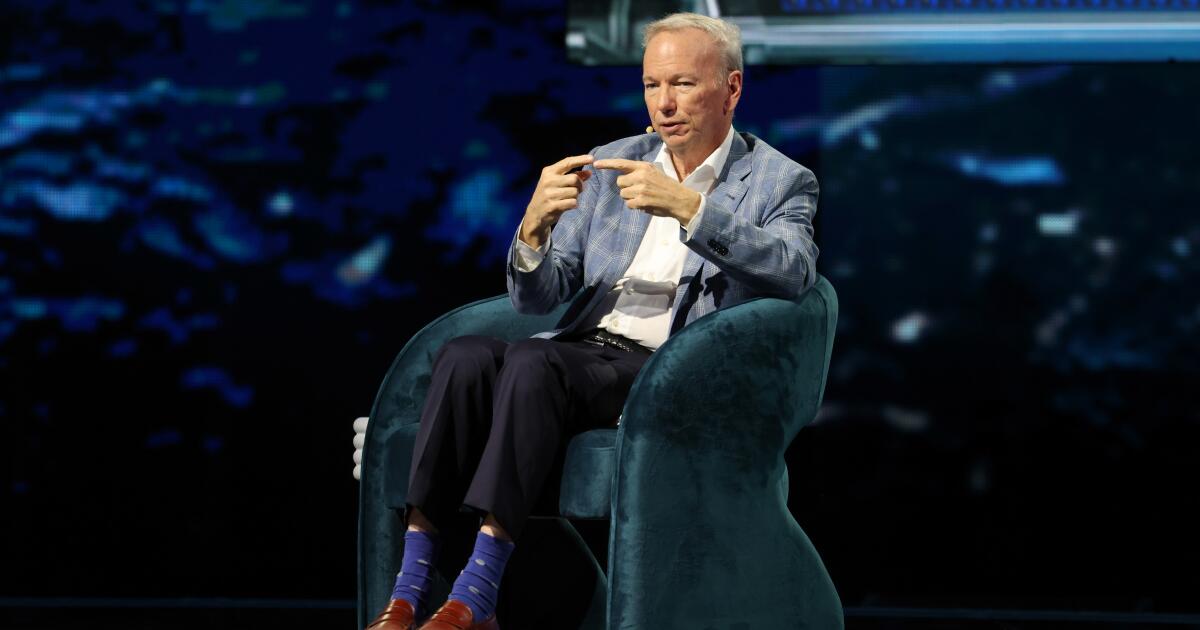
Ex-girlfriend of former Google CEO Eric Schmidt ordered to pay him $10 million after rape accusations
-
 Entertainment13 minutes ago
Tony Awards 2026: “Schmigadoon!” wins best musical in a season saved by revivals
-
 Politics25 minutes ago
Mainstream California Democrats survived election night, but their brand remains challenged
-
 Sports33 minutes ago
The Times’ softball coach of the year: Katie Stith of JSerra
-

 World43 minutes ago
Peru’s Sanchez visits jailed ex-president as votes are counted
-

 News1 hour ago
6 injured in stabbing at New York’s Penn Station | CNN
-

 Los Angeles, Ca2 hours ago
2 kids, 1 adult shot to death in Canoga Park

