It was Donald Trump who, in December 2016, tapped Ronna Romney McDaniel to run the Republican National Committee. Trump and the party were ascendant, holding majorities in both chambers of Congress and nearly two-thirds of state governorships. McDaniel (who, The Washington Post reported, dropped the “Romney” at Trump’s behest) would be the party’s shepherd.
Washington
Analysis | Ronna McDaniel’s wobbly tenure is largely her tormentor’s fault


Her tenure will probably come to an end in the coming months, thanks to a reversal of confidence from the now-former president. Since she took over, the party has lost the presidency, lost control of the Senate, barely held the House and lost almost a fifth of its governors.
Blame for those federal losses, though, doesn’t lie with McDaniel as much as it does with Trump.
Running a national party is a strange task. It’s a lot of fundraising overlaid onto significantly less steering the party toward ideal candidates and electoral matchups. In the modern era, success generally means securing a slightly bigger share of the vote to effect a thin legislative majority. Success is often a game of inches.
The GOP has held the White House for 12 of the past 25 years. Their caucuses in the House and Senate have wavered above and below the midpoint in each chamber, rarely at significant distances. They’ve done better in state houses and state capitols, thanks to the preponderance of rural, red states.
Really, the pattern over the past 25 years has been one of feast or famine: The GOP was crushed in 2006 and 2008, ascendant in 2010 and 2014 and wobbly in 2018. The past four RNC chairs have steered the party in that period, overseeing a spectrum of political influence.
If we compare the start and end of the most recent chairpeople, though, you can see why Republicans might be frustrated with McDaniel. Under Michael Steele — in position during the 2010 red wave — the party gained in state capitals and on Capitol Hill. Reince Priebus, at the RNC from 2011 to 2017, oversaw additional gains — including the White House, to which he headed when Trump took office.
Even setting aside the Trump issue, McDaniel was in a tough position. A party that holds the White House and both chambers of Congress has nowhere to go but down, as Democrats who were active in their party in 2009 can tell you. But it is nonetheless the case that, during her tenure, the party gave up all of those majorities. The GOP regained the House in early 2023, but even that was an underperformance: Historic trends suggested that a first-term president’s party should lose far more seats than President Biden’s Democrats did.
But again, the blame here isn’t solely — or even primarily — on McDaniel.
Trump’s victory in 2016 cemented him as the party’s leader, and he has refused to relinquish that title since, despite losing in 2020. The 2018 midterms, in which the Democrats romped, were a referendum on Trump more than anything. So were most of the special elections that occurred during Trump’s presidency: Voters came out in droves to vote against Trump’s party. In 2020, most Biden voters informed pollsters that their votes were meant as a ballot against Trump rather than for the Democrat.
Recent polling shows that’s once again the case, that anticipated 2024 votes are about Trump rather than Biden. In 2022, the Republican underperformance was heavily influenced by abortion politics, something that Trump effected by virtue of his Supreme Court appointments. But 2022 was also in part about Trumpism, particularly in Senate races where he anointed Republican nominees who went on to lose seemingly winnable races.
None of this absolves McDaniel of culpability, of course. She retained her position over the years in part by bending over backward to accommodate Trump’s whims. Deploying a stronger guiding hand might have shifted some electoral outcomes but also meant she was more rapidly shunted off to new employment. Nor can we say that Trump is responsible for the party’s recent fundraising issues.
But it is certainly not fair to suggest that the Republican Party lost political power since 2017 primarily because of McDaniel. The decline was in keeping with historic patterns. It was also significantly exacerbated by the party’s real leader, the one who picked McDaniel to run the Republican National Committee in the first place.



July 4 weekend is a quiet one for new indie releases, leaving the field to Angel Studios’ PG-13 wide release Young Washington on 2,700 screens.
From Angel and Wonder Project, the film, timed to the 250th anniversary of the founding of the U.S., stars British actor William Franklyn-Miller as the young man who would go on to become the nation’s first president.
Directed by Jon Erwin (I Can Only Imagine, Jesus Revolution), with Mary-Louise Parker as George’s mother, Ben Kingsley as Virginia Gov. Robert Dinwiddie, and Kelsey Grammer as wealthy nobleman Lord Fairfax. See Deadline review.
Synopsis: “Before he was the Father of a Nation, he was a soldier fighting to survive. A single misstep thrusts young George Washington into the center of a global conflict, testing his honor, loyalty, and courage. As alliances crumble and the frontier erupts into war, he must confront not only his enemies but the man he’s becoming.”
The action is set in the 1750s with Washington as a young man eager to fight, initially as a British officer in a period of complex loyalties. He enlists at 23 and leads a disastrous campaign against the French in Ohio but fights brilliantly and his career takes off.
Elsewhere this frame, Music Box Films is out with a 4K restoration of Ross McElwee’s Sherman’s March July 3-9 at Film Forum. It will lead into Venice award-winning Remake, McElwee’s new documentary, which premieres at the NYC art house July 10.
Sherman’s March, which won the Grand Jury prize at the 1986 Sundance Film Festival, was ranked as one of the highest-grossing documentary films of all time until the mid-1990s. In it, McElwee sets out to make a movie about Union Gen. William Tecumseh Sherman’s March to the Sea towards the end of the American Civil War, but keeps getting sidetracked by his own love life. He’ll appear in-person for post-screening Q&As on July 8-9.
Kino Lorber opens Sasha Waters’ Mary Oliver: Saved By the Beauty of the World, on the Pulitzer Prize-winning poet, at the IFC Center in New York today, expanding to select theaters nationwide in the coming weeks. The documentary includes new recitations of her work by fans as varied as Stephen Colbert, Lucy Dacus, Steve Buscemi and Oprah Winfrey and Helena Bonham Carter alongside stories from longtime friends like John Waters.
World premiered in March at the True/False festival in Columbia, MO, screened at DOC NYC Spring Selects, the Martha’s Vineyard Film Festival and the Miami Film Festival. Waters gained access to Oliver’s personal archives to make the film.
Citizen Kane is also back via Fathom Entertainment at about 900 theaters on July 5 and July 8. It’s for the 85th anniversary of the 1941 classic directed by and starring Orson Welles as publishing tycoon Charles Foster Kane. The rerelease includes exclusive insight from Leonard Maltin.

Washington
Review: Our critic cannot tell a lie: ‘Young Washington’ is the dullest of history lessons
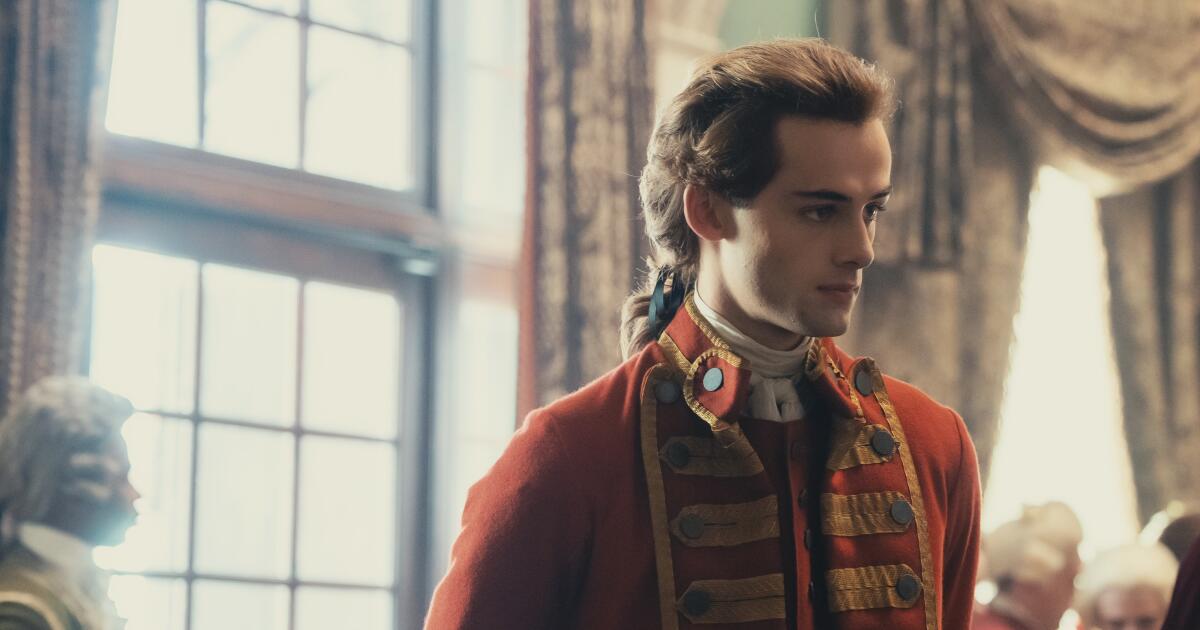
It’s the 250th birthday of the United States of America and how better to celebrate than with a big-screen hagiography of America’s first president, George Washington? “Young Washington” arrives in theaters just in time for the Fourth of July with a chiseled, hot young actor in the lead role and the sheen of a prestige HBO drama, though the result isn’t really big-screen spectacle or appointment television. It feels more like something to be watched on the AV rig in a middle school social studies class. At least there won’t be a quiz at the end.
But there could be, because the plot of “Young Washington” plays out with all the thrill of a textbook chapter. It takes place mostly around 1753-55, at the advent of the French and Indian War. We open in medias res when the 23-year-old Col. Washington (William Franklyn-Miller) lurches from a dysentery-riddled nap directly into battle in the Pennsylvania woods, his battalion on the back foot, surrounded by gore and gunpowder. Another officer describes how dire the situation is while George ponders saving his men and asks, “What could be worth the risk?” Washington steels his gaze and we cut to black. You can almost hear the eagles scream, guitars riff and engines rev.
“Young Washington” is produced and distributed by Angel Studios, the faith-based movie studio that churns out films based on true stories that either feature freak accidents, strange illnesses or, more recently, unique stories from the past in which faith in God is a factor. Apparently, our nation’s founding also falls under this umbrella.
The film is directed by Jon Erwin, one of the in-house Angel Studios mainstays, who also helmed “Jesus Revolution,” “I Still Believe” and “I Can Only Imagine.” Erwin gives the whole project a kind of gritty, visceral approach — very “Game of Thrones” in red coats. It’s violent, muddy, the contrast is high and too many drone shots soar over the forest treetops.
Though it opens with a bang, this 1755 battle framing device gives way to the George origin story, starting with his father’s death 12 years earlier, when the 11-year-old George is bereft that he’ll have to sacrifice his education in order to become a tenant farmer and provide for his family including his mother, Mary (Mary-Louise Parker, doing a bizarre accent).
His older half-brother Lawrence (John Foss) takes him under his wing and teaches him, and the young George grows into a smart, bright, ambitious young man, whose dreams of becoming a British officer are dashed because he doesn’t have formal education, a fortuitous marriage or his own land. But he’s bootstrapped himself into intelligence and with savvy networking and know-how, he becomes indispensable to the British, volunteering as a major to survey land and negotiate treaties with the Native tribes and French army. It’s all a bunch of politicking and petty disputes until it escalates into all-out war thanks to an ill-advised ambush.
Sir Ben Kingsley, Kelsey Grammar (who starred in “Jesus Revolution”) and Andy Serkis play the British officers who begrudgingly, at times, believe in George and his capabilities, though a lot of the film is about a young man getting rebuffed by snobbish British officers.
He’s the kind of character who always makes the noble choice, does and says what’s right, and sees everyone as equals (including enslaved African men and Native American allies). He inspires his brother and others that the world can change and takes inspiration from his mother, who encourages him to continue his path and do it as God’s servant.
Unfortunately, this doesn’t make for a character that’s in any way complex or interesting at all. Franklyn-Miller is certainly pretty, serving as a fine face for this story, but the screenplay (by Erwin, Diederik Hoogstraten and Tom Provost) flattens his character into a basic cookie-cutter hero. Audiences, including the middle school social studies students, deserve better and more nuanced stories about this country and the values it was built upon.
“Young Washington” is propaganda in the form of a history lesson wrapped in a summer blockbuster. If only it were even slightly entertaining — maybe they’ll tackle that in the inevitable sequel.
‘Young Washington’
Rated: PG-13, for sequences of strong war violence and some bloody images
Running time: 2 hours, 5 minutes
Playing: Opens Friday, July 3 in wide release
-

 Nebraska2 minutes ago
Some Nebraska communities ban fireworks in year marked by drought, wildfires
-

 Nevada7 minutes ago
How Chinese-Americans contributed to mining in Nevada
-

 New Hampshire14 minutes ago
Man From Concord Arrested On Drug Sale, Subsequent Possession Charges: Concord Police Log
-

 New Jersey17 minutes ago
Mikie Sherrill welcomes July 4 tall ships to NJ at Sandy Hook
-

 New Mexico22 minutes ago
Wildfire smoke moves through Taos Valley, Northern New Mexico
-
North Carolina29 minutes ago
More than 60 North Carolina cases tied to parasite behind ‘explosive diarrhea’
-

 North Dakota32 minutes ago
Pembina bridge closure, causing headaches for community members, close to short-term solution
-

 Ohio37 minutes ago
Where and when to see fireworks in Central Ohio

