Utah
‘This is a mistake’: Utah woman shocked to learn perpetrator granted parole just months after sentencing


SALT LAKE CITY – A Utah woman said her sense of safety and justice was shattered by a single text message this month alerting her that the man she’d fought for years to put behind bars had been granted parole.
“It makes me cry,” Cami Johnson told the KSL Investigators. “Because I have fought, and I have fought, and I have fought when there was no hope.”
The text sent from VINE, Utah’s automated victim information service, at 6:42 p.m. on Friday, Jan. 12, informed Johnson that “parole was granted” for her ex-husband, Byron Thad Haderlie, and scheduled to begin in February 2025.
“This is a mistake, this is a mistake, this has to be a mistake,” she recalled thinking. “I have not gone through all of this for a mistake.”
Johnson was not aware Haderlie was up for parole, just three months after he was sentenced.
Utah’s Board of Pardons and Parole has acknowledged it needs to improve how it communicates with victims of crime and has promised to implement a victim-centered notification system that is in progress but not yet up and running.
Case Background
Johnson reported to police in Cache County in 2017 that Haderlie drugged and sexually assaulted her. Despite Johnson reporting to police quickly and undergoing a forensic exam at the hospital, North Park Police inactivated their investigation into Haderlie multiple times.
Detectives didn’t attempt to contact Haderlie to ask him about Johnson’s report until more than a year later, after a 16-year-old girl reported to police in a different county that Haderlie drugged and attempted to sexually assault her too.
Byron ‘Thad’ Haderlie appears in court in Cache County for a sentencing in October 2023. (KSL TV, Josh Szymanik)
Haderlie was sentenced in the case involving the teen in 2019. Then, in October last year, he was sentenced to zero to 15 years for lesser charges he pleaded guilty to in the case involving Johnson.
“The whole system has failed me from the beginning to today,” said Johnson.
Parole Decision
Haderlie’s parole hearing happened on Jan. 2. The board could have kept him incarcerated until March 2039, but granted his release early next year, contingent on his successful completion of sex offense treatment.
According to Jennifer Yim, Administrative Director of Utah’s Board of Pardons and Parole, the state’s sentencing guidelines recommended a release date in July of this year. The Board’s decision would keep him incarcerated seven months longer than that recommendation.
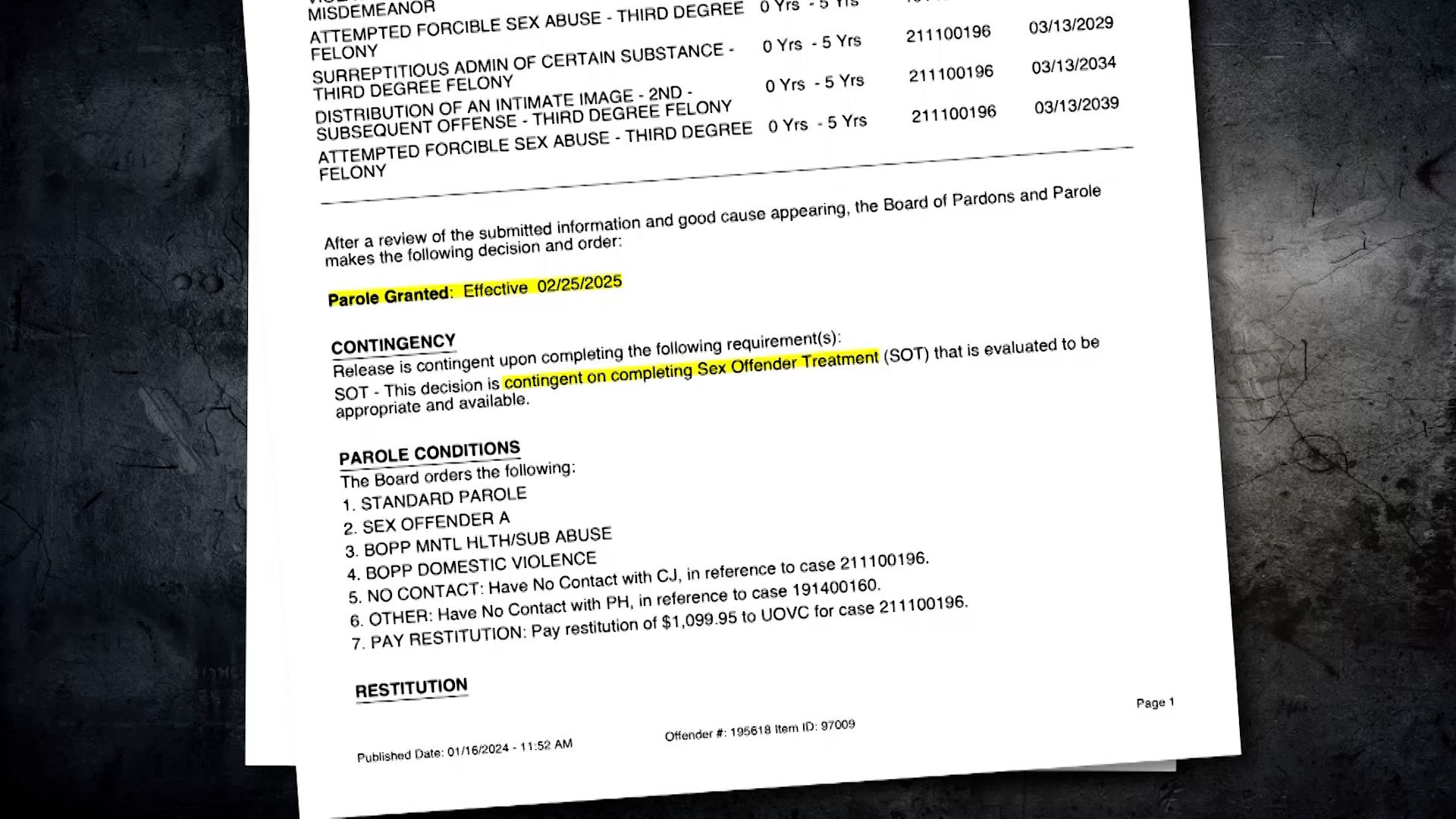
Utah’s Board of Pardons and Parole granted Haderlie’s contingent release in February 2025.
“It made me feel like everything we did, you know the last seven years and getting this sentence, meant absolutely nothing,” said Johnson.
During the parole hearing that lasted about 15 minutes, Haderlie said he’s changed during the time he’s been incarcerated.
“My perspective has holistically changed through these last five years, approximately five years of incarceration,” he said. “I continue to have forward progression and would like an opportunity to be able to, to get back out into society.”
Haderlie, now 53, told the hearing officer, “I have no malice towards anyone, and those were my decisions, and that’s 100% on me.”
Unsuccessful Victim Notification
Johnson said she was told at Haderlie’s October sentencing that she didn’t need to worry about a parole hearing for at least four years. That information was wrong. Offenders typically have an initial parole hearing within a few months of their sentencing.
“I, if I had any word of a parole hearing, would absolutely clear everything to make sure that I’m there,” Johnson told the KSL Investigators.
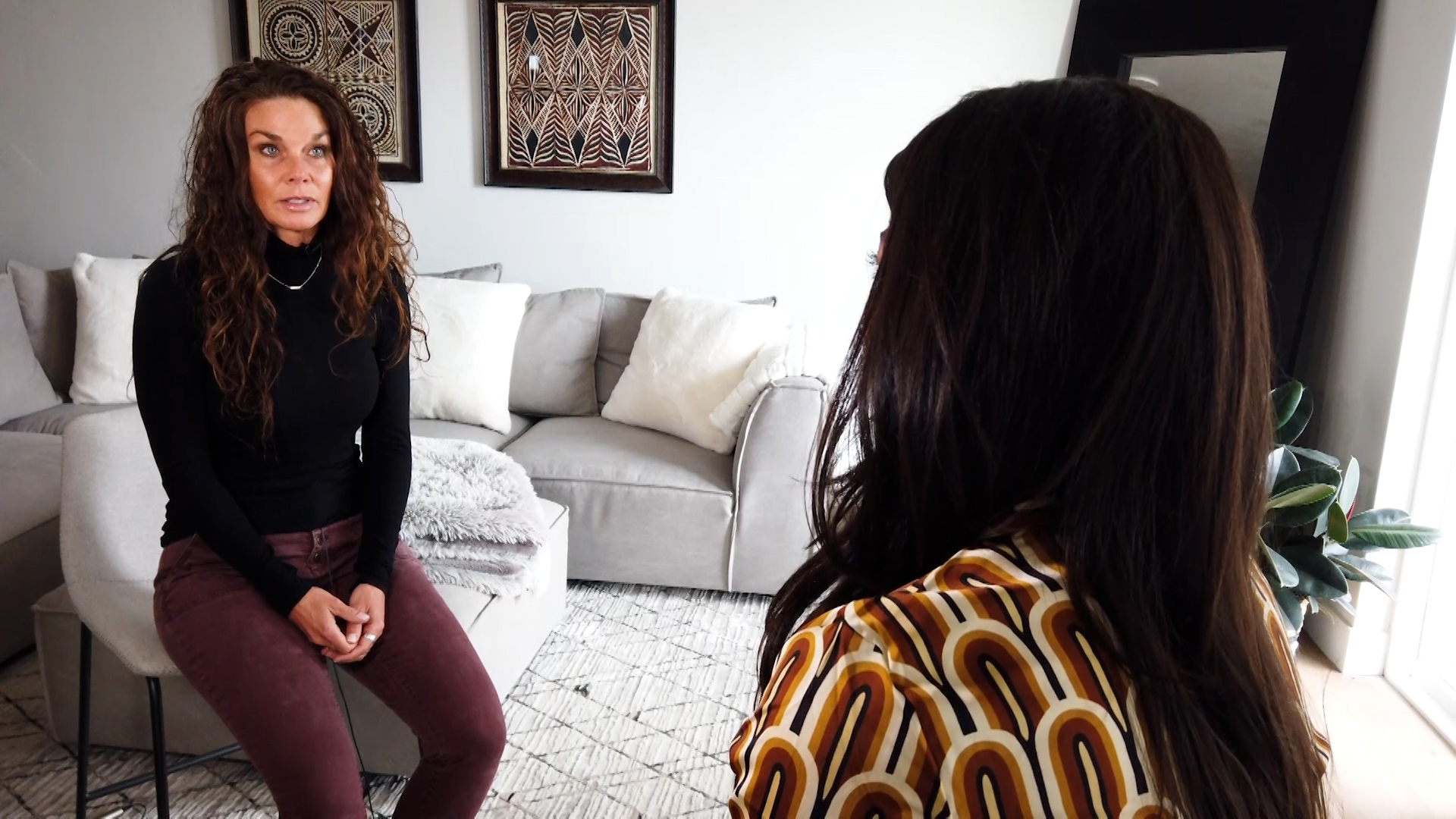
Cami Johnson speaks with the KSL Investigators in January 2024. (KSL-TV,Josh Szymanik)
Yim said the board mailed Johnson a letter notifying her of the hearing, as required by Utah law, but they had the wrong address. The letter was returned to the sender on Dec. 11.
When that happens, Yim said the board tries to find other ways to contact people before the hearing – but because victim information is protected, contact information is almost always redacted in the case records the board receives from the courts.
“I know people think, ‘Well, the DMV has my information, why don’t you?’” said Yim. “The reality is, we don’t have it, and we have to do the research to find it.”
Unfortunately, Yim said in the 13 business days between the day they got the letter back in the mail and Haderlie’s hearing, they were not able to reach Johnson.
Victim Impact Hearing
When asked whether what happened with Johnson’s case is a failure, Yim said, “If Cami Johnson feels like the Board of Pardons and Parole specifically failed her, then I’m sorry for that. That was not our intention. And we have done everything that we can, since we found out, to fix that problem.”
The board has scheduled a special victim impact hearing in early March to allow Johnson an opportunity to address the board.
“There’s no guarantees,” said Yim. “I can’t second guess what our board members will do. But I can tell you that they’re committed to an evidence-based, careful consideration of the facts of the case, which includes the impact on victims.”

Utah BOPP Administrative Director Jennifer Yim speaks with the KSL Investigators in January 2024. (KSL-TV,Josh Szymanik)
Yim said Johnson will testify, Haderlie will be allowed to respond, and then the board will reconsider the decision.
“There are absolutely examples in the board’s history where the board, under these very same circumstances, have changed their decision based on victim impact,” said Yim. “There are also other situations where they haven’t.”
Johnson said she is exhausted after years of navigating Utah’s justice system, but she plans to attend the victim impact hearing and take the opportunity to testify against Haderlie’s release.
“I will keep doing this over and over and over and over again, to make sure that he does not do this to one more person,” she said.
A fix on the way
At least one lawmaker has expressed interest in updating the board’s victim notification responsibilities in state statute during the current legislative session. An early draft of a victims rights bill sponsored by Provo Republican Rep. Tyler Clancy called for victims of crime to be notified of all of their perpetrator’s parole hearings, but that section was removed before filing. Clancy said a different lawmaker intends to address the issue in another bill.
“It’s crazy to me that they notify you that he had a parole hearing, but we’re not notified of a parole hearing,” Johnson said, noting the automated text she received regarding the board’s decision.
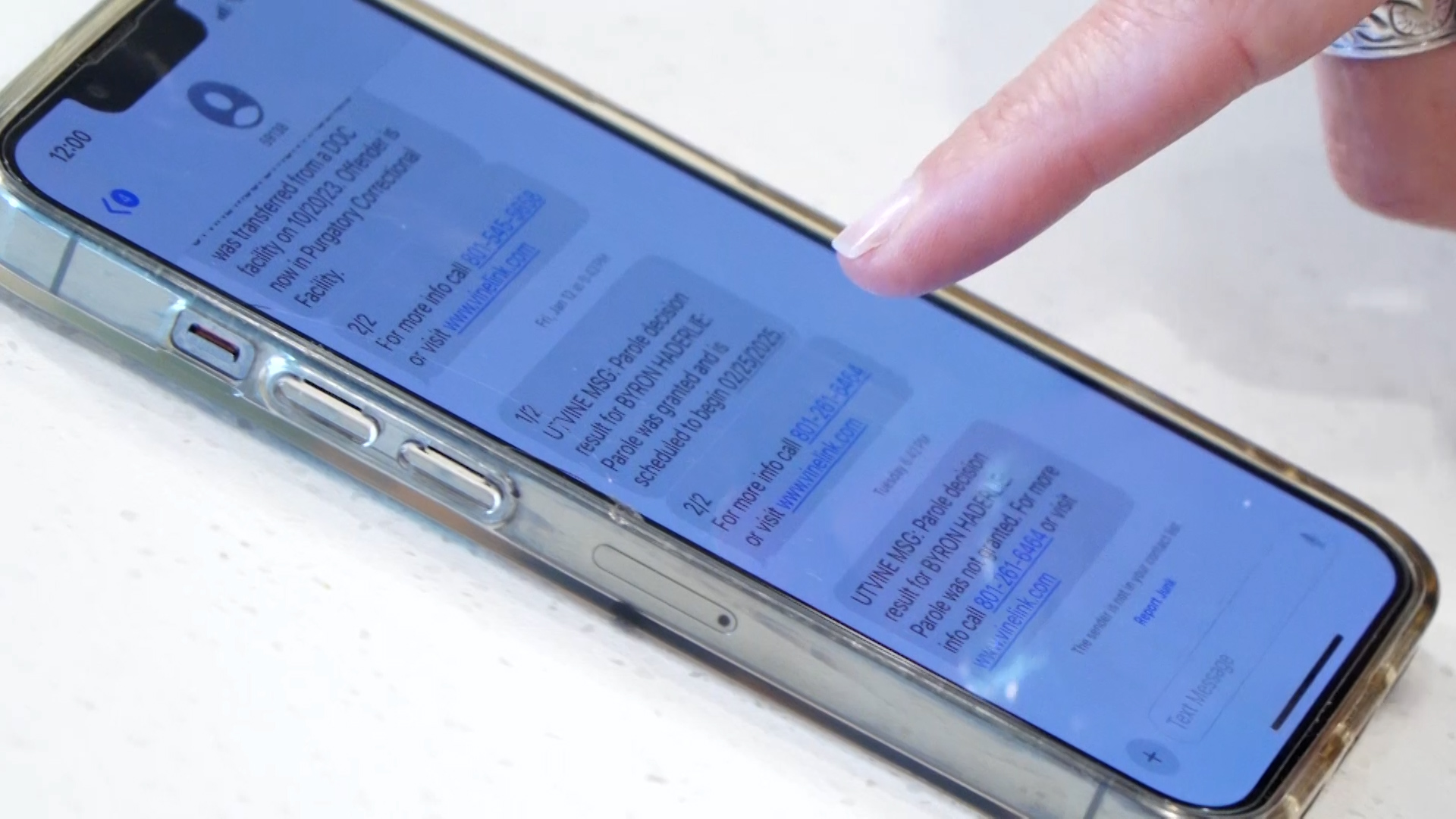
A text from Utah’s automated victim notification service, VINE, alerted Johnson to the board’s decision to grant Haderlie parole. (KSL-TV,Josh Szymanik)
Johnson is registered with the free VINELink notification system, which allows people to receive automated updates on the custody status of offenders in Utah prisons and jails. Yim said while it’s a common misconception that the board works with VINE, that system is not controlled by the parole board.
“We owe one another better contact, victim-centered, trauma-informed contact, and that’s what we’re working towards,” said Yim.
Under Yim’s direction, the board has been working to implement a victim-centered notification system for parole hearings and decisions. She said the project is in progress, with a vendor selection expected to happen this week. She expects it to be up and running with all the features she wants to include by the end of the year.
Until then, Yim said the best thing a victim who wants to participate in parole hearings can do is call or write to the board and let them know their preferences for when and how the board contacts them.
“It’s our commitment to honor those,” said Yim.
The Utah Board of Pardons and Parole can be reached at 801-261-6464.
This report is part of a series examining how apparent gaps at every level of Utah’s criminal justice system fail to protect Utahns.
If you have experienced sexual violence, you can access help and resources by calling Utah’s 24-hour Sexual Violence Helpline at 1-888-421-1100. You can also call the National Sexual Assault Hotline at 1-800-656-4673 for free, confidential counseling.
Have you experienced something you think just isn’t right? The KSL Investigators want to help. Submit your tip at investigates@ksl.com or 385-707-6153 so we can get working for you.



SPANISH FORK — Three very talented Utah high school musicians get to show their talents at a national music festival.
Palmer Brandt, 16, from Maple Mountain High School, said music speaks for him.
“Music is a way for me to communicate what I feel without having to put it into words and I think it’s an easier way for me to do that than actually talking,” he said.
Brandt and two other high school students from Utah — Jack Hales, 18, of Herriman, and Tanner Brinkerhoff, 16, of American Fork — were chosen to be part of the Music For All National Festival, which hosts the top student ensembles from across the country. The students traveled to Indianapolis, Indiana, on Tuesday before enduring three long days of rehearsals to be ready for a performance on Saturday.
Brandt and Hales will be performing in the Honor Band of America, which is described by the festival as the “nation’s finest student concert honor bands.” Brandt was chosen as the only baritone saxophone player in the band, and Hales is one of the trumpet players.
“It’s a little bit scary, but also pretty cool. It’ll be really exciting to play with a lot of other really good musicians and be able to get straight to like tackling the expressive part of the music rather than just focusing on notes and rhythms,” Brandt said.
Hales said it was both surreal and exciting when he found out he had been accepted into the band. He had applied after learning about the band from someone he knew who had done it the previous year.
“I was a little nervous before going because I had a little bit of imposter syndrome, but once I got here, it felt real and exciting,” Hales said Thursday after a day of rehearsing. “Preparing was difficult because the music was very foreign to me. All the songs were so difficult, which I am not used to.”
The students in the bands were given the sheet music for the performance last month, but they knew they would only have three days to practice with the band in person once they got to the festival.
“It’s some of the hardest music I’ve ever played, it’s stupid hard actually. I’ve been looking at it a ton and trying to learn all these new things. Being able to go and play with the best kids in the country is going to be such a great experience,” Brinkheroff told KSL before arriving in Indiana.
Brinkerhoff was chosen to be part of the Jazz Band of America, dubbed “one of the top honor ensembles for young musicians in the nation.”
Brinkerhoff is the alto saxophone player for the band, but is also bringing a soprano saxophone, a clarinet and his flute to Indiana as some of the songs he has to play other instruments.
He got the email saying he had been accepted to the Jazz Band of America on Christmas Eve.
“I was super happy and started calling all my friends … it was like a little Christmas present,” he said.
Brinkerhoff said he was excited to go, but also “scared out of my mind” to perform with some of the best musicians in the country. But he also said it’s an honor to participate in such an advanced performance.
“Especially with the jazz band, Utah isn’t really a music state … it’s mostly like on the East Coast. So representing Utah, I get to tell everyone that Utah does have players and you can actually do stuff in Utah,” he said.
Hales agreed, saying it feels awesome to represent Utah’s music programs.
“Not only to show others how good I am as a player, but how good Utah is at making competent, professional-level musicians,” Hales said.
Despite knowing a week full of hourslong rehearsals and a challenging performance awaited them, the students were so happy to show off their skills and do what they love.
“Performing has always been a musical thing that I really like. I’m not a dancer or a singer or anything, so I feel like playing my instruments actually substitutes dancing or singing, it’s like another way to express (myself),” Brinkerhoff said.
Hales said he loves music because there is so much nuance that can make it hard to understand, but once you do, “it becomes one of the most powerful things you have.”
“Music has history, emotion, movement, creativity and sound, which make it just as, if not more, powerful than speaking,” Hales said.
The students’ parents couldn’t be prouder of their children. Matthew Brinkerhoff said it has been a “whirlwind,” but he just thinks it’s amazing his son gets to participate in the festival.
Kara Brandt said she is so happy her son has found his own way to communicate, adding that he has even composed some of his own music, letting people “see the world through his eyes.”
“It’s just so cool to see his genius just flow through him and to see how his hard work pays off in that excellence. He really is so dedicated. People will say, ‘He’s so talented,’ and I agree that he has a lot of talent, and it’s because he works hard. That’s why he is here and is in Honor Band of America,” she said.
The Key Takeaways for this article were generated with the assistance of large language models and reviewed by our editorial team. The article, itself, is solely human-written.

NHL, the NHL Shield, the word mark and image of the Stanley Cup and the NHL Conference logos are registered trademarks of the National Hockey League. All NHL logos and marks, including the foregoing, and NHL team logos and marks, as well as all other proprietary materials depicted herein are the property of the NHL and the respective NHL teams and may not be reproduced without the prior written consent of NHL Enterprises, L.P. © National Hockey League. All rights reserved.

WEST VALLEY CITY, Utah (KUTV) — A woman was killed in a crash after running a red light on Mountain View Corridor in West Valley City.
Police said the collision was reported just before 1:30 p.m. at the intersection of 4100 South.
Officers said a northbound tow truck entered the intersection on a green light when an eastbound SUV ran a red light and was T-boned.
Both vehicles reportedly caught fire after the impact.
The SUV driver was taken to a hospital, where she later died. Authorities are working to identify her.
The tow truck driver suffered non-life-threatening injuries.
Northbound lanes at 4100 South will remain closed for several hours while crews clear the scene and investigate the crash.
BE THE FIRST TO COMMENT
_____

The iconic South African theater that took on apartheid

All the latest in AI ‘music’

US allows Russian oil tanker to reach Cuba amid blockade as Trump says island ‘has to survive’

Dem senator warns deportation could let Virginia woman’s illegal immigrant killer ‘escape accountability’

Sleeping 11 minutes longer each night shows surprising health benefit, study finds

Florida High School Football Rankings: Top 25 teams – Oct. 21

How old is Bo Nix? What to know about Oregon quarterback ahead of 2024 NFL Draft

Cleary's 21 help Le Moyne down Central Connecticut State 69-64 in OT

99th annual Pony Swim held in Virginia

Indiana Members Credit Union announced as new anchor tenant at Bottleworks District
Dem senator warns deportation could let Virginia woman’s illegal immigrant killer ‘escape accountability’

Newsletter: G7 ministers to hold talks on war’s economic fallout

ICE officers could remain at airports after TSA workers are paid

Scathing report claims nation’s oldest labor union ‘betrayed’ MAGA members through ‘shocking’ spending

Republican US lawmaker demands Congress vote on any Iran troop deployment
-

 Sports1 week ago
IOC addresses execution of 19-year-old Iranian wrestler Saleh Mohammadi
-

 New Mexico1 week ago
Clovis shooting leaves one dead, four injured
-

 Miami, FL4 days ago
Jannik Sinner’s Girlfriend Laila Hasanovic Stuns in Ab-Revealing Post Amid Miami Open
-

 Tennessee6 days ago
Tennessee Police Investigating Alleged Assault Involving ‘Reacher’ Star Alan Ritchson
-

 Minneapolis, MN4 days ago
Boy who shielded classmate during school shooting receives Medal of Honor
-

 Politics1 week ago
Schumer gambit fails as DHS shutdown hits 36 days and airport lines grow
-

 Science1 week ago
Record Heat Meets a Major Snow Drought Across the West
-

 Technology1 week ago
YouTube job scam text: How to spot it fast