West
Unanimous Supreme Court in Colorado vs. Trump tells us this about our legal elites

NEWYou can now listen to Fox News articles!
In the end, the Supreme Court’s ruling on the issue of whether a state can kick Donald Trump off its presidential ballot for having engaged in insurrection, under Section 3 of the 14th Amendment, was anticlimactic. A legal theory that had won the hearts of law professors across the country – barely half a year from law review article to Supreme Court opinion is a record that won’t be beat – swayed the mind of exactly zero justices.
Because “the Constitution makes Congress, rather than the states, responsible for enforcing Section 3 against federal officeholders and candidates,” state courts and state officials have no power to remove federal candidates from the ballot, the court unanimously held. Congress’s power under Section 5 of the 14th Amendment to pass “appropriate” legislation “is critical when it comes to Section 3.”
While the states retain sovereign power to determine the qualifications of their own state officeholders, they have no such power with regard to federal officeholders.
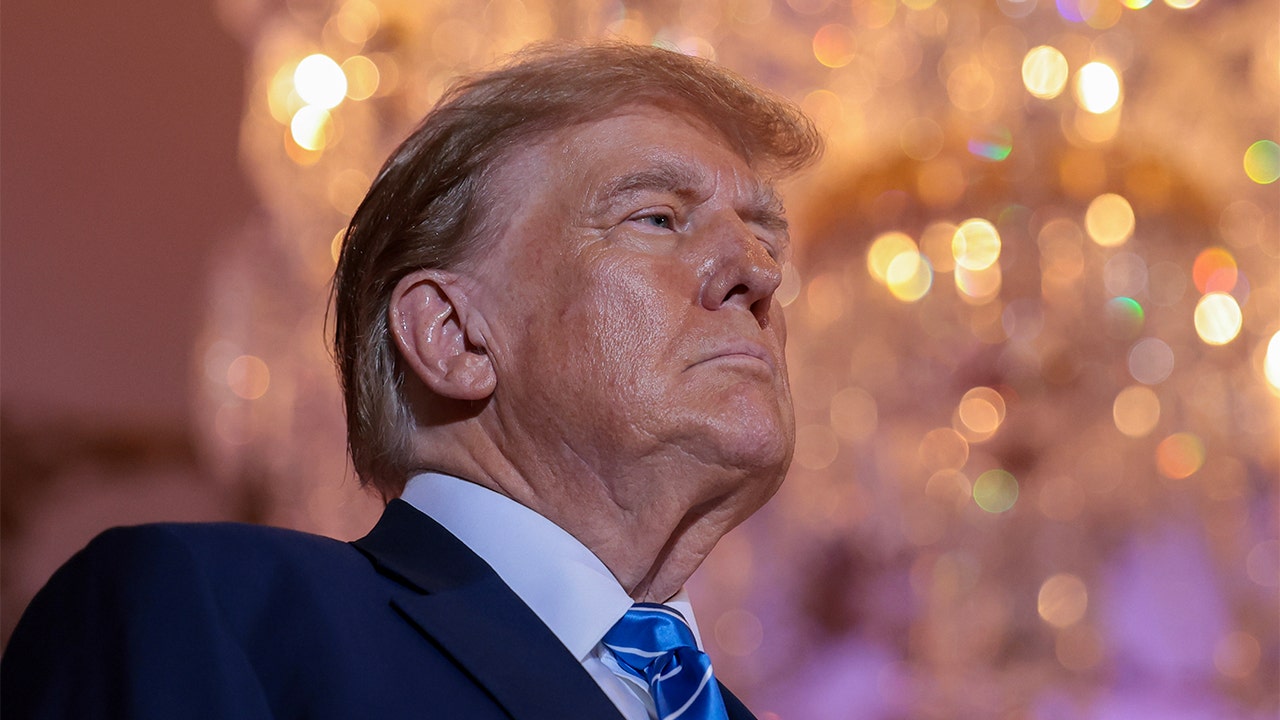
Former President Donald Trump arrives for an election-night watch party at Mar-a-Lago on March 5, 2024, in West Palm Beach, Florida. (Win McNamee/Getty Images)
That’s it. End of story, without the need to engage in a battle of dictionaries to define “insurrection” or parsing of Trump’s actions to determine whether he had engaged in it. No abstruse debates over whether the presidency is an “office under the United States” or whether Trump was an “officer of the United States.”
DEMOCRATS RUSH TO KEEP TRUMP OFF BALLOT AFTER SCOTUS DECISION BECAUSE ELECTION CAN’T BE LEFT TO VOTERS
There’s a certain elegance to the simple off-ramp that all nine justices chose, forestalling further partisan toxicity and avoiding any labeling of a “MAGA court” and the like.
Now, there was certainly disagreement over whether the court needed to go further and decide that the only way to enforce Section 3 is through legislation. Chief Justice John Roberts and Justices Clarence Thomas, Samuel Alito, Neil Gorsuch, and Brett Kavanaugh said yes, while Justices Sonia Sotomayor, Elena Kagan, Ketanji Brown Jackson, and, separately, Amy Coney Barrett took no position. They would’ve preferred to leave the question open, leaving open the possibility that another federal actor, like a judge or the Justice Department, could enforce Section 3 the same way they enforce more familiar parts of the 14th Amendment, like the due process clause and equal protection clause.
TRUMP SAYS SUPREME COURT RULING IN COLORADO CASE IS ‘UNIFYING AND INSPIRATIONAL’
But then the same parties might have filed suit in federal court and we’d be back in the same place a few months down the line, even closer to the election. Or, even worse, Congress might have taken it upon itself to reject Trump electors during the vote certification on Jan. 6, 2025 – which would again result in emergency Supreme Court filings.
No, the more I consider it, the more I think it was wise to head off any such shenanigans and nip these easily foreseeable developments in the bud.
But regardless, the justices were quite concerned that a ruling in Colorado’s favor would result in a “patchwork” of rules such that the same person would be eligible in some places and not in others, a sort of Schrödinger’s candidate. That’s no way to run a presidential election.
None of this was apparent to most of our esteemed legal scholars, however. Although the idea of using an obscure constitutional provision to disqualify Trump originated with originalists – most of the interesting theoretical debates are among right-leaning academics, rather than with liberal lions who can’t even figure out how to teach con law when the Supreme Court actually applies what the Constitution says – it really took off among those who would gleefully deny voters their preference in the name of “democracy.”
That’s a damning indictment of our legal elites at a time when the illiberal takeover of law schools is subverting open inquiry and poo-pooing the rule of law to those who will be the gatekeepers of our political institutions in coming decades.
There’s a direct line between the transformation of education into intersectional activism – such that law students shout down federal judges and sign letters supporting Hamas – and the inability to see how a clever theory for getting rid of a controversial populist wouldn’t survive contact with reality.
But the Supreme Court won’t always be there to save us, particularly if that same legal and media elite continues its campaign to delegitimize an institution that remains much more popular than any other part of the government.
That’s why it’s important to continue to call out the rampant gaslighting in our midst. Not for Donald Trump, but for the health of our American polity.
CLICK HERE TO READ MORE FROM ILYA SHAPIRO
Read the full article from Here

San Francisco, CA
A Leak of San Francisco Police Drone Footage Exposes the New Reality of Urban Surveillance

Just after noon on a Saturday last month, a Skydio X10 quadcopter hovered about 200 feet over a San Francisco apartment complex, watching police chase a man hiding behind a parked car. The target of this manhunt lay down on the pavement, apparently unaware that he remained in full view of the flying eye overhead. The 5-pound drone had, in fact, already followed him across the city, zooming in on his black SUV’s license plate, keeping the vehicle locked at the center of its video frame until he pulled over. Now it watched the police as they closed in and surrounded him.
As the officers approached, the man adjusted his hiding spot, moving to the other side of the parked car. At that moment, however, another Skydio drone zoomed in on his location, one of four Skydio quadcopters that had followed the man in just the prior hour. This one had been called away from a nearby McDonald’s, where it had been watching two people who’d exited the suspect’s car a few minutes earlier—and now began watching him from a second angle.
Within seconds, three officers converged on the man, two pointing weapons at him, then tackled him as half a dozen more police arrived on the scene. Police records provided to WIRED by the San Francisco Police Department show the entire street-and-sky response followed from what the SFPD described as an alleged “auto boost/strip” incident—the suspected theft of car parts or another object from a vehicle.
This glimpse of modern drone-enabled police surveillance, including the highly sensitive video of the man’s physical takedown, wasn’t voluntarily released by the SFPD—which, like most US police departments, rarely releases drone videos even in response to public records requests. Instead, it was accidentally livestreamed onto the open internet via Skydio’s website. That’s where two security researchers, Sam Curry and Maik Robert, discovered that the SFPD was leaking all of the real-time footage from five of its surveillance drones, including both color and thermal imaging, accompanying location metadata, and the drone pilots’ names and email addresses, to anyone who merely found the public web address where the videos were hosted.
Curry and Robert say they reported their discovery to Skydio around two days after discovering it, and it was quickly taken offline. By then, though, the researchers had watched police carry out what appeared to be multiple arrests and searches as well as tracking cars and individuals from the sky, all visible at a fully public web address.
“There’s a certain trust given to the police to use these things correctly,” says Curry. “When you’re watching a drone feed live, you can look into dozens of different apartments, you can see police zooming in on people, you can see arrests. The fact that all of this was exposed feels like a really big issue from a privacy perspective.”
The leaked feed of video captures two forced detentions—whether any actual arrests were made is unclear from the footage—a police visit to an apartment in a high-rise apartment building, and an apparent search of an alley populated with homeless people, as well as numerous other more ambiguous instances where police used drones to surveil individuals, vehicles, or buildings. While the feed remained live, Curry and Robert began archiving the public stream of data and videos and later shared the results with WIRED.
The archive Curry and Robert captured offers a detailed record of SFPD drone operations over about 48 hours in mid-June. It includes 60 videos from 20 separate flights, with each mission recorded from three feeds: a color camera, a thermal camera that renders people as heat signatures, and a third view from the drone’s rooftop dock. WIRED analyzed all 20 color videos with software that detects people, vehicles, and other objects in images. The review found that the cameras had filmed hundreds of people and vehicles across the 20 flights. In a single frame, as a drone hovered over a downtown intersection, the software counted 34 people crossing the street or standing on the sidewalks. Across all of the videos the footage showed clear faces of dozens of people.
Together, the videos amount to more than three hours of aerial color footage and roughly the same amount of thermal footage. The archive also includes second-by-second telemetry logs for every flight—more than 5,000 GPS points in all tracing over some 44 miles—recording each drone’s latitude and longitude, altitude, speed, heading, and battery level from takeoff to landing. Six SFPD pilots’ names and email addresses also appear across the logs.


SEATTLE — Following the news of likely new ownership for the Seattle Seahawks ahead of the upcoming 2026 season, many questions linger about the future of the franchise.
The Paul G. Allen Estate announced Saturday that it had entered a formal sales agreement with tech billionaire Vinod Khosla, and his family to sell the team for $9.6 billion, as reported by ESPN. The Khosla family currently owns a minority stake in the San Francisco 49ers, which they would need to divest.
PREVIOUS COVERAGE | Paul Allen estate agrees to sell Seattle Seahawks to ownership group led by Khosla family
The sale would be unprecedented for multiple reasons; not only would a $9.6 billion price tag make this the highest team purchase in NFL history, surpassing the $6.05 billion sale of the Washington Commanders in 2023, but this will also be the first time a team has been sold immediately after winning the Super Bowl.
Taking ownership of reigning Super Bowl champions will put the Khosla family in a unique position. Often when NFL teams are sold, they’re not in a great stead, said Dick Fain of Seattle Sports Radio KJR.
“So, they need a new general manager, they need a new president, maybe they need a new head coach,” Fain explained. “The Seahawks need none of that right now.”
Fain, and most other industry experts, are confident the Khosla family knows to leave football operations largely untouched and remain under the leadership of General Manager John Schneider and Head Coach Mike Macdonald. New owners should, instead, focus on business operations, Fain added.
Many have suggested a facelift for Lumen Field could be the first “order of business.” The Seahawks’ stadium lease will run through 2032, and like any stadium over the years, Fain thinks Lumen Field would benefit from renovations and potentially increasing capacity by 5,000 to 10,000 seats, especially if Seattle wants to secure another global stage opportunity.
“Based upon what we just saw with the World Cup, this city is absolutely able to host a Super Bowl,” Fain said.
Unlike the Allen family and the team’s original owners, the Nordstrom family, the Khoslas are not from Seattle, nor do they have any known, direct ties to the area. Talk of a stadium lease expiring and outside ownership has naturally sparked fans’ fear of the team leaving the Emerald City.
But those are expected to remain as unsubstantiated fears. A franchise relocation deal would need to be approved by a league of NFL team owners, which rarely does so out of established, successful markets.
“This is a very different situation than Clayton Bennett [and the Supersonics]. This is a very different situation than Jeff Smulyan and the Mariners,” Fain said. “This team’s not going anywhere.”
In a statement released on behalf of their family, Vinod Khosla acknowledged that the group will have to earn the trust of the Seahawks organization and its fans. He also wrote that their family looks forward to building on “Paul Allen’s winning legacy.”
While making his debut at the 2026 American Century Championship, a celebrity golf tournament in Nevada, Macdonald told a reporter he was excited but that “nothing really changes on our front” at this point.
“It’s a great chapter in Seahawks history, and I look forward to getting to know everybody,” Macdonald said.
The NFL is expected to approve the team’s sale to the Khosla family during an August meeting, according to ESPN.
-
 Lifestyle4 seconds ago
As L.A. River morphs into impromptu stage for nature-loving musicians, gentrification fears remain
-
 Politics6 minutes ago
States sue to block Paramount’s $111-billion Warner Bros. takeover
-
 Sports18 minutes ago
Commentary: Inside the Shohei Ohtani Economy driving a wild auction for his worn cleats
-

 World30 minutes ago
EU sanctions Russia’s VK Company for helping expose Putin’s critics
-

 News1 hour ago
One person killed in Maine in second fatal ICE-involved shooting in less than a week | CNN
-

 New York3 hours ago
How a Family of 5 Lives on $46,000 a Year in Wakefield
-

 Los Angeles, Ca3 hours ago
Southern California braces for 110-degree heat, thunderstorms this week
-
 Detroit, MI3 hours ago
Detroit Sandwich Party returns to Eastern Market on Sept. 6

