West
Trump plans to undo Obama’s ‘insulting’ rename of Mt. McKinley; ‘Awful idea’ says Alaska Republican

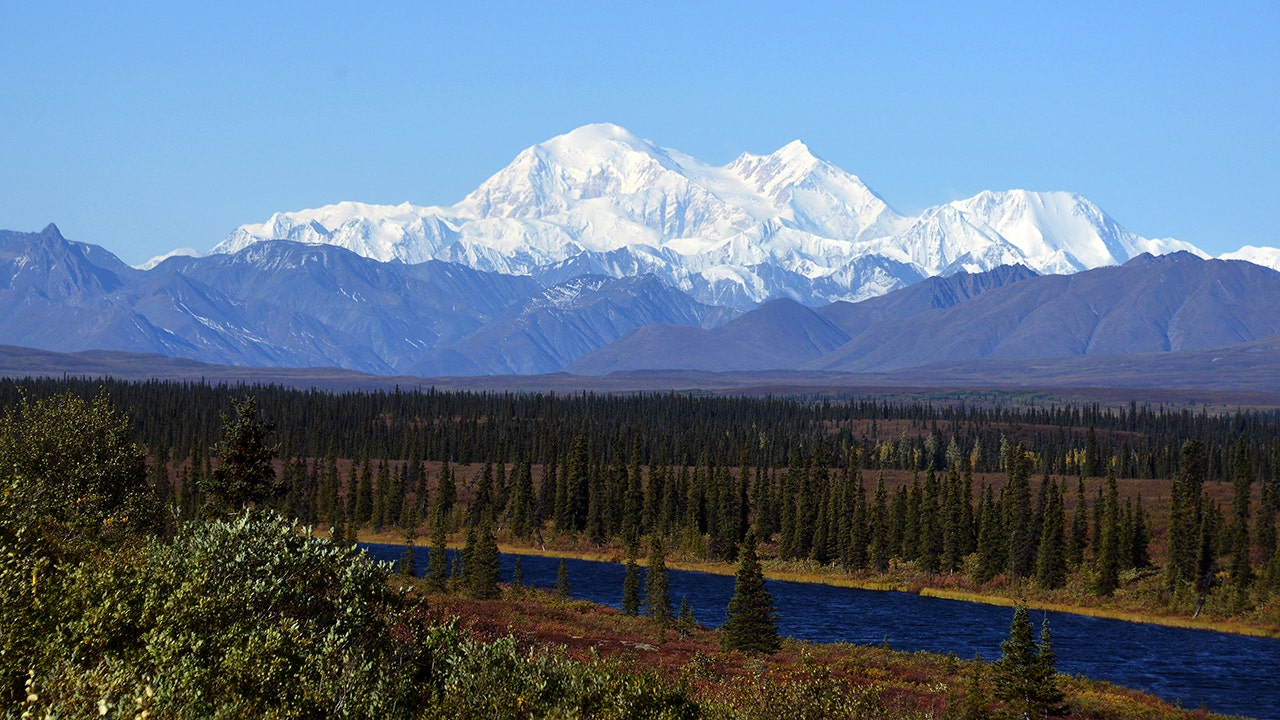
President-elect Trump pledged this week to undo former President Obama’s 2015 decision to change the name of North America’s tallest peak to its Koyukon Athabascan name “Denali,” meaning “High One” or “Great One.”
Speaking to conservatives at a Phoenix conference, Trump made the pledge and noted President William McKinley was also a Republican who believed in tariffs. He first promised to undo Obama’s action in August 2015 and called it an “insult to Ohio,” where McKinley was born and raised.
During his Phoenix remarks, he also pledged to undo Democrats’ rebranding of southern military bases named for Confederates – like Fort Liberty in Fayetteville, North Carolina, which was formerly named after Gen. Braxton Bragg.
The 20,320-foot mountain was first dubbed Mount McKinley in 1896 by gold prospector William Dickey, after learning the Ohioan had won the GOP presidential nomination – and as a swipe at silver prospectors he met who preferred Democrat William Jennings Bryan and his plan for a silver standard for the dollar.
ALASKA OUTRAGED AT BIDEN’S FEDERAL OIL LEASE SALE SETUP AS ‘FITTING FINALE’ TO FOSSIL FUEL-AVERSE PRESIDENCY
Ohio’s William McKinley (1843-1901) was the 25th president of the United States, serving from March 4, 1897, until his assassination in September 1901. (Universal History Archive/Universal Images Group via Getty Images)
Six months into his second term, McKinley was visiting Buffalo, New York, when anarchist laborer Leon Czolgosz assassinated him in a gladhanding line. Czolgosz believed the root of economic inequality stood with the government and was reportedly inspired by the 1900 assassination of Italian King Umberto I.
However, many Alaskans have appeared to prefer the historic name Denali:
GOP Sen. Lisa Murkowski told KTUU that Trump’s plan to bring back “Mt. McKinley” is an “awful idea.”
“We already went through this with President Trump back and at the very, very beginning of his first term,” she said Monday.
Murkowski said both she and Sen. Dan Sullivan, R-Alaska, – who originally hails from McKinley’s Ohio – support the name Denali.
“[Denali] is a name that has been around for thousands of years… North America’s tallest mountain – shouldn’t it have a name like ‘The Great One’?” Murkowski added.
MURKOWSKI SAYS SHE’S NOT ‘ATTACHED’ TO GOP LABEL
Denali, near Talkeetna, Alaska (AP Photo/Becky Bohrer, File)
In 2015, Sullivan told the Anchorage Daily News that “Denali belongs to Alaska and its citizens” and that the naming rights are held by Alaskan Natives.
In a statement to KTUU this week, a spokesperson for Sullivan said he, “like many Alaskans prefers the name that the very tough, very strong, very patriotic Athabascan people gave” the peak.
Meanwhile, then-Rep. Ralph Regula, R-Ohio, spent decades in Congress preventing any name change from McKinley to Denali – as the namesake president hailed from his Canton district.
Regula, who died in 2017, lambasted Obama over the name change, saying he “thinks he is a dictator.”
Appearing to cite his own work presenting procedural roadblocks and language added to Interior-related bills, Regula said Obama could not change such a law “by a flick of his pen.”
“You want to change the Ohio River?” he quipped.
Sen. Lisa Murkowski speaks during a news conference. (Drew Angerer/Getty Images)
However, some Ohio officials have also been deferential to the will of Alaskans.
Current Lt. Gov. Jon Husted told the Dayton Daily News in 2015 that if Denali is what Alaskans want, then he in turn understood, as he wouldn’t want Alaskans dictating Ohio name changes.
“So, I guess we shouldn’t tell people in Alaska should do in their own state. But I’m a big fan of Canton and McKinley and I’m glad that he’s getting talked about some more,” he said at the time.
Read the full article from Here


SALT LAKE CITY (AP) — For more than a century, Utah has kept gambling almost entirely out of the state. There are no casinos, no lotteries and no racetracks that allow bets, a prohibition rooted in the conservative ideals of The Church of Jesus Christ of Latter-day Saints, which views gambling as a vice that leads to selfishness and addiction.
But now, the state is fighting a new, more challenging battle to keep gambling outside its borders. It’s on the verge of enacting a law intended to undercut prediction markets like Kalshi and Polymarket, which allow anyone with a smartphone to wager on anything from whether it will rain in Los Angeles to whether the United States will go to war.
While regulators and other states are still debating whether those markets constitute finance or gambling, Utah has already made up its mind.
“We are putting a casino in the pocket of every single American, and they are targeting especially young people,” said Gov. Spencer Cox. “It is really awful what they are doing, and we are going to make sure this doesn’t happen in our state.”
Cox said he will sign the legislation, putting conservative Utah at odds with the federal government. Kalshi has already sued the state, and the company is backed by the Commodity Futures Trading Commission, the federal agency responsible for regulating financial markets.
The conflict puts Utah, a place that’s not known for picking fights, on the frontlines of a cultural, political and economic battle sweeping the country. On one side is a state deeply rooted in what is widely known as the Mormon church, where both politicians and faith leaders have treated the issue as a moral crusade. On the other is a growing industry — Kalshi and Polymarket are estimated to be worth $20 billion each after their last fundraising rounds — with connections in Washington that may offer some regulatory protection.
President Donald Trump’s eldest son is an adviser for both Kalshi and Polymarket and an investor in the latter. Trump’s social media platform Truth Social is also launching its own cryptocurrency-based prediction market called Truth Predict.
Whoever wins this round could shape how other states handle the issue in the future.
“What’s at stake here is whether states will be able to regulate gambling or if gambling is going to be subsumed into finance and ultimately regulated by Congress,” said Todd Phillips, a professor at Georgia State University who has written extensively about prediction market regulation.
Utah takes aim at prop betting
Polymarket and Kalshi allow participants to buy and sell contracts tied to the probable outcome of an event. Contracts are typically priced between one cent and 99 cents, which roughly translates to the percentage of customers who believe that event will happen.
The companies argue they offer products that allow customers to manage risk, like how farmers can buy corn futures to lock in the price of their crops ahead of time. And derivative markets like the Chicago Board of Trade and Chicago Mercantile Exchange have long offered what are known as binary options to investors, which bet on whether an event will or will not happen.
But unlike those derivative markets, the bulk of Kalshi’s trading volume and roughly half of Polymarket’s are now tied to sports. Kalshi said it saw more than $1 billion in volume traded on the Super Bowl alone.
Utah is seeking to limit prediction markets from doing business in the state by taking aim at proposition betting in sports, which can be a significant source of their revenue.
The bill that Cox plans to sign would expand the state’s gambling ban to include wagers on certain events happening in a game rather than the game’s outcome. An example of these “prop bets” would be how well a particular player performs, or a team hitting a specific threshold like rebounds or other metrics.
The legislation also aims to stop sportsbooks companies like FanDuel and DraftKings that have set up their own prediction markets, which analysts say could allow the companies to get around state gambling prohibitions.
Because of the vocal opposition of Utah officials, Kalshi preemptively sued the state in late February, asking a federal judge to stop Utah from enforcing its gambling restrictions on the platform. The judge has yet to rule on Kalshi’s request. Other judges in Nevada and Massachusetts have issued early rulings in favor of states looking to ban Kalshi and Polymarket from offering sports betting in their states, while judges in New Jersey in Tennessee have ruled in favor of Kalshi.
Kalshi argues its product is different from sportsbooks companies or casinos because customers are betting against each other instead of against the “house,” spokesperson Elisabeth Diana said.
The Commodity Futures Trading Commission under Trump has agreed with Kalshi and has asserted that it has exclusive regulatory oversight of prediction markets. The agency argues states cannot ban the products from operating in their jurisdiction just because they are morally opposed to them.
“To those who seek to challenge our authority in this space, let me be clear, we will see you in court,” chairman Michael Selig said recently in a video posted to social media.
A moral crusade with religious roots
It’s the first major issue in which Cox has clashed with Trump in the year and a half since the Republican governor worked his way into Trump’s good graces after not voting for him in 2016 and 2020.
Patrick Mason, the chair of Mormon history and culture at Utah State University, said he is not surprised to see Cox and other Utah Republicans take a stand against prediction markets, even if it means going against their own party’s leadership in Washington. In the state, where about half of the 3.5 million residents are Latter-day Saints, even a simple game of church bingo is a rare sight.
“Maybe they play for M&Ms, but never money,” he said.
All the state’s major politicians, including the governor, lieutenant governor and its entire congressional delegation, are members of the church headquartered in Salt Lake City. When they view an issue as moral rather than political, the faith’s teachings often take precedence over appeasing the party, Mason explained.
Church doctrine prohibits gambling in any form, saying it is motivated by “a desire to get something for nothing” and is destructive to individuals and families.
“The idea that it goes against a sense of work ethic, a kind of fair exchange, has always been at the heart of the way a lot of people think about themselves in terms of Utah identity, and certainly Latter-day Saint identity and ethics,” Mason said.
Because of Utah’s religious roots, the state has prohibited gambling since it was admitted to the Union in 1895. Along with Hawaii, it has the strictest gambling prohibitions in the country. Utah doesn’t even allow broad multi-state lotteries like Powerball or Mega Millions.
Utah leads on both state and federal fronts
Phillips, the professor focused on industry regulation, said if Congress does not step in to clarify whether these new prediction markets are legal, the issue will be left to the courts.
“The line between gambling and finance is very, very fine,” Phillips said. “There’s a reason why Congress has, over and over again, stepped in to define and regulate financial markets when the products skew too close to gambling.”
There is already some movement on Capitol Hill, led in part by another Utah Republican.
Republican Rep. Blake Moore of Utah and Democratic Rep. Salud Carbajal of California introduced bipartisan legislation this week to more aggressively regulate prediction markets. The bill would prohibit the platforms from allowing bets on war, assassinations, terrorist attacks or election outcomes, and allow states to ban sports-related betting.
“We, as a society, should not be taking bets on whether we are going to invade Cuba,” Moore said.
Democratic senators have also said they will introduce legislation to ban wagers on violence.
“It’s insane this is legal,” Sen. Chris Murphy of Connecticut said on social media.
In court filings, Kalshi has tried to argue that its sports prediction market has economic utility and usefulness. It uses an example of an insurance company that underwrites the careers of college athletes using prediction markets to hedge the risk. Kalshi also argues that hotels, travel agencies and stadium management companies may be able to use prediction markets to hedge their risk against underperforming sports.
Moore said he is not swayed by Kalshi and Polymarket’s economic arguments.
“Utah’s economic outlook has been strong for many years,” he said. “I see no need why we need to embrace these as an economic tool.”

WASHINGTON STATE — Strong winds and steady rain moved through western Washington on Wednesday, knocking out power to tens of thousands of customers and toppling trees across the region.
Utilities reported widespread outages as gusty conditions intensified throughout the afternoon and evening.
I-90 fully reopens after Snoqualmie Pass spinouts and crashes briefly shut lanes
As of 11:04 p.m., the following companies have reported the outage numbers below.
The storm brought periods of heavy rain and wind gusts strong enough to bring down tree limbs and power lines in some areas. Crews are working throughout the region to assess damage and restore service.
Utilities urged residents to stay away from downed power lines and report outages through official company websites or hotlines.
They also said conditions are expected to gradually improve as the storm system moves out of the area, though scattered showers may linger.
Before a power outage
- Register life-sustaining and medical equipment with your utility company.
- Consider buying a generator. When installing a generator, follow the instructions carefully. Keep your generator outside and run a cord inside. Don’t connect your generator to main service panels—it’s dangerous! Be sure to place a carbon monoxide detector indoors.
- Make sure your disaster preparedness kit contains light sticks, flashlights, a battery-powered radio with extra batteries and a wind-up clock.
- Have a corded telephone available — cordless phones will not work when the power is out.
- Have a safe alternative heat source and supply of fuel. Never burn charcoal or use a generator indoors.
- If you own an electric garage door opener, know how to open the door without power.
During a power outage
- Turn off lights and electrical appliances except for the refrigerator and freezer.
- Even if it is dark, turn light switches and buttons on lamps or appliances to the “off” position.
- Unplug computers and other sensitive equipment to protect them from possible surges when the power is restored.
- Leave one lamp on so you will know when power is restored. Wait at least 15 minutes after power is restored before turning on other appliances.
- Conserve water, especially if you use well water.
- Never use gas ovens, gas ranges, barbecues or portable or propane heaters for indoor heating—they use oxygen and create carbon monoxide that can cause suffocation.
- Candles can cause a fire. It’s far better to use battery-operated flashlights or glow sticks for lighting.
- Using a kerosene heater, gas lantern or stove inside the house can be dangerous. Maintain proper ventilation at all times to avoid a buildup of toxic fumes, and be sure to have a carbon monoxide detector.
- Stay away from downed power lines and sagging trees with broken limbs.
Keep food safe
- Use and store food carefully to prevent foodborne illness when power outages make refrigeration unavailable.
- Use foods first that can spoil most rapidly.
- Keep doors to refrigerators and freezers closed. Your refrigerator’s freezer will keep food frozen for up to a day. A separate fully-loaded freezer will keep food frozen for two days.
- Use an ice chest packed with ice or snow to keep food cold. Buy dry ice to save frozen food. Do not handle dry ice with your bare hands. Use blocks or bags of ice to save refrigerator foods.
- Use caution if storing food outside during winter to keep it cold. The outside temperature varies, especially in the sun. Frozen food may thaw and refrigerator food may become warm enough to grow bacteria. Food stored outside must be secured from contamination by animals.
- If in doubt, throw it out. Throw out meat, seafood, dairy products and cooked food that does not feel cold.
- Never taste suspect food. Even if food looks and smells fine, illness-causing bacteria may be present.
- If you do experience a power outage, below are ways you can report an outage to your utility company.
Safety Around Fallen Power Lines
Officials say it’s never safe to approach a power line that is on the ground, often called a “downed” power line. These lines can still be energized and electrocute people. You should stay at least 30 feet away from any downed power line and call the utility company to report it. If the fallen line is life-threatening, for example, causing a fire or touching an occupied car, call 911. Read more on power line safety here.
Stay with KOMO News for updates during severe weather by downloading our app and following us on Twitter, Facebook, Instagram, and TikTok.
JOIN THE CONVERSATION (1)
Check our KOMO News forecast here. Share your photos with us on Chime-In.
A thunderous comeback made for a thrilling opener of the opening game of the 2026 Credit Union 1 Mountain West Men’s Basketball Championship, but the No. 9 Wyoming Cowboys fell just short of the No. 8 UNLV Runnin’ Rebels, who held on to advance to the quarterfinals, 73-70.
UNLV got out to a 13-point lead by halftime thanks to a dismal shooting half by Wyoming, which shot 12-38 from the field and 2-17 from 3. Wyoming came roaring back in the second half and took the lead at one point, but the Runnin’ Rebels found a way.
“I thought our late-game execution, which has been pretty good for the most part for a lot of this year. We’ve won a lot of close games. We’re 3-0 in overtime. We’ve won a lot of close games, so our late-game execution really was at a high level,” UNLV coach Josh Pastner said. “Obviously, this isn’t a plays game. It’s a players’ game. The guys next to me (Dra Gibbs-Lawhorn and Kimani Hamilton) got the job done, made big shots, and that’s just the bottom line.”
Which was particularly impressive given UNLV star Dra Gibbs-Lawhorn went scoreless in the second period after dropping 15 points in the first. The scoring load and playmaking had to come from elsewhere after Wyoming guard Damarion Dennis locked Gibbs-Lawhorn down.
Down the stretch, that came mostly from Kimani Hamilton, who Gibbs-Lawhorn told to take over late.
A wild turnaround jumper by Hamilton, along with some massive free throws in the pressure cooker — including two with two seconds left to take an insurmountable three-point lead — kept UNLV just out of reach of Wyoming.
“Earlier in the year, things just happened to go my way, but there are multiple people on this team that can do the same thing, if not better than I can,” Gibbs-Lawson said. “When you have Kimani playing more than 30 minutes a game, it’s going to be hard to beat us with how locked in we’ve been defensively. Walter Brown, Tyrin Jones, they made some big plays, blocks and steals tonight.
“(If) We continue playing how we played defensively, then I think we have a good shot at this thing.”
But perhaps no play was bigger than Tyrin Jones’s final of six blocks on the night: up a point with less than 10 seconds left, Wyoming missed a jumper and got an offensive rebound. On the putback, Jones rose to the rafters for a block on Damarion Dennis, who had a double-double and led the comeback effort. In the moment, the crowd pleaded for a goaltending call, but he got to the ball just in time.
To go with seven points and five rebounds, his six blocks were tied for the fourth-most in an MW tournament game.
“I was debating if I could try to have him pump fake twice, but he got it up quick,” Jones said. “I got just enough and I was thankful to get it out of the sky, then it ended up in our hands. … I just knew my timing was going to be enough just to get it right at that top, peak moment.”
The Runnin’ Rebels will meet No. 1 Utah State in the quarterfinals on Thursday.

Storm debris piles raise flooding concerns ahead of rain in Middle Tennessee

Riders share views on Waymo safety after viral incident videos

Utah’s anti-gambling tradition meets Kalshi and Polymarket in a new legal fight

An ICE operation in Vermont leads to violent clashes between protesters and police – The Boston Globe

BYU uses stingy defense and another big game from AJ Dybantsa to rout West Virginia 68-48 in a Big 12 tournament second-round game Wednesday in Kansas City

Florida High School Football Rankings: Top 25 teams – Oct. 21

Cleary's 21 help Le Moyne down Central Connecticut State 69-64 in OT

How old is Bo Nix? What to know about Oregon quarterback ahead of 2024 NFL Draft

99th annual Pony Swim held in Virginia

Indiana Members Credit Union announced as new anchor tenant at Bottleworks District
ICE Lawyer Who Told Judge She Was Overwhelmed Is Running for Congress

Dr Oz helps older woman who collapsed during Trump’s speech at Kentucky event

The Ring: Is the EU a spectator or player as war grips Middle East?

The government is investigating new claims that DOGE misused Social Security data

Reporter’s Notebook: Trump’s SAVE Act ultimatum runs into Senate reality
-

 Massachusetts1 week ago
Massachusetts man awaits word from family in Iran after attacks
-

 Detroit, MI6 days ago
U.S. Postal Service could run out of money within a year
-

 Miami, FL1 week ago
City of Miami celebrates reopening of Flagler Street as part of beautification project
-

 Pennsylvania7 days ago
Pa. man found guilty of raping teen girl who he took to Mexico
-

 Sports1 week ago
Keith Olbermann under fire for calling Lou Holtz a ‘scumbag’ after legendary coach’s death
-

 Michigan2 days ago
Operation BBQ Relief helping with Southwest Michigan tornado recovery
-

 Culture1 week ago
Try This Quiz on the Real Locations in These Magical and Mysterious Novels
-

 Virginia1 week ago
Giants will hold 2026 training camp in West Virginia