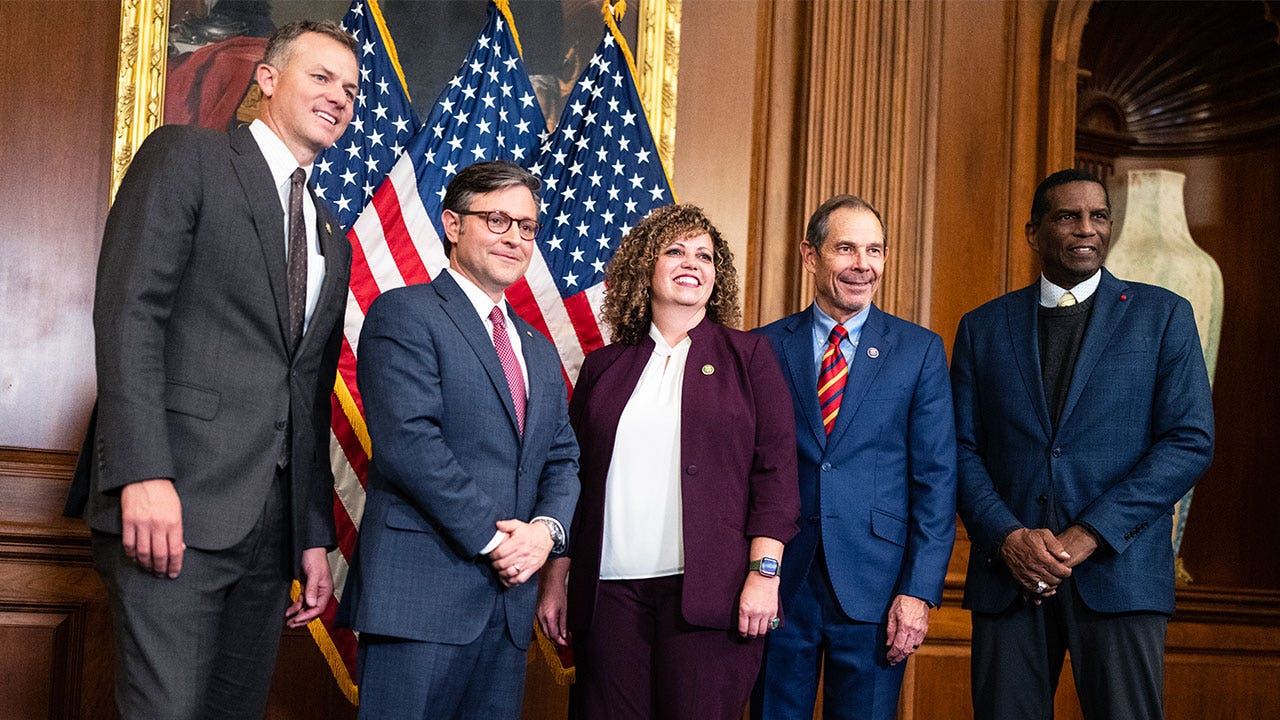
Rep. Celeste Maloy, R-Utah won Tuesday’s Utah Republican primary election for the state’s 2nd congressional district.
Maloy faced off against her combat veteran challenger Colby Jenkins. Maloywill take on the Democratic nominee come November.
Utah’s 2nd district, which includes cities such as Cedar City and St. George, has been a reliably Republican voting district and is considered non-competitive going into the general election.
From left, Rep. Blake Moore, R-Utah, Speaker of the House Mike Johnson, R-La., Reps. Celeste Maloy, R-Utah, John Curtis, R-Utah, and Burgess Owens, R-Utah, attend a swearing-in ceremony in the Rayburn Room of the U.S. Capitol after Maloy was sworn in on the House floor on Tuesday, November 28, 2023.(Tom Williams/CQ-Roll Call, Inc via Getty Images)
The district’s Republican primary featured the involvement of several influential figures, including former President Trump, who endorsed Maloy earlier this month.
Advertisement
Sen. Mike Lee, R-Utah, weighed in on the race much earlier, endorsing Jenkins in April.
“Too many Republicans in Congress have voted to expand the size, scope and cost of the federal government, in many cases deferring to congressional GOP leaders bent on advancing the Democrats’ agenda. Now more than ever we need bold conservatives in Congress,” the conservative Republican said at the time. “We need Colby Jenkins. His commitment to the Constitution, fiscal responsibility, limited government, and individual liberty make him the best candidate to represent Utah’s values in Washington.”
ELECTION OFFICIALS IN ALL 50 STATES URGED TO SEEK INFO FROM BIDEN ADMIN TO PREVENT NONCITIZENS FROM VOTING
After gaining Lee’s surprise endorsement, Jenkins went on to defeat Maloy at the Utah GOP nominating convention 57%-43%. They both ultimately moved on to the primary, according to Deseret News.
Advertisement
Sen. Rand Paul, R-Ky., also endorsed the Republican challenger. The two Republican senators even cut a promotional video for Jenkins that was posted on the candidate’s YouTube channel.
Former Republican presidential candidate Vivek Ramaswamy backed Jenkins too, calling him “America first,” and crediting Lee with having introduced them.
HOW TO WATCH THE CNN PRESIDENTIAL DEBATE SIMULCAST ON THE FOX NEWS CHANNEL
Ramaswamy, pictured here, said Lee introduced him to Jenkins. (Micah Green/Bloomberg via Getty Images)
In addition to Trump’s support, incumbent Maloy boasted the backing of House Speaker Mike Johnson, R-La., and that of the three other Republican House members from Utah, Reps. Blake Moore, John Curtis, and Burgess Owens.
Advertisement
Lee had notably spent time ahead of the primary election espousing his support for Jenkins on social media and urging Utahns to vote.
‘GREATEST THREAT’: FORMER TOP KAMALA HARRIS AIDE REVEALS WHICH TRUMP VP PICK COULD SINK HER CANDIDACY
Lee’s endorsement surprised many.(Bill Clark)
“1. Who has already voted for Colby Jenkins? 2. Who plans to vote for Colby Jenkins, either today or tomorrow? 3. Who would eagerly vote for Colby Jenkins, if only they lived in Utah’s second congressional district? I’m in category 3. How about you?” the senator wrote on one of his X accounts on Monday.
Advertisement
Maloy assumed the House seat after winning a special election in November 2023 to succeed former U.S. Rep. Chris Stewart. In her short time in the lower chamber, Jenkins pointed to Maloy’s voting record and criticized her for compromising with Democrats on spending bills and the Foreign Intelligence Surveillance Act (FISA) reauthorization.
In response to his criticism during a debate earlier this month, Maloy said, “Angry talking points and hyperbole and hardline stances aren’t really a formula for winning, but they do sound really nice on the campaign flayer,” reported Deseret News.
Get the latest updates from the 2024 campaign trail, exclusive interviews and more at our Fox News Digital election hub.
Julia Johnson is a politics writer for Fox News Digital and Fox Business, leading coverage of the U.S. Senate. She was previously a politics reporter at the Washington Examiner.
Advertisement
Follow Julia’s reporting on X at @JuliaaJohnson_ and send tips to Julia.Johnson@fox.com.
Brendan Duval, CEO and founder of Glenfarne Group LLC. (Bill Roth/ADN)
No one envies the Alaska Legislature being called back into a second special session on the proposed liquefied natural gas pipeline. One wonders if legislators are being held hostage to the governor’s predetermined decision. While the benefits of an LNG project are easily imagined, the economic risks of the Alaska LNG project must not be ignored.
Alaskans are not assured that Glenfarne, the company that was granted 75% of this project in an undisclosed document, won’t just flip it — sell it — to another entity after it gains billions of dollars in concessions from Alaska. Why the sudden change by Glenfarne and the Alaska Gasline Development Corporation from saying no legislative action was needed to the recent assertion that billions of dollars in property tax reductions are now necessary? It is without question that local municipalities will collectively incur hundreds of millions of dollars in direct impact costs.
Will Alaska give away another resource “farm” again? How would Alaska respond if the LNG project stalls and our resource continues to be a stranded asset? No purchaser has signed on the dotted line to actually buy fixed quantities of our gas. Are prospective purchasers interested? Yes. Have they signed binding contracts? No.
Russia has natural gas pipelines flowing into China. Russia has substantial volume to sell, having lost its natural gas sales to Europe after invading Ukraine. China currently produces 60% of its oil and natural gas needs by fracking its resources in western China. What would keep the Chinese from selling their or Russian natural gas to Alaska’s potential customers in Asia?
Advertisement
Natural gas prices have remained steady, which says there is plenty of it. Can Alaska’s project, including costly export facilities, be built at a cost that allows it to compete?
Legislators, please respond. But don’t sell out the interests of Alaskans. Glenfarne’s and AGDC’s lack of truthful answers raises many red flags. The correct decision is to let Glenfarne pay for its project. If it can’t or won’t, it isn’t economic.
Patrice Lee is a 49 year resident of Alaska, a retired math and science teacher, and a former elected member of the Interior Gas Utility Board of Directors. She lives in Fairbanks.
• • •
The Anchorage Daily News welcomes a broad range of viewpoints. To submit a piece for consideration, email commentary(at)adn.com. Send submissions shorter than 200 words to letters@adn.com or click here to submit via any web browser. Read our full guidelines for letters and commentaries here.
VIDEO: Hundreds of loved ones and first responders gathered Saturday to celebrate the life of Nicholas Hutcherson, an Arizona wildland firefighter killed late last month while battling a wildfire in Colorado.
Hutcherson was part of a Helitack crew trained to respond to remote areas and contain wildfires before they spread.
He was one of three wildland firefighters killed June 27.
His father, Ron Hutcherson, said his son sent him a text message the morning he died, saying he was on his way to a fire and would try to call that evening.
Advertisement
“The text included a picture from inside his Helitack helicopter,” Ron Hutcherson said. “One of his crew members had a Snoopy on their helmet — he knew how much me and my wife loved Snoopy.”
That evening, a call came — but not from Nicholas.
Saturday, Ron Hutcherson read a letter addressed to his son, recounting their shared memories — including the moment a young Nicholas fell in love with the fire department.
Widening income inequality and a growing number of U.S. billionaires is supercharging the political debate around wealth taxes, at both the national and local level. Democratic lawmakers and candidates, including some from the party’s energized democratic socialist wing, are promising to impose new levies on the über-wealthy should they win control of Congress, citing both fiscal and moral imperatives. Many blue states and cities are exploring similar measures, even as critics warn of high-income residents fleeing to lower-tax red states.
A key test will come this fall in California, where voters will decide whether to impose a one-time 5% tax on the state’s billionaires. The Golden State has a history of pioneering policy ideas via ballot initiatives.
Supporters say the ballot measure, sponsored by a healthcare workers union, would generate needed funds to cover rising healthcare costs for low-income people. Critics – including Democratic Gov. Gavin Newsom – say it could decimate the state’s tax base by driving wealthy people away. Opposition groups, funded in large part by Google co-founder Sergey Brin, have spent over $100 million to try to defeat the initiative. They are backing two counterinitiatives that would undercut the billionaire tax and that will also appear on this November’s ballot.
Why We Wrote This
With the top 1% holding nearly one-third of household wealth in the United States, efforts to impose new levies on the wealthy have been gaining traction. A key test will come this fall in California, where voters will decide whether to impose a one-time 5% tax on the state’s billionaires.
Advertisement
“What happens in California is going to determine the course of what happens in this country on this issue,” said California Rep. Ro Khanna, who supports the billionaire tax, on a call with reporters last month. “This fight is defining, for what type of Democratic Party we’re going to be.”
Taxing the rich has long been a familiar refrain among Democrats. Vermont Sen. Bernie Sanders has been calling for wealth taxes for decades, and President Joe Biden proposed a billionaire tax in 2024. With the top 1% holding nearly one-third of household wealth in the United States, efforts to impose new levies on high-net-worth individuals have been gaining traction.
Katie Godowski/MediaPunch /IPX/AP
Advertisement
Vermont Sen. Bernie Sanders holds a “Tax the Rich” Rally at Lehman College in New York City, March 29, 2026.
In Washington state, which historically has not had an income tax, legislators this spring passed a 9.9% tax on incomes over $1 million. Opponents there are mobilizing behind a referendum to repeal the measure, which appears headed for the November ballot. Maine’s governor this spring signed into law a new income tax surcharge on incomes exceeding $1 million, and legislatures in Minnesota and Rhode Island have passed similar measures.
Advertisement
In New York, Mayor Zohran Mamdani won a historic victory last fall with a campaign that promised to impose new taxes on the wealthy while making life more affordable for ordinary New Yorkers. While New York legislators have not moved ahead on Mr. Mamdani’s biggest tax proposals, in May they passed a tax on second homes worth more than $1 million.
California’s wealth tax, known as Proposition 40, would apply to all billionaires who were living in the state at the start of 2026. Proposed by the Service Employees International Union-United Healthcare Workers West, 90% of revenue from the tax will be earmarked to cover funding gaps caused by federal cuts to Medicaid; the other 10% would go to food assistance and public education from kindergarten through two years of community college.
New York Mayor Zohran Mamdani (third from left) holds a forum with economists at CUNY Graduate Center in New York to discuss the increasing gap in incomes between the very rich and the rest of the population, April 15, 2026.
Advertisement
Hours after the measure officially qualified for the November ballot, Mr. Newsom, who is term-limited and thought to be eyeing a White House run, announced his support for a federal wealth tax instead. Mr. Khanna and Mr. Sanders, who also support the California tax, introduced a bill in March for a 5% annual wealth tax on billionaires, which they say would raise $4.4 trillion in revenue over 10 years.
When congressional Republicans passed President Donald Trump’s tax and spending plan last summer, they approved tax cuts for wealthier Americans and funding cuts to food benefits and healthcare. With the cost of living rising and gas prices up since the start of the Iran war, voters are concerned about affordability and disapprove of Mr. Trump’s handling of the economy, according to polls.
Surveys show slightly higher public support for raising income taxes on top earners than for a wealth tax. A majority of Americans support higher taxes on the wealthy, and more than 80% say they’re bothered by the feeling that wealthy people don’t pay their fair share.
“We think this is about values, we think this is about fairness, we think this is about equity,” said Dave Regan, president of SEIU-UHW, on a press call with Mr. Khanna. “We believe that Californians are willing to say that the most fortunate and the wealthiest people among us can put forth a modest, one-time 5% tax so that millions and millions and millions of people will continue to have at least a stable health insurance system.”
Advertisement
California – which has a progressive tax system that relies heavily on high earners as a source of revenue – is home to more than 200 billionaires, though some have relocated in recent years. Elon Musk, who recently became the world’s first trillionaire, moved his family and some of his business operations from California to Texas. Mr. Brin reportedly moved to the Nevada coast of Lake Tahoe early in 2026. Others – like Jeff Bezos, Mark Zuckerberg, Larry Page, and Bill Gates – own homes in other states as well as in California.
The proposed tax, if approved by voters, would raise about $100 billion, according to its architects. But critics say in the long run it could actually result in decreased revenue for the state. Even though the ballot measure is only a one-time tax, they predict many billionaires will anticipate that more such taxes will likely follow, and move out of state in response.
“[California gets] the one-time windfall of taxing the wealth, but then if [rich] people leave after that, they’re missing out on all of the income and capital gains taxes that would come for all of the future years they would have lived in California,” says Adam Michel, director of tax studies at the libertarian Cato Institute.
California Gov. Gavin Newsom, shown at the Obama Presidential Center June 18, 2026, in Chicago, does not support the proposed billionaire tax in his state but says he favors a federal tax instead.
Advertisement
California’s dependence on tax revenue from high-income people, Dr. Michel says, makes it especially vulnerable to shocks like a downturn in the stock market – or people and businesses moving away.
Supporters of the wealth tax say those concerns are overblown.
“It is a total fallacy that this is going to mean that investment leaves California,” said Mr. Khanna, who represents a district in the Bay Area, on a press call. “There’s more capital infusion into California than ever before. No one thinks that the AI revolution is happening in Miami, Florida. It’s happening in Silicon Valley.”
Advertisement
In countries like Spain, where there might be three different wealth taxes in a 50-kilometer radius, studies have shown that wealthy people don’t tend to move in response, says Brian Galle, a law professor at University of California, Berkeley, and one of the authors of the California measure.
“The overwhelming evidence is that very few people move in response to wealth taxes,” says Professor Galle. “People are pretty embedded in their work and social lives.”
It’s possible to structure a tax so it doesn’t distort behavior, says Kyle Pomerleau, a senior fellow at the American Enterprise Institute. Ideally, the tax would be retroactive, only applying to economic activity that already took place. It’s also better if the tax kicks in at the same time that it’s announced. And it needs to be one-time, he says.
Reassuring people on that last point may be hard in this case, though. While the architects of the billionaire tax say it is only a one-time levy, “if voters are willing to pass this one-time tax, it’s possible they’re willing to pass another,” says Mr. Pomerleau.
Mr. Regan, the president of the union, calls the state-level tax an imperfect solution. In a perfect world, the tax would be federal, he said in a press briefing the night the measure officially qualified for the California ballot. But that would require Democratic control of Congress. For now, the union views this as the next-best step.
Advertisement
Billionaire Tax Now, the coalition backed by the union to campaign for the measure, has far fewer resources than Building a Better California, the billionaire-backed coalition supporting the countermeasures.
There’s some concern voters might get confused among the three different ballot initiatives pertaining to the billionaire tax, two of which are designed to effectively neutralize it. One countermeasure would prohibit new taxes on retirement accounts and other assets, and includes a provision prohibiting retroactive taxes. The other requires audits of any state program funded by special taxes before funds are received. It would also prohibit California from creating or collecting new taxes that bypass the state’s appropriations limit, which caps the growth of tax-funded spending.
Wealth tax proponents note that California’s billionaires have seen their assets grow substantially just in the past six months.
“The estimates I’ve seen say that already this year their wealth has grown by 6% or 7%,” says Professor Galle, who also helped to author former President Biden’s proposed billionaire minimum income tax. “Even after they pay this tax, they’ll be richer at the end of the year than when they started.”