West
Trump backed by 27 states in Supreme Court fight, who warn of 2024 'chaos' if he's removed from ballot

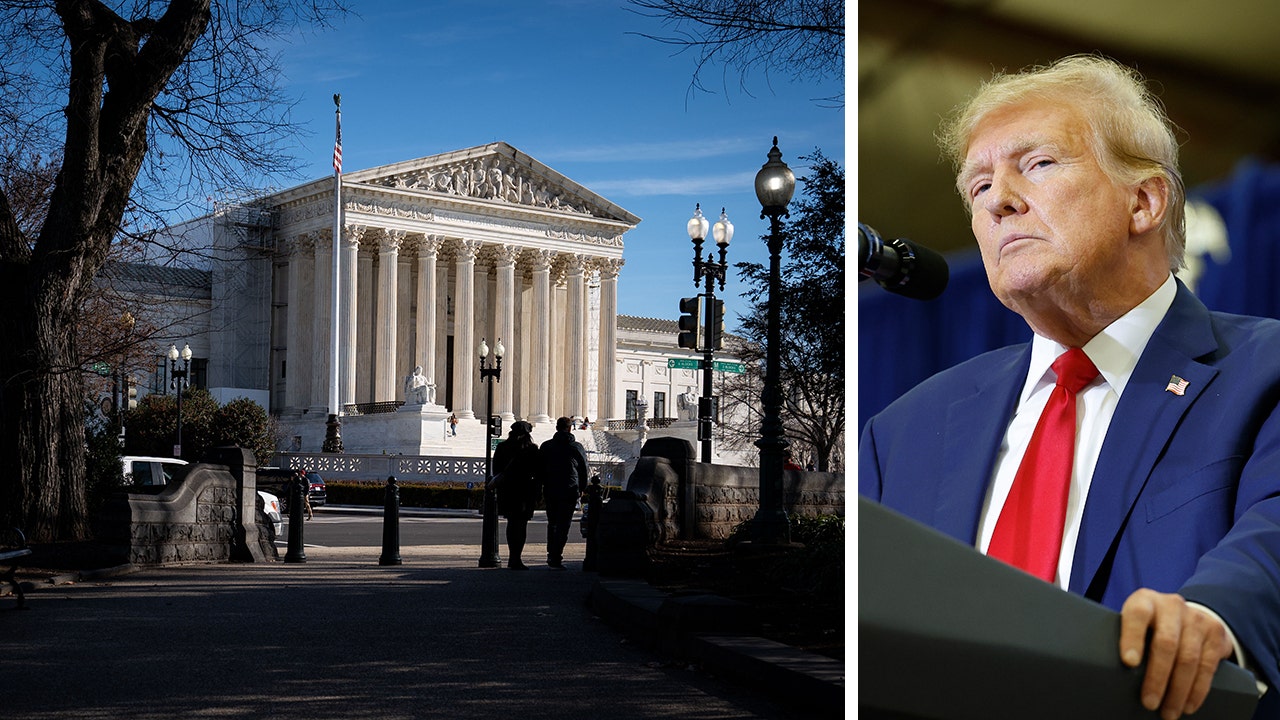
More than two dozen states have filed an amicus brief with the Supreme Court, urging the nation’s highest court to keep former President Trump on the Colorado Republican presidential ballot and warning that failing to do so could throw the 2024 presidential election “into chaos.”
The attorneys general of Indiana, West Virginia and 25 other states, warn the court that the move by the Colorado Supreme Court to declare Trump an “insurrectionist” under the Fourteenth Amendment “has vast consequences that reach far beyond Colorado.”
The nation’s highest court will hear arguments on February 8 and set a January 18 deadline for similar briefs. The justices issued an administrative stay that orders the Colorado Secretary of State to put the former president’s name on the GOP primary ballot, at least until the case is decided.
SUPREME COURT TO DECIDE IF TRUMP BANNED FROM COLORADO BALLOT IN HISTORIC CASE
Former U.S. President Donald Trump waves to the crowd on the field during halftime in the Palmetto Bowl between Clemson and South Carolina at Williams Brice Stadium on November 25, 2023, in Columbia, South Carolina. (Sean Rayford/Getty Images)
The state court ruled that Trump had engaged in an insurrection for his role in January 6, 2021, riots at the U.S. Capitol. The Fourteenth Amendment, adopted in 1868 after the Civil War, bars people who “engaged in insurrection” from holding public office.
The states argue that state-imposed restrictions have a national consequence in this instance and the ruling “threatens to throw the 2024 election into chaos.”
“Voters who may wish to cast their ballots for former President Trump cannot know whether he ultimately will be excluded from the ballot in their State or others. They may wonder whether a little non-mutual offensive collateral estoppel is all it takes for former President Trump to be excluded from ballots across the Nation,” they say.
They also argue that the court’s decision on what constitutes an insurrection is “standardless and vague” and denied the former president an opportunity for due process, including calling witnesses and the discovery process.
“The Colorado Supreme Court has cast itself into a ‘political thicket,’ . . . and it is now up to this Court to pull it out,” they say.
The states warn that if the Colorado decision is allowed to stand, the confidence in the integrity of the electoral process will be harmed.
TRUMP ASKS SUPREME COURT TO KEEP NAME ON COLORADO BALLOT
“Many Americans will become convinced that a few partisan actors have contrived to take a political decision out of ordinary voters’ hands,” they warn.
The brief also argues for immediate action as the court “should not let the uncertainy persist” and warns that additional confusion could build if more states remove Trump from the ballot as the primaries and caucuses near.
“Any damage may already have been done by the time another case raising similar issues makes its way back to this Court. And the longer litigation over a national candidate’s eligibility persists, the more uncertainty and confusion will spread. Voters need an answer in time to judiciously weigh the merits of competing candidates before casting their ballots, not after voting has begun,” the states say.
BIDEN MARKS THREE YEARS SINCE JAN. 6 BLASTING TRUMP, SAYING HE IS ‘TRYING TO STEAL HISTORY’
The brief also argues that, if allowed to stand, other potential disqualifications could arise in the future, asking whether a president could be stopped from running for re-election due to a wartime mistake construed as giving “aid or comfort” to enemies.
“The Court should act now to stop all these ‘strange, far-reaching, and injurious results’ from spinning out of control,” the states say.
Finally, the brief argues that the decision for who is qualified to serve as president is up to the voters, not to the courts.
“If the voters find former President Trump qualified, and Congress concurs, then the Constitution does not contemplate a time for the judiciary to second-guess that call. Rather, the Constitution gives Congress the sole and final authority to determine whether the President can continue to serve, as many courts have said.”
Fox News’ Sarah Rumpf-Whitten, Bill Mears and Shannon Bream contributed to this report.
Read the full article from Here



Golden Gate Bridge fireworks will be a rare patriotic event
This year on July 4th, for the third time in history, an organized fireworks display will be held at San Francisco’s iconic Golden Gate Bridge. This only happned in twice before in 1987 and 2012 for the bridge’s 50th and 75th annivesary. Expect crowds to be massive and public transportation, ride shares and simply walking is highly recommended.
SAN FRANCISCO – San Francisco is preparing for its major July 4th fireworks display on Saturday night, an event expected to draw massive crowds as pyrotechnics are launched directly from the Golden Gate Bridge for only the third time in history.
Will crowds flood Marina?
What we don’t know:
To pull off the event, the Golden Gate Bridge, major roadways, and key parking lots at Marina Green and Crissy Field will be shut down.
Several neighborhood streets will also be blocked off, creating significant traffic hurdles. Officials are strongly advising spectators to utilize public transit due to severely limited parking.
Local residents in the Marina District have expressed concern over the impending chaos as crowds flood the neighborhood.
“I’m a little worried, yeah,” said nearby resident Michael Zoboski. “I think it’s gonna be definitely hectic. I don’t know where people are going to park, it seems like it’s taking up a large amount of the streets up here. I think it’s going to be a little crazy.”
To manage the influx, access to many surrounding neighborhoods will be strictly limited to local residents.
Checking IDs
What we know:
Law enforcement officers will be checking IDs and questioning drivers to verify residency. According to the district supervisor, there will be 10 police officers deployed per block in the Marina.
Road closures will stretch from Baker Street to Van Ness Avenue between 8 p.m. and 11 p.m.
Portions of Fisherman’s Wharf are scheduled to shut down even earlier, starting at 1 p.m. Saturday afternoon, with much of that neighborhood also restricted to local access. The Golden Gate Bridge itself will close to traffic starting at 9 p.m.
Additionally, roads will be closed in the Presidio and Richmond District. To encourage the use of public transportation, Muni is providing special shuttles to help transport spectators to the viewing areas.
The Source: Marina neighbors, Muni, San Francisco city website

There have been many great offensive linemen in Denver Broncos history, so this list is likely going to vary greatly from person to person. In fact, my take might be a little too bold, but I’m sticking with it.
At the top spot, I think Garett Bolles has earned it. Since coming into the league as a first-round pick in 2017, he has grinded through one of the worst periods in Broncos’ history and grown from beleaguered oft-penalized first-round bust into a perennial All-Pro caliber left tackle. Even more, he has stayed a Bronco through his entire career. The rest of my list speaks for itself and is a throwback to Super Bowl greatness.
Here’s where our Mile High Report staff landed on the top five for offensive line:
Scotty Payne: Tom Nalen was the leader of Mike Shanahan’s offensive line, Ryan Clady was a top LT on a Hall of Fame career before injury and Stink was a key member of the Broncos Super Bowl winning OL back in the 90s. I included Bolles and Meinerz since both will be on this list once their successful careers are over with.
Chris Hart: This position group was one of the toughest to come up with a top five. Denver has an incredible history of top-tier offensive lineman. There are several players I left off who were certainly deserving. I posted Tom Nalen as my top guy because he was a stalwart at the pivot for many years for the franchise. We all know what Gary Zimmerman and Mark Schlereth provided on the field and they are both Super Bowl champions. The last two spots go to two recent Broncos, left tackles Garret Bolles and Ryan Clady. Bolles, a decade into his career, continues to play at a high level and Clady was a fantastic blindside protector whose career ended earlier than it should due to injury.
Ian St. Clair: For the first time in Elway’s career, he had a blind-side protector. And Zimmerman is one of the best to ever do it. Same for Nalen, who should be in the HOF. Clady was special. Bishop was the first Broncos offensive lineman in franchise history to get a Pro Bowl invite and provided one of the best in-game quotes ever when he said in Denver’s endzone at old Cleveland Stadium before hiking the ball at the 2-yard line in what would become The Drive, “We got ‘em right right where want ‘em.” And Schlereth helped lock down the left side of the line that was one of the best in league history.
Sadaraine: The top 3 are largely indisputable, other than maybe swapping Schlereth and Zimmerman. Ken Lanier started 178 consecutive games, which is nuts for an OT, and appeared in 3 Super Bowls. Garret Bolles has crafted himself into an all-time great at tackle and may move up the list.
Ross Allen: The Hall-of-Famer Gary Zimmerman was everything you could ever ask for in a left tackle and was a huge reason why John Elway and that 1997 team was so dominant. Schlereth also gets his credit as he was a massive contributor to Denver’s Super Bowl successes. There’s a strong case for Tom Nalen deserving a spot in the Hall of Fame too. And for the past two years I’ve become a huge spouter of Bolles being destined for the Ring of Fame. He’s an incredible talent as has been the cornerstone of this team for a while now. I just hope he gets his Super Bowl.
Joe Mahoney: Top 3 are a no-brainer. Bolles will finish his career with more starts on the OL than any other Bronco. The man he will pass is Ken Lanier. Since stats from Lanier’s era don’t exist we only have starts to go off, but Lanier was an iron man. He started 167 NFL games and 165 were for the Broncos.
There is a bit of variation here, but a general consensus of who should be in the Top 5. I loved the throwback to Keith Bishop who was a big part of the John Elway fourth quarter magic back in the day.
Who gets into your top five offensive lineman list?

SEATTLE — Fireworks are set to light up the sky above Lake Union on Saturday night as Seattle marks America’s 250th birthday on the Fourth of July.
Crews are preparing more than 7,000 pounds of fireworks for the Seafair show over the water, with hundreds of thousands of spectators expected at Gas Works and Lake Union parks.
This year’s festivities come as visitors from around the globe are in Seattle ahead of another World Cup match featuring Team USA on Monday.
One major change for this year’s celebration is that Gas Works Park will be gated off and will require tickets for entry. Seafair organizers say the new system is intended to help manage the expected increased capacity and keep spectators safe.
RELATED | Boom! Here’s where to catch 4th of July fireworks in and around Seattle
Planned activities during the day on Saturday include an interactive Seafair coloring wall and all-American games, where people can compete in a pie-eating contest, sack races, and a water balloon toss. Musical performances are scheduled to start at 5 p.m.
Free parking is available in the surrounding Gas Works Park neighborhood, but finding a spot is expected to be difficult. Organizers are urging people to give themselves extra time and consider rideshare, carpooling, or public transportation.
Fireworks sales and setting off fireworks are illegal in many areas of western Washington, making large public shows a safer option for many people.
Spectators at Gas Works Park will notice some changes this year. The city recently removed ladders, catwalks, and platforms from the structures there after the death of a 14-year-old last summer.
The teen’s family said the city failed to address dangerous conditions around the park’s towers despite years of warnings and several injuries.
BE THE FIRST TO COMMENT
The Lake Union fireworks are expected to start at roughly 10:15 p.m. Saturday.
-
 News2 minutes ago
Oregon ER doctors win a ‘David and Goliath’ battle against a national company
-

 Videos1 hour ago
Iran gets ready for Khamenei’s funeral • FRANCE 24 English
-

 Los Angeles, Ca1 hour ago
2 arrested after 3 LASD deputies injured during East L.A. World Cup celebration
-

 Detroit, MI2 hours ago
Ex-girlfriend in custody after Taylor man found fatally stabbed, police say
-

 San Francisco, CA2 hours ago
Marina braces for Golden Gate Bridge fireworks show, massive crowds
-

 Dallas, TX2 hours ago
Maradona’s ‘Hand of God’ ball heads to auction in Dallas
-

 Miami, FL2 hours ago
Miami-Dade sheriff urges residents to celebrate Fourth of July safely
-

 Boston, MA2 hours ago
Jaylen Brown says Celtics showed ‘lack of respect’ after trade to 76ers – The Boston Globe

