West
Supreme Court shuts down California GOP bid to block Newsom’s new map

NEWYou can now listen to Fox News articles!
The Supreme Court cleared the way for California to use its newly redrawn congressional map, which shifts five seats in Democrats’ favor, in the 2026 midterm elections.
The high court’s decision to decline to take up an emergency appeal from California Republicans comes after voters in the state approved a ballot measure called Proposition 50, which allowed the state to enact the Democrat-friendly map in time for the midterms. The justices’ decision included no dissents or explanation.
State Republicans, joined by the Department of Justice, had sued Democratic Gov. Gavin Newsom, alleging the map was an illegal racial gerrymander, in part because the mapmaker, Paul Mitchell, touted that it would bolster the Latino vote.
DOJ JOINS LAWSUIT AGAINST NEWSOM OVER ‘RACIAL GERRYMANDER’ OF CALIFORNIA MAP
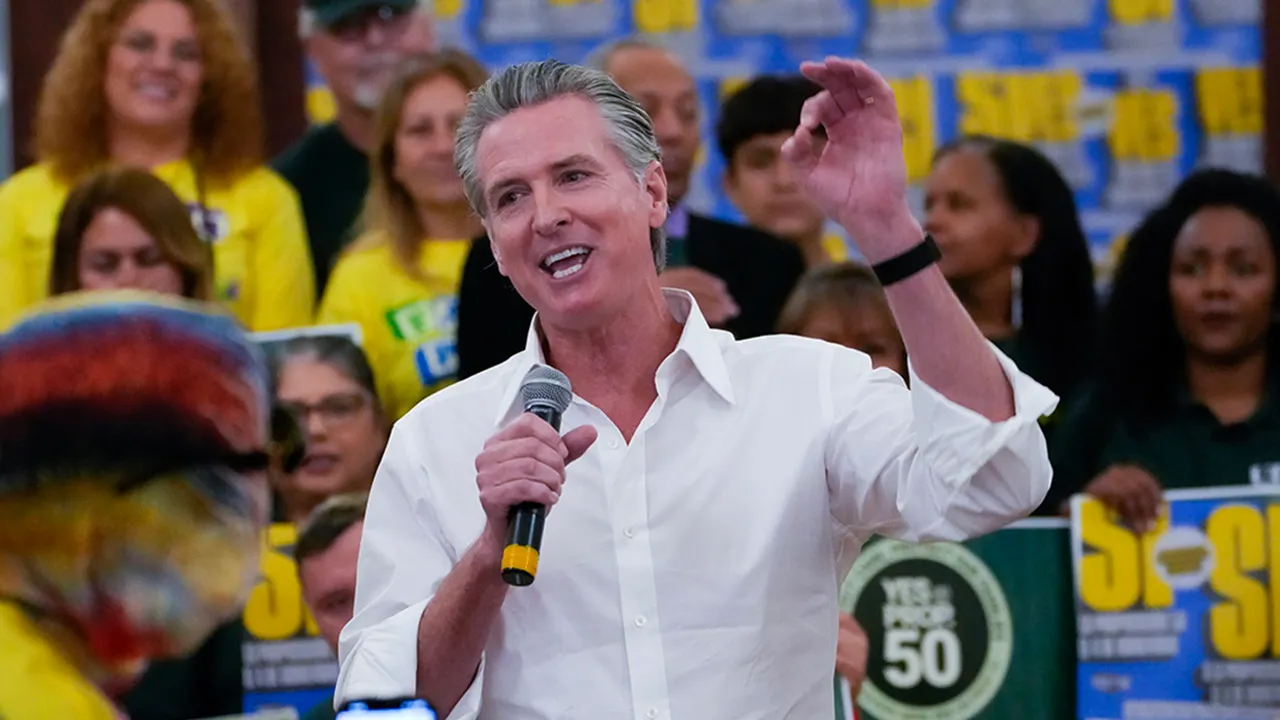
Gov. Gavin Newsom speaks at a “Yes On Prop 50” volunteer event in Los Angeles, California. (Getty Images)
California lawyers argued to the high court that those claims were insufficient to meet the high burden required to overturn the map. They also said no district actually gained Latino residents of voting age.
“None of the stray statements invoked by plaintiffs … reveals any race-based motive, let alone a racial motivation that predominates over all others,” the California lawyers wrote.
Proposition 50, according to Newsom, was a way to fight what he called President Donald Trump’s “power grab in Texas,” which passed its own map intended to give Republicans five seats.
The Supreme Court building is seen in Washington, D.C. (AP/Jon Elswick)
Newsom and Republican Gov. Greg Abbott both professed that their redistricting efforts were grounded in politics and that race was not a predominant factor in the map drawing process.
But lawyers for California Republicans argued to the Supreme Court that state officials “harbored another purpose as well: maximizing Latino voting strength to shore up Latino support for the Democratic Party.” The lawyers called Proposition 50 a “pernicious and unconstitutional use of race.”
The Supreme Court greenlit Texas’ map in December, reversing a lower court decision that had blocked it. Its decision on California’s map now effectively cancels out the two states’ mid-cycle redistricting maneuvers.
Texas Sen. Phil King displays a map during a hearing on Aug. 7, 2025, in Austin, Texas. (Brandon Bell/Getty Images)
The voting rights groups who challenged Texas and Republican Gov. Greg Abbott claimed that the map was an illegal racial gerrymander, but the high court said the groups could not offer an alternative map that served Texas’ political needs. In the 6-3 unsigned order, the justices also said the lower court should not have “interfered with an active primary campaign, causing much confusion and upsetting the delicate federal-state balance in elections.” The three liberal justices dissented.
The decision in Texas was issued on an emergency basis while the case proceeds, but the court schedule signals that the state’s map will remain in place through at least the 2026 elections.
Fox News Digital reached out to Republican Assemblyman David Tangipa and the DOJ for comment.
Tangipa, who led the lawsuit, noted that Republicans’ appeal to the Supreme Court was made on an emergency basis and that litigation would continue, even though the map will stay in place this year.
“The case will now head back to the lower court to be ruled on,” Tangipa said. “While this is happening, California will proceed with the Prop 50 maps and we will continue to work on this issue until the very end.”
Read the full article from Here



President Donald Trump was once again floating the idea of sending federal agents to San Francisco to tackle crime.
It happened during a cabinet meeting on Thursday. The president praised Mayor Daniel Lurie’s efforts to lower crime but said he can do it more effectively.
“San Francisco, I know, they have a mayor who’s trying very hard. He’s a Democrat, but he’s trying very hard, but we can do it much more effectively, because he can’t do what we do. He can’t take people out from the city and bring them to back to the country, from where they came, where they were in prisons,” Trump said.
“He’s trying. He’s doing okay, but we could do much better. We could make it a lot safer than it is. San Francisco, a great city, was a great city, could quickly become a great city again. But, you know, they’re going very slowly,” he continued.
The president implied that the mayor needs federal help to battle crime, saying immigrants are responsible for the lawlessness. However, according to a 2025 study by researches at UCLA and Northwestern, arresting and deporting undocumented immigrants was not associated with reduced crime rates.
Gabriel Medina, executive director of La Raza Community Resource Center In San Francisco agrees.
“I think we need to make sure that our city does not also try to play this game of making up ideas about always associating crime with immigrants, when immigrants commit less crime, so that’s really bad,” Medina said.
In response to the president comments, the mayor released a statement that reads: “In San Francisco, crime is down 30%, encampments are at record lows, and our city is on the rise. Public safety is my number one priority, and we are going to stay laser focused on keeping our streets safe and clean.”
This isn’t the first time President Trump has mused with the idea of sending federal agents to the Bay Area; last October, agents were staged at a military base in Alameda, but Trump called off the plan after talking with Lurie and Bay Area tech leaders.
“We cannot normalize what this president is saying from San Francisco, that crime is associated with immigration. We need to stop conflating that,” Medina said.

The Utah Jazz and Denver Nuggets are tipping off their second-to-last meeting of the 2025-26 season on Friday in the Mile High, where for the Jazz in particular, they’ll be dealing with several injuries headed into the matchup that’ll make them shorthanded once again.
Here’s what to expect on the injury front for both the Jazz and Nuggets on Friday night:
Utah Jazz Injury Report
OUT – Isaiah Collier (hamstring)
OUT – Keyonte George (hamstring)
OUT – Jaren Jackson Jr. (knee)
OUT – Walker Kessler (shoulder)
OUT – Lauri Markkanen (hip)
OUT – Jusuf Nurkic (nose)
PROBABLE – Kyle Filipowski (illness)
OUT – Blake Hinson (two-way)
It’s a lot of the same for the Jazz when looking back at some of their recent injury reports, but there’s also some good news to note as well.
Second-year big man Kyle Filipowski, specifically, is trending up to play in Denver after dealing with an illness against the Washington Wizards; an issue that kept him sidelined for one game and left the Jazz’s frontcourt notably shorthanded for what would be a double-digit loss.
During his post-All-Star stretch, Filipowski has been averaging 13.2 points, 8.8 rebounds, 4.2 assists, along with 1.2 steals and 0.9 blocks through 11 games.
He’s slotted in primarily as the Jazz’s starting center since both Walker Kessler and Jusuf Nurkic have been out with season-ending injuries, and has shown some nice flashes throughout.
However, outside of getting Filipowski back in the mix, the Jazz will still be without second-year guard Isaiah Collier, who continues to deal with hamstring soreness, and will also continue to be down Keyonte George and Lauri Markkanen with their extended absences.
It remains to be seen if any of the latter two will be able to return at some point this season, but now with less than 10 games to go on the calendar before the offseason officially hits, the chances of either Markkanen or George coming back keep getting slimmer and slimmer.
For the extent either remains out, expect to see a good chunk of Ace Bailey being the primary scoring option as he has through his recent slate of games, along with an expanded role for their two-way and 10-day players down the bench who have gotten more minutes in recent weeks.
Denver Nuggets Injury Report
OUT – David Roddy (two-way)
OUT – KJ Simpson (two-way)
As for the Nuggets, their injury slate remains clean. The only names out will be a pair of their two way signings in David Roddy and KJ Simpsons, while the rest of their roster is slated to be active.
It’s a major change from what the Nuggets have been used to all season when factoring in their several injuries to key players lasting multiple weeks.
Nikola Jokic, Cameron Johnson, Christian Braun, Aaron Gordon, and Peyton Watson have all missed significant time at one point or another this season, but against Utah, they’ll have all systems go as they roll into the game on a three-game win streak.
Tip-off between the Jazz and Nuggets lands at 7 p.m. MT in Ball Arena.
Seattle, WA
Harger: Hundreds responded to my Seattle homelessness commentary. Here’s what you said, and what I missed – MyNorthwest.com

Last week, I wrote about the word “homeless” and what it’s hiding. About Ben, who lives in his Jeep with his dog after a divorce and a job loss, ready to work, unable to get help because he doesn’t fit the profile the system was built for. About a woman in a tent in Ballard, severely addicted to fentanyl, found unresponsive twice in one week, turning down shelter every time it’s offered. About a third group: the severely mentally ill, cycling endlessly between the street, the ER, and the jail.
One word covering three completely different crises. One industry getting rich off the confusion.
I was not prepared for what came back.
A listener texted almost immediately to say I had perfectly described the homeless industrial complex. I’ve heard that phrase before. I’d never stopped to really sit with it. But that’s exactly what it is: A system that has organized itself around the problem rather than the solution, where the incentive is to manage homelessness, not end it.
Seattle readers respond: The homeless industrial complex, tiny homes, and a broken housing system
The emails and texts started coming in immediately and haven’t stopped. From people who said they felt seen for the first time. From people living this. From people who have been trying to say exactly this for years and couldn’t get anyone to listen.
Don wrote that the suffering caused by misguided homeless policy is just as real whether the motivation is malicious or simply misguided. He put it better than I did.
“The results are likely worse than what most of us could generate from a lifetime of determined ill-will,” Don wrote.
You don’t have to be cruel to cause real damage. You just have to be wrong and well-funded.
Igor called it “homeless heresy.” Two words. Said everything.
Laurie asked me to keep holding the spending accountable. I intend to.
Tammy told me her friend was given a tiny home and is doing meth inside it. She said the community has a room where residents do their drugs. She thought tiny homes were drug-free. They’re not required to be. That’s exactly what I was talking about. We put a roof over someone’s head, call it compassion, and walk away from the harder problem.
James flagged something I want to look into more closely. Affordable housing programs, he said, require proof of residency going back two years. This makes it nearly impossible for someone who is actually homeless to qualify. He was denied housing himself because his name wasn’t on his brother’s lease, even though that was the only address he had. That’s worth a much closer look.
Seattle homelessness has more categories than I described. A DV survivor showed me what I missed
Andrea is a domestic violence survivor who suffered a serious work injury the same year. She lost her mobility, her housing, and her safety all at once, and ended up back in a home with family members she’d spent years trying to escape. She doesn’t fit neatly into any of the three categories I described. She falls through every crack in the system.
I should have included her situation, and I didn’t. That was a mistake.
I’ve worked on stories with The More We Love, an organization that works specifically with women and children in situations like Andrea’s, and I want to tell her story more fully in the weeks ahead.
Steve spent seven years as a mission coordinator at a Seattle homeless mission in Belltown, interviewing everyone who came in seeking help. He wrote to describe a fourth category I did not address: people in the country illegally using services intended for others. It’s a complicated area, and I’m not going to treat his account as the final word, but it’s worth noting that people working directly in these facilities are seeing things the policy conversations aren’t accounting for.
Sally, a low-income senior who navigated the system herself and now rides Seattle buses regularly, wrote to describe several more categories I had not addressed: LGBTQ+ youth, domestic violence survivors on the run, and the residentially unstable who cycle through evictions and can’t get along in shelter settings. She’s offered to talk, and I may take her up on it.
North Beacon Hill: Open-air drug use, encampments near schools, and letters that go nowhere
Kevin is from North Beacon Hill. He wrote to describe his neighborhood: the parks full of encampments, the open-air drug use and sales, the day cares and schools nearby, the community group writing letters that go nowhere. His council member attended one meeting and didn’t seem particularly interested. The neighborhood is left to document what’s happening and hope someone eventually notices.
I went out to Kevin’s North Beacon Hill neighborhood this week. I talked to him. That report airs early next week, and I think you’ll want to check it out.
Seattle’s homeless policy is failing. People see it clearly. They just needed someone to say it
People aren’t confused about this. They see it clearly. They’ve been seeing it for years. They just haven’t had anyone reflect it back to them without flinching.
Igor called it heresy. Around here, maybe it is. We’ve spent billions. The people sleeping outside are still sleeping outside. The people like Ben who just need a hand up can’t get one. And suggesting that what we’re doing clearly isn’t working is apparently the most controversial thing you can say in this city.
I’m not done with this story. Not even close.
Charlie Harger is the host of on KIRO Newsradio. You can read more of his stories and commentaries . Follow Charlie and email him .

Retired Detroit sergeant faces new sexual assault charge involving 14-year-old victim from 2002

Trump floats sending federal agents to San Francisco to tackle crime

Dallas ISD will offer free pre-K starting next school year

Norwegian Cruise Line offers a first look at Luna, new cruise ship setting sail from PortMiami – WSVN 7News | Miami News, Weather, Sports | Fort Lauderdale

Boston ‘No Kings’ rally expected to draw 100,000; others planned across Mass.

Florida High School Football Rankings: Top 25 teams – Oct. 21

How old is Bo Nix? What to know about Oregon quarterback ahead of 2024 NFL Draft

Cleary's 21 help Le Moyne down Central Connecticut State 69-64 in OT

99th annual Pony Swim held in Virginia

Indiana Members Credit Union announced as new anchor tenant at Bottleworks District

Video: Will ICE Change Under Its New Leader?

DHS shutdown breakthrough comes at cost for Republicans as funding fights nears end

Rubio joins crucial G7 talks as Iran war set to dominate second day

A surprise resignation could open the door for an independent to win a Montana Senate seat

Video: Savannah Guthrie Says She Believes Her Mother Was Taken for Ransom
-

 Detroit, MI1 week ago
Drummer Brian Pastoria, longtime Detroit music advocate, dies at 68
-

 Science1 week ago
How a Melting Glacier in Antarctica Could Affect Tens of Millions Around the Globe
-
 Science1 week ago
I had to man up and get a mammogram
-

 Movie Reviews1 week ago
‘Youth’ Twitter review: Ken Karunaas impresses audiences; Suraj Venjaramoodu adds charm; music wins praise | – The Times of India
-

 Sports6 days ago
IOC addresses execution of 19-year-old Iranian wrestler Saleh Mohammadi
-

 New Mexico5 days ago
Clovis shooting leaves one dead, four injured
-
 Business1 week ago
Disney’s new CEO says his focus is on storytelling and creativity
-

 Technology5 days ago
YouTube job scam text: How to spot it fast