West
Seattle police arrest 5 demonstrators in election night protest

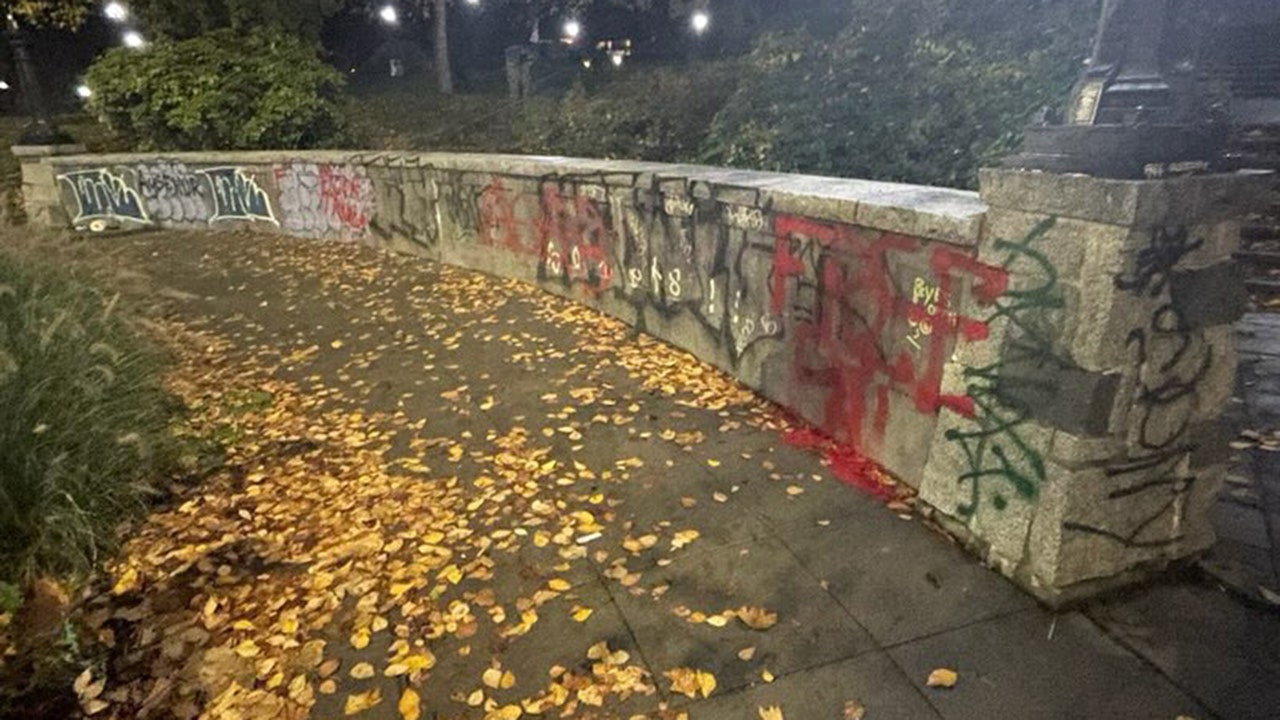
Demonstrators in Seattle were arrested after damaging property during a protest on Election Day, authorities said.
A few dozen protesters dressed in all black passed 12th Avenue and East Pike Street in the city’s Capitol Hill neighborhood around 6:45 p.m., FOX13 Seattle reported.
Police said announcements were made to the group over loudspeakers to disperse, and five individuals were arrested over property damage.
Protesters dragged scooters into the street and some tagged public property with graffiti that read, “Kill Cops,” “ACAB,” “Free Palestine” and more.
HARRIS WORLD BLAME GAME BEGINS AFTER CRUSHING LOSS TO TRUMP
Police in Seattle arrested five individuals who were part of a group of protesters who damaged property in Seattle during a protest on Election Day. (Seattle Police Department)
The protesters did not appear to be affiliated with either political party. Authorities did not immediately say whether it was a known group.
Protesters tagged public property with graffiti that read “Free Palestine.” (Seattle Police Department)
Jason Rantz, radio host at KTTH Seattle, reported that the group appeared to have been organized by far-left, antisemitic activists.
CLIMATE ACTIVISTS SPARY US EMBASSY IN LONDON WITH ORAGE PAINT AFTER TRUMP REELECTION VICTORY
Rantz reported that flyers posted around the Capitol Hill neighborhood claimed Israel is committing “a new Holocaust” in Gaza, while a separate flyer posted on social media made a similar message to “stop funding genocide!” Both flyers called on protesters to meet at Cal Anderson Park in Seattle around 6 p.m.
Police have yet to release the identities of the five individuals arrested.
CLICK TO GET THE FOX NEWS APP
More information would be released as it becomes available, police said.
Read the full article from Here


San Francisco’s Fourth of July celebration along the city’s waterfront quickly turned into hours of gridlock, dangerous fireworks incidents and a surge in emergency calls.
Thousands packed Crissy Field to watch fireworks launched from the Golden Gate Bridge. But once the show ended, it wasn’t exactly a smooth ride home.
While many left with great memories. Others found themselves stuck for hours in gridlock, caught in a massive backup involving dozens of Waymo cars, while firefighters across the city were responding to fires and serious fireworks injuries.
For Rose Peterson, the ride home after San Francisco’s Fourth of July fireworks took an unexpected turn.
“We were pulling up to a four-way stop and this guy was shooting off a firework in the middle of the road, and then our Waymo starts driving, and we’re like ‘Wait, what’s happening?’,” she said.
No one inside was hurt, but Peterson says the experience left her questioning how autonomous vehicles respond in unpredictable situations.
“I definitely think it needs to be more sensitive of anything that can come into the path of the road,” she said.
That wasn’t the only challenge after the show.
As thousands left Crissy Field and the Presidio, traffic came to a standstill. Among those stuck was Dave Guingona, who had friends visiting from the Philippines and wanted to show them a memorable Fourth of July in San Francisco.
“Five minutes, 10 minutes, 15 minutes went by, then we realized people were getting out of their cars, yelling and screaming at these Waymos because there were no drivers,” he said.
He says nearly two hours later, Waymo employees finally began driving the vehicles out.
“They had a great time, but this is what they’re going to remember for the rest of their lives. This was unbelievable,” he said.
While traffic barely moved, San Francisco firefighters responded to more than 500 calls for service, including four fireworks-related wildfires, numerous outside fires across the city and a vehicle fire on Connecticut Street believed to have been sparked by illegal fireworks.
Crews also responded to two life-altering fireworks injuries.
Captain Jonathan Baxter says the incident Peterson experienced in the Waymo was another reminder of how quickly things could have turned tragic.
“That situation could’ve had a far worse outcome—not only for the individuals in the car that could’ve been injured or worse—but for the individuals who lit the fireworks. They could have their life altered for the rest of their lives as well,” Baxter said.
Waymo says extreme traffic congestion disrupted operations for several vehicles after the fireworks and crews worked with city officials to clear them from the area.
The company also says it’s evaluating the incident surrounding fireworks, adding it’s committed to learning from situations like this.
San Francisco fire officials are reminding people that even fireworks marketed as “safe” can cause devastating injuries and fires. As for Waymo, the company says it’s reviewing both last night’s traffic congestion and the incident involving Rose’s ride as it looks for ways to improve operations during major events.


9:20 PM: Seattle Fire has a water-rescue response headed to Alki Avenue and 64th SW after a report of someone hanging onto a capsized watercraft – possibly a kayak, per dispatch – about 50 yards offshore.
9:29 PM: SFD responders report another kayaker appears to be towing in the person who was in trouble, or trying to.
9:34 PM: Rescuers, including an SFD boat, are deciding where to take the kayaker once he’s out of the water.
9:36 PM: They’re going to move a medic unit and battalion chief to Don Armeni Boat Ramp and take the kayaker there for evaluation.
-

 Health3 minutes ago
How a 93-year-old soccer referee credits wartime rations and discipline for his longevity
-

 Sports8 minutes ago
England stuns Mexico 3-2 in instant World Cup classic, hands team first World Cup loss at Estadio Azteca
-
 Business18 minutes ago
FDA escalates recall of Utz brand potato chips before July Fourth holiday
-
 Entertainment23 minutes ago
Inside the all-star America250 concert at the L.A. Coliseum
-

 Lifestyle30 minutes ago
Luxury Clients Want Meaning More Than Status
-
 Politics33 minutes ago
Commentary: Even in ugly times, the bicentennial united us. America 250 still can
-
 Sports45 minutes ago
‘I wish she was alive.’ Eliezer Alfonzo has emotional day as Dodgers lose to Padres
-

 World53 minutes ago
Photos: Khamenei funeral procession under way in Tehran

