West
Sanctuary city Denver spending a whopping $356 million on migrants: study


As Democratic Denver Mayor Mike Johnston says he would be willing to go to jail over his opposition to the Trump mass-deportation plan, a new study claims the mayor’s Blue city has spent a whopping $356 million of taxpayers’ hard-earned money on migrants.
The eye-popping sum, which amounts to $7,900 per foreign national in the city, was revealed by an updated analysis last week by the Common Sense Institut (CSI), a non-partisan research organization dedicated to protecting and promoting the U.S. economy.
The group says it used city data to land on the stunning sum, which equates to 8% of the city’s 2025 budget of $4.4 billion. The figures combine the city’s budget as well as regional education and healthcare organizations.
Denver Mayor Mike Johnston, right, and a migrant in the city, left. A new study claims Denver has spent a whopping $356 million of taxpayers’ hard-earned money on migrants since the crisis began in 2022 with costs including education, health care and housing. (Hyoung Chang/The Denver Post)
DENVER MAYOR MIKE JOHNSTON SAYS TRUMP’S MASS MIGRANT DEPORTATIONS WILL CREATE ‘TIANANMEN SQUARE MOMENT’
Denver has seen an unprecedented influx of migrants arrive in the city under the Biden-Harris administration and Johnston has already slashed city services to house and feed those migrants. Cuts included reducing services at recreation centers and stopping the planting of spring flower beds, while the city tapped into a contingency fund to pay for the spiraling costs.
The CSI claims that the bulk of the $356 million spent on migrants was through education, with the city also splashing out on healthcare, hotels, transportation and childcare. Denver is a sanctuary city, meaning it does not enforce immigration law, nor does the city cooperate with Immigration and Customs Enforcement agents.
The group says that about 45,000 migrants have arrived in the Denver metro area since December 2022, with 16,197 migrant students enrolling in Denver metro schools.
DENVER MIGRANT ADVOCATES SAY SIX MONTHS OF FREE RENT, FOOD NOT ENOUGH: ‘A SLAP IN THE FACE’ AND ‘OFFENSIVE’
“The total cost to Denver metro schools related to new migrant students is $228 million annually, which would equate to 1-2% of the total state K-12 education budget for the 2024-25 academic year,” the group writes.
“Previous CSI reporting estimated the per-student cost of instruction and support in the Denver metro to be $14,100 per year. Assuming this cost across all recent migrant students totals $228 million.
Meanwhile, Denver doctors earlier this year said that the migrant crisis had pushed the state’s hospital system to its breaking point and was causing a humanitarian crisis.
Migrants at a makeshift shelter in Denver, Colorado, on Jan. 13, 2023. (Hyoung Chang/The Denver Post)
The CSI study estimates that emergency departments in the Denver metro area have delivered an estimated $49 million in uncompensated care to migrants.
“With 16,760 [migrant] visits to Denver metro emergency departments from December 2022 to the present, providers would have delivered $49,124,029 of uncompensated care to migrants.
The study reports that at the height of the migrant influx in January 2024, officials estimated Denver was going to spend $180 million through 2024. Actual expenditures tracked by the city now show it will spend about $79 million.
“Of the total, 34.5% has been spent on facilities including hotels, 29.4% on personnel, 14% on services, and 11% on food,” the report finds.
Johnston said during a recent interview that he was prepared to protest against anything he believes is “illegal or immoral or un-American” in the city – including the use of military force – and was then asked if he was prepared to go to jail for standing in the way of policies enacted by the administration.
Tom Homan, Trump’s “border czar” designate, told Fox News’ Sean Hannity that he would jail Johnston if he broke the law in shielding illegal migrants. (Andrew Caballeroy-Reynolds/AFP via Getty Images)
“Yeah, I’m not afraid of that, and I’m also not seeking that,” Johnston said. “I think the goal is we want to be able to negotiate with reasonable people [on] how to solve hard problems.”
Tom Homan, Trump’s “border czar” designate, told Fox News’ Sean Hannity this week that he would jail Johnston if he broke the law in shielding illegal migrants.
“All he has to do is look at Arizona v. U.S., and he would see he’s breaking the law. But, look, me and the Denver mayor, we agree on one thing. He’s willing to go to jail, I’m willing to put him in jail.”
Fox News’ Hanna Panreck contributed to this report.
Read the full article from Here

NEWYou can now listen to Fox News articles!
A registered sex offender convicted in a child sex abuse material case is seeking elected office in California — launching a campaign for Fresno City Council amid fierce backlash and renewed questions about whether someone with his record should hold public office.
Rene Campos, a Fresno native required to register as a sex offender, has announced plans to run for the District 7 seat on the Fresno City Council.
Campos was charged in 2018 with possession of child sex abuse material, according to court records. He has said he pleaded no contest to a misdemeanor charge and is now a registered sex offender.
His opponent, Nav Gurm, says the campaign has transformed what should be a local race focused on infrastructure and public safety into a national controversy.
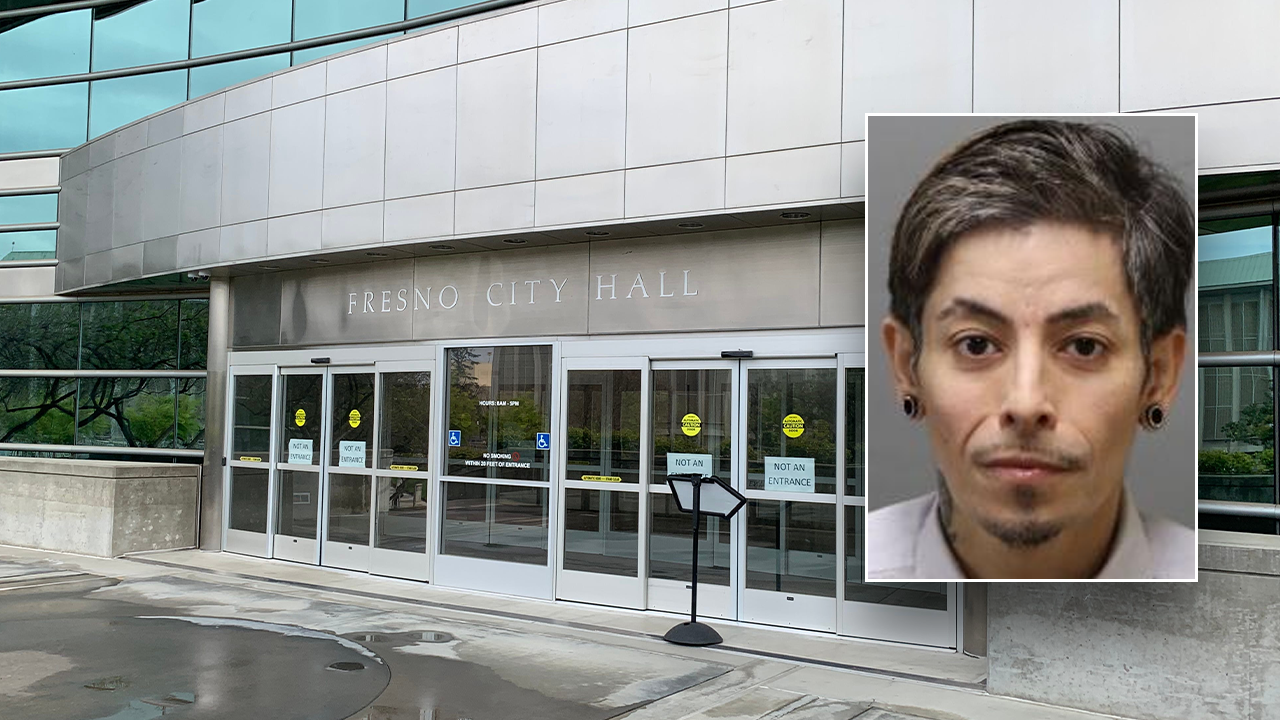
Rene Campos in a 2018 booking photo related to a child sex abuse material possession case. Campos, now a registered sex offender, has launched a campaign for Fresno City Council. (State of California Department of Justice)
“His candidacy is a slap in the face to families and children in Fresno,” Gurm told Fox News Digital. “They deserve a councilmember who can show up at their schools and in their neighborhoods without restriction.”
In a statement to Fox News Digital, Campos defended his candidacy, arguing he has met all legal requirements.
“I satisfied every legal obligation imposed under the laws this state enacted for accountability and rehabilitation,” Campos said.
CONVICTED KILLER KEPT IN POLICE OVERSIGHT ROLE AS CITY COUNCIL DISMISSES CONCERNS OVER PUBLIC SAFETY
The entrance to Fresno City Hall in Fresno, California. The District 7 City Council seat is up for election amid controversy surrounding a registered sex offender candidate. (James Ward, Visalia Times-Delta via Imagn Content Services, LLC)
“If those same laws can be set aside when politically inconvenient, then we are not debating one candidacy — we are testing whether the rule of law is stable or selective. Democracy depends on consistent standards. When eligibility shifts under pressure, public confidence weakens. Voters decide elections — not political preference.”
Under California law, registered sex offenders are not automatically barred from seeking or holding local office as long as they meet voter registration and residency requirements.
But Gurm argues that legality does not equate to fitness for office.
CHILD PREDATOR DUBBED ‘MONSTER PARENTS FEAR MOST’ CLEARED FOR RELEASE THROUGH CALIFORNIA PAROLE PROGRAM
“While it may not be a legal disqualification, it’s a disqualification in practice,” he said. “If you can’t fully participate in school events, youth gatherings and community activities, you can’t fully do the job.”
Gurm is urging state lawmakers to amend eligibility standards.
“I urge the Fresno City Council and the California State Legislature to push forward legislation making lifetime sex offender registration an explicit disqualification for holding public office,” he said.
NEW JERSEY POLICE SERGEANT, FORMER DEM MAYOR ALLEGEDLY DRUGGED, SEXUALLY ASSAULTED CHILD HE MET ONLINE
Nav Gurm, a candidate for Fresno City Council District 7, has called on his opponent to withdraw from the race amid controversy. (Nav Gurm for Fresno City Council Campaign Team)
The backlash has extended beyond campaign opponents.
Fresno City Council President Mike Karbassi said he believes voters will reject Campos and suggested he would oppose him taking office if elected.
“When it comes to the safety and welfare of our children, your past matters,” Karbassi said in a statement to Fox News Digital. “So long as I am Council President, I will not permit him to be seated on the Fresno City Council.”
VICTIM FEARS FOR OTHERS AFTER CALIFORNIA PAROLE BOARD APPROVES RELEASE OF CONVICTED CHILD PREDATOR
It remains unclear what legal authority, if any, the council president would have to prevent an elected candidate from assuming office.
Outgoing Councilman Nelson Esparza, who currently represents District 7 and is termed out, also criticized the campaign.
“Regardless of any rehabilitation, he needs to find a different line of work,” Esparza told Fox News Digital. “So much of what I do in this district is for and with respect to our children and youth. I don’t see any reasonable way someone with registered sex offender status could effectively do this job.”
CLICK HERE TO DOWNLOAD THE FOX NEWS APP
Esparza noted that councilmembers regularly participate in school initiatives and that children frequently visit City Hall for tours and meetings. He said councilmembers are examining possible municipal policy changes and urging legislative action at the state level.
The District 7 seat will open when Esparza’s term expires. Candidates face a filing deadline in early March, and the primary election is scheduled for June.
Stepheny Price covers crime, including missing persons, homicides and migrant crime. Send story tips to stepheny.price@fox.com.
Related Article

Read the full article from Here

The people cheering and banging drums on the front steps of San Francisco’s Hall of Justice are usually quietly keeping the calendars and paperwork on track for the city’s courts.
Those court clerks are now hitting the picket lines, citing the need for better staffing and more training. It’s the second time the group has gone on strike since 2024, and this strike may last a lot longer than the last one.
Defense attorneys, prosecutors and judges agree that court clerks are the engines that keep the justice system running. Without them, it all grinds to a slow crawl.
“You all run this ship like the Navy,” District 9 Supervisor Jackie Fielder said to a group of city clerks.
The strike is essentially a continuation of an averted strike that occurred in October 2025.
“We’re not asking for private jets or unicorns,” Superior Court clerk employee Ben Thompson said. “We’re just asking for effective tools with which we can do our job and training and just more of us.”
Thompson said the training is needed to bring current employees up to speed on occasional changes in laws.
Another big issue is staffing, something that clerks said has been an ongoing issue since October 2024, the last time they went on a one-day strike.
Court management issued their latest statement on Wednesday, in which the court’s executive officer, Brandon Riley, said they have been at an impasse with the union since December.
The statement also said Riley and his team has been negotiating with the union in good faith. He pointed out the tentative agreement the union came to with the courts in October 2025, but it fell apart when union members rejected it.
California’s superior courts are all funded by the state. In 2024, Sacramento cut back on court money by $97 million statewide due to overall budget concerns.
While there have been efforts to backfill those funds, they’ve never been fully restored.
Inside court on Thursday, the clerk’s office was closed, leaving the public with lots of unanswered questions. Attorneys and bailiffs described a slightly chaotic day in court.
Arraignments were all funneled to one courtroom and most other court procedures were funneled to another one. Most of those procedures were quickly continued.
At the civil courthouse, while workers rallied outside, a date-stamping machine was set up inside so people could stamp their own documents and place them in locked bins.
Notices were also posted at the family law clinic and small claims courts, noting limited available services while the strike is in progress.
According to a union spokesperson, there has been no date set for negotiations to resume, meaning the courthouse logjams could stretch for days, weeks or more.

David Fountaine Black
OBITUARY
Dave and Martha and their three boys moved to Denver in 1974 when Dave started work at the Rocky Mountain Arsenal. He and a business partner later purchased Mid-America Plating Company. Dave operated Mid-America for 36 years and finally retired in 2018.
He was a great golfer and natural athlete. Dave was an avid runner, and for many years, he woke up before the sun to get his miles in before work. He and Martha loved playing bridge with friends, gardening – growing fruit and flowers – and spending time outside relaxing and walking on the High Line Canal Trail and in Bible Park. Dave and Martha enjoyed getting back to Arizona during the winter at their Tucson home. They loved spending time with their family.
Dave passed away on February 20, 2026. He is loved by family and friends and will be missed. Dave was a hard-working, kind, optimistic, and thoughtful person who leaves the world a better place. He is survived by his wife, Martha, and his three sons, Dave (Robin), Tom (Debbie), Eric (Kendra), as well as six grandchildren and three great grandchildren, Casey (Nicole), Jake (Ashleigh and great granddaughter Faye), Hailey (Robby and great granddaughter Jensen), Keenan (Nicole and great granddaughter Olivia), Griffin, and Addie (Erik).
Baz Luhrmann will make you fall in love with Elvis Presley

Here’s your first look at Kratos in Amazon’s God of War show

State Dept authorizes non-essential US Embassy personnel in Jerusalem to depart ahead of possible Iran strikes

Where Iran’s ballistic missiles can reach — and how close they are to the US

Heart disease threat projected to climb sharply for key demographic

Florida High School Football Rankings: Top 25 teams – Oct. 21

Cleary's 21 help Le Moyne down Central Connecticut State 69-64 in OT

How old is Bo Nix? What to know about Oregon quarterback ahead of 2024 NFL Draft

99th annual Pony Swim held in Virginia

Indiana Members Credit Union announced as new anchor tenant at Bottleworks District
Where Iran’s ballistic missiles can reach — and how close they are to the US

Has India’s influence in Afghanistan grown under the Taliban?

Bill Clinton to testify before House committee investigating Epstein links

Read Judge Schiltz’s Order

Vulnerable House Dem lashes out at Trump’s ‘racist’ SOTU challenge: ‘That was uncomfortable’
-

 World1 day ago
Exclusive: DeepSeek withholds latest AI model from US chipmakers including Nvidia, sources say
-

 Massachusetts2 days ago
Mother and daughter injured in Taunton house explosion
-

 Montana1 week ago
2026 MHSA Montana Wrestling State Championship Brackets And Results – FloWrestling
-

 Oklahoma1 week ago
Wildfires rage in Oklahoma as thousands urged to evacuate a small city
-

 Louisiana4 days ago
Wildfire near Gum Swamp Road in Livingston Parish now under control; more than 200 acres burned
-

 Technology6 days ago
YouTube TV billing scam emails are hitting inboxes
-

 Denver, CO2 days ago
10 acres charred, 5 injured in Thornton grass fire, evacuation orders lifted
-

 Technology6 days ago
Stellantis is in a crisis of its own making