San Francisco, CA
Civil grand jury report warns of wildfire risk at SF’s Glen Canyon Park


SAN FRANCISCO (KGO) — A recent Civil Grand Jury report has identified wildfire risks in San Francisco’s Glen Canyon, warning that vegetation management is needed to reduce the potential for a fire in an area not typically associated with wildfire danger.
The report focuses on the canyon’s large population of Blue Gum eucalyptus trees, an invasive species originally imported from Australia.
Historical photographs show Glen Canyon was largely treeless in the late 1800s, when the land was used primarily as a dairy farm.
The eucalyptus trees were planted after investors believed the fast-growing species could be harvested for timber.
“And these people were so stupid, they didn’t realize they were going to build railroad ties and use the wood for building, and it’s worthless. It warps, it splits. it has no commercial value,” said Rick Carell, a member of the Civil Grand Jury.
While the timber venture failed, the trees remained.
Today, their flammability is a concern for fire safety officials and grand jury members.
MORE: 600 goats graze Poplar Beach in Halfmoon Bay to reduce wildfire risk
“The leaves have a lot of oil in them, and so actually, if it’s very hot, and it’s been very, very dry, they actually explode, because it’s highly flammable. And so, you can see here, look at all the debris right next to this road. So somebody throws a cigarette out into there, and you have a potential fire,” Carell said.
Carell said assessments of the trees have raised additional concerns.
“They evaluated something like 427 eucalyptus trees and 80% of them, back in 2012, were in bad shape,” he said.
Although CAL FIRE has repeatedly rated San Francisco’s wildfire risk as low because of the city’s cool, foggy climate, the grand jury report points to the 2025 Pacific Palisades fire in Los Angeles as an example of how fires can occur in urban areas where vegetation management is inadequate.
The report notes that Glen Canyon has only two fire hydrants, one near the Glen Park Recreation Center and another near a day camp building.
However, San Francisco’s Emergency Firefighting Water System provides additional resources through reservoirs, high-pressure hydrants and underground cisterns.
One nearby cistern at Chenery and Surrey streets can supply 75,000 gallons of water. Based on a fire engine’s typical pumping rate of 1,500 gallons per minute, that amount of water would be exhausted in about 50 minutes. Additional cisterns are located in surrounding neighborhoods.
MORE: CAL FIRE urging Bay Area residents to create defensible space as wildfire season begins
Despite the concerns, the report concluded that removing all eucalyptus trees is not a practical solution because of the canyon’s steep terrain. Large-scale removal could increase the risk of landslides. Instead, the report recommends managing vegetation by clearing brush and fallen debris and removing diseased trees.
“To remove any brush that might be a fire hazard, if something could really ignite quickly. We’re going to raise up the branches, the lower branches of the tree because that’s where a lot of the problem is for the spread of the fire, and if there are any dead trees that are really hazardous or branches that may hang over the roadway, that we can take them out as well,” said Rachel Gordon of the San Francisco Department of Public Works.
Public Works officials are expected to coordinate closely with CAL FIRE on vegetation management efforts.
“CAL FIRE guys, they train in the type of environment, and so what they do, they get their chainsaws out, they eliminate. They limb the trees, they bring out the debris and that sort of stuff so this is an ideal training site for them,” Carell said.
The San Francisco Public Utilities Commission, which manages a small portion of the canyon, has already removed trees on its property to prevent them from falling across O’Shaughnessy Avenue, a potential emergency evacuation route.
The agency has also hired habitat experts to remove non-native vegetation and replace it with fire-resistant native species, including coast live oaks.
“That has all these tannins in the foliage that resist fire. You can put a lighter right under that thing in the middle of the hottest day of the year, and it will not burn like these willows. They will not burn, and so that’s what we want to load our parks with instead of having things like the eucalyptus and the pine — which, as we all know, they just burn like a crazy Christmas tree fire,” said Habitat Specialist Josiah Clark.
The majority of the 66-acre canyon is managed by the San Francisco Recreation and Parks Department, which agrees that improved coordination among city agencies is essential to maintaining fire safety in the area.
Copyright © 2026 KGO-TV. All Rights Reserved.


Presidio Heights is proving to be a center of gravity as luxury housing supply in San Francisco vanishes and the city’s well-to-do scramble to claim their slice of the artificial intelligence industry’s nerve center.
On the same day last week, the city recorded two home sales in the wealthy neighborhood for $9.2 million and $10 million.
The first reflected the fortunes being created by the AI industry. Venture capitalist Kenneth Wallace and his wife, Moriah Lewis, sold their five-bed, 4,755-square-foot home at 3875 Clay Street for $9.2 million. Josh McAdam of Sotheby’s International Realty represented the seller. The property last sold for $6.8 million in 2021.
The buyer initially kept their name hidden behind a Delaware-incorporated LLC named after the property’s address. However, according to public loan documents, the LLC is managed by Daniel Berrios and Kimberly Tan, a couple in their early 30s who graduated from Stanford into the San Francisco tech sector. Berrios works on special projects at OpenAI, and Tan is an investing partner with blue chip venture capital firm Andreessen Horowitz. Wells Fargo Bank provided a $5.4 million loan for the purchase.
Ten blocks east, sellers Herbert and Shwu-Ling Wei sold their six-bed, 5,000 square-foot home at 2881 Jackson Street for $10 million. Kyle Vineyard, a CPA with Realize Tax Advisors, is the trustee of the buyer, RKLA Trust. It is unclear whether Vineyard’s involvement is purely professional or if he’s connected to the trust.
The home last sold in 2014 for $6.8 million.
Presidio Heights, the neighborhood that runs along Presidio Park at San Francisco’s north end, has experienced a hot streak during the first half of 2026. Earlier this month, two mansions in the area sold for a combined $32 million, marking the fourth and fifth sales this year to eclipse $10 million. There were seven sales above that benchmark in Presidio Heights in all of 2025, according to Zillow data.
San Francisco, where the median home sale fetches $2.2 million, is dealing with its own version of champagne problems: a mansion shortage. The AI boom has attracted a wave of high-paid employees, apparently leaving the city with more millionaires than mansions. Steep capital gains taxes have made some mansion owners hesitant to let go of their property. Others are holding out for the expected spike in luxury home demand following Anthropic and OpenAI’s initial public offerings of stock, which are expected to come later this year.
Residential
San Francisco
Single-family, condo spike as AI boom meets Lurie administration to reverse “doom loop”
Residential
San Francisco
San Francisco’s mansion shortage claims two more trophy homes
Residential
San Francisco
AI boom pushes San Francisco median home prices north of $2M
Residential
San Francisco
SF’s high-end headache: “Egregious shortage of mansions”
Read more


Staying safe at San Francisco’s Pride festivities
The SFPD has announced that officers from all districts, stations and specialized agencies will be positioned along the route for the Pride Parade to ensure the event is safe for attendees. The annual parade will be held this Sunday and is expected to attract hundreds of thousands of people from around the world.
San Francisco – San Francisco city and police officials said Wednesday that they want people to enjoy Pride festivities this weekend — including the popular parade on Sunday — and that they will be on the lookout for criminal activity.
“All of the leaders up here know how important this weekend is, and we are ready,” Mayor Daniel Lurie said while flanked by a host of officials at a news conference at San Francisco police headquarters.
Lurie said his message is simple: “Look out for one another. Report anything concerning and know that every first responder, city worker and volunteer has one goal: to help everyone celebrate safely.”
Hundreds of thousands expected at SF Pride Parade
What we know:
The annual Pride festivities and parade on Sunday are expected to draw hundreds of thousands of people from around the world to San Francisco. Police say they’re working with state and federal partners to monitor any potential threats while making sure people enjoy themselves.
“You’ll see many of our officers – including me – wearing Pride patches,” said Police Chief Derrick Lew, gesturing to a multicolored patch on his shoulder. “As always, we’re excited to showcase San Francisco, and our longstanding status as a safe haven for members of the LGBTQ+ community.”
No tolerance for hate, DA says
What they’re saying:
District Attorney Brooke Jenkins says she and other city leaders will have no tolerance for hate.
Just last week, she charged a man with a hate crime for allegedly spray-painting a homophobic message outside a Castro District flower shop and punching a witness.
“There will be accountability if anything like that happens here, and so as much as we want to be joyous, we also have to take this occasion very seriously,” Jenkins said.
Suzanne Ford, executive director of SF Pride agreed, saying, “I think we all have the responsibility of demonstrating that we can work together to make sure that the LGBTQ community is centered for this weekend.”
Sheriff Paul Miyamoto said those who don’t behave will go straight to jail.
“The one mode of transportation we want to make sure all of you avoid this weekend is the party buses that the sheriff’s department will have out there,” Miyamoto said.
City officials are urging everyone to celebrate responsibly, don’t drink and drive or accept drinks from strangers and to report any suspicious activity.
Henry Lee is a KTVU crime reporter. E-mail Henry at Henry.Lee@fox.com and follow him on X @henrykleeKTVU and www.facebook.com/henrykleefan
The Source: KTVU reporting, San Francisco police and sheriff, district attorney’s office
San Francisco, CA
First of its kind queer museum in San Francisco Chinatown amplifies Chinese LGBTQ artists

On one side of the world, Xiangqi Chen can be punished for her LGBTQ+ activism. But on the other, the activist and artist is lauded as a trailblazer — the architect behind the first of its kind Chinese queer art museum.
The irony that she left her home in China and found a public platform for her LGBTQ+ artistic expression in San Francisco’s Chinatown — the country’s oldest — is not lost on her.
“Here in San Francisco Chinatown, I still continued my journey and met so many like-minded community members and friends,” Chen told The Associated Press through an interpreter. “It kind of actually encouraged me and gave me lots of strength to do what I know is my mission, my calling.”
The OUT Museum opened with a rainbow-ribbon cutting at the end of May — between Asian American Pacific Islander Heritage Month and Pride Month. Situated across from the Chinese Historical Society of America Museum, the bilingual museum is giving recognition to a demographic that has long felt invisible. It seems like an ideal fit in the progressive city at a time when some cities, states and the federal government are restricting or banning certain LGBTQ+ rights.
To start, the museum is only open on Saturdays and is one room with fewer than a dozen artworks by artists from China and the Chinese diaspora. But there is hope to expand the museum’s exhibits and days of operation.
Museum allows Chinese artists to fully tell their stories
While still living in China, Chen launched a Kickstarter for a proposed museum six years ago — more than 2,000 donated on the platform. But she knew it likely wouldn’t be built there. In 2022, she came to the U.S. on a J-1 visa as a visiting scholar at Georgetown University. By 2024, Chen gained attention in San Francisco for her role in an exhibition at the Asian Art Museum. That led to a residency with the Chinese Culture Center of San Francisco.
The organization was “proud to be the incubating space for the OUT Museum prototype,” executive director Jenny Leung said in an email.
The level of support that followed amazed Chen.
“I got so many chances to connect with the local Asian American queer community and even the Chinatown community in general,” she said.
Interest soon followed from longtime collaborators and younger artists who reached out via Instagram. They are represented in the inaugural exhibition, which includes photography, zines and an interactive installation where visitors use thread to trace their self-discovery journey with gender and sexuality.
For Hong Kong-born artist Dixon Ngai, this museum offers an outlet to tell his story as mainstream media typically overlook the Chinese LGBTQ+ community. He contributed a hand-painted, Chinese porcelain wine pot inspired by the Cantonese opera “Di Nü Hua,” or “The Flower Princess.”
Ngai said the OUT Museum, unlike other exhibitions, is very specific to the experience of the Chinese queer community, allowing “more people to see our voice.”
Museum affirms evolving attitudes toward LGBTQ+ presence
Since the museum’s opening, Chen has been “one hundred percent moved” by unexpected feedback from one particular demographic: Chinese immigrants, both queer and straight, who have lived in California for decades.
A 60-year-old transgender man who visited shared how he immigrated to the U.S. in the 1970s for crucial gender-affirming care. There was also a mother looking to connect with her gay adult son.
“She later emailed me saying that she’s so grateful for all the events the art museum has organized,” Chen said. “Her son came out to her, and she’s very proud of her son and she wants to express gratitude.”
These reactions are proof the museum is elevating the visibility of Chinese, Chinese American and Asian American LGBTQ+ people, said author and activist Helen Zia, a museum advisory board member. It also shows how attitudes have shifted, she said, as it would have been difficult to mount even 20 years ago.
“There were Asian churches who would have demonstrations week after week with thousands of people just condemning same-sex couples,” Zia said, recalling the response from the Chinese community in 2008 when she handed out pro-gay marriage flyers in Oakland’s Chinatown. “We got people yelling at us, spitting.”
Later that year, Zia and her wife were among many couples who wed after the California Supreme Court rejected a same-sex marriage ban. Even today, she says the museum’s presence sends a needed message.
“See our humanity,” Zia said. “Here’s the beautiful art that we create and imagine and contribute to the world.”
LGBTQ+ life in mainland China
versus the US
Being homosexual in China means living under the radar and discriminatory policies. In 2001, the Chinese Psychiatric Association stopped listing homosexuality as a mental disorder. But LGBTQ+ couples still cannot marry or adopt. They are also limited in their right to publicly advocate. When Chen lived in Shanghai, she ran a grassroots center for lesbians. One of the reasons she left was because during the pandemic the government started cracking down on spaces for LGBTQ+ activism.
She likely could not even put on an art show, let alone a museum.
“From 2013 to 2015, that kind of art exhibition by queer artists (could) exist, but only if you don’t explicitly show or tell the audience that your work or yourself identify as queer or LGBTQ,” Chen said. “But not nowadays.”
That Shanghai center is how Zia met Chen a decade ago. Zia was doing research for a book and toured the center.
“She’s been just incredibly brave in China, creating a center that attracted a lot of state attention,” Zia said.
A key difference Chen has noticed among American-born Chinese LGBTQ+ people versus those in China is they are more educated about gender and sexual identity and have more access to support.
Under the second Trump administration, LGBTQ+ rights are increasingly under threat. President Donald Trump’s administration has targeted gender-affirming care and sought to ban transgender people in the military. Some anti-Pride lawmakers recently proposed “Nuclear Family Month.”
San Francisco also recently dealt with shifting LGBTQ+ attitudes after Giants baseball players wrote Bible verses on Pride Night hats.
Nevertheless, the Chinese artists say the social landscape here is a breath of fresh air.
“Here in San Francisco, in California, we enjoy the air of freedom, there is equal human rights, there is security,” Ngai said. “So, we are very proud to be ourselves.”
This Sunday, Chen will proudly walk in her first San Francisco Pride Parade. She will plug the museum while dressed fittingly as a woman warrior from a Cantonese opera.
“I think completing this opening will be a start for me. It’s not the end,” Chen said. “We still have a long way to go.”
___
Tang reported from Phoenix.
-

 Sports6 minutes ago
Second Lady Usha Vance joins celebrity-filled crowd for Team USA’s group-stage finale in LA
-

 Technology11 minutes ago
Debt collection letter for debt you don’t owe? What to do now
-
 Business18 minutes ago
Newsom blesses Uber ballot measure truce — but fight over car crash lawsuits continues
-
 Entertainment21 minutes ago
La Cruz offers a musical memorial to Pulse shooting victims on Pride Month
-
 Politics33 minutes ago
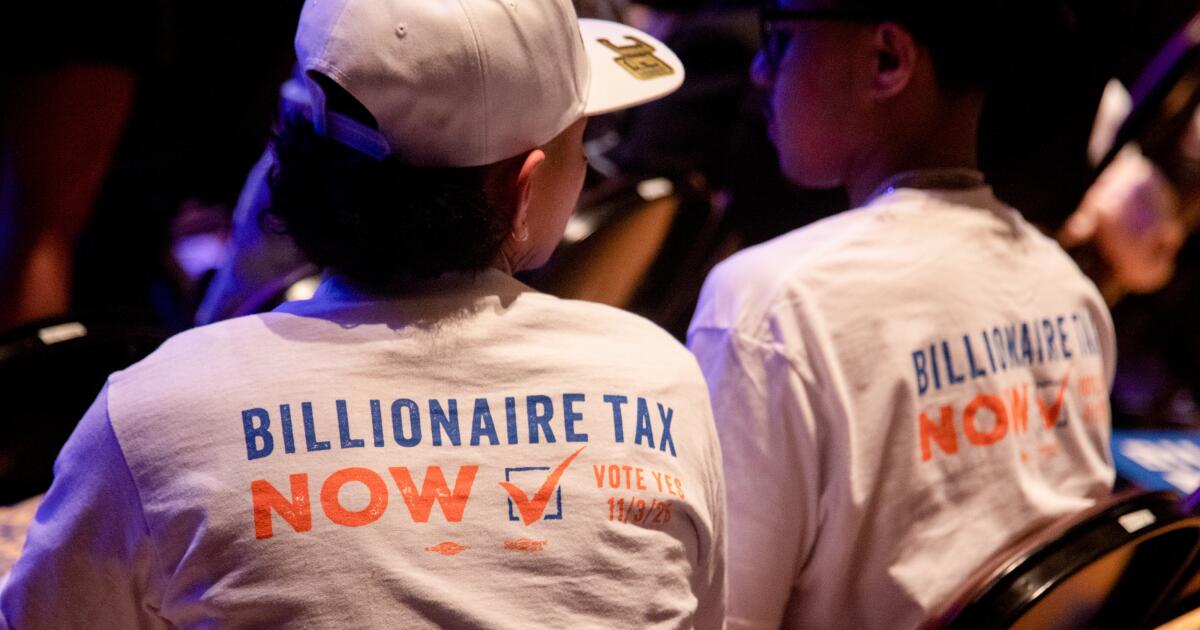
Controversial billionaire tax proposal will appear on November ballot
-
 Sports41 minutes ago
Shohei Ohtani is the first Dodger to be named 2026 All-Star
-

 World51 minutes ago
Who will control Africa’s AI infrastructure and at what cost
-
 News1 hour ago
The Supreme Court says the U.S. can turn away asylum seekers at the border

