
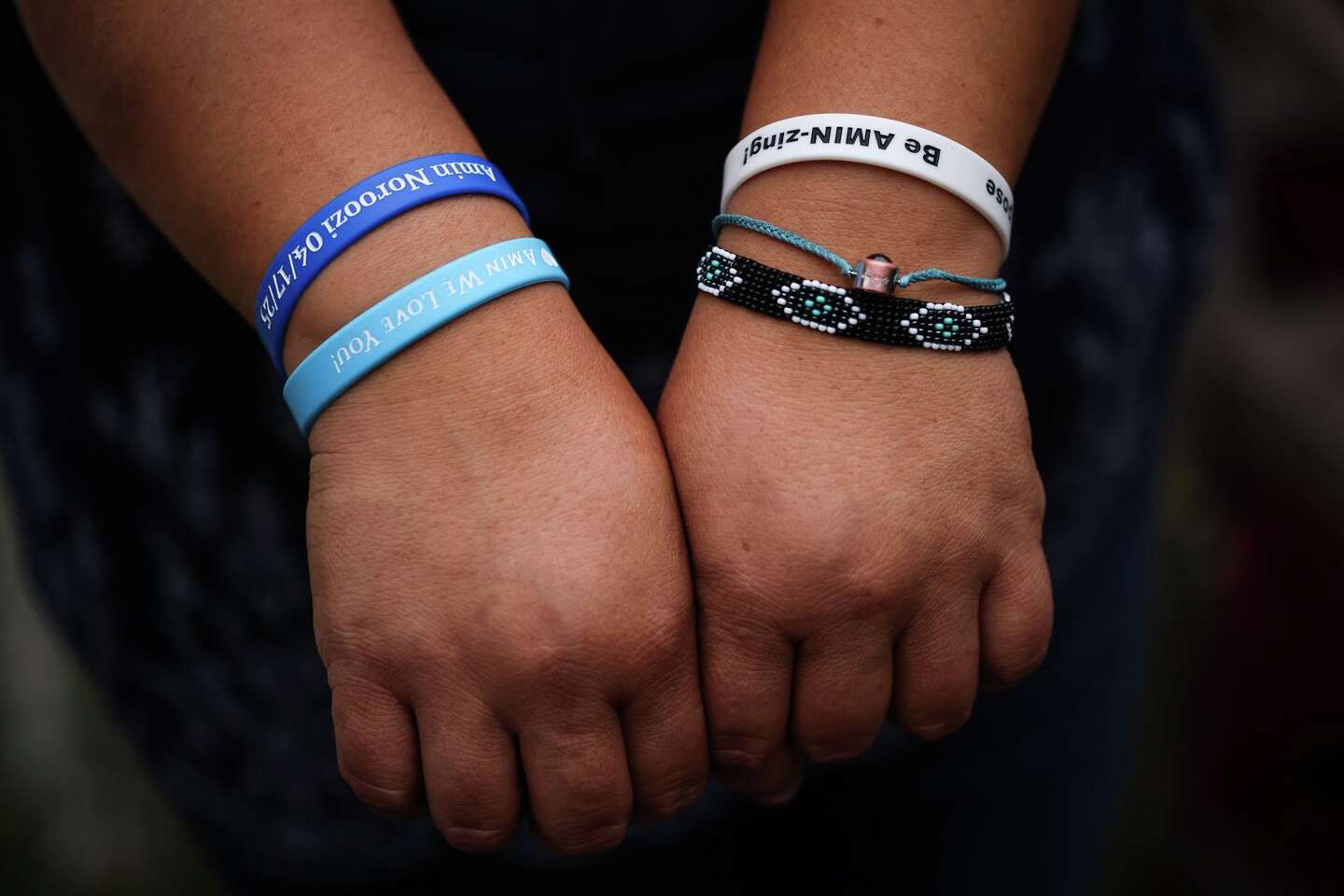
The helicopter carrying Amin Noroozi landed at John Muir Medical Center in Walnut Creek less than an hour after the 17-year-old broke his neck while swimming in the ocean.
San Francisco, CA
Bay Area teen survived a broken neck after swim accident. His family says the hospital care cost him his life


Payman and Ofelia Noroozi, right, pose for a portrait as they hold an image of their son, Amin, at their home in Lafayette, Calif., on Tuesday, Sept. 30, 2025. Amin was paralyzed while swimming in the ocean with his girlfriend at Stinson Beach and died days later.
Amin, a varsity football player, track and field athlete and wrestler at Acalanes High School, had lost feeling below his chest. But after an emergency surgery to stabilize his spine on April 13, his parents and younger sister said he moved a finger, and indicated he could sense a touch on his leg.
Although it was unclear whether Amin would walk again, doctors told his parents, Ofelia and Payman Noroozi, that he was young and strong, which would help with his physical rehabilitation and recovery.
Article continues below this ad
“We were very hopeful,” Ofelia Noroozi told the Chronicle. “Everything seemed pretty OK, like they knew what they were doing.”
Over the next 48 hours, Amin’s temperature soared to 109 degrees, his electrolyte counts spiraled, and his heart rate plummeted. His parents have alleged in a lawsuit filed Thursday in Contra Costa Superior County Court that John Muir doctors failed to manage his increasingly critical condition. Amin died on April 17, just four days after arriving at John Muir.
“Despite the successful surgery, the critical post-surgical care was deficient, disorganized, unsupervised and spun out of control, directly and unnecessarily causing Amin Noroozi’s suffering and death,” according to the lawsuit, which alleges that John Muir should have transferred Amin to UCSF-Benioff Children’s Hospital in Oakland, the nearest top-level pediatric trauma center.
The complaint names John Muir, the neurocritical care physician who treated Amin, Dr. Sandeep Walia, and John Muir’s affiliate partner, Stanford Medicine Children’s Health, which the lawsuit alleges has allowed the community hospital to fraudulently present itself to the public as being capable of treating highly complex medical conditions.
Article continues below this ad
John Muir declined to comment on specific allegations or details of Amin’s care, citing the pending litigation and patient privacy requirements.
“We extend our deepest sympathies to the family and loved ones of Mr. Noroozi,” the hospital said in a statement. “John Muir Health is a nationally recognized provider that treats complex, high-acuity cases using evidence-based protocols and multidisciplinary teams, and when appropriate we coordinate transfers through established regional networks.”
The hospital said its partnership with Stanford improves access to subspecialty expertise and maintains its high-quality care.
“We stand behind the professionalism and dedication of our physicians, nurses, and staff, and we remain focused on patient safety, quality, and continuous improvement,” John Muir said.
Stanford Medicine Children’s Health and Dr. Sandeep Walia, the neurocritical care physician who treated Amin, did not immediately respond to requests for comment.
Article continues below this ad
In 2015, John Muir partnered with Stanford Medicine Children’s Health to open a Pediatric Intensive Care Unit, or PICU, for critically ill children. Leaders of both hospital systems said at the time that the alliance would allow John Muir to provide top-notch care to children in the East Bay.
Although Amin was not treated in John Muir’s PICU, Ofelia and Payman Noroozi are the latest parents to accuse the community hospital of trading on its partnership with Stanford to take on cases beyond its expertise, leading to potentially preventable deaths.
A 2022 Chronicle investigative series detailed the deaths of four children at John Muir’s PICU, which top medical experts said appeared to reflect the hospital’s low patient volumes and inexperience treating exceptionally sick children. Those children included 2-year-old Ailee Jong, who died in 2019 during a complex liver surgery at John Muir. The hospital approved the procedure — its first-ever pediatric liver resection — despite warnings from staff members that the unit wasn’t prepared.
Ailee’s parents, who have an ongoing lawsuit against the hospital, also allege that it was the Stanford association that reassured them John Muir was capable of treating their daughter. John Muir and the doctors involved in Ailee’s care have denied the allegations. A judge is expected to set a trial date for next year.
Following the Chronicle’s reporting, federal and state health inspectors found John Muir’s PICU had violated regulations, forcing corrections and prompting threats to pull funding and close the unit.
Article continues below this ad
Ofelia and Payman Noroozi, who live in Lafayette, said they knew nothing about this history as emergency medical specialists airlifted Amin to John Muir. Amin had been born there and as Ofelia and Payman researched the surgeon online and spoke to friends, they said the Stanford connection gave them confidence their son would receive excellent care.
“At that point, I was like, we know we have the best people working on him,” said Payman Noroozi. “At no point was there talk of him dying.”

The door to Amin Noroozi’s room at the family home in Lafayette, Calif., on Tuesday, Sept. 30, 2025.
Amin was a rambunctious, outgoing and social child, who showed maturity and skill beyond his youth. He fell in love with scooters at an early age, so the family searched for skate parks in their hometown of Lafayette and across the East Bay. There, Amin would befriend the older kids and eventually built his own scooter from scratch.
Article continues below this ad
Although Amin got good grades, Ofelia recalled that he wasn’t particularly studious, often coming to her for help the night before a school project was due. Ofelia, who was born in Honduras, remembered laughing with Amin last school year as she tried to guide him through a Spanish class presentation, despite his limited Spanish.
“The whole thing was a disaster,” she recalled, “but the two of us had a blast.”
When the family moved to a new house close to Acalanes High in Lafayette, Ofelia and Payman said they became aware of an older neighbor with medical problems. Amin gravitated to him and soon, the neighbor would yell out Amin’s name, and the teen would walk over, helping him set up his television, internet and radio.
Another time, Amin sat next to a woman he found crying on the curb of a local grocery store parking lot and spoke to the stranger for more than an hour, his parents said. She attended Amin’s funeral.
“He never sugar coated anything, he was so authentic,” Ofelia said. “He literally told you the truth in a way that wasn’t hurtful.”
In middle school, he played flag football. By high school, he wore No. 51 and played offensive and defensive line.
“Amin fell in love with football,” Ofelia said. “Not just with football but his teammates and coaches.”
After football season, he joined the track and field team, throwing shotput and discus. And because his father wrestled in high school, he joined the Acalanes team and qualified for the North Coast Section Championship. His father called him a “gentle giant.”

Amin Noroozi, who played football for Acalanes High School, posed with his mother Ofelia. Amin, 17, died in April at John Muir Medical Center in Walnut Creek after being paralyzed in a swimming accident.
The morning of April 13, Amin gave his mother a kiss before leaving with his girlfriend to Stinson Beach, a popular Marin County shoreline Amin had visited many times. That Sunday was a stunning spring day, and a bunch of East Bay high school kids met to hang out and swim.
A half hour after setting up, Amin and his girlfriend Audrey Martin, also an Acalanes High junior at the time, ran into the cold Pacific Ocean for a quick dip, she recalled. As they waded into the salty, grey knee-deep water, a small wave rose. Audrey dove through before it broke.
When she surfaced, Amin was floating face down in the water, she said. Audrey thought he was joking, but when she flipped Amin over he told her he couldn’t feel his legs. Authorities would later say that they believed his head struck a sand bar. Audrey said she screamed for help and teens from Acalanes and nearby Campolindo high schools rushed to pull Amin from the water.

Amin Noroozi with his girlfriend Audrey Martin.
“I was really scared and really nervous,” said Audrey, now 17. “He was an athletic guy and he loved to do stuff. It’s just really scary when someone says they can’t move their limbs.”
A medical helicopter arrived for Amin. Paramedics determined the closest Marin County hospital, a Level 3 trauma center, was inadequate for his severe injuries, the lawsuit alleges. Instead, he was airlifted to John Muir, a Level 2 adult trauma center, bypassing UCSF-Benioff Children’s hospital in Oakland, a Level 1 pediatric trauma center, the highest caliber.
“A community hospital like John Muir does not have the resources to treat complex cases such as Amin’s,” said attorney Dan Horowitz, co-counsel for the Noroozi family. “They should have transferred him 15 miles down the road to UCSF Benioff and he would have survived.”
Amin’s mother was working in the family’s food truck when she got the call.
It was Amin’s number, but his girlfriend was on the other end. Amin was hurt, Ofelia recalled the girl saying. He hurt his neck and couldn’t feel his legs. They raced home.
The phone rang again. This time it was Amin as Audrey held a phone to his ear, his mother recalled.
“Hi Baba,” Ofelia said.
“Hi Mom, I got hurt,” he said. He explained he wasn’t in pain, but he had lost feeling below his chest. Amin’s girlfriend took the cell and told the family to meet them at John Muir.
Payman began calling friends and family. Was John Muir the right place to be?
They all agreed, he recalled, the Walnut Creek facility had topnotch credentials. Online, Payman read how it provided Stanford level care as part of its partnership.
However, the lawsuit claims that John Muir should have transferred Amin upon learning the severity of his injury. They allege John Muir was out of its depth as it did not treat such severe cases on a regular basis like surrounding tertiary hospitals, such as children’s hospitals in Oakland and Palo Alto.
“Calling yourself Stanford does not make you Stanford,” the suit said, referring to John Muir Health as JMH. “Yet JMH has constructed an elaborate, systematic branding scheme designed to create the false impression that patients receiving care at JMH are receiving Stanford-level medical care.”
The X-ray contained bad news, the doctor explained shortly after Amin’s arrival. He had shattered his C-5 vertebrae and damaged his spine. While he could partially move his arms and shoulders, he could not move his hands or anything in his lower body. The doctor said he was paralyzed.
“Excuse me?!” Amin told the doctor, according to his mother. “Tell me again, I don’t think I heard you right.”
“I’m sorry buddy, you are paralyzed from the chest down,” the doctor said.
Amin turned toward Ofelia.
“Mom, I want to cry but I can’t,” Amin told her. “The tears are not coming.”
“Mi amor, I will take you anywhere in the world. I will find a way to get you better,” she said.
Hours after his arrival, nurses wheeled Amin into surgery, where a surgeon removed a portion of his vertebrae and fused three together to stabilize his spine.
“People around us were saying they are the best. They have surgeons from Stanford,” Payman recalled. “Even the nurse was saying this is something that we see all the time. It is nothing that is new to us, so that made me feel better.”
The surgery appeared to be a success.
Still sedated and with tubes preventing him from speaking, Amin wagged his finger after his sister Sahar joked with him that if he didn’t get better soon she’d start driving his BMW. Not long after, a doctor poked Amin’s lower body asking if he could feel her touch his leg. At one spot, Amin nodded yes.
His parents started researching a rehabilitation center in Colorado.

Mementos of Amin Noroozi at the family home in Lafayette, Calif., on Tuesday, Sept. 30, 2025.
A catastrophic neck injury can disrupt the communication between the brain and the body’s autonomic nervous system, which controls involuntary functions like body temperature regulation and blood pressure. Constant monitoring is required. The lawsuit claims John Muir staff fell short in Amin’s post-surgery care.
When Amin suffered cardiovascular instability, the hospital “inappropriately treated” him with the wrong drugs for his condition, the family alleges. It caused his heart to slow, the suit said.
Amin also developed severe hypokalemia, critically low potassium levels that can lead to cardiac arrest. The hospital did little to bring it up, the lawsuit alleges, and when they finally responded, they overcorrected, sending his potassium levels soaring dangerously in the other direction — levels approaching those used by veterinarians for euthanasia, the lawsuit claims.
In addition, the lawsuit claims the hospital failed to diagnose and treat an infection and signs of sepsis. When testing was performed, a protein released into the bloodstream to fight bacterial infections was at such an elevated level it indicated sepsis had been raging for days unchecked, the suit said.
Amin’s fever rose to 109 degrees and remained elevated for more than 12 hours, according to the suit. The hospital only administered an over-the-counter fever reducer, the family alleges.
“Amin was allowed to overheat so that his entire metabolic system was off the charts,” Horowitz said. “No parent would let their child run a 109 fever without massive intervention, why did John Muir basically sit back and watch?”
The hospital indicated it used cooling blankets at one point, according to the suit, but the hospital failed to use one of its more powerful Arctic Sun cooling devices designed to control hyperthermia in critically ill patients until moments before his heart stopped.

Payman Noroozi discussing his son Amin at their home in Lafayette, Calif., on Tuesday, Sept. 30, 2025.
After returning from the cafeteria on the afternoon of April 17, Payman found Amin’s room in chaos. Multiple doctors and nurses took turns with chest compressions on his son.
Daryoosh Khashayar, a family friend who is also representing Ofelia and Payman as an attorney, walked in expecting to greet Amin. Instead, he heard Payman screaming and people yelling “Code Blue!”
Ofelia and Sahar arrived soon after, holding Amin’s hands for more than 20 minutes as nurses performed CPR.
Doctors declared Amin dead at 3:41 p.m.
Payman said he asked a doctor what happened and he repeatedly said: “I don’t know.” Ofelia, Payman and Sahar stayed in the room with Amin for hours, as word spread in the lobby where more than 100 friends, as well as Amin’s coaches, had gathered.
The community raised almost $200,000 for the family with friends, family and rival teams donating money and sending condolences. Now, days after what would have been Amin’s final Homecoming dance, the family said it wants accountability.
“We just don’t want it to happen again,” Ofelia said. “We cannot bring my son back, we cannot take away the pain. We lost someone extremely valuable to this world, he had his whole life ahead of him and it got cut short because of mistakes that could have been prevented.”



What would happen if you asked an artificial intelligence program to build and run a store? The world is about to find out.
Shoppers in San Francisco now have access to a store built, developed and run almost entirely by an AI bot.
The Andon Market, located at the corner of Union and Webster streets in San Francisco’s Cow Hollow neighborhood, is run by a bot called Luna, who also made the decision to hire a human employee, Felix Johnson.
“Luna put out an ad on Indeed, and I answered it and we talked via Zoom,” Johnson said.
The bot also picked the merchandise to sell, according to Andon Labs, Luna’s creators.
When asked why AI should run store, Luna replied to an NBC Bay Area reporter “As an AI, I can operate at superhuman speed to make sure everything is proactively managed.”
Anyone who wants to purchase an item from the store, shoppers pick up a phone to talk to Luna, who then charges them for the purchase.

FILE – OpenAI CEO Sam Altman speaks during the OpenAI DevDay event on Nov. 6, 2023, in San Francisco, California. (Photo by Justin Sullivan/Getty Images)
SAN FRANCISCO – San Francisco police are investigating a fire caused by a Molotov cocktail overnight Friday at the home of OpenAI CEO Sam Altman, authorities and the company confirmed.
According to OpenAI, the suspect also made threats to the company’s San Francisco headquarters.
Fire at OpenAI CEO Sam Altman’s home caused by incendiary device
What we know:
Police say firefighters were called to the home near Jones and Leavenworth streets just before 4 a.m. Friday for a fire.
The fire occurred at an exterior gate of the home.
According to SFPD, the fire had “self-extinguished” by the time they had arrived, though officers found evidence of an incendiary device.
It’s unclear if Altman was home at the time.
“We deeply appreciate how quickly SFPD responded and the support from the city in helping keep our employees safe,” OpenAI said in a statement.
Police say the cause of the fire is now under investigation.
No injuries were reported.
Altman purchased his San Francisco home in 2020, according to the San Francisco Standard.
Threat to burn OpenAI headquarters in San Francisco
Dig deeper:
After throwing the Molotov cocktail at the home, police say the suspect then fled on foot.
A short while later, just after 5 a.m., officers responded to a business on the 1400 block of 3rd street, where a suspect was threatening to burn down the building.
Police say they identified the 3rd Street suspect as the same person who was at the home the hour before.
The suspect, only identified as a 20-year-old man, was then taken into custody.
Police say charges are still pending.
OpenAI is headquartered in San Francisco’s Mission Bay neighborhood at 1455 3rd Street.

OpenAI amends Pentagon deal, CEO Sam Altman says
OpenAI is revising its contract with the Pentagon following criticism that the agreement could enable mass surveillance of Americans.
According to Axios, CEO Sam Altman sought to add explicit protections against monitoring Americans.
The Source: San Francisco Police Department and OpenAI

I still laugh at being called the “bad circuit party guy.” It was a moment three years ago when I had just become editor of The Bold Italic, and it must have come from someone who knew me—or knew of me—around 2015 to 2019.
Back then, I was in my early 30s and only recently active in the San Francisco LGBTQ+ community. I’m not sure I ever went to that specific kind of party, but I did drink; I kept an aggressive social calendar, and I organized events. A series of them at small bars—Q Bar, the Lone Star Saloon, SF Eagle, and others—I meant as a love letter to Comfort & Joy’s Pride party, Afterglow. (Maybe that’s what my critic meant.) And equally as a love letter to the drag queen, Juanita More.
At the time, I loved Ms. More’s Booty Call Wednesdays series, specifically for the amazing photography captured by one Cabure Bonugli. When my peer group debuted Glow at SF Eagle, Cabure was the first photographer we hired. I invested considerably on photo booths at every subsequent event. Glow also wasn’t my main fare; I mostly hosted weekly game nights where I took the photos.


I belonged to a group of misfit nerds who commonly shared stories of loneliness in the San Francisco LGBTQ+ community. This is a topic I distinctly remember a pair of bar owners discussing with me—that our group was a rare one within this age bracket to coalesce on the queer scene at that point. Other popular choices included a set of sex parties, gay kickball leagues, and a series of wine nights that featured the sort of Grindr eye candy with white-collar jobs and Fitness SF memberships.

Lately I’ve been expanding my horizons and going to more events. In reviewing this story, my partner asked what my argument was. I don’t have one. I might have just wanted to reset the narrative on my nonexistent circuit party habits.
But in writing this feature, I think the most honest thing I concluded about the San Francisco dance party scene in 2026 is that it resists a thesis. So do I.
A born-again circuit queen
I only started going to dance parties a bit more in the 2020s. I shimmied in tulle at Trixie Mattel’s Solid Pink Disco in 2024. In the last two weeks I went to a Cave Rave at the old Sutro bathhouse, and then Tinzo + Jojo made an appearance at 1015 Folsom. I found the latter two parties lacking something I can’t put my tongue on. Probably molly.


The cave rave felt particularly young and not well managed; and in a way, that was almost charming. I just had nothing in common with a group of Gen Z that, as I wrote, clutched NÜTRL and Bud Light while lots of weed wafted around. Both this party and the one at 1015 felt, ahem, quite heterosexual. I think of San Francisco as the queer heart of the planet, so I get a strong vibe mismatch attending parties like these.
“We’re seeing a common thread,” my lesbian friend told me. “The problem is straight guys.”

She and I had just come from the Tinzo + Jojo party, where a man almost punched me after he had been hogging a small space in front of the DJs. Behind us, another man was drunk to the point of falling over on everyone, happily, until my partner turned around and said, “Do you mind?”
“Yes we do mind!” one of the women with him said before carting him off. Later when we passed the group upstairs, the man was dry humping the same women against a railing. “He’s going to fuck them right off the balcony,” my friend said.
The gay/straight dichotomy

My friend’s read was specific to that night, but the dynamic she described isn’t new.
A few years ago, Vice published a piece about queerbaiting nightlife, describing venues and promoters who borrow the aesthetics of queerness to draw crowds that end up being overwhelmingly straight. A DJ named Meduusa put it plainly: in the past, straight people didn’t really want to party with queer people. Now they do, or at least they want the vibe.
“Our visibility has brought us to a place where people see we’re cool and influencing the culture,” she said, “and they want to be cool and in the know, too.”


Katherine Conrad, a local DJ in San Francisco, offered a more hopeful read.
“There’s definitely a movement toward events that are really queer, sapphic, that everyone can go to,” she told me. “You can tell that they are spaces that invite people to express themselves freely.”
Conrad is co-president of FLUX SF, which hosts events for the trans and nonbinary community, and she goes to a lot of music festivals. On raving, she noted that if the performer is too mainstream, you get a crowd that’s not even that into the music, and they don’t know how to behave.
“They don’t maintain space or know how to be polite,” she said. “They barge through people.”
The substance use question

I struggle in other ways. I quit drinking seven years ago, and now I notice when the DJ is fine but not transcendent. I notice that the room is too hot and that someone near me smells like a distillery. I notice that nobody is having the same experience, because the chemical that would synchronize them is doing different things to different nervous systems, and without it, we’re just a bunch of strangers standing in the dark.
I don’t miss drinking at parties; what I miss is the permission that drinking gave me to not care whether a party was good. And for those around me, it isn’t alcohol that motivates them anyway; the chemistry of the room is literally changing.

Cocaine use nearly doubled and ketamine nearly tripled in the U.S. from 2016 to 2019, while MDMA held flat. The pattern continued through 2023: ketamine kept climbing, molly didn’t. The rave drugs of the moment aren’t the ones that make you love everyone; they’re the ones that numb you out or wire you up.
“And how the fuck are you partying until 5 a.m. and just drinking?” one friend told me. They noted that most people appear to do some kind of drug at parties, but in SF it’s never one specific thing.
“It’s just common. It enhances the experience,” they said. “Would I go to a rave completely sober? Probably not.”
Sober sisters

Not true for Connie Chen, a new influencer I found in San Francisco through her Instagram, Curious Connie. She’s amassed nearly 11,000 followers in just three months from promoting day raves and other sober-leaning events.
“In the past, I think a fun night for people meant getting really drunk and going to a show,” she told me. “So I thought I should like it too, but then I didn’t.”
Chen stopped drinking about two years ago after noticing that every drink cost her roughly an hour of sleep. But quitting didn’t mean staying home. Through San Francisco’s Burning Man scene, she discovered a network of house parties, day raves, and creative gatherings that run on Partiful invites rather than bottle service.

The day events, she told me, share a quality that my friend and I noticed was missing:
“There’s no aggression. People are sober, it’s during the day, everyone is really friendly,” Chen said.
And the big venues? “Nobody knows me. It feels kind of hetero. Kind of aggro. It’s already late and I don’t like that.”


The bigger picture, and the rise of the third space
Conrad described a queer scene that’s thriving in its own rooms. Chen found a sober world that was invisible to her for eight years. My anonymous friend can’t imagine raving without drugs. All of this is true at the same time, on the same weekends, in the same seven-by-seven miles.
San Francisco has always run on parallel tracks. The tourist San Francisco and the local San Francisco. The tech San Francisco and the artist San Francisco. The sober San Francisco and the one where someone you just met is offering you a bump in a bathroom at midnight. These aren’t contradictions. They’re just the city.
Dance parties here are the same way. The experience you have depends entirely on which door you walk through. What stays with me, though, is something Chen said about her first eight years in the city. She was here the whole time along with the house parties, day raves and creative gatherings. She just didn’t know.

Partiful added 2 million new users in the first quarter of 2025 alone, with monthly active users up 400 percent year over year. The majority of users are under 30, and its pitch is literally helping people plan “intimate dinner parties, weekend house parties, or warehouse raves” to cultivate real-world relationships.
For San Francisco, this is a puzzle piece wedged between ambition and economics. A report from the National Independent Venue Association released this year found that the city’s independent stages generate $152 million annually in off-site economic impact, but only 36 percent of them were profitable in 2024. The rooms are producing enormous value for the city while struggling to survive inside it.
Meanwhile, the parties that people actually want to go to are increasingly the ones that don’t need a room at all.

“As you get older, it’s not as easy to make friends,” said Stuart Schuffman, the San Francisco writer known as Broke-Ass Stuart, who this month is launching an algorithmically-matched dinner club. “This takes the pressure off of having to walk into a club or join a class to meet people.”
Dinner clubs are having a moment, much the same we’ve seen a proliferation of outdoor dance parties. Daybreaker, for example, is a sober morning dance series that began in Brooklyn in 2013. It now operates in San Francisco out of venues like the Ferry Building and Thrive City at Chase Center—on the premise of no booze, no VIP or bottle service.
For its part, the city itself has been loosening the screws. In 2024, Mayor Breed waived entertainment permit fees for outdoor music. San Francisco also became the first city in California to create “entertainment zones”, allowing bars to sell drinks for outdoor consumption during events. And that gave us ongoing moments like Castro Night Market (and a spate of others), and Downtown First Thursdays.


I’m not making friends at these parties, but I’m not sure I was supposed to. The dance party scene in San Francisco in 2026 is fractured and alive, and probably happening somewhere you haven’t been invited yet.
Under all the bass, and in between the ketamine and the Partiful links and the faux fur, is the same question the SF dance scene has always asked: Do you want to be in this room with these people? If the answer is no, that’s okay—there’s always another room to dance in.
Saul Sugarman is editor-in-chief and owner of The Bold Italic.
The Bold Italic is a not-for-profit media organization, and we publish first-person perspectives about San Francisco and the Bay Area. We operate under a fiscal sponsorship of a 501(c)(3).
You can become a paid subscriber. Or donate. Or learn more about us.
Many of these photos in this story were proudly commissioned and paid for in prior stories for The Bold Italic. The cover photo of The Stud reopening was taken by Gooch.
This month we are sponsoring LGBT Center Soirée 2026. This isn’t a paid gig; but they promised to sing The Bold Italic‘s praises on their party brochures and messaging, so long as we did the same. I have gone to this party twice before. It’s not as fancy as, say, Art Bash or SF Ballet’s opening gala, but—much like Hunky Jesus earlier this month—it is a great time to see many notable faces in the LGBTQ+ community. And a good time to reuse yester-year’s Pride dress. Sister Roma and Honey Mahogany aggressively went for those fundraising dollars at the 2024 dinner. And I loved the drag performances that year.
LGBT Center Soiree party details: Soirée 2026 – SF LGBT Center
As we celebrate the SF LGBT Center’s 24 incredible years of service to our community, please join us for an evening filled with reunion and community brilliance. SF LGBT Center’s annual gala radiates resilience
The soirée on 4/20 raised $360,000; Hosted by Sister Roma and Honey Mahogany with an after party setlist by Juanita More.
📅 Saturday, April 18, 2026
🕑 5:30 PM
📍City View at Metreon
🏠 135 4th St, San Francisco, CA 94103
Want even more events?
I’ve got a new events page at events.thebolditalic.com – and I’ve set aside all my picks for April at the top of the list.
What’s Happening in SF — The Bold Italic
The Bold Italic’s guide to the greatest events in San Francisco and the Bay Area.
And in full disclosure
Not to totally dismiss an untrue narrative, lol: I did go to an occasional dance party in the 2010s. At small venues. For example, I loved Lindsay Slowhands’ Hell’a Tight.
Nightlife party ‘Hell’a Tight’ enters new era at SF Oasis The long-running LGBTQ+ drag show and dance party by Lindsay Slowhands begins a new chapter after officially winding down at Underground SF.
I also made an occasional appearance at Bootie. (And its organizer, Adriana Roberts, is a freelance writer for The Bold Italic.)
20 years in, ‘Bootie’ is still mixing tracks for ‘girls, gays, and theys’
But straight men are welcome, too. Their April 6th party at Cat Club will celebrate “the best mashups in the world ever.”
Photos from Bootie’s 20th Anniversary
I loved that people came for good music and laughs, not to stand and pose, cruise, or get blackout drunk. The vibe was pure happiness.
I never wrote about D’Arcy Drollinger’s Sexitude, but I should do so eventually. In this dance group, I’ve performed onstage with her at Pride. We’ve shared moments at galas. SF Oasis was, in many ways, my introduction to San Francisco LGBTQ+ nightlife.
High noon at the Oasis D’Arcy Drollinger’s busy at the helm of the SoMa drag club and other ventures, too
The legacy of SF Oasis will live on, following its successful gala
More than $200,000 flooded in support of the SoMa drag club and its quest to pay artists fair wages.


New Mexico6 minutes ago
Strong to severe storms possible in New Mexico today

North Carolina12 minutes ago
How North Carolina Developed Its 2026 NFL Draft Class

North Dakota18 minutes ago
Man arrested in North Dakota six months after Durham County murder

Ohio24 minutes ago
Police responded to a report of a ‘domestic dispute’ at Ohio governor candidate’s home in 2019

Oklahoma30 minutes ago
TIMELINE: Rounds of storms in Oklahoma continue throughout weekend

Florida1 year ago
Florida High School Football Rankings: Top 25 teams – Oct. 21

Oregon2 years ago
How old is Bo Nix? What to know about Oregon quarterback ahead of 2024 NFL Draft

Connecticut2 years ago
Cleary's 21 help Le Moyne down Central Connecticut State 69-64 in OT

Virginia2 years ago
99th annual Pony Swim held in Virginia

Indiana2 years ago
Indiana Members Credit Union announced as new anchor tenant at Bottleworks District

Politics4 hours ago
Trump adversary running for Senate borrows his filibuster playbook

World5 hours ago
Russian propaganda unit targets Hungary’s elections

News5 hours ago
WATCH: Artemis II astronauts splash down on Earth

Politics16 hours ago
Swalwell’s former female staffer drops bombshell allegations of sexual assault, exposing himself: report

World17 hours ago
NASA’s Artemis II prepares for splashdown on Earth
-

 Atlanta, GA6 days ago
1 teenage girl killed, another injured in shooting at Piedmont Park, police say
-

 Education1 week ago
Video: Toy Testing with a Discerning Bodega Cat
-

 Movie Reviews1 week ago
Vaazha 2 first half review: Hashir anchors a lively, chaos-filled teen tale
-

 Georgia4 days ago
Georgia House Special Runoff Election 2026 Live Results
-

 Pennsylvania5 days ago
Parents charged after toddler injured by wolf at Pennsylvania zoo
-

 Arkansas22 hours ago
Arkansas TV meteorologist Melinda Mayo retires after nearly four decades on air
-
 Milwaukee, WI5 days ago
Potawatomi Casino Hotel evacuated after fire breaks out in rooftop HVAC system
-
 Entertainment1 week ago
Inside Ye’s first comeback show at SoFi Stadium