San Diego, CA
Opinion: Disengaged voters will decide the 2024 presidential election


On Tuesday, the presidential election finally takes place. When it comes to what led to the outcome, a case can be made that political pundits on the left and right have got it all wrong. That’s because their expertise makes them uniquely unqualified to understand disengaged voters. Political pundits are like sportswriters trying to fathom why some people pay no attention to the Super Bowl. Yet disengaged voters will likely determine the winner. Why? Because these are the only voters still up for grabs.
Engaged voters have already decided who they’ll vote for. Some decided based on ideology (liberal or conservative). Others decided based on group interest (labor status, ethnicity, gender, religion). Some decided based on how they answered the question: Are you better or worse off than you were four years ago?
So who are the disengaged? These are undecided potential voters who just don’t care about politics. As a result, they process information about campaigns in ways that are unfathomable to those fully engaged.
In July, YouGov reported crunched polling numbers from a survey to identify characteristics of “disengaged” voters. The disengaged consume little political news; they are largely ignorant of political issues. They are less likely than others to actually vote. They tend to be “on average younger, more likely to be women, more likely to be Black or Hispanic, less educated, and have a lower household income than the average engaged American voter.”
Scientific models suggest that people take in information and make decisions using different mental processes. To varying degrees, engaged voters process information systematically. They connect issues together through mental links. Because of these intricate connections, the engaged decide early and are unlikely to change their minds. Changing their minds on one issue means changing their minds on others.
The disengaged take a different approach. They do what scientists call “heuristic” processing. They rely on peripheral cues that have very little to do with issues and candidate qualifications. For example, physical appearance of candidates can sway the disengaged. Research shows that people tend to like others who are physically attractive. If one doesn’t care much about politics, then appearance could serve as a basis for choosing. Using stereotypic notions of “good looks,” John F. Kennedy was better looking than Richard Nixon. Kamala Harris is better looking than Donald Trump.
Research dating from the 1940s shows that many disengaged voters depend on more engaged voters for advice (two-step flow). They also tend to take advice from people they admire, regardless of political expertise.
Arguably, this is why Taylor Swift’s endorsement of Harris could prove so impactful. After the Sept. 10 debate, the singer posted her endorsement on Instagram. According to Axios, Swift has 283 million Instagram followers. The Instagram post inspired 338,000 Swifties to visit Vote.gov, the federal voter registration website, during the 15 hours after her post.
One can only speculate how many Swifties are young women that YouGov identified as politically disengaged. Whether Swifties actually registered and will vote is also subject to speculation. Historically, celebrity endorsements don’t seem to improve a candidate’s chances. Ask Hillary Clinton. Normally, debates don’t have much impact either. But this is no normal campaign. Ask Joe Biden. In a close race, a percentage point boost from the disengaged in swing states could decide the election outcome.
Dozier, Ph.D., is professor emeritus in the School of Journalism and Media Studies at San Diego State University. He lives in Encinitas.


A California yoga instructor known as “Namasteve” is leveling up his warrior pose as he battles San Diego’s efforts to end his popular beachfront classes.
Steven Hubbard recently filed his third lawsuit over a 2024 city ordinance that prohibits teaching yoga to four or more people at local beaches and parks.
Hubbard, who’s been teaching yoga by the Pacific Ocean shoreline for 17 years, contends the local law violates his right to free speech because he doesn’t charge his students and instead accepts voluntary donations.
“It does set a dangerous precedent for government to be passing bans on specific types of speech that, for whatever reason, it doesn’t like,” Hubbard’s lawyer, Bryan Pease, told The Independent. “We don’t know why they decided yoga is something they want to target. They’ve never explained it, but it is concerning from a First Amendment perspective.”
Neither the San Diego mayor’s office nor the city attorney’s office replied to inquiries from The Independent.

The yoga ban is buried in a subsection of the San Diego Municipal Code that defines the “services” that are regulated at beaches and parks.
“Examples include massage, yoga, dog training, fitness classes, equipment rental, and staging for picnics, bonfires or other activities,” it says, marking the only time yoga is mentioned.
At the time the ordinance was introduced, Pease said, it was “put on the city council agenda as a sidewalk vending ordinance.”
“There was no public notice that they would be targeting the free and donation-based teaching of yoga in parks and beaches,” the lawyer said. “ I don’t even know that the city council members themselves knew what they were voting on.”
Videos posted on Hubbard’s “Namasteve Yoga” page on YouTube show scores of students following his instructions as they face the water in the Southern California sunshine.
San Diego park rangers issued Hubbard a total of 10 citations under the 2024 law, Pease said.
Some were for leading classes from his backyard while livestreaming on YouTube as students apparently watched on their devices by the beach, Pease said.
After Hubbard first challenged the 2024 ordinance in federal court, the judge overseeing the case denied a motion to block its enforcement, saying the First Amendment didn’t protect the teaching of yoga.
But that decision was reversed last year by the U.S. Court of Appeals for the Ninth Circuit, which ruled that Hubbard and fellow yoga teacher Amy Baack were “likely to succeed” in challenging the legality of San Diego’s public yoga ban.

“Teaching yoga is protected speech. The City’s prohibition on teaching yoga in shoreline parks is content-based and fails strict scrutiny,” according to the unanimous decision written by U.S. Circuit Judge Holly Thomas.
Hubbard has also filed two lawsuits in state court, with the most recent on June 22. It was first reported by the Times of San Diego.
It seeks unspecified damages for three tickets he received in May 2025, all of which charged him with giving a lecture without a permit.
The accusation came despite a ruling in the federal case that said requiring a permit to give a lecture “substantially overburdens” the right to free speech, according to Hubbard’s lawsuit.
All the citations issued against Hubbard were dismissed in April when the city attorney’s office didn’t appear in court to prosecute, Pease said.
Meanwhile, city lawyers have issued a series of subpoenas that seek “detailed GPS tracking information, all social media posts from all time and complete financial records for all financial transactions” involving Hubbard and Baack, Pease said.
Pease characterized the move as “pure harassment,” saying it seemed “calculated to have a chilling effect on people’s participation if they think their personal information is going to be obtained through these channels.”
“All that the city attorney has said to me about it is that it’s to prove that this is commercial activity, and they’re going to hire a financial expert to go through all these records,” he said.
A hearing on a motion to quash the subpoenas is scheduled for July 17 in state court, and pretrial discovery in the federal case is pending, with a deadline of August 28.
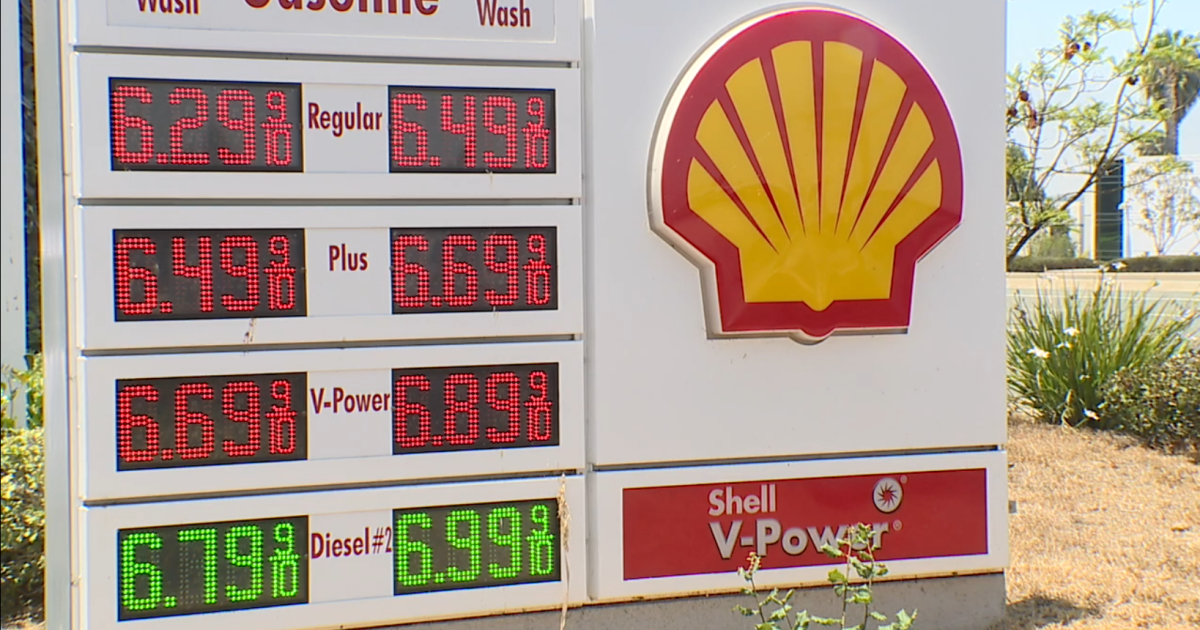
SAN DIEGO (CNS) — The average price of a gallon of self-serve regular gasoline in San Diego County dropped for the 44th time in 45 days today, falling eight-tenths of a cent to $5.42, its lowest amount since March 12. The average price has fallen 74.9 cents over the past 45 days, including eight-tenths of a cent Saturday, according to figures from the AAA and Oil Price Information Service. It is 9.8 cents less than one week ago and 53.2 cents less than one month ago, but 80 cents more than one year ago. The national average price dropped for the 43rd time in 45 days, falling six-tenths of a cent to $3.804, its lowest amount since March 17.
It has decreased 76 cents over the past 45 days, including 1.3 cents Saturday. The national average price is 6.3 cents less than one week ago and 41.6 cents less than one month ago, but 65.6 cents more than one year ago. “Crude oil prices have fallen to their lowest levels in months, dropping to the $60 a barrel range,” the AAA said Thursday. “Overall, gas prices remain the highest they’ve been in 4 years, but the downward trend since late May is welcome news during the busy summer driving season.”
Copyright 2026, City News Service, Inc.

-

 New York35 minutes ago
How a Museum Security Guard and Artist Lives on $51,000 in Parkchester
-

 Los Angeles, Ca38 minutes ago
Heat advisory issued as Southern California temps near triple digits this week
-

 Detroit, MI58 minutes ago
Detroit Battery Safety Provider Reaches to the Skies with Med Hawk
-

 San Francisco, CA1 hour ago
A Locals-Approved Modern Guide to Fisherman’s Wharf: Seafood, Beer Gardens + Iconic Bay Views
-

 Dallas, TX1 hour ago
New glitzy Houston steakhouse Juliet opens next to Delilah this summer
-

 Miami, FL1 hour ago
Allapattah man faces charges over armed robbery after crash in Miami’s Liberty City
-

 Boston, MA1 hour ago
Somehow, This is a Fitting, Confusing End to Jaylen Brown’s Boston Celtics Career
-

 Denver, CO1 hour ago
Denver Broncos 2026 schedule

