San Diego, CA
Head to the beach at night: Enchanting neon-blue light is flashing in the surf from bioluminescent plankton


The night-time surf at many San Diego County beaches is once again flashing pretty neon-blue light that stems from plankton blooms that have developed in some coastal areas.
In recent days, beach-goers have reported seeing the bioluminescence at Torrey Pines, La Jolla Shores, Carlsbad and Mission Bay.
It’s not unusual for this to happen at various beaches several times a year.
The phenomenon is caused by single-cell organisms in plankton blooms that produce a chemical reaction that generates fleeting flashes of light, especially in breaking surf and around pier pilings.
It is common for surfers to wade into the water at night and see their boards light up as they catch a wave. Bioluminesence typically lasts for a few days but periodically occurs for weeks on end when the plankton bloom is large.


LOS ANGELES — Adrian Morejón made the pitch he was supposed to and got the result he was supposed to.
But that pitch might have begun the Padres’ final minute of relevance in 2026.
Because 58 seconds later, as Teoscar Hernández’s grand slam cleared the wall in left-center field, Dodger Stadium was literally rocking and the Padres were clearly shaken.
“Games like this, games like the last six nights, it’s not great,” second baseman Jake Cronenworth said late Friday night. “We’ve got to somehow turn it around, and me not making that play doesn’t help.”
He referred to a 4-3 loss to the Dodgers that ran the Padres’ losing streak to seven games, and he referred to his booting a double-play grounder in the seventh inning that immediately preceded Hernández’s homer.
“I lost this game,” Cronenworth said. “Simple as that.”
It was a bitter ending to a night that showed the potential of the Padres’ No.1 starter and their offense to keep the team contending.
Michael King worked six scoreless innings in the most economical way, and the Padres built a 3-0 lead by scoring in the first, fourth and sixth innings against Shohei Ohtani.
Then King’s command faltered at the start of the seventh inning, and the Padres’ season continued to slip away with it.
Two innings later, they were officially a sub-.500 team.
The Padres did not reach base against Edgardo Henriquez in the eighth or Tanner Scott in the ninth, meekly finishing off their 26th loss in the 40 games since they beat the Dodgers on May 18 to move into first place in the National League West.
The Padres were 29-18 at that point. They are now 43-44 and sit four games out of the final NL wild-card spot.
Their five losses on this road trip included a 23-3 drubbing Wednesday in Chicago and a 12-7 loss Thursday in a game they led 6-0 after two innings.
“They’re testing how we can handle the failures of the season and if we can come back,” manager Craig Stammen said of the recent results. “And I like the attitude of this team. I think we will come back. Right now, it stinks. It feels very awful. It’s a gut punch, but we’ve got to bounce back tomorrow and play our best game.”
That was what especially stung Friday. They played well.
King’s outing was the first in seven games by a Padres starting pitcher that lasted longer than 4⅔ innings. It was the first time in 10 games that a Padres starter made it through six innings.
But he began the seventh by walking Mookie Betts and yielding a soft single to Max Muncy.
Morejón was brought in to face Kyle Tucker and got him to hit what seemed to be a double-play grounder directly at Cronenworth, who hurried a bit too much and had the ball come out of his glove as he went to transfer it to his hand.
“Morejón coming into the game, I know a groundball is coming to me,” Cronenworth said. “I was anticipating it the whole time he walking in from the bullpen and I didn’t make the play and lost the game for us.”
That and the slider Morejón left thigh high and over the middle of the plate.
“Obviously, it’s frustrating,” Morejón said through interpreter Jorge Merlos. “You’re talking about a bullpen that everybody relies on, and unfortunately today it was my day that it hit me. We’re going through a rough spot. And it just feels even more difficult, not just for myself but especially the outing that Michael had out there and the way he was throwing. They call on me for those situations that I’ll be able to get out of it, and unfortunately it didn’t happen tonight.”
The normally loquacious and candid King was in no mood to discuss the outing in depth. For the first time in his three seasons with the Padres, his postgame answers were clipped and terse.
His pitches were doing what he wanted and going where he wanted for six innings, perhaps on par with his best outings of the season.
“Fine,” he said of his outing. “Didn’t win the game.”
While King frequently is of the opinion he should be left in a game, it seemed readily apparent he did not think he should have been taken out after 75 pitches.
“I wanted the next batter,” he said.
Stammen had other plans. He decided to try to ride Morejón and closer Mason Miller for the fional nine outs.
“Dominated,” Stammen said of King. “Great outing by him. One of his best. He had a tough one the last one, and he bounced back with one of his better ones. He knew we needed it, and he gave it to us. We just weren’t able to finish it off for him.
“It always makes it tougher when you have a lead late in the game and aren’t able to hold it and finish the game. He was very efficient with his pitch count and probably had more in the tank, but at that point we felt really good about going to our bullpen and using one of our best guys to get some of their left-handed hitters.”
Instead, after Morejón got through the seventh, Bradgley Rodriguez worked the seventh.
Where the Padres’ offense failed at the end, getting runners on first and second with one out in the seventh before making the final eighth outs in succession, it started well against Ohtani, who shut them out over five innings last month and entered the game with a 1.58 ERA.
The Padres scored the first run Ohtani surrendered in the first inning this season when Fernando Tatis Jr. and Cronenworth walked to start the game and Gavin Sheets drove in Tatis with a one-out single.
That hit also got Cronenworth to third, where he was stranded when Ty France and Jackson Merrill struck out.
All three pitches to Merrill were fastballs — the first and last at 100 mph, the middle one at 101.
Ohtani threw 29 pitches in the first and then retired the next eight batters on 34 pitches before Merrill came up with two outs in the fourth and homered to center field on a 100 mph fastball — on a 2-0 pitch that immediately followed Merrill winning an ABS challenge.
The Padres scored in the sixth on a two-out single by Merrill and Xander Bogaerts’ double.
King got through MLB’s most dangerous lineup in 30 pitches and without anyone reaching base before allowing his first hit — a two-out single by Freddie Freeman — in an eight-pitch fourth inning.
Against the Dodgers five days earlier at Petco Park, King navigated four innings having allowed a run on two hits and thrown strikes on nearly three-quarters of his 61 pitches. Then, in his words, he “fully lost it.”
He retired one of the six batters he faced, walked three, hit one and allowed a single as the Dodgers scored three runs and ran him from the game.
On Friday, King struck out two and added just 12 pitches in a 1-2-3 fifth inning and was at 68 pitches after stranding runners at first and second in the sixth.
Then came the end, with the Padres’ best starter unable to get an out and one of their best fielders making an error and one of their best relievers making a bad pitch.
“It’s a tough game and good opponent,” Stammen said. “Sometimes, things you think should always happen — it’s a game of failure and bouncing back, and tonight that kind of hurt us there in just that one inning, but we played eight other good innings. … It adds to the frustration of this last week of baseball for us. Those guys are very dependable players.”
San Diego, CA
California to institute Bruce Lee Day, a first for a Chinese American in the state’s history

Martial arts icon Bruce Lee, who was born in San Francisco, will become the first Chinese American in California history with an annual namesake day.
Gov. Gavin Newsom signed a law Tuesday afternoon officially designating May 17 as Bruce Lee Day, according to the office of state Assemblymember Matt Haney, who represents San Francisco.
An 18-year-old Lee returned to San Francisco on May 17, 1959, after spending his childhood in Hong Kong.
Lee’s daughter, Shannon, who is CEO of the Bruce Lee Foundation, said the honor is a testament to her father’s enduring legacy as a bridge between cultures.
“From young people who found confidence and possibility in his philosophy, to families who finally saw themselves represented on screen, to athletes who still draw on his teachings of discipline and inner strength, his reach is profound,” Shannon Lee said in a statement.
Haney called Lee the epitome of the best of California.
“At a time when Asian Americans were too often absent from or stereotyped on screen, Bruce Lee helped generations see themselves represented with strength and dignity,” he said in a statement.
The foundation and various Asian American organizations hope Lee will be celebrated every year with voluntary commemorative activities around the state such as cultural exhibits, public events and classroom lessons.
Born in 1940 to Chinese parents who were touring with an opera, Lee was allowed to have birthright citizenship. A few months later, the family returned to Hong Kong where Lee became a child actor and began learning Chinese kung fu. He moved back to the U.S. in 1959 and enrolled in the University of Washington in Seattle two years later. He dropped out and threw himself into practicing and teaching martial arts.
In the ‘60s, Lee found work in Hollywood, most notably as Kato in the TV series “The Green Hornet,” but studios wanted him to play racist stereotypes and paid him less than his white counterparts.
He pivoted back to Hong Kong and soon became a megastar of martial arts flicks, including “The Big Boss” and “Fist of Fury.” Lee died in 1973 at 32 after an allergic reaction to pain medication.
Lee’s name and likeness remain popular. Fans gather on his birthday. A treatment for a proposed TV action series he wrote inspired the HBO Max show “Warrior.”
San Diego, CA
New training program grants tribal members access to reservation land during emergencies

When emergencies such as wildfires, floods and rockslides caused road closures on Native American reservations in San Diego County, tribal personnel — including law enforcement, firefighters and elected leadership — couldn’t access their own land to help their community.
This week, that changed.
The Rincon Band of Luiseño Indians, a tribe with a 5,000-acre reservation in Valley Center, partnered with the Sheriff’s Office, the county of San Diego, the county’s Office of Emergency Services and the Southern California Tribal Chairmen’s Association to launch a first-of-its-kind program Tuesday.
Rincon Tribe Chairman Steve Stallings said the idea for an Emergency Tribal Access Pass Training has been in the works for 20 years, following the East County fires.
The three-hour-long training offers authorized tribal personnel instruction on emergency access procedures, incident command, wildfire safety and first responder coordination. With these passes, they are verified at emergency checkpoints for entry. All tribes in the county can take part in the training.
The pass does not grant entry under all circumstances; whichever agency has top authority at emergency scenes will ultimately determine if it’s safe enough for tribal personnel to enter.
While Stallings said there hasn’t been a recent emergency in which tribal members have been denied access to enter their land, he said this is a solution for the future, when tribal personnel need access to help their people and protect government operations and infrastructure on the reservation.
It benefits all groups involved when everyone is on the same page during an emergency, he said.
“If we’re not part of the process, then our team of specialists and urgent personnel are operating independently of other local law enforcement when what you want is everyone coordinated in that,” Stallings said.
Sheriff Kelly Martinez said this has “been a long time coming” during her opening remarks at the inaugural training on Tuesday at the Rincon Government Center.
“It’s been long overdue that we allow you access to your critical infrastructure,” Martinez said. “I’m happy to support it.”
There are 18 Native American reservations in San Diego County — more than any other county in the United States.
Martinez said there were representatives from 16 of the 18 tribes, totaling about 260 people, in attendance at the Tuesday training.
That day, 143 access passes were distributed to authorized tribal representatives who had completed the required application ahead of the training. The other participants at the training will receive their passes once their applications have been finalized, according to a Rincon Band representative.
“This is a game changer,” said Rincon Fire Chief Chip Duncan. “When we can’t get on the reservation, we can’t provide service.”
Stallings said the hope is for the training to eventually move online, so people can take the course more quickly.
“We know that this is a change for the better — puts us on equal footing,” Stallings said.
-

 Sports48 seconds ago
Chris Johnson’s former teammate reflects on ex-star’s surprise ALS diagnosis, tight-knit bond after milestone
-
 Business9 minutes ago
Want an AI-proof job? New research says you may be safer at companies embracing the technology
-
 Entertainment16 minutes ago
Taylor Swift and Travis Kelce: Revisit the roots of their love story ahead of MSG wedding bash
-
 Lifestyle19 minutes ago
A historically hot Paris Fashion Week photographed with a kid’s camera
-
 Politics24 minutes ago
Commentary: Birthright citizenship ruling was a win for democracy — and a warning about erasing history
-
 Science31 minutes ago
July Fourth fireworks may bring ‘hazardous’ air quality to Southern California. What you need to know
-
 Sports34 minutes ago
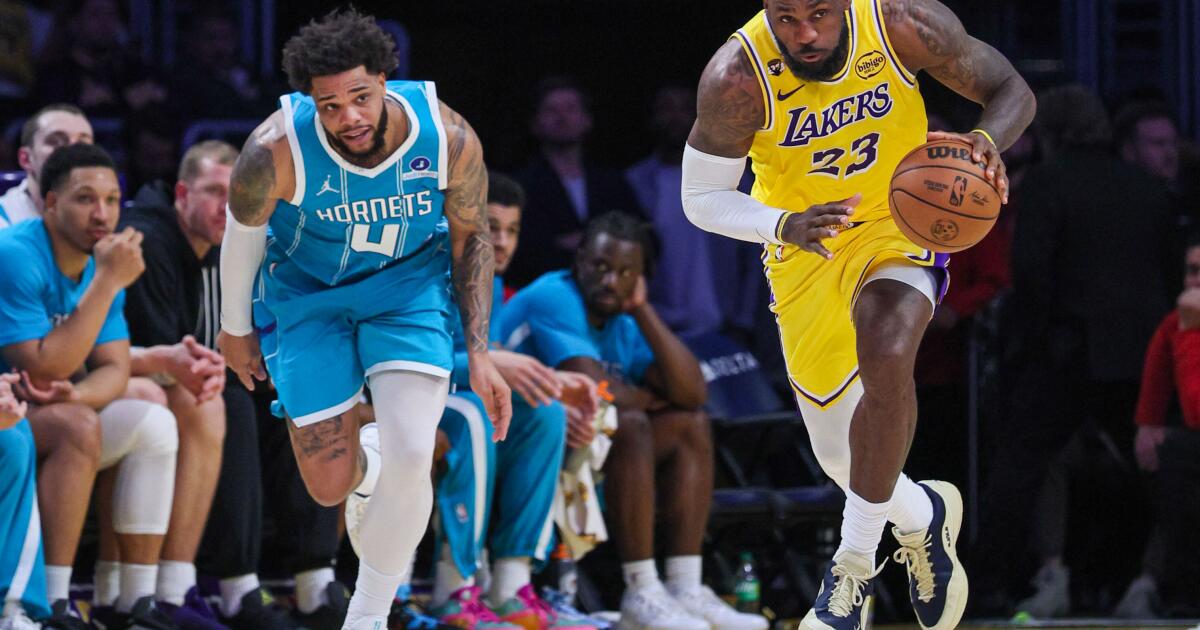
Letters to Sports: Mixed emotions over LeBron James leaving Lakers
-

 World46 minutes ago
Nabatieh recovery begins amid ongoing southern Lebanon tensions

