Connect with us

Entertainment

Taylor Swift, Travis Kelce married at lavish Madison Square Garden wedding

Published

on

Taylor Swift, Travis Kelce married at lavish Madison Square Garden wedding

Manhattan was sweltering at 100 degrees and preparing to mark 250 years since the United States declared independence from Great Britain.

But on Friday, the city seemed transfixed by what might be the closest the country gets to a royal wedding: The nuptials of pop superstar Taylor Swift and Kansas City Chiefs tight end Travis Kelce.

The two were married Friday night, but the party is expected to continue into the morning. Swift’s publicist confirmed the marriage to several news organizations.

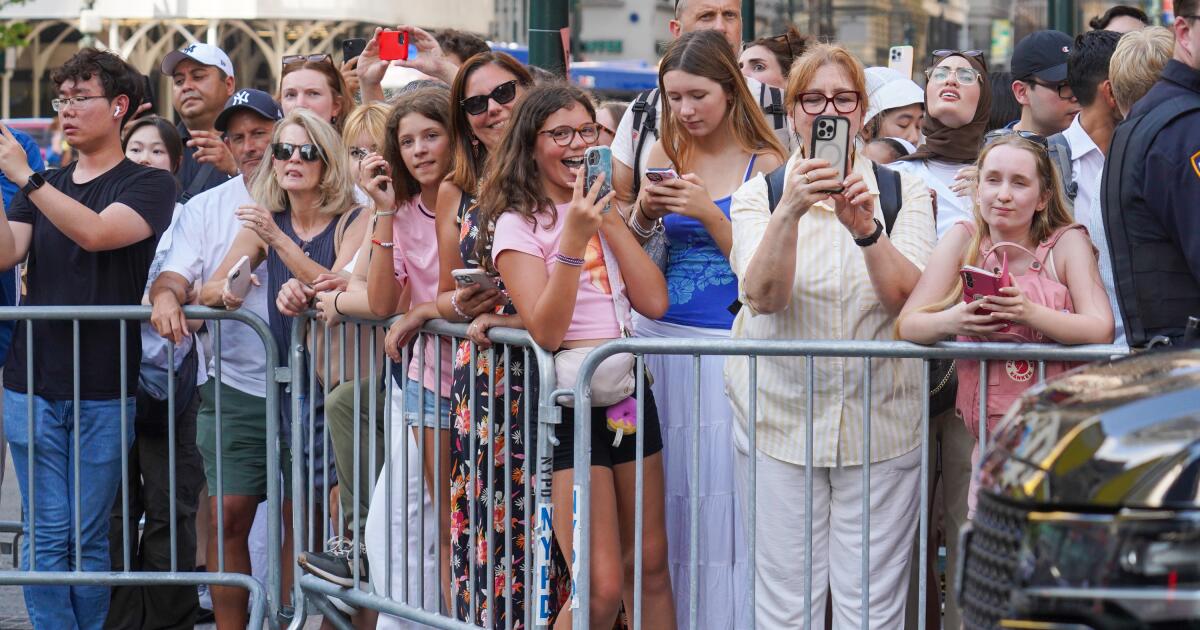
Madison Square Garden and its surrounding streets — 31st and 33rd streets toward 6th and 8th avenues — were blocked off as guests arrived for the event. Fans craned their necks for any views they could get from the street.

The world-famous arena was reportedly set to transform into a “massive castle,” surrounded by a garden fit for pop culture’s royal couple, both 36. While the complete event details and guest list have been kept a secret, the Associated Press reportedly obtained a city permit showing Friday’s wedding event was set to start at 5 p.m. Eastern time and could last until 4 a.m.

Advertisement

Secrecy surrounding the event is so tight that the reported venue has been cordoned off with privacy tents, tarps and barricades. But neither those measures nor Friday’s sizzling temperatures stopped fans from gathering in hopes of sneaking a peak at their longtime idol and sending Swift their well wishes.

“I heard we won’t be able to see her either way because the spot that they picked is going to be covered,” said Sarah Shrestha, 21, an Anaheim resident visiting friends in Manhattan.

Madison Square Garden was a good venue for the couple’s nuptials because “in interviews, [Swift] said she wanted to be able to invite everybody to the wedding so it’s still a good venue for that,” she added.

Ellie Kitschke, 13, and her mother, Mymy Nguyen, 38, were visiting New York City from Adelaide, Australia.

Ellie said she thought it was a weird choice for the venue.

Advertisement

“It’s like a stadium. I get that no one can come inside but I think it’s a bit much blocking up the roads,” added Ellie, who attended the Eras tour in Sydney with her mom.

The two said they also thought it was odd Swift didn’t choose a venue or date that included her lucky number, 13, saying it “didn’t add up.”

“If she does get married, we wish her well,” Nguyen said. “We’d love to see her.”

Emma Rasco, 19, was also surprised by the choice in wedding venue.

“When I heard it, I was like, that’s definitely a choice,” Rasco said. “It’s a little unconventional and very forward-facing.”

Advertisement

Swift and Kelce announced their engagement in August after two years of dating, to much fanfare. “Your English teacher and your gym teacher are getting married,” Swift wrote in the caption of her Instagram post.

While the Swift camp didn’t release a guest list, various news organizations staked out local hotels and Madison Square Garden and began counting bold-face names headed to the event. The New York Times obtained a schedule for the wedding, which included a cocktail hour followed by a 5 p.m. wedding and reception. The event was set to end at 2 a.m.

The AP reported the guests included Hugh Grant, Ethan Hawke and Jason Sudeikis, Karlie Kloss and Kareem Hunt.

The couple were first linked in July 2023, when Kelce mentioned his desire to meet the pop superstar on his podcast, “New Heights,” and made their relationship public that September. Their coupling instantly captured the attention and hearts of fans around the world, and Swift’s presence at Chiefs games was even credited with bolstering female interest in NFL football.

Kelly, 36, is a longtime Swift fan who said she grew up listening to her music. She came from her apartment on the Upper West Side to 33rd Street to see if she could catch a glimpse of Swift entering the stadium.

Advertisement

“I feel like I was the same peer group growing up with her, and am just so happy that she had her happy ending,” she said. “I want to see what a royal American wedding looks like.”

Kelly said she admires Swift and Kelce for donating to charity. The couple donated a combined $26 million to 20 local and national charities ahead of their nuptials, Swift’s publicist told Business Insider.

“They really are a positive influence,” she added.

Kelly said Madison Square Garden made sense as a venue for the privacy and security of guests.

“It’s not an ideal wedding venue but they’re both creative and have their own stages in a way,” she added.

Advertisement

By mid-afternoon Friday, dozens of fans clustered near MSG as black SUVs and vans with tinted windows, presumably filled with wedding attendees, turned the corner toward the stadium.

New York Police Department sources told The Times that streets will be blocked off all Friday and should return to normal by Saturday morning.

In October, Swift told TV host Graham Norton that she was casting a wide net with the guest list, joking that she would invite “anyone I’ve ever talked to.”

“I shouldn’t have said any of that,” she added.

Pulling off an event of this magnitude — which many described as America’s “royal wedding” — required considerable preparation, with a particular emphasis on privacy. Guests were reportedly required to sign nondisclosure agreements before receiving any event details (although the NDAs were said not to have included any penalties for violating the terms).

Advertisement

The couple were also linked to wedding planner Mark Seed, who previously orchestrated the 2023 wedding of Jack Antonoff and Margaret Qualley and the 2019 wedding of Jennifer Lawrence and Cooke Maroney. Seed is known for his elaborate event builds and notable discretion.

On the Tuesday before the event, workers were photographed installing a red carpet outside of MSG, which one individual reportedly said was for “a wedding,” according to Page Six. It was quickly removed that same day.

Lin reported from New York; Garcia and Rollins-Fife from Los Angeles.

Advertisement

Movie Reviews

The Kernel: Freshly popped film reviews — Batch #6 – Excalibur

Published

on

The Kernel: Freshly popped film reviews — Batch #6 – Excalibur

Obsession, dir. Curry Barker

Obsession is the debut feature from director Curry Barker, which follows Bear (Michael Johnston), an awkward teenager desperately in love with his friend Nikki (Inde Navarrette). When he is given a mystical chance to make one wish come true, he decides to make Nikki fall head-over-heels in love with him, unaware of the horrific consequences that will arise. A twisted tale of entitlement and regret, Obsession is eager to let audiences sit with the discomfort it offers.

The film’s cast is mostly made up of unknown actors (Andy Richter not included) who bring life and levity to an, at times, very heavy script. Michael Johnston’s puppy dog eyes and tender demeanour make him apt for this tortured lead, especially as we watch him descend deeper into the hell of his own making. However, Inde Navarrette’s gutting portrayal of Nikki is Obsession’s standout performance, as she carries the weight of the film on her shoulders with seeming ease. Navarrette captures the vacancy and lifelessness that this character requires, with moments of lucidity and terror that will undoubtedly make this a horror performance discussed for years to come.

Obsession is a mean film at its heart — one that does not let the audience feel comfortable at any moment, and that thrives in its grime and dimness. The “hero” of the story is hateable and places every character around him into terrible scenarios, leaving the audience to squirm as he tries to make things right. Barker’s direction provides palpable suspense for moments of sudden intensity and horror, yet the film remains comedic in its efforts to relieve tension. I, however, left this screening with a pit in my stomach. Highly recommend!

Photo courtesy of Featured Creatures.

Dead Lover, dir. Grace Glowicki

Advertisement

Presented at my screening in sickly “Stink-O-Vision,” Dead Lover is the sophomore feature of writer, director, and actress Grace Glowicki. Inspired by works of Gothic horror like Frankenstein and The Cabinet of Dr. Caligari, Dead Lover is a gloriously grotesque, goofy, and grody romantic horror-comedy that centres a smelly gravedigger (Glowicki) who goes to monstrous and comedic extremes to reanimate her one true love (Ben Petrie) after he perishes at sea.

Though the film is co-written by her partner and frequent collaborator, Ben Petrie, Dead Lover feels like Glowicki’s brain-child, harnessing her aptitude for the cartoonish and the outrageous. This is best exemplified through its use of Stink-O-Vision, a scratch-and-sniff technology seen previously in John Waters’ “Odorama” for Polyester, placing these filmmakers in conversation for their vulgarity, comedic stylings, and embracement of camp.

Dead Lover, shot entirely on black-box stages over the course of two weeks, uses only four actors playing multiple parts in heightened makeup and costumes, evoking the feeling of a filmed stage show. The film employs over-the-top performances, handcrafted sets, stage props, and colourful, high-contrast lighting reminiscent of German expressionism. Indeed, Glowicki’s directorial vision seems to be heavily inspired by the handmade aesthetics and experimentalism of independent theatre and silent-era filmmaking, akin to the work of fellow Canadian, Guy Maddin.

Dead Lover’s plot is more of a contrivance to get to the next excellent set piece, disgusting smell, or gonzo performance, though still remaining full of twists and tenderness. While the film may grate at times and the sickly scents conjured by the scratch-and-sniff cards were certainly gag-inducing, Dead Lover carries an infectious sense of fun and delight that keeps audiences laughing. Recommend!

Advertisement
Continue Reading

Entertainment

Who is on Elle Woods’ playlist? ’90s bands like No Doubt and Sleater-Kinney

Published

on

Who is on Elle Woods’ playlist? ’90s bands like No Doubt and Sleater-Kinney
p]:text-cms-story-body-color-text clearfix”>

“I’ve talked about rain on this show more than I have in my entire life,” Kittrell says.

It was a constant consideration, both on set and in the writers room. Weather became a way to distinguish Elle from those around her in Seattle. The locals never carry umbrellas; Elle shows up with a pink one.

“We had a writer from Seattle who always said the city gets a bad rap because of the rain,” Kittrell says. “But the rain is what makes it beautiful — it makes Seattle green.”

Advertisement

Elle entering the halls of Rainier West High School with her pink umbrella.

(Kimberley French / Prime Video)

That philosophy stayed with the writers, later showing up in a line Miles (Jacob Moskovitz), Elle’s crush, says to her, and ultimately leading them to Garbage’s “Only Happy When It Rains” as the show’s theme. “We were like, of course,” says Kittrell. “This is what we’ve been talking about the entire time.”

The song was originally meant to end the pilot. “Then we decided we should just be hearing it in every single episode,” says Neustadter. (The pilot instead uses Radiohead’s “Creep,” which also bookends the series.) The main title sequence, an animated “saga sell” from the studio Shine, tells the story of Elle’s move from Bel-Air to Seattle.

Advertisement

“We’re constantly reminding the audience of the contrast between Elle’s essence and the world she’s now in,” Neustadter adds. “There’s an optimism to ‘Only Happy When It Rains’ that feels very Elle Woods. And the irony of it is so delightful.”

Continue Reading

Movie Reviews

‘Baby Do Die Do’ movie review: In the mood for Mumbai

Published

on

‘Baby Do Die Do’ movie review: In the mood for Mumbai

Monsoon sets in Mumbai with a bang. Rain drops ram the streets in desperation. The relief easily drifts into panic. Sea of umbrellas everywhere but one amongst them at a local station stands out. Wading through the downpour, its red colour drips with a warning. The person holding it exhibits a stone-cold demeanour, as she looks for an old man in the bustling chaos of the train at rush hour. She moves through the crowd inconspicuously and readies her umbrella, which secretly hides a gun as a trigger appears on its handle. She takes a muffled shot and disappears into the ensuing chaos.

The opening scene in Huma Qureshi’s Baby Do Die Do bears an uncanny resemblance to the real horrific killing of a young man in the local train recently, which laid bare the brutality that some people in the city carry within. An argument can escalate soon into homicide and there would be no one coming to rescue. Baby Karmarkar (Qureshi) carries a similar violence in her heart, that rises from the clutches of a city that failed her when she witnessed the death of her twin sister as a child. The city has turned her into a sociopath

The film however, doesn’t always treat the violence with gravity. Its tone is not always sharp and cynical even as it aims to critique the cornerstones of wealth and power on occasions by establishing the link between the builder lobby and mafia. Director Nachiket Samant largely uses the noir as part of the design element, lending a pulpy, comic-bookish layer to the narrative while the thematic undercurrents don’t really get time to marinate. As a result, the rainy undercurrents, moody lighting and dark humour gets dissolved just into style rather than adding complexity to the narrative.

Baby Do Die Do (Hindi)

Director: Nachiket Samant

Duration: 125 minutes

Advertisement

Cast: Huma Qureshi, Chunky Panday, Sikandar Kher, Seema Pahwa, Rachit Singh, Marudhar Shekhawat, Arun Kushwah

Synopsis: A deaf and mute assassin gets softened by love as she vows to take revenge from the man who murdered her twin sister

That being said, there’s more heart in Baby Do Die Do than the combined range of some of the other monotonous films that have come out in recent times. Its disregard for template is quite reassuring as it also aims to subvert genre cliches with a touch of quirk. The film doesn’t forget to have fun while juggling along with the grimness, as seen in an inventive item song which is inserted when Manu (a brilliant Marudhar Shekhawat), an associate of Baby, is tasked with an assassination that takes him to a gay pub in Andheri East. Saqib Saleem (also producer) makes a guest appearance as a sexy, ripped dancer, grooving seductively to a song with the hook line ‘Alpha Q’ repeated all along, creating an edgy innuendo. The gaze is empowering, building a sense of liberation to Saqib’s character, who controls his body and its movements. Rather than being an object of desire, he becomes its subject, withholding the capacity to flirt with anyone he wants, without crossing a boundary. Even the onlookers carry a sense of respect in their eyes as the camera doesn’t become a medium to represent lecherous gazes.

A still from the film

A still from the film
| Photo Credit:
Saleem Siblings/Youtube

All of this inherent loudness compliments the muted worries of Baby, who cannot hear and speak. It is delightful to see her first tryst with love unfold like a silent film as Siddhu (Rachit Singh), a likeable Sikh music teacher is smitten by her beauty. Their love story starts in a bus and later blooms in a cramped apartment, as there’s again a gender reversal at play, with Baby incorporating toughness as Siddhu stays dipped in vulnerabilities. There’s still a lot more to them that remains unexplored as the film has to fixate on the central conflict of Baby’s vengeance, which remains its weakest and most predictable link.

It is only when it digresses from the way that the film shows beguiling promise. Whether it is in smaller sketchy moments like when a character with vitiligo is called black and white in a humourous scene or the dwarf gangster Lucky (Arun Kushwah) immortalised by his brother, Zafar Katkar (Sikandar Kher) by putting his name on the tallest building in the city. The film also allows these dreaded gangster’s tiny moments to breathe, reflecting a common link between all the characters, born and raised on the same soil of Mumbai. Zafar gets into reverie during a violent hold up in a shanty when the distinct smell in the air takes him back to his childhood. He sniffs a blanket and talks of living in the underbellies and wanting to escape that netherworld as others seem to sympathise to his sentiments. All of them become Mumbaikars in that one moment before mayhem, disarmed of other identities when put in a space of mutual co-existence, rooting for the common concerns of roti, kapda and makaan. It is also short-lived for time has shaped each of them differently and they must react to the version that the city has forced them to be in the present.

Huma Qureshi and Chunky Panday in the film

Huma Qureshi and Chunky Panday in the film
| Photo Credit:
Saleem Siblings/Youtube

Kher inhabits this dichotomy with urgency, lending an astounding tragic-comic quality to his screen presence. He is a treat to watch but the screenplay just stops short of taking him to murkier territories while resorting to familiar, convenient turns to reach the resolution. Even Huma remains impressive as she stays silent for the most part and uses her face to translate Baby’s emotional turmoil. The real surprise in the mix comes from the restrained act put on by Chunky Panday, who represents the helpless middle-class Mumbaikar with remarkable honesty.

Advertisement

These are all characters that become much more superior than the immediate storyline which Baby Do Die Do struggles to run along with. Their dreams feel palpable, their anger unresolvable and their beauty merging with the soul of the city. On occasions, their collective aspirations represent the charms of Bombay films of the 70s and 80s by Sai Paranjpye and Basu Chatterjee. Even the twin sisters retribution tale seems to be a reworked ode to older Hindi movies. It is an aesthetic that is hurriedly disappearing from other contemporary city films.

So, although Baby Do Die Do imagines Mumbai as a cyberpunk landscape, it actually prospers while recollecting the unassuming everyday pulse of the metropolis, whether it is in the tale of a shoe polisher, who suffocated to his death on an overcrowded bridge, a peon in the High Court, who got killed by mistake and the mother whose sanity was taken away by the city’s violence. Then, in the compounding mess created by the bigger folks Murjhani and Bhambhani, it is important, like Baby, to be zara hatke, zara bachke. It is after all, Bambai meri jaan.

Baby Do Die Do is currently running in theatres

Published – July 03, 2026 03:10 pm IST

Advertisement
Continue Reading
Advertisement

Trending