West
Russia, China squeeze US Arctic defense zone as Trump eyes Greenland

NEWYou can now listen to Fox News articles!
EXCLUSIVE: After U.S. officials detected a sharp rise in Russian and Chinese military incursions near Alaska — including a growing number of joint operations — Sen. Dan Sullivan is warning that the Arctic has become an active security front. And he’s pushing Congress to accelerate icebreaker construction, reopen Cold War–era bases and bolster U.S. defenses in the region.
Sullivan’s warning comes as new data show foreign military traffic near Alaska climbing sharply, a trend he says has gone largely unnoticed outside the region even as Moscow and Beijing coordinate more closely. He argues the activity has exposed how thin U.S. Arctic capabilities have become and why Washington is now scrambling to catch up.
“Let’s just say the world’s largest fleet of oceanographic survey ships wasn’t off the coast of Alaska to ‘save the whales,’” Sullivan told Fox News Digital in an interview.
President Donald Trump’s ongoing friction with Denmark over Greenland reflects the growing importance of the Arctic for the administration, Sullivan said. As melting ice opens new shipping lanes, energy access and military routes, Alaska is becoming a front line in the contest for economic and strategic dominance.
TRUMP SAYS GREENLAND’S DEFENSE IS ‘TWO DOG SLEDS’ AS HE PUSHES FOR US ACQUISITION OF TERRITORY
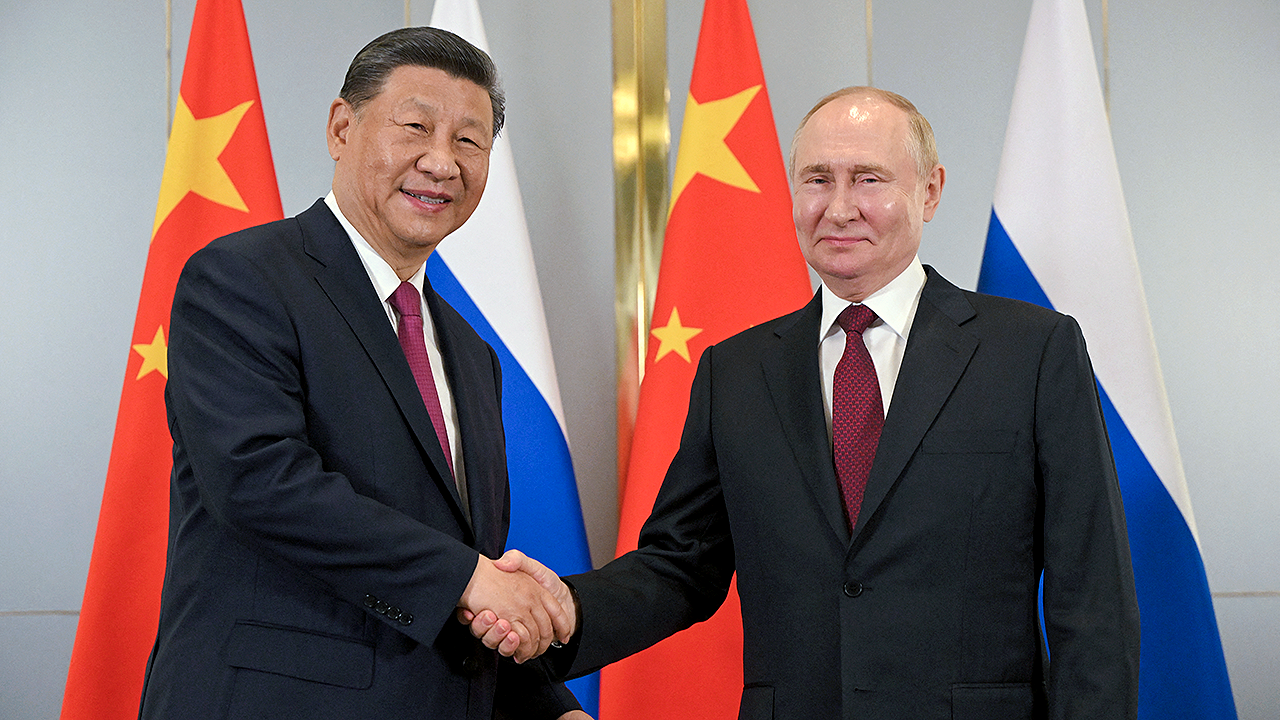
Xi Jinping, left, and Vladimir Putin (Sergei Guneev/Reuters)
Plans to reboot far-flung military operations off Russia’s back door — recently revisited in Tom Cruise’s latest “Mission: Impossible” installment — along with crucial new port infrastructure and a major cash infusion to the U.S. Coast Guard are all efforts to demonstrate the only thing America’s adversaries respect, Sullivan said: “Power.”
Sullivan, R-Alaska, recently chaired a Senate Commerce Subcommittee hearing examining the U.S. Coast Guard’s Arctic presence and discussed a new U.S.-Finnish deal to secure crucial new icebreaker craft and funding from the recent tax-cut law funding for at least three USCG Arctic security cutters amid a record $25 billion total investment in Coast Guard prowess.
The U.S. currently has two, one of which is out of service, while the Russians have 54 icebreaker craft, “nuclear-powered and weaponized,” he said.
Sullivan shared data with Fox News Digital showing a sharp rise in Russian, Chinese and joint Sino-Russian military aircraft and maritime incursions into the U.S. Air Defense Identification Zone, or ADIZ, a security buffer stretching beyond 12-nautical-mile sovereign U.S. airspace where foreign craft are required to identify themselves.
Since 2019, there have been more than 100 Russian aircraft, four Chinese vessels and, most alarmingly, more than a dozen joint operations that have entered the ADIZ, Sullivan said.
Trump’s recent focus on Greenland underscored the urgency of Arctic national security, Sullivan said, echoing warnings from NATO commander USAF Gen. Alexus Grynkewich that China’s expanding “research” presence in the region is becoming increasingly aggressive.
NATO CHIEF PRAISES TRUMP AT DAVOS, SAYS HE FORCED EUROPE TO ‘STEP UP’ ON DEFENSE
While the Russians identify with the Arctic, China’s self-moniker of a “near-Arctic power” is confounding and concerning, he added, pointing to its actual location on the globe.
Sullivan said the situation is reminiscent of Vladimir Lenin’s mantra that when you probe an enemy with a bayonet, “if you find mush, you push. If you find steel, you withdraw.”
The U.S., he said, must steel itself against these threats, and Congress must be on the front lines, ensuring the resources and defenses are ready and in service.
WHY TRUMP ZEROED IN ON GREENLAND AND WHY IT MATTERS IN 3 MAPS
Russia and China make joint air patrols near Alaska. (Russian Defense Ministry/Getty Images)
“The only thing authoritarian regimes that are our adversaries understand is power. That’s U.S. energy security, Coast Guard, military assets and infrastructure.”
As the chairman of the Senate Commerce Coast Guard subcommittee, Sullivan said he is working hard to ensure that is what Moscow and Beijing will see, noting the new Storis icebreaker vessel received funding to home port in Juneau, along with 16 more icebreakers and $4.5 billion in shorefront infrastructure.
In addition, a World War II-era base on far-flung Adak in the Aleutian Chain is on track to be reopened, Sullivan revealed.
AMERICA DOESN’T NEED TO OWN GREENLAND — THERE’S A BETTER, MORE PEACEFUL WAY
The base, somewhat dramatized in “Mission: Impossible: Dead Reckoning,” which featured a counter-Soviet listening post on nearby St. Matthew Island, was key to Allied defenses as Japan bombed present-day crabbing port Dutch Harbor and invaded Attu and Kiska islands, events less remembered than the Axis’ other Pacific attack at Pearl Harbor.
Adak’s Base largely closed down in 1994 after the end of the Cold War.
Sullivan revealed he secured $115 million to begin rebuilding Adak, paired with $500 million to establish a deepwater port in Nome, one of the closest cities to both Russia and the Arctic Ocean.
NATO CHIEF WARNS EUROPE CAN’T DEFEND ITSELF WITHOUT US AS TENSIONS RISE OVER GREENLAND
The state of Alaska matched that Nome investment and put $30 million of its own funds toward the new Adak project, Sullivan said. Gov. Mike Dunleavy separately told Fox News Digital that enhancing Alaska’s icebreaking capabilities and expanding the Coast Guard’s presence to safeguard the state’s coastline are key.
“[Further,] supporting life-saving missions and countering foreign influence in the Arctic are vital not only to our state but to the nation as a whole. Alaska stands ready to receive these icebreakers and leverage our geostrategic position to advance Trump’s America First agenda,” Dunleavy said.
Brent Sadler, a naval warfare expert and veteran at the Heritage Foundation, said the Arctic — and Antarctic — are also critical for space-based sensors detecting long-range missile attacks.
US COMMANDER SAYS RUSSIA AND CHINA’S ARCTIC PATROLS ARE ‘NOT FOR PEACEFUL PURPOSES’
“China and Russia have impacted our fishermen’s livelihoods with military exercises in our EEZ (exclusive economic zone) … (and) should be viewed as a threat. It needs to be deterred and pushed back on appropriately with an increased Coast Guard presence,” Sadler said.
Many of Russia’s incursions lately have originated in Anadyr, directly across the Bering Strait from Nome, and Adak sits just a few hundred miles east of Kamchatka, Russia.
Paired with Trump’s Golden Dome security initiative, Sullivan said now is the time to “plus-up” Arctic defenses as malign activity continues in his backyard.
CLICK HERE TO DOWNLOAD THE FOX NEWS APP
The “peace through strength” mantra is best served this way, he said, as each area targeted in the latest appropriation brings U.S. might right to Russia and China’s face, versus more populated but less strategic areas to build up like Kodiak and Anchorage.
“We’ve got to keep pedal-to-the-metal, and I give President Trump and his team a lot of credit. He was talking about Arctic issues and icebreakers and missile defense during his first term, and now we’re doing it,” Sullivan said.
“It’s important because the Chinese and Russians understand one thing: power — big flashy speeches without backing it up with military force don’t really mean anything.”
Read the full article from Here



San Francisco Giants pitchers say they don’t feel MLB discriminated
Three San Francisco Giants pitchers say they did not feel discriminated against after the DOJ announced an investigation into Major League Baseball.
The San Francisco Giants have a lot to consider at this juncture of the MLB season.
There were mid-level expectations for the Giants at the start of the season. On paper, it seemed like the Giants could battle for a wild card berth.
The Giants won’t meet those expectations.
A week before the All-Star break, San Francisco has the third-worst record in baseball at 38-54. The Giants lost 10-0 to the Toronto Blue Jays on July 8, held hitless through eight innings.
It’s becoming increasingly obvious that this team won’t be competitive down the stretch, which has many of the Giants faithful singing a NxWorries tune, wondering what to do and where to go from here.
It’s evident that a shake-up is needed. It’s simply a matter of where they start and what they can realistically do to change things in the dugout. But one thing’s for sure: the Giants are sellers heading into the trade deadline.
What should the Giants do now?
The Giants have to accept their fate. Entering the season, they looked like a team that could compete with anybody, but then the baseball games were played and that proved to not be the case. So now San Francisco has to look itself in the mirror and figure out what went wrong and how to make things right – well, better than they have been going, anyways.
Here are a few ideas:
Get aggressive in the trade market, sell high
It’s easier said than done, but the Giants have to get off the expensive contracts eating up their salary. Reason being, you won’t be able to get any talent, let alone invest in your prospects, if there isn’t enough dollars to go around by the time negotiations occur.
It’s also a matter of how aggressive they plan to be and who will be prioritized. Who is untouchable? ESPN’s Jeff Passan has Giants outfielder Jung Hoo Lee as a top-ranked trade candidate. He plays all throughout the outfield. Offensively, Lee ranks top 10 in MLB in batting average and strikeout rate.
Lee, 27, makes $22.83 million this season and next, before going down to $21.33 million in both 2028 and 2029. Although not a star, the Giants can sell teams on Lee being a promising, solid all-around player.
Move on from veteran players
With a record like San Francisco’s, the best thing you can do for the fans is give them something to be hopeful for. That’s not aging veterans.
Examine the market for your guys who are age 30 and up, or are occupying a ton of salary space.
Rafael Devers turns 30 in October. His age isn’t so much a problem, but his contract … combined with the lack of expected production. Devers has had a down year so far, batting .244, registering 86 hits and 18 homers. He’s under contract through 2033 at a hefty price tag.
Others to consider moving on from are Willy Adames and Matt Chapman. They’re fan favorites, but based on age and dollars it all makes sense. Adames is under contract through 2031 at over $31 million per season. Chapman is locked up through 2030 at over $25 million per year.
It’s hard to say goodbye, but in the best interest of the Giants, they have to find new homes for these guys. And honestly, it wouldn’t be surprising if Devers, Chapman and Adames wanted to find a new home if it meant playing for a contender and a chance at a World Series title.
Retain young talent, bring in fresh faces
There’s promise for the future in this squad with guys like Bryce Eldridge, Blade Tidwell and Drew Gilbert. It’s a start.
“The San Francisco Giants, who would love to trade two of their infielders at the trade deadline, need to clear space for power-hitter Bryce Eldridge. They realize it’s stunting his growth as an infielder to keep using him as a DH at the age of 21,” USA TODAY Sports’ Bob Nightengale wrote.
Eldridge has had plenty moments as a designated hitter but none bigger than his walk-off grand slam against the Washington Nationals on June 10.
Another intitiative San Francisco needs to focus on is hanging on to guys like Logan Webb, Heliot Ramos, Casey Schmitt and Landon Roupp. The best bet is to hang on to them to help usher in a new era. Years from now, when the team has a new look, you can decide whether to leverage them for additional assets.
However, in the interim, hold on to those guys for dear life because teams will come knocking as MLB gets closer to the trade deadline.

DENVER (KDVR) — Two officers, one now formerly of the Denver Police Department, face multiple charges relating to separate incidents in the past two months.
According to a release, now-former Denver Police Officer Gabriel Lucero was issued a citation for third-degree assault, official misconduct and false reporting, while Officer Javon Leach was cited for reckless driving and eluding.
The incident involving Lucero reportedly occurred on May 22 just before 1 a.m. in the 500 block of 16th Street. According to a release, Lucero was involved in an assault at a business, as he allegedly assaulted a person and walked away as others continued to assault the victim.
Security guards and an off-duty officer escorted him and the group out; however, Lucero reportedly identified himself as a Denver police officer and attempted to re-enter by using his police badge.
Lucero reportedly provided a false name without any other information, and further investigation verified Lucero as the person involved. Lucero was hired in 2025 and, due to his current probationary status, was fired as of Wednesday.
The incident involving Leach occurred around 1:41 a.m. on June 21, when Leach was reportedly pulling out of a parking lot on Larimer Street, attempting to drive against traffic.
Leach reportedly refused commands to stop as he left the area. Officials said he was found just seven minutes later, traveling at high speeds northbound on Park Avenue West.
He reportedly fled a traffic stop and continued to drive away, and officials deemed Leach to be the suspect following an investigation. He was placed in an off-line assignment while the case progresses, as they are considered misdemeanors.
“The Denver Police Department’s administrative review of Leach’s incident will begin once the criminal case is adjudicated, and that process includes the Denver Department of Safety and the Office of the Independent Monitor, a civilian oversight agency,” the release said.

Breast milk samples from moms in the Seattle area contained chemicals linked to health problems, new research has found.
The chemicals are often used in beverage can liners, receipt paper, and other products, and they’ve been linked to reproductive problems, cancer, and immune problems like asthma.
Ryan Babadi is the science director at the nonprofit Toxic Free Future, which co-authored the research. He said breast milk is still the best food for most babies.
“The problem is not breast milk,” he said. “The problem is that we have chemical policies that are allowing these contaminants to end up in women and breastmilk and result in exposure to infants during a very sensitive time period of development.”
Researchers collected breast milk from 50 women and tested it for various chemicals. They found that the majority of the samples contained BPA and the related chemical BPS, triclosan, and melamine. All three of these chemical groups are known as “endocrine disruptors” because they can mimic, block, or alter human hormones and thus affect a large number of systems. BPA, for example, has been linked to diabetes, the early onset of puberty, and a number of cancers. Triclosan interferes with thyroid function and could increase cancer risk. And melamine has been linked to kidney problems.
“This isn’t a problem that mothers or people in general can shop their way out of,” Babadi said. “We need government decision-makers and policymakers as well as the corporate environment to come up with policy solutions that protect us.”
RELATED: Trump administration actions contradict MAHA rhetoric on toxic chemicals
Breast milk for the study was collected in 2019. In the years since, Washington state has started regulating some of the chemicals the researchers found.
For example, as of last year, beverage cans in Washington aren’t allowed to contain BPA and related chemicals. And as of January, those chemicals aren’t allowed in receipt paper in the state.
That’s because, under a state law passed in 2019, the ecology department prioritizes harmful chemicals, identifies consumer products that contain those chemicals, and writes new regulations to ban or restrict them.
So far, the state has regulated not only BPA and related chemicals, but also phthalates in personal care products and vinyl flooring, triclosan in cosmetics, and PFAS chemicals in carpets, rugs, and furniture. Those last are known as “forever” chemicals because they do not degrade over time.
RELATED: 5 ways to reduce everyday exposure to ‘forever chemicals’
The state is now looking at chemicals in cosmetics, jewelry, cookware, paint, and artificial turf, among other products, for possible future regulation.
The state has not looked at banning or restricting melamine, one of the chemicals the researchers found in breast milk.
Babadi said in an email that Washington’s law is the nation’s strongest for regulating toxic chemicals, but he said it needed to be improved “to be able to enact bans in urgent scenarios when, for example, we observe harmful chemicals in breast milk.” The process for restricting new chemicals currently takes at least five years.
Marissa Smith is a toxicologist and the former technical lead for the Safer Products for Washington program. She now works on chemical policies across the ecology department.
She said the state’s current process of chemical regulation helps build compliance by giving manufacturers and industries plenty of lead time and compliance assistance.
“We generally do see compliance with state laws,” she added. “Most manufacturers want to sell products that are compliant.”
RELATED: Trump cuts demolish agency focused on toxic chemicals and workplace hazards
Smith emphasized that state-level chemical regulations like those in Washington and California can have an effect across the country, as manufacturers switch over to safer alternatives for their entire supply chain.
And Smith sees other reasons for hope.
“ Products are getting safer over time,” she said. “ There were some toxic flame retardants that were used in kids’ pajamas and other products, and we banned those, and we actually saw concentrations in our bodies and in our environment go down.”
For another example, Smith pointed to the dramatic decline in how much lead was in children’s blood after the U.S. banned leaded gasoline in 1996.
“ There’s just a lot of examples where we have actually regulated products and we’ve seen reductions in people’s exposure,” Smith said.
-

 Crypto1 minute ago
Binance maintains commitment to EU, seeking more licences in Asia
-

 Finance6 minutes ago
How Banreservas mobilised diaspora capital
-

 Fitness13 minutes ago
I’d Fallen Into an Exercise Rut—Until Trail Running Reminded Me How Joyful Movement Could Be
-

 Movie Reviews21 minutes ago
Movie review: Supergirl is a blast
-

 World26 minutes ago
Trump Says He Thinks He Will Remove Syria From US Terrorism Sponsor List
-
 Lifestyle1 hour ago
Appeals court denies Trump’s request to halt removal of his name from the Kennedy Center
-

 Technology1 hour ago
Meta is reportedly working on smart glasses that would be recording all the time
-

 World1 hour ago
Trump says ‘Iran lies and cheats’ as IRGC emerges as dominant force in negotiations with US

