West
Portland elections office vandalized hours before Trump's second inauguration

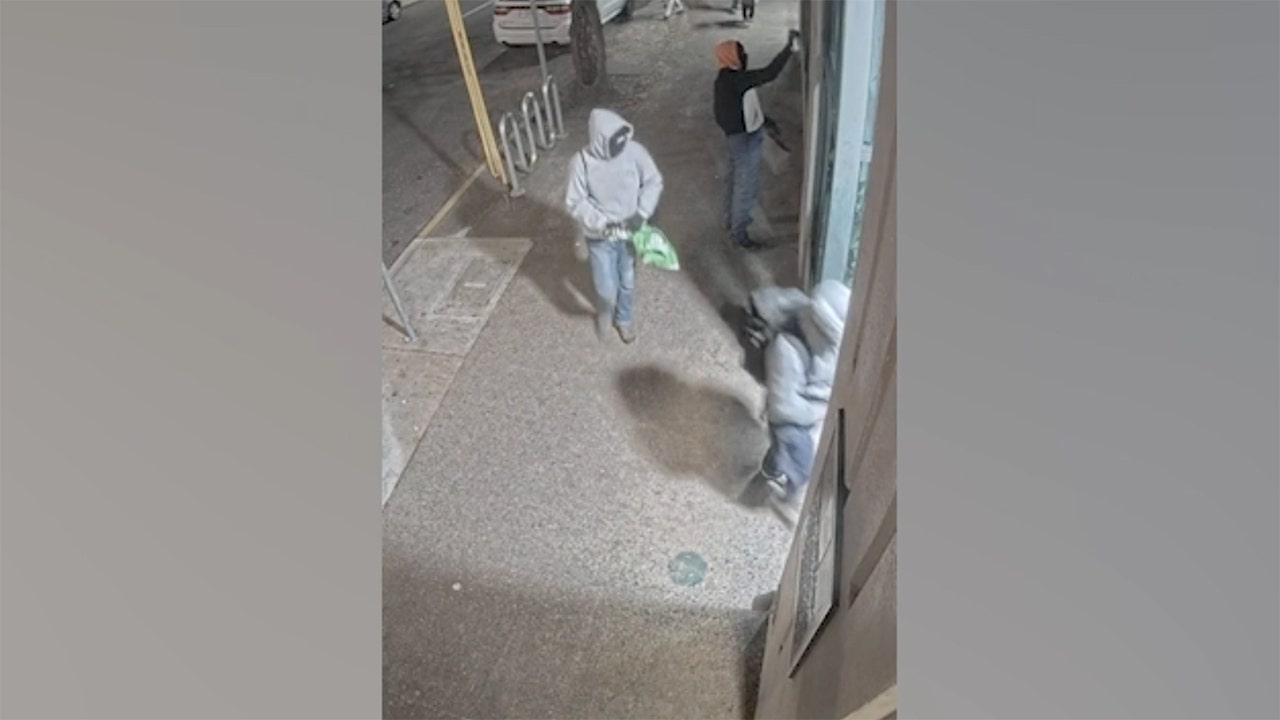
An Oregon elections office was vandalized and heavily damaged just hours before the second inauguration of President Trump.
Portland police confirmed to Fox News Digital that two dozen windows and two doors were smashed by rocks at the Multnomah County Elections office in southeast Portland in the early hours on Monday.
A spokesperson for the department said an alarm alerted officers to the incident, adding that officers found that the building had been tagged with graffiti.
“We believe 8-10 people were involved,” the officer stated. “In addition, there was some anti-government/anti-establishment graffiti on the building.”
CLIMATE ACTIVISTS LEARN FATE FOR RED POWDER ATTACK ON US CONSTITUTION AT NATIONAL ARCHIVES
Portland police released video and images of suspects wanted for vandalizing an elections office hours before Trump’s inauguration. (Portland police)
Police said multiple suspects fled before officers arrived.
An election worker also told KATU that the vandals threw rocks and smashed every window on the street side of the building, but nothing appeared to be stolen.
The worker added that there did not seem to be any damage inside the building other than shattered glass on the floor and sidewalk outside.
FBI SAYS WASHINGTON, OREGON BALLOT BOX FIRE SUSPECT STILL UNKNOWN, EXPLOSION SEEN ON SURVEILLANCE VIDEO
Portland police said eight to 10 suspects are wanted for vandalizing an elections office hours before Trump’s inauguration. (Portland police)
Officials said there is no indication the vandalism is related to Trump’s inauguration in any way.
Police said no arrests have been made.
The incident is under investigation and officials are urging anyone with information to contact Portland police at crimetips@police.portlandoregon.gov and reference case number 25-17004.
Fox News Digital reached out to the Multnomah County Elections office and did not immediately receive a response.
FIRES AT OREGON AND WASHINGTON BALLOT BOXES CONNECTED, POLICE ID ‘SUSPECT VEHICLE’: ‘ATTACK ON DEMOCRACY’
The vandals smashed multiple windows. (Portland police)
This is not the first political violence incident to happen in Oregon.
During the 2024 presidential election, an unknown suspect was caught on surveillance video setting a ballot drop box on fire with an incendiary device in Portland, one of several incidents that happened in Oregon and Washington state.
Clark County Auditor Greg Kimsey called the incident “a direct attack on democracy” as it occurred just days before Election Day.
The first ballot box fire happened on Oct. 8 between 3:30 a.m. and 4 a.m. in Vancouver, Washington, the FBI said. No ballots were damaged in that incident.
Two more incidents happened on Oct. 28 between 2 a.m. and 4 a.m. in Vancouver and Portland. Hundreds of ballots were destroyed in the Vancouver drop box, while officials said three were damaged in Portland.
All three incidents involved improvised incendiary devices placed on the outside of the boxes. Investigators recovered enough material from the devices to link all three fires.
Authorities are offering a reward of up to $25,000 for information leading to the arrest and conviction of the suspect.
Fox News Digital’s Stephen Sorace contributed to this report.
Stepheny Price is writer for Fox News Digital and Fox Business. Story tips and ideas can be sent to stepheny.price@fox.com
Read the full article from Here

Nemanja Jokic, the older brother of Denver Nuggets superstar Nikola Jokic, has successfully transitioned from a protective family advisor into a credentialed professional by becoming a certified NBA agent, Serbian outlet Meridian Sports relayed on Tuesday. The middle of the three brothers had to navigate the strict licensing protocols dictated by the National Basketball Players Association, which stands as the sole governing body authorized to issue the official license required to negotiate contracts with league franchises. The former collegiate player turned team executive for Serbian club KK Joker Sombor completed the strict application process.
EuroHoops.net

The Seattle Seahawks are the defending champions, but that doesn’t mean their rookie class isn’t important.
If anything, it means the rookie class is more important because these first-year players will have to play at a very high level right from the jump in their careers. The Seahawks’ rookie class is going to be expected to help the team win a Super Bowl by replacing some key players on the roster.
“The world champion Seahawks, as I saw it, had three clear areas that became needs this offseason: running back, safety and corner, with the departures of Kenneth Walker III, Coby Bryant and Tariq Woolen,” Sports Illustrated reporter Albert Breer wrote.
“Accordingly, running back Jadarian Price, safety Bud Clark and corner Julian Neal were their first three draft picks, and all three will be guys to watch in late July and August. And another storyline, one that’ll tie back to Price, will be Zach Charbonnet’s return from a torn ACL.”
Jadarian Price
With Zach Charbonnet tearing his ACL during the divisional round game against the San Francisco 49ers back in January, first-round pick Jadarian Price will be thrown into the limelight in Week 1, assuming he gets through training camp in full health.
This will be an excellent opportunity for Price to get early reps, especially considering he was a backup in college to Jeremiyah Love, the No. 3 overall pick in the draft. He’ll compete with George Holani in training camp for the starting job against the New England Patriots on Sep. 9.
Bud Clark
Clark shouldn’t be expected to start over Julian Love and Ty Okada, but he should still have a handsome role in the secondary. Last year, the secondary proved how important depth is, and everyone in Seattle’s back line can play at a high level.
Clark is taking over for Coby Bryant, who signed with the Chicago Bears back in March. Those are tough shoes to fill, but Clark will be given an opportunity to show why he was a second-round pick.
Julian Neal
The Seahawks won’t have Riq Woolen this season after he signed with the Philadelphia Eagles. Josh Jobe and Nick Emmanwori will also need to fill in for Woolen’s absence, but third-round pick Julian Neal will have to shoulder some of the responsibility as well.
Woolen played in 78 percent of the team’s defensive snaps last season, which means Neal could hear his number early and often if he has a strong showing in training camp.
— Enjoy free coverage of the Super Bowl champions from Seattle Seahawks On SI —
Sign Up For the Seahawks Daily Digest – OnSI’s Free Seattle Seahawks Newsletter
 Add us as a preferred source on Google
Follow

Blink, and you might miss it.
Adobe Falls isn’t Niagara Falls — or anything close — but after winter rains, a seasonal waterfall briefly appears in a narrow Del Cerro canyon, hidden beneath streets, homes, and San Diego State University property.
The waterfall forms along Alvarado Creek, which drains parts of eastern San Diego, including the SDSU area and surrounding neighborhoods. In wet months, runoff moves through a steep canyon and drops over a short rock ledge known locally as Adobe Falls. In dry periods, the flow often fades to a trickle or disappears entirely, leaving exposed sandstone and a shaded canyon bed.
What makes the site stand out is its setting. Above the canyon are Del Cerro residential streets and university property tied to San Diego State. Below it, Alvarado Creek continues west as part of the Mission Valley watershed, eventually feeding into the San Diego River system. Like many urban drainages in San Diego, its flow is shaped by stormwater runoff, paved surfaces, and altered drainage patterns tied to development.

Access is restricted. The canyon sits on a mix of SDSU and city-managed land and has long been closed to the public due to safety concerns, including steep terrain, erosion, and unstable footing after rain. Although widely referenced in maps and online posts, it is not an official trail or recreation site.
The canyon itself pre-dates modern development in Del Cerro. It is part of a broader network of inland waterways and canyon corridors used for thousands of years by the Kumeyaay, whose presence shaped movement and settlement patterns across the region.
In the mid-20th century, as Del Cerro developed, homes and roads were built along canyon rims rather than through them, leaving Alvarado Creek intact as a drainage system. Adobe Falls remained within that corridor even as surrounding hillsides filled with residential and institutional development.
Today, Adobe Falls remains a small but persistent reminder that San Diego’s natural drainage systems still function within a heavily built environment — appearing briefly after storms, then receding back into the canyon until the next rain.
Read more history stories here, and do you have a story to tell? Send an email to DebbieSklar@cox.net.
Sources:
City of San Diego – Stormwater & Watershed Division (Alvarado Creek / Mission Valley watershed)
San Diego State University – planning and environmental impact documentation for adjacent canyon areas
U.S. Geological Survey (USGS) – San Diego County watershed and hydrology mapping (Alvarado Creek / San Diego River system context)
San Diego History Center – Kumeyaay regional land use and inland canyon corridor history
City of San Diego Planning Department – land use records and access restrictions for Adobe Falls area
California State Historic Landmark files – Adobe Falls (Landmark No. 80)
-

 Boston, MA7 minutes ago
Historian clears up one of the biggest myths about the Boston Tea Party
-
Denver, CO10 minutes ago
Nemanja Jokic, the older brother of\u00a0Denver …
-

 Seattle, WA15 minutes ago
3 Seahawks Rookies Who Must Step Up Right Away
-

 San Diego, CA22 minutes ago
Adobe Falls: The elusive waterfall that briefly returns after San Diego rains
-

 Milwaukee, WI25 minutes ago
Steve Czaban returns with new home in Milwaukee sports-talk radio
-

 Atlanta, GA30 minutes ago
Golestan brings a taste of Persian home cooking to Peachtree Corners – Atlanta Magazine
-

 Minneapolis, MN37 minutes ago
Minneapolis City Council abandons tax hike near George Floyd Square, revises development plan
-

 Indianapolis, IN40 minutes ago
Caitlin Clark not practicing Tuesday, to do individual workout

