Oregon
Oregon Ducks’ Gary Bryant: ‘National Championship Or Bust’


The Oregon Ducks are not shy about their National Championship goals in 2024. Entering the Big Ten Conference, coach Dan Lanning’s Ducks have one of the most exciting rosters and schedules in college football.
Oregon quarterback Dillon Gabriel already made his intentions known to his Duck teammates. The nation’s No. 1 transfer quarterback gathered his teammates before fall football practices and promised the “best version of himself” in his final college football season.
Gabriel is the current favorite to win the Heisman Trophy, odds which are boosted by possibly Oregon’s best and deepest receiving corps ever, highlighted by Tez Johnson and transfer Evan Stewart.
However, don’t overlook Gary Bryant Jr.
Last season after transferring from USC, Bryant Jr. caught 30 passes for 442 yards and four touchdowns. The versatile Bryant also returned 14 kickoffs for 259 yards.
Bryant is confident 2024 will be his breakout season.
“I just think the preparation I put into this year,” Bryant Jr. told Oregon Ducks SI’s Bri Amaranthus. “This is a big year for me, a big year for my team We have a big goal, you know, to go all the way.”
“National championship or bust. We’ve been grinding, grinding very hard for it.”
The biggest difference in Bryant Jr. this season is his leadership role, the junior is making an effort to be more vocal and it isn’t going unnoticed.
“Gary is the glue to that room,” receivers coach Junior Adams said. “There’s a lot of guys in there that lean on (him). He’s a vet. I’m excited. He’s made plays at all three positions for us so far, and I’m excited to see what he’s going to do.”
The Ducks’ depth at receiver is impressive:. While Johnson and Stewart receiver the lion share of attention, Bryant Jr., Traeshon Holden and Justius Lowe are all impact players. Why does Bryant Jr. think Oregon’s receivers are the best unit in college football?
“Obviously, the talent we got in that room, but I think, how well we play together,” Bryant told Amaranthus. “I think they got a chance to see it kind of last year. We had one receiver leave and go pro, and then we got Evan coming in. But I think the way that they see we play together and play off each other was a big thing. And obviously, the talent we have in the room is far from none.”
Bryant Jr. says the Oregon coaches have put emphasis on physicality leading up to the Ducks’ inaugural season in the Big Ten conference.
“The weight room for us has been fantastic, phenomenal,” Bryant told Amaranthus. “Everything that we’ve been doing this off season is going to pay off for us. So I’m excited to put that on tape for everybody else to see.”
“We love the doubters… When we prove them wrong, it’s big for us.”
Team chemistry, toughness, growth with a focus on tuning out noise… Bryant Jr. is preaching coach Lanning’s ‘Team DNA.’
Bryant Jr. is very pleased with his decision to transfer to Oregon from USC, to join coach Lanning. What is his favorite thing about his coach?
“I’ll say his transparency,” Bryant told Amaranthus. “Everything that he told me, being recruited here has played out to the T. And it wasn’t any promises or nothing like that. It was, ‘go out there and earn it.’ But everything he’s told me has been true. He’s been a great coach to me, a great mentor on and off the field, somebody I can come and talk to about anything. He’s going to give me his 100% opinion on it. So I appreciate him for that and all the coaches.”
And now, it’s time for Bryant and the Ducks to “go out there and earn it” en route to their ultimate goal: Oregon football’s first National Title.
MORE: Oregon Football’s Dan Lanning Analyzes First Full-Pads Practice: “You See Who’s Real and Who’s Not”
MORE: Oregon Ducks Recruiting: Three Flippable Football Recruits, Class of 2025


PORTLAND, Ore. (KATU) — The Oregon Zoo has welcomed a second red panda to their ranks this month, as 6-year-old Liu gets settled in to the habitat.
Liu comes to Portland from the Toledo Zoo as part of the Association of Zoos and Aquariums’ Species Survival Plan for red pandas.
He arrived just weeks after Enoki, a female red panda, and caregivers will soon introduce the duo in the hopes that they may eventually help add to the population of the endangered species.
PAST COVERAGE | Enoki the red panda joins Oregon Zoo, ‘exploring, snacking & napping’ in new habitat
For those coming to see the pandas, they should be easy to tell apart. Liu has a blonde tail, and Enoki is much smaller with a darker coat.
“He’s very handsome,” said Dr. Carlos Sanchez, the zoo’s director of animal health, who stopped by Liu’s habitat to observe, a red panda plushy tucked under one arm. “His tail is so blond — surfer blond.”
Liu was born on June 28, 2019 at Prospect Park Zoo in Brooklyn. His name means “willow” in Mandarin Chinese, a nod to his mother, whose name is also Willow.
Enoki is nearly three years old, and is of the refulgens subspecies of red panda, known for having darker faces and more prominent tail rings.
“These two represent a species in trouble,” said Kelly Gomez, who oversees the zoo’s red panda area. “In the past 25 years, habitat loss, poaching and the illegal wildlife trade have wiped out nearly half the world’s red panda population. Hopefully, we can help inspire a new chapter in the conservation of this incredible species.”
The duo joins the Oregon Zoo family more than a year after the death of Moshu, the zoo’s previous resident red panda who was dubbed “Sir Snacks-a-Lot.” Moshu was 14 years old.
More info from the Oregon Zoo.

Summer is in full swing, and across the country, the songs of birds and the cheeps of baby chicks are filling the air. While birdwatching season is happening just about everywhere right now, the Pacific Northwest offers something truly special: the chance to see puffins along the Oregon Coast. If you’re wondering when, where and how to see puffins in Oregon, you’re in the right place.
Few wildlife sightings feel as magical as spotting a Tufted Puffin (Fratercula cirrhata) in the wild. These beloved seabirds return to the Oregon Coast each year during their breeding season, drawing birdwatchers, photographers and nature lovers hoping for a glimpse of their bright orange beaks, expressive faces and unmistakable charm. For many visitors, seeing puffins in their natural habitat is a heartwarming coastal experience that captures the spirit of the Pacific Northwest.
Because puffins are seasonal migratory birds that nest in specific coastal areas, timing and location are key. With a bit of planning—and a little luck—you can witness one of Oregon’s most iconic wildlife moments along its rugged coastline. Here are the best places to see puffins on the Oregon Coast.
What Are the Best Places to See Puffins in Oregon?
If you’re wondering where you can you see these cute creatures, there are three spots that are worth going to and are hailed as the best places to see puffins in Oregon.
Haystack Rock, Cannon Beach
Haystack Rock is a popular place where puffins nest in Oregon.Getty Images Big5 Studio
Few wildlife encounters feel as effortless as spotting puffins right from shore, and Haystack Rock at Cannon Beach is one of the rare places where that’s possible.
This towering sea stack isn’t just an Oregon landmark, it’s also a seasonal nesting site for Tufted Puffins, who return here each year to raise their young on the rocky ledges. From the beach, visitors can often catch glimpses of puffins flying to and from the rock or resting along its cliffs, especially during the warmer months when activity peaks.
Because it requires no boat or hike to access, Cannon Beach remains one of the most rewarding and beginner-friendly places to experience puffins in the wild.
Face Rock State Scenic Viewpoint (Bandon)

Image via Getty Images/Moelyn Photos
For a quieter, more immersive coastal experience, Face Rock in Bandon offers a different kind of puffin viewing.
Here, the focus shifts from crowds to coastline where Tufted Puffins and other seabirds nest along offshore rocks just beyond the shoreline. The setting is calmer than Cannon Beach, making it ideal for visitors who want to slow down and scan the horizon for wildlife activity.
Every Saturday and Sunday from now until July 26, Face Rock Wildlife Interpreters will host on-site sessions at Face Rock Wayside from 9 am to 11 am, where guests will get to look out for puffins nesting on Face Rock with the wildlife interpreters’ help. Whether you go puffin-peeping on your own or with a group, be sure to bring binoculars!
Three Arch Rocks National Wildlife Refuge

Image via Getty Images/Bob Stefko
If looking for something a little closer to Portland, Three Arch Rocks is home to the largest breeding colony of Tufted Puffins in Oregon. A trip to Three Arch Rocks National Wildlife Refuge is sure to be a treat for any lovers of the Pacific Northwest’s coastal wildlife.
Not only is it one of the top places in Oregon to spot nesting puffins over the summer, but it is also the only pupping site on the North Oregon coast for the federally-threatened Steller sea lion, one of two sea lion species native to Oregon. Incidentally, the Steller sea lion’s pupping season, which runs from mid-May to mid-July, coincides with the first half of the Tufted Puffin’s nesting season, so right now is the perfect time of year for a visit!
When Do Puffins Arrive on the Oregon Coast?
For a large part of the year, Tufted Puffins live far out at sea across the North Pacific Ocean (in fact, they can be found as far eastward as Japan). However, from right now through August, Tufted Puffins are making their way back to coastal islands along the Oregon coastline to create their nests and raise their young until they are strong enough to join them out at sea. Therefore, if you want to catch a glimpse of them, now’s the perfect time.
What’s the Best Time of Day to See Puffins in Oregon?
These birds don’t follow a predictable shoreline schedule, which is part of what makes spotting them such a rewarding experience. So when’s the best time to see puffins in Oregon? Throughout the day during the breeding season, they move between offshore feeding areas and nesting sites on rocky cliffs and sea stacks. However, early morning and late afternoon often offer the most consistent viewing opportunities, when bird activity around colonies tends to increase and lighting conditions make movement easier to spot from shore.
For visitors hoping to increase their chances, choosing calm, clear days can make distant movement easier to detect against the waves.
What Do Puffins Eat and Why Do They Come to Oregon?
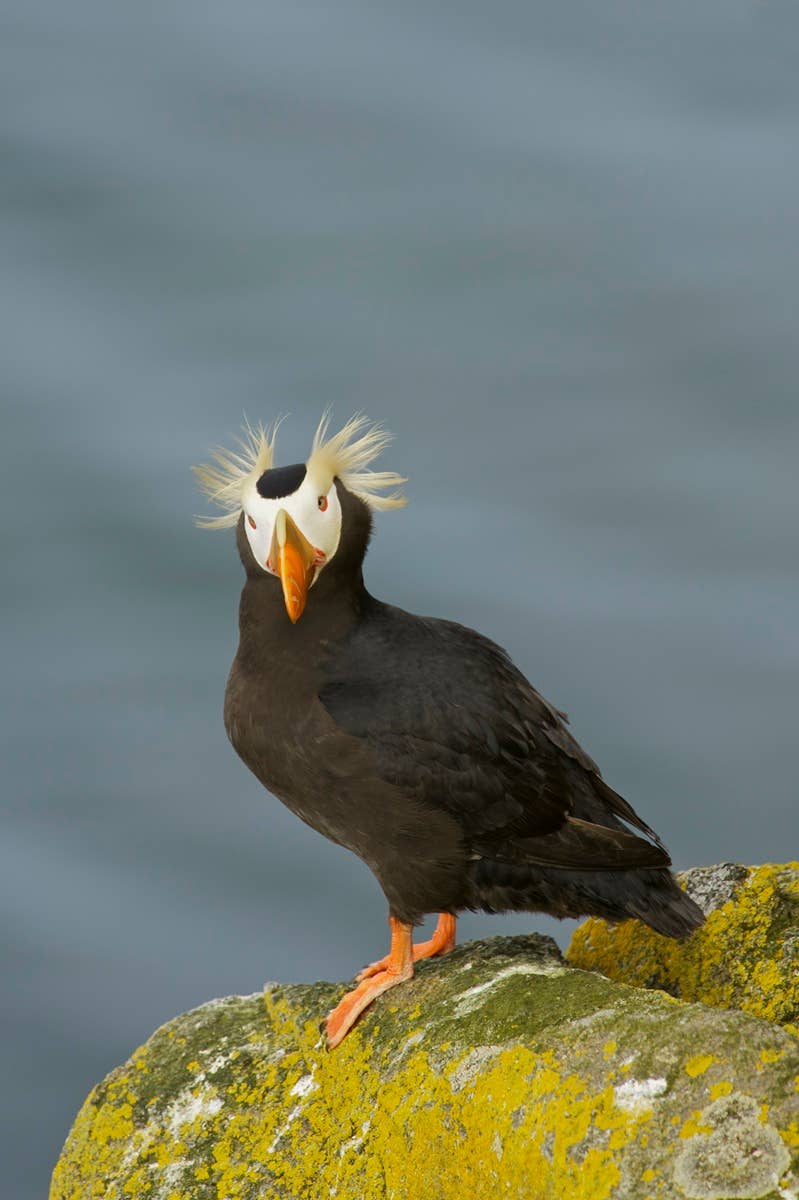
Tufted Puffins return to the Oregon Coast each summer.Getty Images Enrique Aguirre Aves
The presence of puffins along the Oregon Coast is closely tied to the health of the surrounding ocean ecosystem.
Oregon’s offshore waters provide an especially productive feeding environment thanks to cold currents that bring nutrients to the surface, supporting large fish populations. After all, Tufted Puffins rely on small schooling fish such as sand lance, anchovies and herring, which they catch by diving underwater and carry multiple fish back to feed both themselves and their chicks during the nesting season.
Combined with nearby rocky islands that offer protected nesting sites, the region creates an ideal seasonal habitat for breeding puffins and is what brings them back each year. It’s also why Oregon remains one of the most important puffin-viewing regions on the West Coast.
Tips for Spotting Puffins in Oregon
At one point, the Tufted Puffin’s distribution in North America stretched from northern California to British Columbia and the Aleutian Islands of Alaska. However, starting in the 1990s, the North American Tufted Puffin population plummeted in numbers, and now only a few thousand visit the Pacific Northwest every summer, including only a little over 500 puffins in Oregon. If you want the best odds at spotting these rare birds in Oregon, there are a few things you should keep in mind.
Puffins are easiest to spot when you know what to look for—and where to focus your attention. Bring binoculars and scan rocky cliffs and offshore waters, especially during calm mornings or late evenings when the sea is quieter. Watch for quick, low flights over the water or brief pops of movement near the surface as they dive for fish. Patience pays off, since puffins often appear suddenly and disappear just as quickly.
Why Puffin Sightings in Oregon is Special
Puffin sightings along the Oregon Coast are special because they’re both seasonal and fleeting. These seabirds spend most of their lives far offshore, only returning briefly to coastal nesting areas. That short window makes each sighting feel rare, especially when you catch them diving, flying, or gathering near rocky shorelines. Their bright beaks and energetic behavior make even a quick glimpse feel memorable.
Sources:

CURRY COUNTY, Ore. (KPTV) – A Texas man wanted for child sex crimes was arrested in Curry County on Tuesday afternoon.
The Curry County Sheriff’s Office says Kenneth Leatherwood of Bastrop, Texas, was arrested with the help of Oregon State Police and U.S. Marshals just after 12:30 p.m.
Leatherwood, who is accused of sex-related crimes involving a child in Texas, was reportedly found camping in a heavy wooded area near Lucas Lodge in Agness.
Investigators say Leatherwood has been on the run from Curry County law enforcement since June 16 after reports that he had been seen with a stolen car in the Agness area.
Leatherwood was also believed to have stolen weapons with him.
His dog was also found and returned to the suspect’s family in good shape, according to the sheriff’s office.
Copyright 2026 KPTV-KPDX. All rights reserved.
-

 Pennsylvania5 minutes ago
Pa. sees growth in over-65 residents, but overall population stagnates
-

 Rhode Island8 minutes ago
GETTING SUPPORT AT THE FORT – Jamestown Press
-

 South-Carolina13 minutes ago
250 years later, Revolutionary War artifacts still tell South Carolina's story
-

 South Dakota20 minutes ago
US Rep. Dusty Johnson looks ahead after primary defeat
-

 Tennessee23 minutes ago
Tennessee Republicans unveil monument honoring unborn children at State Capitol
-

 Texas28 minutes ago
USDA reports screwworm spread in Texas
-
Utah35 minutes ago
Edwin Munk Woolley — Obituary | Larkin Mortuary
-

 Vermont38 minutes ago
Experienced pros have Vermont Green women’s team on cusp of USLW playoffs


