Oregon
New York’s top football recruit picks Oregon over Syracuse, Fran Brown


Rochester, N.Y, — Wide receiver Messiah Hampton, the top-ranked football prospect in New York in the Class of 2026, has committed to Oregon over Syracuse.
The four-star recruit announced his commitment in Rochester on Friday afternoon, nearly one week after his final visits to Syracuse and Oregon.
Hampton, who plays for Rochester’s James Monroe High School, had his seven finalists pictured on a wheel and spun it, with the wheel ultimately designed to land on Oregon.
The announcement was live-streamed by recruiting website On3.com and attended by local television reporters.
In remarks on the livestream, Hampton said it was Oregon wide receivers coach Ross Douglas Sr. that was the deciding factor for the Ducks.
Douglas coached last year at Syracuse before taking a job with Oregon.
“Couch Douglas, he came from Syracuse,” Hampton said. “We built a great bond.”
Hampton is one of two highly-coveted 2026 wide receivers Syracuse is pursuing, along with five-star recruit Calvin Russell, who is expected to make his college decision on July 5.
A 6-foot-1, 180-pound receiver, Hampton is ranked just outside the top-100 players nationally, according to 247Sports.com.
Syracuse and Oregon were considered by recruiting experts to be the top-two teams on Hampton’s list thanks to Douglas.
The other schools he listed as finalists included Michigan, Penn State, Miami, Georgia and Ohio State.
Hampton can formally sign an agreement to play for Oregon in December.
Syracuse’s 2026 recruiting class is currently ranked No. 24 in the country by 247 Sports. That places the Orange seventh in the ACC.
Only 15 schools in the country have more players ranked as four-star prospects than the Orange’s four.
Syracuse and Fran Brown were trying to land New York’s top recruit for the second straight year.
Syracuse freshman defensive lineman Quante Gillians finished as the top-ranked prospect in 2025 in the 247 rankings, the first time that happened in more than 15 years.


Summer is in full swing, and across the country, the songs of birds and the cheeps of baby chicks are filling the air. While birdwatching season is happening just about everywhere right now, the Pacific Northwest offers something truly special: the chance to see puffins along the Oregon Coast. If you’re wondering when, where and how to see puffins in Oregon, you’re in the right place.
Few wildlife sightings feel as magical as spotting a Tufted Puffin (Fratercula cirrhata) in the wild. These beloved seabirds return to the Oregon Coast each year during their breeding season, drawing birdwatchers, photographers and nature lovers hoping for a glimpse of their bright orange beaks, expressive faces and unmistakable charm. For many visitors, seeing puffins in their natural habitat is a heartwarming coastal experience that captures the spirit of the Pacific Northwest.
Because puffins are seasonal migratory birds that nest in specific coastal areas, timing and location are key. With a bit of planning—and a little luck—you can witness one of Oregon’s most iconic wildlife moments along its rugged coastline. Here are the best places to see puffins on the Oregon Coast.
What Are the Best Places to See Puffins in Oregon?
If you’re wondering where you can you see these cute creatures, there are three spots that are worth going to and are hailed as the best places to see puffins in Oregon.
Haystack Rock, Cannon Beach
Haystack Rock is a popular place where puffins nest in Oregon.Getty Images Big5 Studio
Few wildlife encounters feel as effortless as spotting puffins right from shore, and Haystack Rock at Cannon Beach is one of the rare places where that’s possible.
This towering sea stack isn’t just an Oregon landmark, it’s also a seasonal nesting site for Tufted Puffins, who return here each year to raise their young on the rocky ledges. From the beach, visitors can often catch glimpses of puffins flying to and from the rock or resting along its cliffs, especially during the warmer months when activity peaks.
Because it requires no boat or hike to access, Cannon Beach remains one of the most rewarding and beginner-friendly places to experience puffins in the wild.
Face Rock State Scenic Viewpoint (Bandon)

Image via Getty Images/Moelyn Photos
For a quieter, more immersive coastal experience, Face Rock in Bandon offers a different kind of puffin viewing.
Here, the focus shifts from crowds to coastline where Tufted Puffins and other seabirds nest along offshore rocks just beyond the shoreline. The setting is calmer than Cannon Beach, making it ideal for visitors who want to slow down and scan the horizon for wildlife activity.
Every Saturday and Sunday from now until July 26, Face Rock Wildlife Interpreters will host on-site sessions at Face Rock Wayside from 9 am to 11 am, where guests will get to look out for puffins nesting on Face Rock with the wildlife interpreters’ help. Whether you go puffin-peeping on your own or with a group, be sure to bring binoculars!
Three Arch Rocks National Wildlife Refuge

Image via Getty Images/Bob Stefko
If looking for something a little closer to Portland, Three Arch Rocks is home to the largest breeding colony of Tufted Puffins in Oregon. A trip to Three Arch Rocks National Wildlife Refuge is sure to be a treat for any lovers of the Pacific Northwest’s coastal wildlife.
Not only is it one of the top places in Oregon to spot nesting puffins over the summer, but it is also the only pupping site on the North Oregon coast for the federally-threatened Steller sea lion, one of two sea lion species native to Oregon. Incidentally, the Steller sea lion’s pupping season, which runs from mid-May to mid-July, coincides with the first half of the Tufted Puffin’s nesting season, so right now is the perfect time of year for a visit!
When Do Puffins Arrive on the Oregon Coast?
For a large part of the year, Tufted Puffins live far out at sea across the North Pacific Ocean (in fact, they can be found as far eastward as Japan). However, from right now through August, Tufted Puffins are making their way back to coastal islands along the Oregon coastline to create their nests and raise their young until they are strong enough to join them out at sea. Therefore, if you want to catch a glimpse of them, now’s the perfect time.
What’s the Best Time of Day to See Puffins in Oregon?
These birds don’t follow a predictable shoreline schedule, which is part of what makes spotting them such a rewarding experience. So when’s the best time to see puffins in Oregon? Throughout the day during the breeding season, they move between offshore feeding areas and nesting sites on rocky cliffs and sea stacks. However, early morning and late afternoon often offer the most consistent viewing opportunities, when bird activity around colonies tends to increase and lighting conditions make movement easier to spot from shore.
For visitors hoping to increase their chances, choosing calm, clear days can make distant movement easier to detect against the waves.
What Do Puffins Eat and Why Do They Come to Oregon?
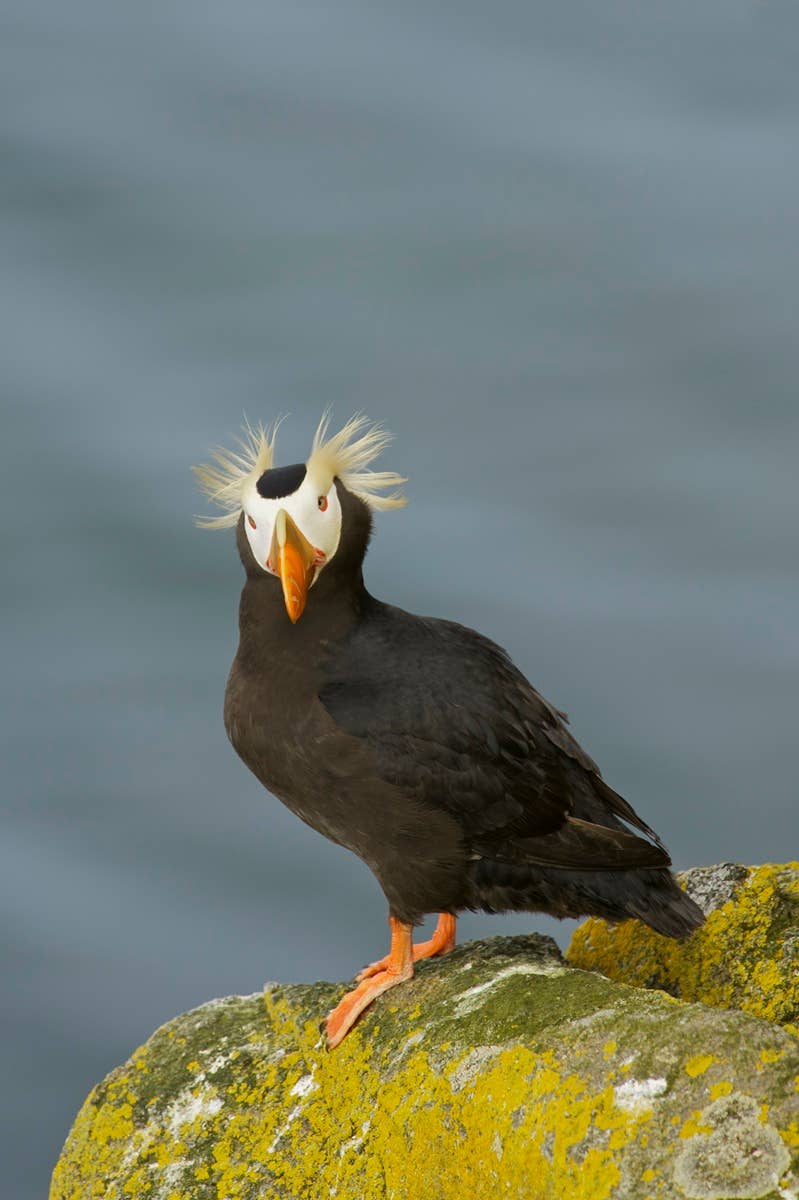
Tufted Puffins return to the Oregon Coast each summer.Getty Images Enrique Aguirre Aves
The presence of puffins along the Oregon Coast is closely tied to the health of the surrounding ocean ecosystem.
Oregon’s offshore waters provide an especially productive feeding environment thanks to cold currents that bring nutrients to the surface, supporting large fish populations. After all, Tufted Puffins rely on small schooling fish such as sand lance, anchovies and herring, which they catch by diving underwater and carry multiple fish back to feed both themselves and their chicks during the nesting season.
Combined with nearby rocky islands that offer protected nesting sites, the region creates an ideal seasonal habitat for breeding puffins and is what brings them back each year. It’s also why Oregon remains one of the most important puffin-viewing regions on the West Coast.
Tips for Spotting Puffins in Oregon
At one point, the Tufted Puffin’s distribution in North America stretched from northern California to British Columbia and the Aleutian Islands of Alaska. However, starting in the 1990s, the North American Tufted Puffin population plummeted in numbers, and now only a few thousand visit the Pacific Northwest every summer, including only a little over 500 puffins in Oregon. If you want the best odds at spotting these rare birds in Oregon, there are a few things you should keep in mind.
Puffins are easiest to spot when you know what to look for—and where to focus your attention. Bring binoculars and scan rocky cliffs and offshore waters, especially during calm mornings or late evenings when the sea is quieter. Watch for quick, low flights over the water or brief pops of movement near the surface as they dive for fish. Patience pays off, since puffins often appear suddenly and disappear just as quickly.
Why Puffin Sightings in Oregon is Special
Puffin sightings along the Oregon Coast are special because they’re both seasonal and fleeting. These seabirds spend most of their lives far offshore, only returning briefly to coastal nesting areas. That short window makes each sighting feel rare, especially when you catch them diving, flying, or gathering near rocky shorelines. Their bright beaks and energetic behavior make even a quick glimpse feel memorable.
Sources:

CURRY COUNTY, Ore. (KPTV) – A Texas man wanted for child sex crimes was arrested in Curry County on Tuesday afternoon.
The Curry County Sheriff’s Office says Kenneth Leatherwood of Bastrop, Texas, was arrested with the help of Oregon State Police and U.S. Marshals just after 12:30 p.m.
Leatherwood, who is accused of sex-related crimes involving a child in Texas, was reportedly found camping in a heavy wooded area near Lucas Lodge in Agness.
Investigators say Leatherwood has been on the run from Curry County law enforcement since June 16 after reports that he had been seen with a stolen car in the Agness area.
Leatherwood was also believed to have stolen weapons with him.
His dog was also found and returned to the suspect’s family in good shape, according to the sheriff’s office.
Copyright 2026 KPTV-KPDX. All rights reserved.

PORTLAND Ore. (KPTV) – Fireworks are on sale in Oregon until July 6, but state and local rules limit where they can be used and what types are allowed.
In Portland, fireworks use and sales are banned year-round.
Fireworks are also banned on beaches and in state and national parks.
Statewide, fireworks that fly into the air, explode, act unpredictably or move more than 12 feet horizontally are illegal. Banned fireworks include sky lanterns, missiles, rockets, Roman candles, firecrackers, cherry bombs and M-80s.
Fountains, sparklers, ground spinners and smoke devices are among the fireworks allowed under state rules.
Officials said people should not call 911 to report illegal fireworks. They said reports should go to the non-emergency line for the area.
First responders said there were 263 fires across Portland during last year’s fireworks season, and 27 were caused by fireworks.
For more details about fireworks regulation in Oregon, click here.
In Washington, fireworks sales legally begin Sunday and run through July 4.
Copyright 2026 KPTV-KPDX. All rights reserved.
-

 Tennessee4 seconds ago
Dolly Parton makes surprise public appearance amid health battle
-

 Texas3 minutes ago
Why Texas? Explaining ins and outs of NHL exploring team for Houston or Austin
-

 Utah8 minutes ago
4 Prospects the Utah Jazz Could Trade Up to Draft in the Second Round
-

 Washington13 minutes ago
Inside Woodlawn Cemetery’s mission to preserve history
-

 Vermont15 minutes ago
Vermont Attorney General will not prosecute state trooper who fatally shot unarmed Putney man – VTDigger
-

 Virginia18 minutes ago
Virginia Tech introduces Brian White as new Athletics Director
-

 Wisconsin30 minutes ago
Top 100 Prospect Visiting Wisconsin on Wednesday
-

 West Virginia33 minutes ago
Yeager Airport director receives four percent pay increase – WV MetroNews

