Oregon
‘It’s local. It’s inexpensive’: Oregon community colleges to offer new program for bachelor’s degrees in nursing


Three generations of Delayna O’Daniels’ family have worked as nurses at Samaritan North Lincoln Hospital in Lincoln City.
Following in her mother’s and grandmother’s footsteps, O’Daniels became a certified nursing assistant and began working at the hospital about three years ago. Now, she’s studying for her associate degree in nursing at Oregon Coast Community College.
She knows she wants to stay in Lincoln City. But she’s also trying to figure out the best way to get a bachelor’s degree in nursing, and perhaps a master’s too.
“Education is one thing that nobody can take away from you,” she said.
Her aspirations make her a prime candidate for a new program: a bachelor’s of science in nursing degree that will soon be offered by a consortium of six Oregon community colleges, including Oregon Coast. Designed for nurses who already have their associate degree, it isn’t expected to directly address the state’s dire nursing shortage, but administrators hope the mostly online program will encourage nurses to stay local and offer a boost to their careers.
The six colleges are aiming to get the 15-month program off the ground by fall of 2026, though they’re still undergoing the lengthy process of approval and accreditation. Besides Oregon Coast, the consortium consists of Klamath Community College, Central Oregon Community College, Chemeketa Community College, Linn-Benton Community College and Treasure Valley Community College.
The plan is to run the bachelor’s program jointly, with each school offering seven slots for a total of 42 seats per year, said Holly Nelson, Chemeketa’s chief workforce innovation and community success officer.
One of the consortium’s goals is to encourage nurses like O’Daniels not to leave the area, according to Central Oregon Community College’s Julie Downing, an instructional dean. The program is designed so students can work while taking two classes per three-month term.
“They’ll be able to stay here in their own community,” Downing said. “They can still continue to work in their home community and take classes from their local community colleges.”
At the moment, seventeen community colleges offer associate nursing degrees in the state. Their graduates often get more advanced degrees via options like Oregon Health & Science University’s registered nurse to bachelor’s program. Many also turn to online programs hosted elsewhere.
The chance to get bachelor’s degrees in any field is still quite new at Oregon community colleges.
In 2019, the state passed a law allowing community colleges to develop bachelor’s in applied sciences. But because nursing doesn’t count as an “applied science,” schools had to wait for the Legislature to pass a second law last year specifically allowing bachelor’s degrees in nursing.
To Lesley Ogden, the CEO of Samaritan North Lincoln Hospital and Samaritan Pacific Communities Hospital, the program will help prepare local nurses to provide better care: “It sets you up for the leadership and the future.”
With the Oregon Center for Nursing estimating that state programs need to graduate about 1,600 more nurses each year to meet demand, any new initiative stirs up talk of addressing the nursing shortage. But because the community college program only accepts nurses who already have an associate degree, it won’t directly add to the total number of Oregon nurses.
John Wykoff, deputy director of the Oregon Community College Association, said he has acknowledged that the program won’t make a huge dent in the nursing shortage from the start.
“This is not going to solve the nursing shortage,” Wykoff said. “This is going to be really impactful for the students that are in the programs, but … these aren’t easy programs to just ramp up at a huge scale.”
Jana Bitton, executive director for the Oregon Center for Nursing, agreed with that assessment. But she also said the program is poised to keep nurses in rural areas where they already have ties. And for individual careers, she said the program could offer a distinct push forward.
Students can become registered nurses after getting their associate degree, but many hospitals only employ those with bachelor’s degrees, Bitton said. And those working in hospitals make about $58 an hour on average, compared to between $48 and $54 in other workplaces like residential facilities, a 2023 Oregon Center for Nursing study found.
“If you’re going to have a bachelor’s degree and you’re going to be working in a hospital that requires you to have a bachelor’s degree,” Bitton said, “… you’re going to have a better opportunity to make more money.”
Nursing student Jason Kincaid, who’s pursuing his associate degree at Central Oregon Community College, knows that. He wants a bachelor’s in nursing, but he also wants to stay in Bend, where his son is growing up.
Getting to stay at Central Oregon seems like a promising option, he said.
“It’s local. It’s inexpensive. I know the instructors. I know their standards. I know the facility,” Kincaid said. “It takes the unknown factor out.”
Tuition costs are still in discussion; administrators said they’re planning to make it slightly more expensive than the associate degree but cheaper than many other options in the state.
At Chemeketa Community College, which offers a bachelor’s of applied science, tuition and fees for each credit hour cost $212 for in-state students. Nelson said tuition for the bachelor’s of nursing will likely be in that range. Students will need to take 60 credits for their core classes and get an extra 30 or so credits from elective courses or prerequisites they’ve already taken.
Nursing students Aurora Gale, left, and Susan Oh practice their skills at Central Oregon Community College.Courtesy of Timothy Park
Second-year nursing student Susan Oh said she’s appreciated the affordability of Central Oregon Community College, where she’s pursuing her associate degree. As she sets sights on her bachelor‘s, she said she’s interested in the new community college program, especially since she likes the education at Central Oregon.
With the goal of working in acute care at a hospital, having a bachelor’s will open up a huge number of opportunities, Oh said. That includes working in a more intense environment, earning an advanced degree and perhaps becoming a nursing teacher one day.
Going into nursing education is certainly what many of the consortium administrators are hoping their students will do.
At the moment, Oregon is stuck in a Catch-22: While it deals with a nursing shortage, it’s also stuck in a nurse educator shortage, meaning it can’t produce as many new nurses as it needs. Nurse educators also make about $49,000 less per year than nurses do in practice, according to a report by the Oregon Longitudinal Data Collaborative, adding an additional hurdle to recruitment.
The community college consortium is handling the problem by starting small and splitting the load. With each college taking on only two classes or so apiece, they’re largely reshuffling their staff, hiring minimal faculty to handle the additional load.
In the long term, though, Downing suggested the program could help address the nurse educator shortage. Nurses need higher degrees to teach than to work as practicing nurses, and that starts with getting a bachelor’s.
O’Daniels, at least, is aiming to follow that path. She sees the impact of the shortage in nursing educators at Oregon Coast, where she said faculty often seem stressed and stretched thin. Crystal Bowman, the college’s dean of nursing and allied health, acknowledged the school is understaffed.
The experience, O’Daniels said, has inspired her to give back. She knows she wants to work as a practicing nurse for some years, but eventually, she’d like to end up as a faculty member at her alma mater.
“When you have a good instructor or a good clinical instructor, it really helps you be a good nurse,” she said. “I want to give that back and make sure people — not only the students, but the community — can have that type of success later down the road.”
— Aviva Bechky covers politics and education for The Oregonian/OregonLive. They can be reached at abechky@oregonian.com or on X at @avivabechky.
Our journalism needs your support. Subscribe today to OregonLive.com.



PORTLAND, Ore. (KATU) — The Oregon Zoo has welcomed a second red panda to their ranks this month, as 6-year-old Liu gets settled in to the habitat.
Liu comes to Portland from the Toledo Zoo as part of the Association of Zoos and Aquariums’ Species Survival Plan for red pandas.
He arrived just weeks after Enoki, a female red panda, and caregivers will soon introduce the duo in the hopes that they may eventually help add to the population of the endangered species.
PAST COVERAGE | Enoki the red panda joins Oregon Zoo, ‘exploring, snacking & napping’ in new habitat
For those coming to see the pandas, they should be easy to tell apart. Liu has a blonde tail, and Enoki is much smaller with a darker coat.
“He’s very handsome,” said Dr. Carlos Sanchez, the zoo’s director of animal health, who stopped by Liu’s habitat to observe, a red panda plushy tucked under one arm. “His tail is so blond — surfer blond.”
Liu was born on June 28, 2019 at Prospect Park Zoo in Brooklyn. His name means “willow” in Mandarin Chinese, a nod to his mother, whose name is also Willow.
Enoki is nearly three years old, and is of the refulgens subspecies of red panda, known for having darker faces and more prominent tail rings.
“These two represent a species in trouble,” said Kelly Gomez, who oversees the zoo’s red panda area. “In the past 25 years, habitat loss, poaching and the illegal wildlife trade have wiped out nearly half the world’s red panda population. Hopefully, we can help inspire a new chapter in the conservation of this incredible species.”
The duo joins the Oregon Zoo family more than a year after the death of Moshu, the zoo’s previous resident red panda who was dubbed “Sir Snacks-a-Lot.” Moshu was 14 years old.
More info from the Oregon Zoo.

Summer is in full swing, and across the country, the songs of birds and the cheeps of baby chicks are filling the air. While birdwatching season is happening just about everywhere right now, the Pacific Northwest offers something truly special: the chance to see puffins along the Oregon Coast. If you’re wondering when, where and how to see puffins in Oregon, you’re in the right place.
Few wildlife sightings feel as magical as spotting a Tufted Puffin (Fratercula cirrhata) in the wild. These beloved seabirds return to the Oregon Coast each year during their breeding season, drawing birdwatchers, photographers and nature lovers hoping for a glimpse of their bright orange beaks, expressive faces and unmistakable charm. For many visitors, seeing puffins in their natural habitat is a heartwarming coastal experience that captures the spirit of the Pacific Northwest.
Because puffins are seasonal migratory birds that nest in specific coastal areas, timing and location are key. With a bit of planning—and a little luck—you can witness one of Oregon’s most iconic wildlife moments along its rugged coastline. Here are the best places to see puffins on the Oregon Coast.
What Are the Best Places to See Puffins in Oregon?
If you’re wondering where you can you see these cute creatures, there are three spots that are worth going to and are hailed as the best places to see puffins in Oregon.
Haystack Rock, Cannon Beach
Haystack Rock is a popular place where puffins nest in Oregon.Getty Images Big5 Studio
Few wildlife encounters feel as effortless as spotting puffins right from shore, and Haystack Rock at Cannon Beach is one of the rare places where that’s possible.
This towering sea stack isn’t just an Oregon landmark, it’s also a seasonal nesting site for Tufted Puffins, who return here each year to raise their young on the rocky ledges. From the beach, visitors can often catch glimpses of puffins flying to and from the rock or resting along its cliffs, especially during the warmer months when activity peaks.
Because it requires no boat or hike to access, Cannon Beach remains one of the most rewarding and beginner-friendly places to experience puffins in the wild.
Face Rock State Scenic Viewpoint (Bandon)

Image via Getty Images/Moelyn Photos
For a quieter, more immersive coastal experience, Face Rock in Bandon offers a different kind of puffin viewing.
Here, the focus shifts from crowds to coastline where Tufted Puffins and other seabirds nest along offshore rocks just beyond the shoreline. The setting is calmer than Cannon Beach, making it ideal for visitors who want to slow down and scan the horizon for wildlife activity.
Every Saturday and Sunday from now until July 26, Face Rock Wildlife Interpreters will host on-site sessions at Face Rock Wayside from 9 am to 11 am, where guests will get to look out for puffins nesting on Face Rock with the wildlife interpreters’ help. Whether you go puffin-peeping on your own or with a group, be sure to bring binoculars!
Three Arch Rocks National Wildlife Refuge

Image via Getty Images/Bob Stefko
If looking for something a little closer to Portland, Three Arch Rocks is home to the largest breeding colony of Tufted Puffins in Oregon. A trip to Three Arch Rocks National Wildlife Refuge is sure to be a treat for any lovers of the Pacific Northwest’s coastal wildlife.
Not only is it one of the top places in Oregon to spot nesting puffins over the summer, but it is also the only pupping site on the North Oregon coast for the federally-threatened Steller sea lion, one of two sea lion species native to Oregon. Incidentally, the Steller sea lion’s pupping season, which runs from mid-May to mid-July, coincides with the first half of the Tufted Puffin’s nesting season, so right now is the perfect time of year for a visit!
When Do Puffins Arrive on the Oregon Coast?
For a large part of the year, Tufted Puffins live far out at sea across the North Pacific Ocean (in fact, they can be found as far eastward as Japan). However, from right now through August, Tufted Puffins are making their way back to coastal islands along the Oregon coastline to create their nests and raise their young until they are strong enough to join them out at sea. Therefore, if you want to catch a glimpse of them, now’s the perfect time.
What’s the Best Time of Day to See Puffins in Oregon?
These birds don’t follow a predictable shoreline schedule, which is part of what makes spotting them such a rewarding experience. So when’s the best time to see puffins in Oregon? Throughout the day during the breeding season, they move between offshore feeding areas and nesting sites on rocky cliffs and sea stacks. However, early morning and late afternoon often offer the most consistent viewing opportunities, when bird activity around colonies tends to increase and lighting conditions make movement easier to spot from shore.
For visitors hoping to increase their chances, choosing calm, clear days can make distant movement easier to detect against the waves.
What Do Puffins Eat and Why Do They Come to Oregon?
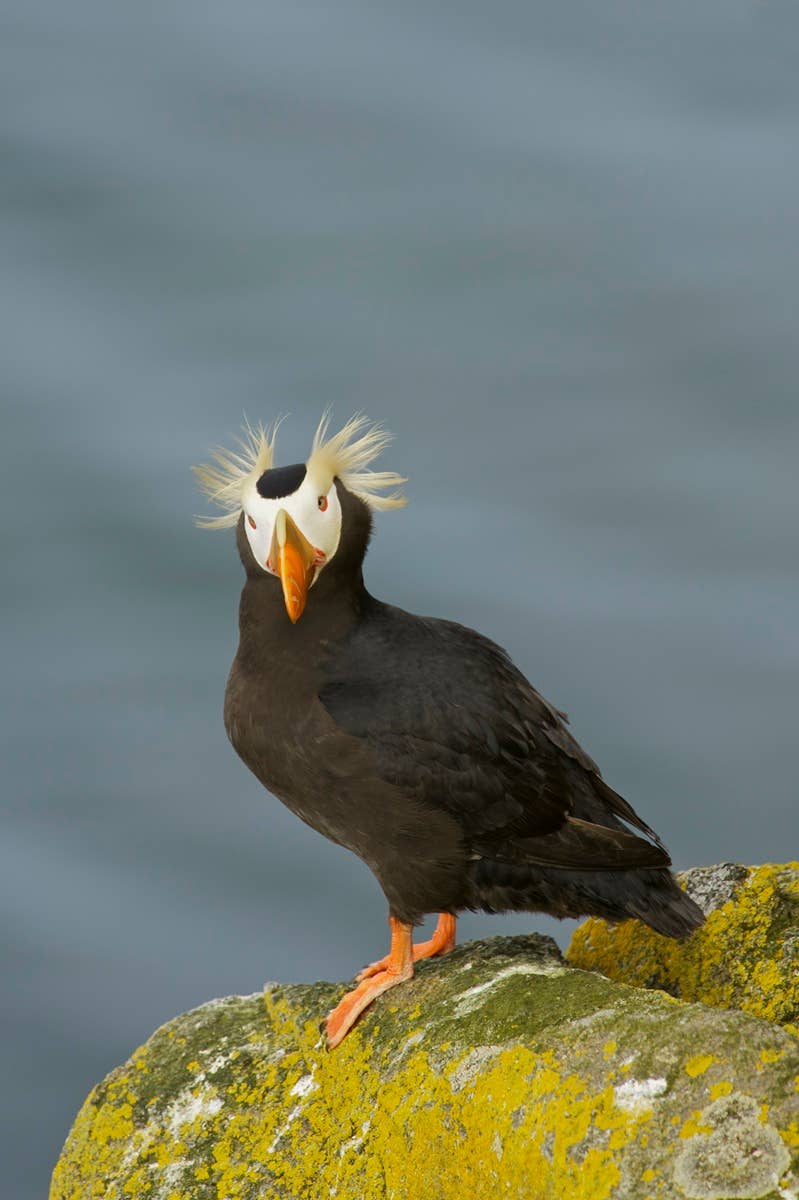
Tufted Puffins return to the Oregon Coast each summer.Getty Images Enrique Aguirre Aves
The presence of puffins along the Oregon Coast is closely tied to the health of the surrounding ocean ecosystem.
Oregon’s offshore waters provide an especially productive feeding environment thanks to cold currents that bring nutrients to the surface, supporting large fish populations. After all, Tufted Puffins rely on small schooling fish such as sand lance, anchovies and herring, which they catch by diving underwater and carry multiple fish back to feed both themselves and their chicks during the nesting season.
Combined with nearby rocky islands that offer protected nesting sites, the region creates an ideal seasonal habitat for breeding puffins and is what brings them back each year. It’s also why Oregon remains one of the most important puffin-viewing regions on the West Coast.
Tips for Spotting Puffins in Oregon
At one point, the Tufted Puffin’s distribution in North America stretched from northern California to British Columbia and the Aleutian Islands of Alaska. However, starting in the 1990s, the North American Tufted Puffin population plummeted in numbers, and now only a few thousand visit the Pacific Northwest every summer, including only a little over 500 puffins in Oregon. If you want the best odds at spotting these rare birds in Oregon, there are a few things you should keep in mind.
Puffins are easiest to spot when you know what to look for—and where to focus your attention. Bring binoculars and scan rocky cliffs and offshore waters, especially during calm mornings or late evenings when the sea is quieter. Watch for quick, low flights over the water or brief pops of movement near the surface as they dive for fish. Patience pays off, since puffins often appear suddenly and disappear just as quickly.
Why Puffin Sightings in Oregon is Special
Puffin sightings along the Oregon Coast are special because they’re both seasonal and fleeting. These seabirds spend most of their lives far offshore, only returning briefly to coastal nesting areas. That short window makes each sighting feel rare, especially when you catch them diving, flying, or gathering near rocky shorelines. Their bright beaks and energetic behavior make even a quick glimpse feel memorable.
Sources:

CURRY COUNTY, Ore. (KPTV) – A Texas man wanted for child sex crimes was arrested in Curry County on Tuesday afternoon.
The Curry County Sheriff’s Office says Kenneth Leatherwood of Bastrop, Texas, was arrested with the help of Oregon State Police and U.S. Marshals just after 12:30 p.m.
Leatherwood, who is accused of sex-related crimes involving a child in Texas, was reportedly found camping in a heavy wooded area near Lucas Lodge in Agness.
Investigators say Leatherwood has been on the run from Curry County law enforcement since June 16 after reports that he had been seen with a stolen car in the Agness area.
Leatherwood was also believed to have stolen weapons with him.
His dog was also found and returned to the suspect’s family in good shape, according to the sheriff’s office.
Copyright 2026 KPTV-KPDX. All rights reserved.
-

 Indiana1 minute ago
Braden Smith to play for hometown Indiana Pacers after NBA draft selection, trade
-

 Iowa8 minutes ago
Iowa one of nine states that won’t have to match portion of federal SNAP benefits
-

 Kansas11 minutes ago
Body believed to be Kansas City highway shooting suspect found in burned home’s basement by family: police
-

 Kentucky16 minutes ago
Kentucky’s Otega Oweh headed to Thunder in 2026 NBA Draft trade
-

 Louisiana23 minutes ago
GOP candidates trade attacks, differ on carbon capture in Louisiana Senate race
-

 Maine26 minutes ago
Hearts of Pine halt 4-game skid with emphatic win
-

 Maryland31 minutes ago
Republican candidates ask judge to block Maryland primary certification
-

 Michigan38 minutes ago
Michigan heatwave on way. See day likely to set a record high

