West
Newsom team torched for image posted in response to mocking of gov’s ‘testicle-crushing’ sitting pose
NEWYou can now listen to Fox News articles!
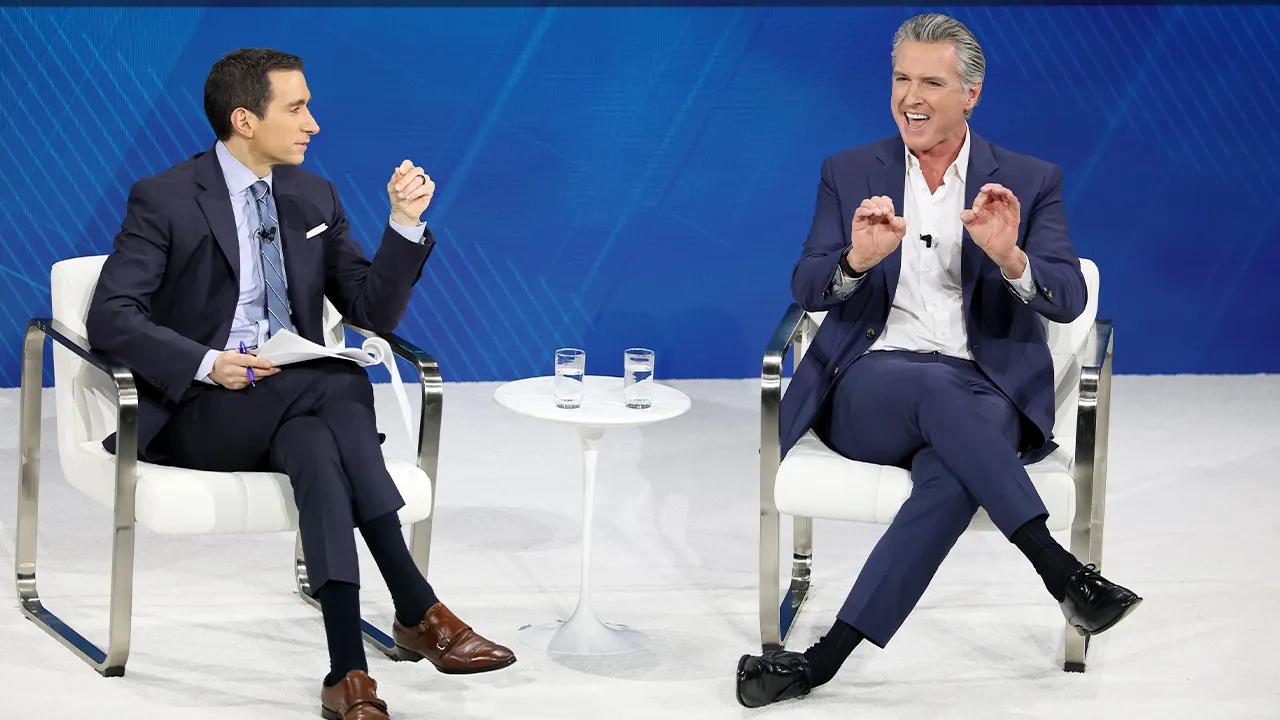
California Gov. Gavin Newsom’s press office responded to a New York Post article mocking his “testicle-crushing” sitting pose with a photo of the politician in an exaggerated, contorted position that quickly went viral.
“Democracy requires flexibility,” Newsom’s office wrote in the post accompanying the image.
HALLE BERRY STUNS CROWD BY CRITICIZING GAVIN NEWSOM, SAYS HE ‘PROBABLY SHOULD NOT BE OUR NEXT PRESIDENT’
The California governor had been ridiculed online after video from his appearance at The New York Times DealBook Summit on Wednesday showed him sitting with his legs tightly crossed, prompting a wave of joking commentary on social media.
“I have never seen a man crush his testicles harder than this dude,” said one user.
LIBERAL COMEDIAN HAS HAD ENOUGH OF NEWSOM’S TRUMP-LIKE TWITTER ANTICS
California Gov. Gavin Newsom speaks at the New York Times DealBook Summit in New York City on Dec. 3, 2025. (Michael M. Santiago/Getty Images)
The press office’s exaggerated photo sparked another round of memes and quips from users, questioning whether the governor’s team had actually meant to post it.
“They… Posted this?” one man wrote.
“Gavin illustrating his taxation policy on your average California residence,” said another user.
CLICK HERE TO DOWNLOAD THE FOX NEWS APP
“What the. When they say ‘the Left can’t meme,’ they’re really not kidding,” another man chimed in.
Newsom himself responded to the viral photo, writing on X, “WOW!”
Read the full article from Here

San Diego, CA
San Diego vacation rental tax proposal sparks debate ahead of committee review
SAN DIEGO (KGTV) — A proposed tax on empty second homes and short-term vacation rentals in San Diego is generating heated debate as it approaches another review by the city’s Rules Committee next week.
The measure, proposed by Councilmember Sean Elo-Rivera, would impose a $5,000 tax per bedroom on vacant second homes and vacation rentals, leaving primary residences and long-term rentals untouched.
He says it could potentially generate up to $135 million annually.
Supporters say it would apply to fewer than 1% of San Diegans while tackling the city’s housing affordability crisis and budget deficit.
“This tax on the 1% could also be used to fund affordable housing projects like the Skyline project behind me,” said David Zepeda, a member of IUPAD DC Local 36, at a press conference Wednesday.
Elo-Rivera and educational coalition propose empty home, vacation rental tax
Bridgette Browning, President of the San Diego Labor Council, argues the tax targets a specific group of people.
“It asks those who have profited so much from our housing crisis to finally pay their fair share and give back to our community,” Browning said.
Labor union members say they’re struggling to afford homes in areas where they work. Zepeda pointed to “homes that at one point were available to working class people.”
Many say the housing shortage affects public safety workers as well. George Duardo, President of San Diego City Firefighters Local 145, warned, “A city that can’t house its firefighters is a city that puts public safety at risk.”
Elo-Rivera says students are being “pushed out of the city where they study, work, and plan their futures.”
However, business leaders strongly oppose the measure. Chris Cate, President and CEO of the San Diego Regional Chamber of Commerce, argues the tax threatens a vital revenue source.
“We feel that this proposal looks at an industry that’s the golden goose for this city in driving tourist tax revenue to pay for basic city services, and they’re going to go after and try to get their hands on more money from this industry,” Cate said.
Cate questions whether the tax would actually create affordable housing.
“There’s no guarantee that the money from this proposal will pay for one new home or new student housing or the like. We do believe that we have a housing crisis in San Diego, absolutely, and the solution to that is to build more housing,” Cate said.
He also warns the tax could reduce rental availability and hurt small businesses that depend on tourism revenue.
“The number of small businesses that rely on these visitors to come into San Diego, not just to stay in those homes, but the money that’s being spent in these neighborhood businesses and small businesses are gonna also see an impact,” Cate said.
Airbnb reports more than 80% of its hosts in San Diego are owned by people who live there.
The Rules Committee will review the proposal next Wednesday. The committee previously advanced it in October with a 3-1 vote.
By early March, the full City Council will determine whether the measure should appear on the June ballot for voters to decide.
This story was reported on-air by a journalist and has been converted to this platform with the assistance of AI. Our editorial team verifies all reporting on all platforms for fairness and accuracy.
Follow ABC 10News Anchor Max Goldwasser on Instagram, Facebook and Twitter.
Alaska
Rare earths and geopolitics: Why Trump wants Greenland and what it means for Alaska
ANCHORAGE, Alaska (KTUU) — President Donald Trump said Wednesday he has “formed the framework of a future deal” on Greenland following meetings with NATO leadership, while also ruling out military force to acquire the Danish territory. The announcement signals a strategic shift in his approach, even as tensions with U.S. Arctic allies remain strained over his aggressive pursuit of control over the resource-rich island.
Speaking at the World Economic Forum in Davos, Switzerland, Trump doubled down on his interest in Greenland as part of broader Arctic security strategy, though he acknowledged the long-term nature of any potential agreement.
“It’s a long-term deal. It’s the ultimate long-term deal, and I think it puts everybody in a really good position, especially as it pertains to security and minerals and everything else,” Trump said.
De-escalation after heated rhetoric
Trump’s announcement that he would roll back threatened tariffs on NATO countries that opposed his Greenland ambitions represents a significant cooling of rhetoric that has dominated discussion for weeks, according to security experts.
Cameron Carlson, dean of the College of Business and Security Management at the University of Alaska Fairbanks, characterized the shift as a necessary step toward restoring international relationships damaged by the president’s aggressive posture.
“I think it’s a signaling to the recognition that President Trump has been able to bring things to a very heated boil,” Carlson said. “Having the rhetoric basically start to cool down, that we will not take military action as he indicated while he was there in Davos, is a tremendous step forward in the relations that we have with our fellow Arctic countries.”
Carlson cautioned that damage to diplomatic relationships with Europe and NATO remains significant.
“I think it’s globally important as well that this starts to basically de-escalate to the point where more focused discussions can take place in terms of how we actually can work with Greenland,” he said.
The Strategic Interest: Rare Earth Minerals and Security
While Trump has emphasized security concerns in Greenland, Carlson said the economic dimension—particularly access to rare earth minerals—appears to be the real driving force behind U.S. interest.
“From an economic perspective, it clearly blunts our ability to partner with countries that are in the region, not just Greenland, but Denmark as well,” Carlson said. “There is a real spillover potential for Alaska in terms of defense spending.”
The Trump administration’s focus on rare earths reflects broader geopolitical competition with China, which currently dominates the global market for these critical minerals essential to modern technology. Carlson explained the stakes.
“Everything that we have come to depend on today, whether it is our cell phone, our computer, our televisions, our automobiles, everything is highly dependent upon our ability to access rare earths.”
Unlike precious metals with concentrated deposits, rare earths require extensive extraction and processing across large areas to yield relatively small amounts of usable material—a process that can take decades and carries significant environmental consequences.
Alaska’s Role and the Golden Dome
Carlson stressed that what makes the United States an Arctic actor is not Washington, but Alaska’s geographic position.
“While that may seem very commonsensical to individuals that live here in Alaska, if you were to look at the lower 48, some individuals would probably say, ‘I failed to see what the real interests of the United States are,’” he said.
Alaska’s strategic importance stems from its vast territory, proximity to Russia, and control over shipping through the Bering Strait—factors that could position the state as a hub for Arctic security infrastructure.
This context makes the “Golden Dome,” a $175 billion missile defense system sponsored by Alaska Sen. Dan Sullivan, a potential “win” for the Trump administration that would also benefit Alaska, according to Carlson.
“Having infrastructure developed here would be a win for the Trump Administration,” Carlson said. “It would likewise be a big win for us in a security context as well, nationally, as it would be for our allies within NATO and our Arctic partners.”
Carlson suggested the Golden Dome represents an alternative pathway forward, noting that, “Alaska is going to be a key component of what we do or what we end up doing when it comes to the Golden Dome,” and could serve as “an off ramp to this where we realize some of the benefit of what will happen in that economic development.”
The Greenland Sovereignty Question
The people of Greenland complicated the rare earth equation when they voted against a mining project in recent elections, signaling their preference for environmental protection over resource extraction. Greenland is not for sale, both the territory and its parent country Denmark have made clear.
Carlson acknowledged this reality.
“They are a sovereign nation, and they have the ability, as they should, for self-determination,” he said. “They have made it very, very clear that that is not for sale, that they want to determine what is going to be in the best interest of them and the territory that they are on over the long term.”
Even if the Trump administration views a dramatic deal as a win, Carlson says any path forward requires carefully navigating partnership with Greenland’s citizens.
“They’re going to have to very carefully navigate that process of taking a look at what it takes to basically partner with the citizens of Greenland if they really want to extract these rare earths and get access to this over the long term,” Carlson said.
A Path Forward
Carlson outlined what he sees as the best outcome: restoration of civil discourse and partnership with NATO, Denmark, and Greenland to develop resource-sharing arrangements that benefit all parties—though perhaps not in the near term.
“I think the easy win that the president could basically determine from this point is that he looks at Arctic security and reinvests in what some of the capabilities are that would provide that umbrella of Arctic security, not only within Greenland, but here in Alaska as well,” Carlson said.
Editor’s note: The Associated Press contributed to this report
Copyright 2026 KTUU. All rights reserved.
Arizona
Arizona Cardinals HC history suggests 4 coaches to be next head coach
If we look at the Cardinals’ history with hiring head coaches, four guys stand out this time around.
The Arizona Cardinals have had a bit of a pattern in the way they hire new head coaches. Since they moved to Arizona, they have alternated between hiring coaches with significant head-coaching experience and guys doing the job for the first time, with one exception.
It is uncanny.
Cardinals history hiring head coaches since coming to Arizona
Their first head-coaching hiring in Arizona was in 1990, They fired Gene Stallings in 1989. He previously had been a head coach in the college ranks at Texas A&M.
Joe Bugel replaced him with no experience. It has gone back and forth since then with one exception.
- 1990 – Joe Bugel, no head-coaching experience
- 1994 – Buddy Ryan, previous NFL head coach
- 1996 – Vince Tobin, no head-coaching experience
- 2001 – Davie McGinnis, no head-coaching experience
- 2004 – Dennis Green, previous NFL head coach
- 2007 – Ken Whisenhunt, no head-coaching experience
- 2013 – Bruce Arians, was interim head coach in 2012 for 12 games
- 2018 – Steve Wilks, was a head coach at a D-II school, never in FBS or NFL
- 2019 – Kliff Kingsbury, head-coaching experience in college (FBS)
- 2023 – Jonathan Gannon, no head-coaching experience
That pattern would suggest the Cardinals’ next hire will have been a head coach before.
What does that mean?
Which candidates have head-coaching experience?
The two finalists the Cardinals wanted to interview a second time who were hired elsewhere were previous head coaches.
New Tennessee Titans head coach Robert Saleh was the head coach for the New York Jets previously. New Miami Dolphins head coach Jeff Hafley was Boston College’s head coach.
Of the candidates the Cardinals have considered, these are the previous head coaches:
- Vance Joseph
- Raheem Morris
- Arthur Smith
- Matt Nagy
Does this mean the Cardinals will hire one of these guys? History says so.
Get more Cardinals and NFL coverage from Cards Wire’s Jess Root and others by listening to the latest on the Rise Up, See Red podcast. Subscribe on Spotify, YouTube or Apple podcasts.
-
Sports4 days agoMiami’s Carson Beck turns heads with stunning admission about attending classes as college athlete
-
Detroit, MI1 week agoSchool Closings: List of closures across metro Detroit
-
Culture1 week agoTry This Quiz on Myths and Stories That Inspired Recent Books
-
Lifestyle1 week agoJulio Iglesias accused of sexual assault as Spanish prosecutors study the allegations
-
Education1 week agoVideo: Lego Unveils New Smart Brick
-
Pittsburg, PA3 days agoSean McDermott Should Be Steelers Next Head Coach
-
Education1 week ago
How a Syrian Hiking Club Is Rediscovering the Country
-
Sports2 days agoMiami star throws punch at Indiana player after national championship loss