Nevada
Northern Nevada businesses and organizations find traffic through van and RV travelers

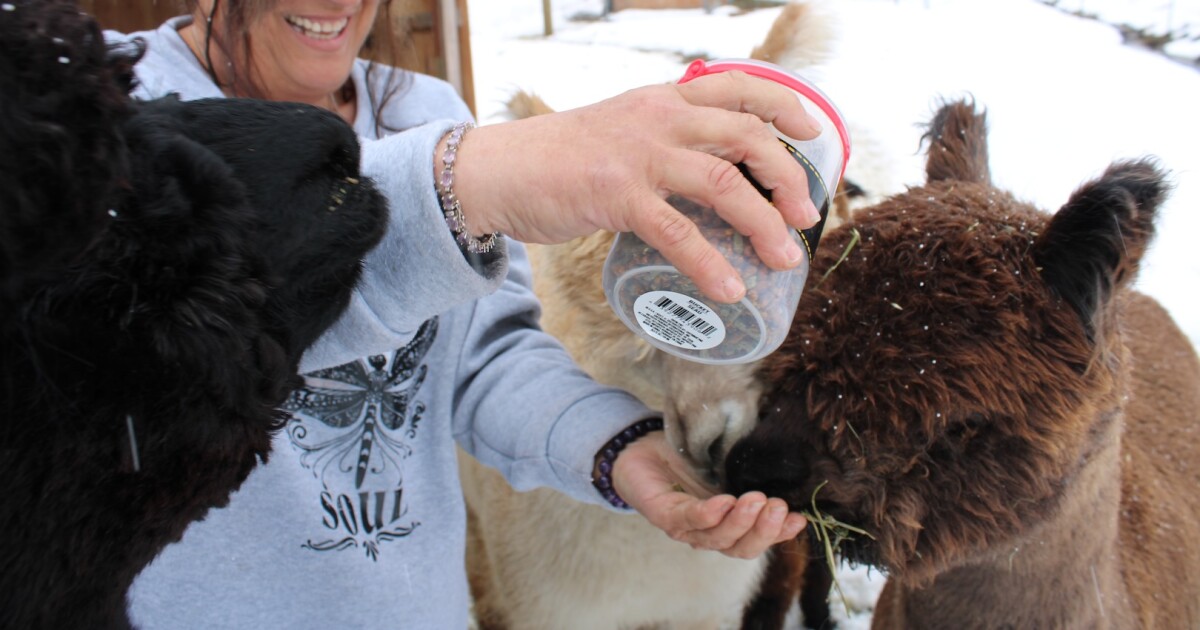
Imagine a ranch with roaming alpacas. And then, off to the side, parked vans and RVs. It’s a sight you might not expect to see on a farm. But for Stacey Payne, this has become a part of her business.
At Olde LYFE Alpacas, people can stay overnight in trailers, vans, tents and more. She rents land on L. Davis Ranch in Washoe Valley, where her chickens, goats, llamas and alpacas live, surrounded by barns and large grazing areas.
Travelers stay overnight on her ranch in two different ways. Payne has a link on her website which allows people to book a parking or camping spot on the ranch. But she’s also signed up for services that do the booking process for her. She’s a host on several websites, including Harvest Hosts.
“I look at every single thing that could possibly draw people here. And people love that they get to have free ranging alpacas around them,” Payne said.
Ember Braun
/
KUNR Public Radio
Payne signed up with these companies because she wants traffic for her agritourism business. In addition to renting out spaces, she also sells yarn and animals. She travels to New Mexico, Arizona, California and other states to shear animals as well.
But with Harvest Hosts, she doesn’t get any income from the booking itself. When travelers book the camping spot on Harvest Hosts, they’re encouraged to spend $30 on products or services from the host. For Payne, this means selling beanies, alpaca wool and felted soaps. People can also walk and feed the alpacas for a fee.
“It really comes down to a lot of different revenue streams. You’ve got to have guests coming. You got to have sales going on, of either animals or product, in order to combat downtimes, like right now, winter. Very few people are traveling this area in their RVs,” she said.

Ember Braun
/
KUNR Public Radio
Other farms around her use Airbnb, but she doesn’t have the means to do that, she said. By hosting campers on the property, she offers something new for the mainly retirees and families that come to visit.
“I think that there’s a huge draw to not staying in a Walmart parking lot. And not staying along the side of the road somewhere or not staying where there’s a bunch of people,” she said.
While hosts can sign up for free, RV users and other travelers pay a fee. Those who sign up with Harvest Hosts pay a $99 yearly membership.
Mary Dierker is one of those members. She and her husband, along with their dog, have used the service for three years.
“So say, we’re in between places and we just need a place where we can park and have some of the local feel of that area. It’s a helpful tool for when you’re traveling long distance,” she said.
Her favorite part is meeting new people on her travels, Dierker said.
“It’s not so much the location for me. It’s those random, wonderful conversations that when you travel, you get to have with another. And the likelihood of you ever seeing them again is slim, but they’re the most engaging,” she said.
Her favorite location is a whiskey distillery out in Wyoming. And as a retired small-business owner, she likes that people get exposed to these local businesses, she said.
“It’s encouraging travelers who so easily get on interstates and blow by unique small communities that have a lot to offer us,” Dierker said.
Many of the businesses and organizations that signed up with these types of companies saw the opportunity to attract more people.
One of them is Gold Hill Hotel, located right next to Virginia City. Tony and Jill Clough own the oldest hotel in Nevada. They’ve operated the business for three years. The weekends between May and October are their busiest, Tony Clough said.
“Going up into Virginia City is difficult from where we are here. Typically, the RV route would be taking the truck route, which runs around the other way. So if we weren’t a part of Harvest Hosts, that would be a whole group of folks we’d probably never see here at the Gold Hill,” Clough said.

Ember Braun
/
KUNR Public Radio
But there’s many more choices than just hotels and ranches. Distilleries, breweries, golf courses, historical sites and even churches are among the locations listed.
One of those churches is the North Valleys Church of the Nazarene. Senior Pastor Pam Plaisted enjoys hearing about other people’s travels. Instead of the recommended $30 purchase, travelers have the chance to leave a donation with the church.
“I feel like it helps the church and gets our name out there. I don’t preach at them per se, but I give them the opportunity, obviously. And I always ask them, ‘Can I pray with you? Is there something I can pray for with you or for you,’ ” she said.
The church typically hosts a majority of female travelers, Plaisted said.
“And I’m like, ‘Aren’t you afraid? You know, you’re out there on your own.’ They’re like, ‘Well, you know, gotta be smart.’ It’s one of the reasons that women will come to our place in particular, is they feel that they’re safe here,” she said.
As for the members themselves, the majority are 55 or older and retired, said Ali Lindsey, senior business development manager for Harvest Hosts. Typically, summers are the busiest season.
“Those special occasions like the solar eclipse are always busier. I think it is beneficial in the way that it drives revenue to those small businesses,” Lindsey said.
KUNR’s Ember Braun is a student at the Reynolds School of Journalism.



Beach Boys co-founder selling Tahoe mansion for $43 million
The Lake Tahoe mansion of one of the original members of the Beach Boys was listed for $43 million.
You love to see it: local artists on local stages. Here are 12 shows featuring local artists between now and Labor Day, including rock, metal, punk, folk, jazz, hip-hop and more.
Bark Hardly
This indie-folk group from Reno headlines an all-local bill with Glitter Bats, Sad Giants and Anabelle and the Desert Scrubs. It starts at 7 p.m. at Holland Project, 140 Vesta St.
The show is July 10. Tickets are $12. Details: 775-742-1858 or hollandreno.org.
Thrashmob
It’s an all-local hip-hop night featuring this artist as headliner. They perform at 7 p.m. at Club Underground, 555 E. 4th St.
The show is July 11. Tickets are $20-$25. Details at clubundergroundreno.com.
Shared Scars
This Reno metal band celebrates the release of its new EP with a show that also features area metal bands Emberwake, Desolist, Titvn and Everglade. It all begins at 7 p.m. at The Alpine, 324 E. 4th St.
The show is July 11. Tickets are $20-$25. Details at thealpine-reno.com.
Cruz Control featuring Bree Rose
Rock, soul and hip-hop mix with this group from Reno. They play at 7 p.m. the first night and 8 p.m. subsequent nights at Terrace Lounge, Peppermill Resort Casino, 2707 S. Virginia St.
Free shows are July 16-18. Details at peppermillreno.com.
Next Question
The popular indie-punk group from Reno kicks off its tour at this show, which also features locals Blackstallion and Ring Pop Wedding. It begins at 7 p.m. at Holland Project, 140 Vesta St.
The show is July 17. Tickets are $10-$12. Details: 775-742-1858 or hollandreno.org.
Vampirates
The longtime local progressive-punk/noise band performs with Sacramento ska punks Lesdystics and local hardcore punk band The Scattering. It all begins at 7:30 p.m. at Lost Highway, 1526 S. Wells Ave.
The show is July 17 and there is a $10 suggested donation. Details at instagram.com/corrigans_losthighway.
Fireman’s Ball Reignited
A benefit for the Silver City Volunteer Fire Department, this show features some big northern Nevada and regional names including former Tahoe resident and country-rock singer/songwriter Matt Axton. Also on the bill are Darren Senn, Charity Kiss and Next Question, among others. It all starts at 1 p.m. at Silver City Park, 385 High St., Silver City.
This free show, with donations accepted, is July 18. Details at instagram.com/silvercityvfd_nv.
Everything Sucks Fest 2026
The annual punk-band event returns, this time with locals Hired Fun, Irreplaceable Beings, Flicker And Fade and Cold Amber Medicine. It begins at 4 p.m. at Shoe Tree Brewing Co., 1496 Old Hot Springs Road, Carson City.
This free show is July 25. Details at instagram.com/shoetreebrewing.
Reno Jazz Orchestra with Matt Mauser
For their Artown show, this local group will be joined by Mauser, an “America’s Got Talent” finalist who specializes in pop and jazz standards. The show starts at 7 p.m. at Robert Z. Hawkins Amphitheater, 6000 Bartley Ranch Road.
This show is July 29. Tickets are $35. Details at artown.org.
Reno Devilles
Rockabilly meets surf-rock with this local band. They play at 8 p.m. at Pele Utu, 1275 Stardust St.
This free show is Aug. 1. Details at instagram.com/peleutureno.
Jakota Wass
A country singer/songwriter from Gardnerville, Wass plays at 7 p.m. at the Outdoor Stage, Brewery Arts Center, 449 W. King St., Carson City.
The free show is Aug. 8. Details at breweryarts.org.
The Electric
A straight-ahead alternative rock band from Reno, the Electric headline an all-local bill that also features Sad Giants and The Jackeyes. They play at 7 p.m. at Holland Project, 140 Vesta St.
The show is Aug. 15. Tickets are $8-$10. Details: 775-742-1858 or hollandreno.org.
Cape Fear Quartet
This swing-jazz quartet from Reno performs at 8 p.m. at Pele Utu, 1275 Stardust St.
This free show is Aug. 15. Details at instagram.com/peleutureno.
Jelly Bread
Soul music meets alternative rock with this Reno group. They perform at 7 p.m. at the Outdoor Stage, Brewery Arts Center, 449 W. King St., Carson City.
The free show is Aug. 15. Details at breweryarts.org.
Band Wars Music Festival
An extension of the contest at Club Underground earlier this year, the participants now get to play at Bartley Ranch. Contest winners No One Good are joined by Split Persona, Interstate, Giant Skunk and Quitter, among others. It all begins at 2 p.m. at Robert Z. Hawkins Amphitheater, 6000 Bartley Ranch Road.
The show is Sept. 5. Tickets are $25-$35. Details at clubundergroundreno.com.

The dilapidated fishing vessel from which “Rose of Nevada” takes its name disappeared into the sea off the coast of Cornwall, England, in 1993, bringing with it two members of a shorthanded crew. A young fisherman who had called out sick that day later died by suicide; some speculate because of survivor’s guilt. There’s a lot of speculation about that old boat. It was the kind of tragedy from which a tight-knit community never really recovers, and this quaint Cornish fishing village has since been stricken by decades of poverty and rot. Now, 33 years later, the Rose has mysteriously returned. It just showed up, ship-shape and empty, sitting there in the harbor one misty Monday morning. All she needs now is another crew.
How and why the boat returned is not for me to say, nor are such matters of much concern to writer-director Mark Jenkin. A time travel adventure with the cadence of a ghost story, “Rose of Nevada” haunts the viewer like the sound of a faint, distant horn on a foggy night. George MacKay stars as Nick, a loving husband and doting dad who has been out of work for some time now. He’s also a bit of a dummy, caving in their apartment’s roof while trying to patch a leak during a rainstorm. Nick finds himself crewing the Rose out of financial necessity — he’s literally trying to put a roof over his family’s heads — while Callum Turner’s gruff drifter Liam comes aboard seemingly because he’s got nothing better to do.
Any other movie would probably try to explain exactly how these boys return from their maiden voyage with a robust catch to find themselves transported back to 1993. They discover their little town thriving and keep running into younger, happier versions of characters we’ve met in the miserable present. Everyone seems to know who Nick and Liam are, but they’re calling them different names. It’s as if the two have somehow stepped into the shoes of those doomed crewmembers from 33 years ago, brought back here by the Rose either to fix history or repeat it.
Part of what makes the movie so mesmerizing is Jenkin’s artisanal approach. He shoots on an ancient, hand-cranked 16mm Bolex camera — a model slightly less advanced than what my film school class was using three decades ago. Jenkin leans into the grainy imperfections of the image, keeping in all the scratches and light leaks that professional labs and technicians typically scrub out. It’s impossible to capture synchronized sound with this equipment, so background noises and the necessarily sparse dialogue are added later in post-production, lending an eerie, uncanny quality to the proceedings.
The set of self-imposed limitations creates its own aesthetic. Jenkin’s hand-cranked camera won’t run for more than 28 seconds at a time, forcing him to tell the story in a series of punchy, discrete images. Instead of wide establishing shots, he favors tight closeups made even more claustrophobic by 16mm’s boxy 1.33 aspect ratio. Our brains assemble the scenes almost like a mental jigsaw puzzle, getting a full sense of the boat without ever getting a complete look at it. Same goes for the town. It’s amazing how many gaps your mind fills in for you when prompted properly.
Jenkin takes a similar approach to the screenplay, allowing rhyming images and visual cues to provide most of the exposition. I went back and watched the movie a second time to try and understand how I always felt like I knew what was happening, even though I couldn’t possibly explain what was going on. The rhythms of the picture feel almost like a dream, obeying their own strict logic that locks in perfectly at the end. Jenkin’s previous picture, the cryptic Cornish island folk tale “Enys Men,” tried similar tactics, but with annoying, off-putting results. Two of the reasons this film connects so much better are the appealing lead performances by MacKay and Turner, a couple of genuine movie stars with whom we are happy to get lost at sea.

MacKay made no impression at all in the insipid, Oscar-winning World War I gimmick film “1917,” but has since revealed himself to be one of our most adventurous young actors. He was electrifying as a bi-curious, homophobic hooligan in the 2024 Boston Underground Film Festival favorite “Femme,” and nailed multiple roles from swoon-worthy stud to psychopathic incel stalker in Bertrand Bonello’s brain-melting “The Beast.” There’s a performative aspect when most actors play dumb, a theatricality that reminds the audience they’re actually smarter than the character. As our stranded family man Nick, MacKay offers no such condescension. He’s a dim bulb with a big heart in an unfathomable situation; his eyes sometimes touchingly, hilariously blank. So much is already beyond Nick, and then all this happens.
Most readers probably know Turner as Mr. Dua Lipa. For those who have trouble keeping track of their cute British boys, he’s the jug-eared, scruffy one who isn’t Josh O’Connor. I’ve never understood the hubbub about this guy, but he won me over here. It’s tough to recall a character in a science-fiction story quite like Liam, who, when experiencing something as foundation-shattering as time travel, figures, “Sure, why not?” and rolls with it. MacKay has some hilarious reaction shots to his screen partner’s blithe acceptance of their new reality. Though I suppose it helps that in this alternate 1993 timeline, Liam winds up with a beautiful wife and daughter, while Nick just gets stuck with overbearing parents.
I’ve been turning over the movie’s ending in my mind for a couple of weeks. “Rose of Nevada” comes to a conclusion both hopeful and bittersweet, depending on how you want to read it. This is an odd, beguiling film that doesn’t look or sound like anything else you’ll see in theaters this year. The raggedly beautiful imagery is a feast of rust and decay, the film itself dinged up like it’s followed the boat here from a distant, mysterious time.
“Rose of Nevada” opens at the Coolidge Corner Theatre on Friday, July 10.

After decades of cheatgrass-fueled wildfires across Nevada, researchers at the University of Nevada, Reno are testing whether cattle can help restore damaged rangelands by spreading native seeds as they graze.
Cheatgrass, an invasive plant common across the Great Basin, dries out early and can fuel larger wildfires, making it harder for native vegetation to return. UNR postdoctoral scholar William Richardson said the plant helps create a self-reinforcing cycle.
“Cheatgrass grows, it creates more wildfires, that allows more cheatgrass to grow, and it becomes a bigger and bigger issue. That’s why we’re seeing all these mega fires spreading across the Great Basin,” Richardson said.
The challenge continues after flames are out. In Nevada’s arid climate, native plants can struggle to reestablish, while cheatgrass often returns quickly.
UNR tests whether cow manure can help restore Nevada landscapes after wildfires
“We struggle with getting five to eight inches of rain a year. Trying to restore a native community in those very arid conditions are extremely difficult,” Richardson said.
Ewe won’t believe it: Sheep munch away at Reno’s wildfire worries in Arrowcreek area
Ranchers already use targeted grazing to reduce cheatgrass. Now, UNR researchers are studying whether cattle can also help reseed the landscape. The approach mixes native grass seeds into protein supplements cattle already eat. Researchers then track whether the seeds can survive digestion and be spread naturally across the range after being deposited in manure.
“We’re already using cattle to combat cheatgrass through targeted grazing, and the ultimate goal is to bring native species back across the landscape, so why don’t we combine those two ideas?” Richardson said.
In lab testing, researchers evaluated special seed coatings designed to help some seeds survive a cow’s digestive system. The results showed certain species could make it through the process and still germinate after being deposited in manure, Richardson said, though some seeds need more protection than others.
UNR tests whether cow manure can help restore Nevada landscapes after wildfires
“Some species naturally have a very thin seed coat and require more protection, while others can go through the gut of a cow easy peasy lemon squeezy,” he said.
The project is expected to move into field testing this fall at Horseshoe Ranch near Eureka, where researchers will track whether seeds can not only survive digestion but also establish new plants on the landscape.
“It’s a passive way to restore the landscape. Instead of having to go in with a tractor or seed from an airplane, you can use cows that are already there,” Richardson said.
UNR tests whether cow manure can help restore Nevada landscapes after wildfires
Researchers said the method is not intended to replace traditional restoration work, but to add another tool for land managers and ranchers. If the field trials are successful, they said the approach could eventually help restore thousands — or even hundreds of thousands — of acres across the Great Basin.
-

 Nevada4 minutes ago
Local artists on Northern Nevada stages, now through Labor Day weekend
-

 New Hampshire6 minutes ago
Trans athletes drop lawsuit to gain access to girls’ sports in New Hampshire after SCOTUS ruling
-

 New Jersey11 minutes ago
Family describes frantic moments delivering baby on the NJ Turnpike
-

 New Mexico19 minutes ago
Hidden gem in Cloudcroft, New Mexico has best BBQ in US
-

 North Carolina22 minutes ago
North Carolina Airport Looks to Expand Commercial Service | AirlineGeeks.com
-

 North Dakota27 minutes ago
San Francisco plots risky socialist bank modeled after controversial experiment
-

 Ohio34 minutes ago
Feeling itchy? Ohio leads nation with 6 cities on Orkin’s 2026 bed bug list
-

 Oklahoma36 minutes ago
Oklahoma’s Brent Venables named to 2026 Dodd Trophy Preseason watch list

