
Connect with us

Nevada

Conner Fire grows to nearly 14,000 acres; evacuations remain in place as evacuation site closes

Published

on

Conner Fire grows to nearly 14,000 acres; evacuations remain in place as evacuation site closes


9:20 P.M. UPDATE:

The Conner Fire has grown massively in size from its last update. It has now burned 13,901 acres.

The fire was mapped to its updated size using an infrared-equipped helicopter that flew around its perimeter.

Advertisement

The fire is showing extreme wind-driven behavior, spreading quickly and with high intensity.

489 personnel are responding to it, and firefighters will remain on the fire throughout the night.


8:50 P.M. UPDATE:

Advertisement

The Douglas County Community & Senior Center is closing as an evacuation site for the Conner Fire since no evacuees are currently using it.

The East Fork Fire Protection District made the announcement on its Instagram page this evening.

The agency says it is ready to reopen the evacuation center if needed.

The large animal evacuation site at the Douglas County Fairgrounds remains open.

Advertisement

ORIGINAL ARTICLE:

A 2,500-acre fire, dubbed the Conner Fire, is prompting evacuations near the Pine View Estates area, located southeast of Gardnerville.

East Fork Fire says it responded to several homes on fire around 1:30 a.m. with high winds pushing flames into nearby brush, in Carter Springs.


Advertisement


The areas in yellow are under precautionary evacuation warning. 

That precautionary warning has recently been expanded to a portion of the Fish Springs area.

Evacuation orders have been issued for residents on the following roads and areas (which you can see also above in the map)

* Old Ranch Road north of Out-R-Way

Advertisement

* Pine Nut Road from Dump Road to Out R Way 

* Lola Road

* Edward Road

* Jackson Road

* Bodie Flat area

Advertisement

* Conner Way area

Residents in these areas are urged to evacuate immediately. 

Evacuees can go to the Douglas County Community & Senior Center during regular business hours at 1329 Waterloo Lane in Gardnerville.

Large animals can be evacuated to the Douglas County Fairgrounds at 920 Dump Road in Gardnerville. Please enter through the east entrance past the main entrance.

Fire officials are urging residents in the affected area to heed all evacuation warnings. Reverse emergency phone calls are going out to residents. 

Advertisement

The Silver Legacy, Eldorado and Circus Circus in Reno are offering emergency room rates for evacuees of $59 per night with waived resort fees. To book a room, call 1-800-223-7277.
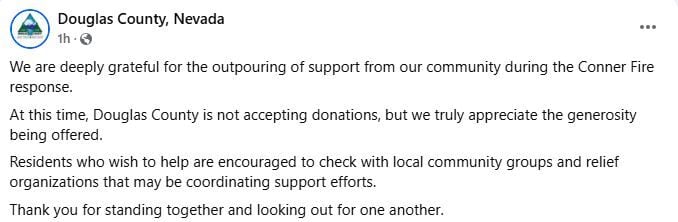


Conner Fire donations


East Fork Fire Protection District, Truckee Meadows Fire & Rescue, BLM, Reno Fire Department, Carson City Fire Department, Tahoe Douglas Fire Protection District and Forest Service are assisting.

An aircraft is currently assisting with fire mapping efforts, and additional air resources have been requested to support suppression operations.

Advertisement

Drivers traveling along U.S. 395 are asked to watch out for emergency vehicles.

Officials are also asking the public to avoid the area to ensure the safety of both first responders and the public.

The cause of the initial fire remains under investigation.

Gusty winds, with speeds reaching up to 45 miles per hour, combined with low relative humidity, are creating extremely challenging firefighting conditions, according to a release from the Bureau of Land Management.

Due to these extreme wind conditions, all aircraft have been grounded this afternoon, limiting aerial suppression capabilities.

Advertisement


Source link

Nevada

Odd and beguiling ‘Rose of Nevada’ will haunt viewers

Published

on

Odd and beguiling ‘Rose of Nevada’ will haunt viewers


The dilapidated fishing vessel from which “Rose of Nevada” takes its name disappeared into the sea off the coast of Cornwall, England, in 1993, bringing with it two members of a shorthanded crew. A young fisherman who had called out sick that day later died by suicide; some speculate because of survivor’s guilt. There’s a lot of speculation about that old boat. It was the kind of tragedy from which a tight-knit community never really recovers, and this quaint Cornish fishing village has since been stricken by decades of poverty and rot. Now, 33 years later, the Rose has mysteriously returned. It just showed up, ship-shape and empty, sitting there in the harbor one misty Monday morning. All she needs now is another crew.

How and why the boat returned is not for me to say, nor are such matters of much concern to writer-director Mark Jenkin. A time travel adventure with the cadence of a ghost story, “Rose of Nevada” haunts the viewer like the sound of a faint, distant horn on a foggy night. George MacKay stars as Nick, a loving husband and doting dad who has been out of work for some time now. He’s also a bit of a dummy, caving in their apartment’s roof while trying to patch a leak during a rainstorm. Nick finds himself crewing the Rose out of financial necessity — he’s literally trying to put a roof over his family’s heads — while Callum Turner’s gruff drifter Liam comes aboard seemingly because he’s got nothing better to do.

George MacKay (left) and Callum Turner in writer-director Mark Jenkin’s “Rose of Nevada.” (Courtesy Ian Kingsnorth/Bosena)

Any other movie would probably try to explain exactly how these boys return from their maiden voyage with a robust catch to find themselves transported back to 1993. They discover their little town thriving and keep running into younger, happier versions of characters we’ve met in the miserable present. Everyone seems to know who Nick and Liam are, but they’re calling them different names. It’s as if the two have somehow stepped into the shoes of those doomed crewmembers from 33 years ago, brought back here by the Rose either to fix history or repeat it.

Part of what makes the movie so mesmerizing is Jenkin’s artisanal approach. He shoots on an ancient, hand-cranked 16mm Bolex camera — a model slightly less advanced than what my film school class was using three decades ago. Jenkin leans into the grainy imperfections of the image, keeping in all the scratches and light leaks that professional labs and technicians typically scrub out. It’s impossible to capture synchronized sound with this equipment, so background noises and the necessarily sparse dialogue are added later in post-production, lending an eerie, uncanny quality to the proceedings.

Advertisement

The set of self-imposed limitations creates its own aesthetic. Jenkin’s hand-cranked camera won’t run for more than 28 seconds at a time, forcing him to tell the story in a series of punchy, discrete images. Instead of wide establishing shots, he favors tight closeups made even more claustrophobic by 16mm’s boxy 1.33 aspect ratio. Our brains assemble the scenes almost like a mental jigsaw puzzle, getting a full sense of the boat without ever getting a complete look at it. Same goes for the town. It’s amazing how many gaps your mind fills in for you when prompted properly.

Jenkin takes a similar approach to the screenplay, allowing rhyming images and visual cues to provide most of the exposition. I went back and watched the movie a second time to try and understand how I always felt like I knew what was happening, even though I couldn’t possibly explain what was going on. The rhythms of the picture feel almost like a dream, obeying their own strict logic that locks in perfectly at the end. Jenkin’s previous picture, the cryptic Cornish island folk tale “Enys Men,” tried similar tactics, but with annoying, off-putting results. Two of the reasons this film connects so much better are the appealing lead performances by MacKay and Turner, a couple of genuine movie stars with whom we are happy to get lost at sea.

From left, Callum Turner and George MacKay in writer-director Mark Jenkin's
From left, Callum Turner and George MacKay in writer-director Mark Jenkin’s “Rose of Nevada.” (Courtesy Steve Tanner/1-2 Special)

MacKay made no impression at all in the insipid, Oscar-winning World War I gimmick film “1917,” but has since revealed himself to be one of our most adventurous young actors. He was electrifying as a bi-curious, homophobic hooligan in the 2024 Boston Underground Film Festival favorite “Femme,” and nailed multiple roles from swoon-worthy stud to psychopathic incel stalker in Bertrand Bonello’s brain-melting “The Beast.” There’s a performative aspect when most actors play dumb, a theatricality that reminds the audience they’re actually smarter than the character. As our stranded family man Nick, MacKay offers no such condescension. He’s a dim bulb with a big heart in an unfathomable situation; his eyes sometimes touchingly, hilariously blank. So much is already beyond Nick, and then all this happens.

Most readers probably know Turner as Mr. Dua Lipa. For those who have trouble keeping track of their cute British boys, he’s the jug-eared, scruffy one who isn’t Josh O’Connor. I’ve never understood the hubbub about this guy, but he won me over here. It’s tough to recall a character in a science-fiction story quite like Liam, who, when experiencing something as foundation-shattering as time travel, figures, “Sure, why not?” and rolls with it. MacKay has some hilarious reaction shots to his screen partner’s blithe acceptance of their new reality. Though I suppose it helps that in this alternate 1993 timeline, Liam winds up with a beautiful wife and daughter, while Nick just gets stuck with overbearing parents.

I’ve been turning over the movie’s ending in my mind for a couple of weeks. “Rose of Nevada” comes to a conclusion both hopeful and bittersweet, depending on how you want to read it. This is an odd, beguiling film that doesn’t look or sound like anything else you’ll see in theaters this year. The raggedly beautiful imagery is a feast of rust and decay, the film itself dinged up like it’s followed the boat here from a distant, mysterious time.


“Rose of Nevada” opens at the Coolidge Corner Theatre on Friday, July 10.

Advertisement


Source link

Continue Reading

Nevada

UNR tests whether cow manure can help restore Nevada landscapes after wildfires

Published

on

UNR tests whether cow manure can help restore Nevada landscapes after wildfires


After decades of cheatgrass-fueled wildfires across Nevada, researchers at the University of Nevada, Reno are testing whether cattle can help restore damaged rangelands by spreading native seeds as they graze.

Cheatgrass, an invasive plant common across the Great Basin, dries out early and can fuel larger wildfires, making it harder for native vegetation to return. UNR postdoctoral scholar William Richardson said the plant helps create a self-reinforcing cycle.

“Cheatgrass grows, it creates more wildfires, that allows more cheatgrass to grow, and it becomes a bigger and bigger issue. That’s why we’re seeing all these mega fires spreading across the Great Basin,” Richardson said.

The challenge continues after flames are out. In Nevada’s arid climate, native plants can struggle to reestablish, while cheatgrass often returns quickly.

Advertisement

UNR tests whether cow manure can help restore Nevada landscapes after wildfires

“We struggle with getting five to eight inches of rain a year. Trying to restore a native community in those very arid conditions are extremely difficult,” Richardson said.

Ewe won’t believe it: Sheep munch away at Reno’s wildfire worries in Arrowcreek area

Ranchers already use targeted grazing to reduce cheatgrass. Now, UNR researchers are studying whether cattle can also help reseed the landscape. The approach mixes native grass seeds into protein supplements cattle already eat. Researchers then track whether the seeds can survive digestion and be spread naturally across the range after being deposited in manure.

“We’re already using cattle to combat cheatgrass through targeted grazing, and the ultimate goal is to bring native species back across the landscape, so why don’t we combine those two ideas?” Richardson said.

Advertisement

In lab testing, researchers evaluated special seed coatings designed to help some seeds survive a cow’s digestive system. The results showed certain species could make it through the process and still germinate after being deposited in manure, Richardson said, though some seeds need more protection than others.

UNR tests whether cow manure can help restore Nevada landscapes after wildfires

UNR tests whether cow manure can help restore Nevada landscapes after wildfires

“Some species naturally have a very thin seed coat and require more protection, while others can go through the gut of a cow easy peasy lemon squeezy,” he said.

The project is expected to move into field testing this fall at Horseshoe Ranch near Eureka, where researchers will track whether seeds can not only survive digestion but also establish new plants on the landscape.

“It’s a passive way to restore the landscape. Instead of having to go in with a tractor or seed from an airplane, you can use cows that are already there,” Richardson said.

Advertisement
UNR tests whether cow manure can help restore Nevada landscapes after wildfires

UNR tests whether cow manure can help restore Nevada landscapes after wildfires

Researchers said the method is not intended to replace traditional restoration work, but to add another tool for land managers and ranchers. If the field trials are successful, they said the approach could eventually help restore thousands — or even hundreds of thousands — of acres across the Great Basin.


Source link

Continue Reading

Nevada

As temperatures rise, HELP of Southern Nevada continues homeless outreach efforts

Published

on

As temperatures rise, HELP of Southern Nevada continues homeless outreach efforts


Advertisement


HELP of Southern Nevada continues homeless outreach efforts | Local Las Vegas | Local


Advertisement


Advertisement
