West
More than a dozen states sue Department of Transportation over EV charging station funds

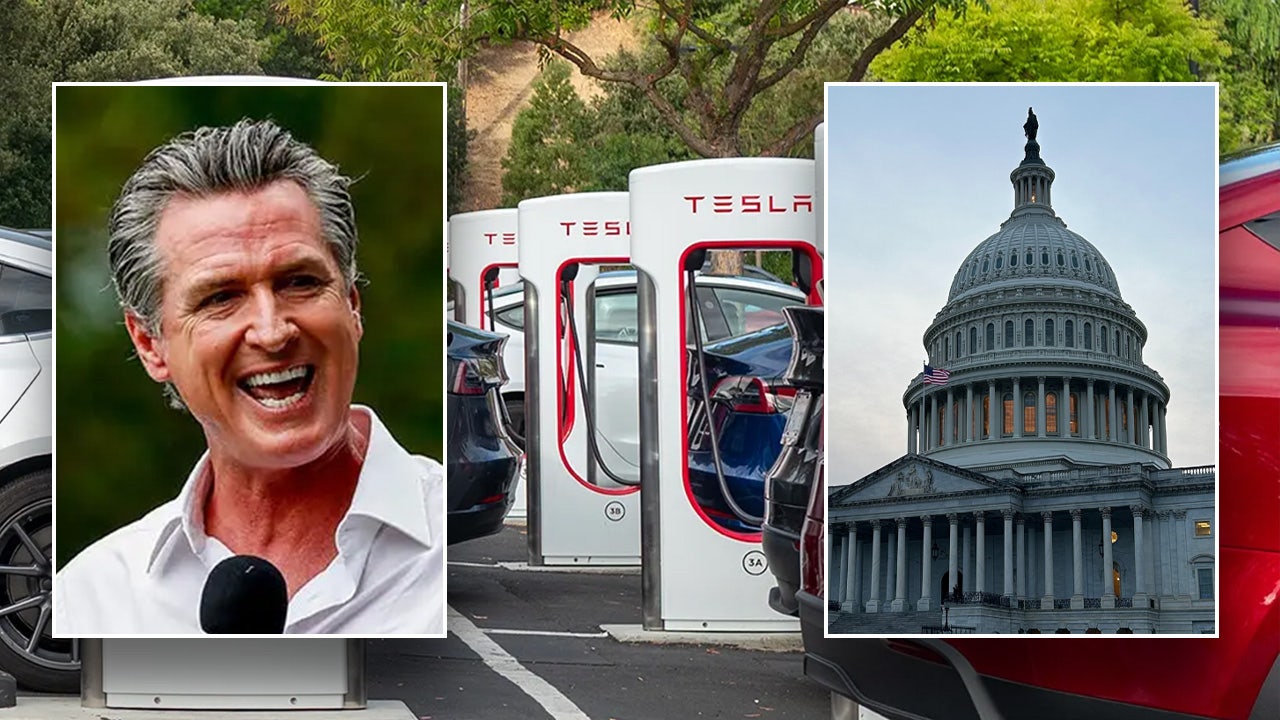
A group of blue states joined forces Wednesday to sue the Trump administration after it halted a program that federally funded electric vehicle charging infrastructure.
The District of Columbia joined 16 states — including California, Colorado and Washington — in a suit over the Federal Highway Administration (FHWA)’s efforts to halt Congress’ $5 billion National Electric Vehicle Infrastructure (NEVI) Formula Program to expand electric vehicle (EV) charging infrastructure.
A Tesla supercharging location on Kipling Street June 3, 2024, in Houston. (AP Photo/Lekan Oyekanmi)
President Donald Trump on Jan. 20 mandated that federal agencies pause disbursement of all funds appropriated under the Infrastructure Investment and Jobs Act and the Inflation Reduction Act, including NEVI program funding.
The Federal Highway Administration notified states in February that it was revoking previous state plan approvals and withholding or withdrawing NEVI program funds.
KAROLINE LEAVITT CONDEMNS ‘DANGEROUS ATTACKS ON TESLA: ‘DOMESTIC TERRORISM’
The lawsuit claims the FHWA is acting unlawfully, devastating the ability of states to build the charging infrastructure needed to make EVs accessible to more consumers, combat climate change and pollution and support the states’ green economies.
It asks the court to declare Trump’s directives unlawful, vacate the actions and permanently stop the administration from withholding the funds.
California is poised to require 100% of new cars, trucks and SUVs sold in the state to be powered by electricity or hydrogen by 2035. (AP Photo/Jeff Chiu)
TESLA VEHICLES, CHARGING STATIONS TARGETED AS PROTESTERS DENOUNCE DOGE, ELON MUSK
In addition to the $300 million and $71 million in funding California and Washington stand to lose, respectively, the blue states previously adopted zero-emission vehicle standards that require a percentage of vehicles sold in the states to release zero emissions.
Washington’s laws further require all new passenger cars, light-duty trucks and medium-duty vehicles sold in the state to be zero emissions by 2035.
California’s State Electric Vehicle Infrastructure Deployment Plan anticipated that California would need hundreds of thousands of additional EV charging ports to support passenger cars and trucks and “incrementally more” charging ports for medium- and heavy-duty trucks and buses to meet climate goals, according to a news release from the state.
SUSPECTED TESLA ARSONISTS HIT WITH FEDERAL CHARGES IN ACTS OF ‘DOMESTIC TERRORISM’: AG
Gov. Gavin Newsom said the action halting federal EV infrastructure funding is “illegal.” (Amy Sussman/Getty Images)
“When America retreats, China wins,” California Gov. Gavin Newsom said in the release. “President Trump’s illegal action withholding funds for electric vehicle infrastructure is yet another Trump gift to China — ceding American innovation and killing thousands of jobs. Instead of hawking Teslas on the White House lawn, President Trump could actually help Elon — and the nation — by following the law and releasing this bipartisan funding.”
The lawsuit comes as Democratic politicians, late-night hosts and political commentators have been touting Tesla’s plummeting stock and acts of vandalism against its vehicles, dealerships and charging stations.
The criminal acts have been linked by the FBI to nationwide protests against Elon Musk’s Department of Government Efficiency (DOGE).
California, Colorado and Washington are leading the suit, joined by attorneys general from Arizona, Delaware, the District of Columbia, Hawaii, Illinois, Maryland, Minnesota, New Jersey, New Mexico, New York, Oregon, Rhode Island, Vermont and Wisconsin.
Read the full article from Here


Presidio Heights is proving to be a center of gravity as luxury housing supply in San Francisco vanishes and the city’s well-to-do scramble to claim their slice of the artificial intelligence industry’s nerve center.
On the same day last week, the city recorded two home sales in the wealthy neighborhood for $9.2 million and $10 million.
The first reflected the fortunes being created by the AI industry. Venture capitalist Kenneth Wallace and his wife, Moriah Lewis, sold their five-bed, 4,755-square-foot home at 3875 Clay Street for $9.2 million. Josh McAdam of Sotheby’s International Realty represented the seller. The property last sold for $6.8 million in 2021.
The buyer initially kept their name hidden behind a Delaware-incorporated LLC named after the property’s address. However, according to public loan documents, the LLC is managed by Daniel Berrios and Kimberly Tan, a couple in their early 30s who graduated from Stanford into the San Francisco tech sector. Berrios works on special projects at OpenAI, and Tan is an investing partner with blue chip venture capital firm Andreessen Horowitz. Wells Fargo Bank provided a $5.4 million loan for the purchase.
Ten blocks east, sellers Herbert and Shwu-Ling Wei sold their six-bed, 5,000 square-foot home at 2881 Jackson Street for $10 million. Kyle Vineyard, a CPA with Realize Tax Advisors, is the trustee of the buyer, RKLA Trust. It is unclear whether Vineyard’s involvement is purely professional or if he’s connected to the trust.
The home last sold in 2014 for $6.8 million.
Presidio Heights, the neighborhood that runs along Presidio Park at San Francisco’s north end, has experienced a hot streak during the first half of 2026. Earlier this month, two mansions in the area sold for a combined $32 million, marking the fourth and fifth sales this year to eclipse $10 million. There were seven sales above that benchmark in Presidio Heights in all of 2025, according to Zillow data.
San Francisco, where the median home sale fetches $2.2 million, is dealing with its own version of champagne problems: a mansion shortage. The AI boom has attracted a wave of high-paid employees, apparently leaving the city with more millionaires than mansions. Steep capital gains taxes have made some mansion owners hesitant to let go of their property. Others are holding out for the expected spike in luxury home demand following Anthropic and OpenAI’s initial public offerings of stock, which are expected to come later this year.
Residential
San Francisco
Single-family, condo spike as AI boom meets Lurie administration to reverse “doom loop”
Residential
San Francisco
San Francisco’s mansion shortage claims two more trophy homes
Residential
San Francisco
AI boom pushes San Francisco median home prices north of $2M
Residential
San Francisco
SF’s high-end headache: “Egregious shortage of mansions”
Read more

Denver, CO
Denver Transplant Games sets Guinness World Record for most living donors, recipients in one place at one time

DENVER — The biennial Transplant Games wrapped up in Denver this week, bringing hundreds of organ donors and recipients together to compete in everything from cycling and swimming to darts and trivia at venues all over the city.
In fact, the games set a Guinness World Record for most living donors and recipients in one place at one time, with 966 gathering at the Colorado Convention Center.
PREVIOUS COVERAGE: Transplant Games bringing competition, life-saving message to Denver
Angela Laino, who used to live in Boulder, came back to Colorado to compete in the games. She donated a kidney to a stranger in January before running in the 5K event.
“I’m what they call a non-directed living kidney donor, which means that I don’t know who my recipient was,” she explained. “So I just said, ‘Whoever needs my kidney, I’m sure they’ll find the best match for it.’”
- Watch the full story in the video player below.
Transplant Games in Denver sets Guinness World Record
Laino said she was inspired by her job, working “on and off” as a dialysis social worker for 17 years.
“I really saw the challenges that my patients faced,” she said. “I saw what they had to go through to get on the [transplant] wait list… I know what transplant means for people. I’ve seen it firsthand. And to be able to see them come out here, compete, they’re doing basketball, they’re doing badminton, they’re swimming, they’re cycling, they’re running. They are living their full lives, and that’s really what transplant can do for people.”
Denver7
Laino said the games unite the community and show off its resilience.
“When you go through the transplant process, sometimes you feel alone, you feel like you’re the only one going through this,” Laino said. “And then you come to an event like this and you literally see thousands of people. You see recipients, living donors, donor families coming together for the same cause. It’s really inspiring, because it really helps to get the word out, spread awareness about the organ shortage, and it shows people what recipients and donors can do after they have the surgery.”
Dr. Michael O’Shea — a nephrologist, a doctor who cares for kidney disease patients and the kidneys in general — agrees. But he said more needs to be down to support patients and spread the word about the need for organ donations.
Denver7
The National Kidney Foundation estimates 37 million Americans have Chronic Kidney Disease, which occurs when kidneys cannot filter the blood properly, leading to serious health issues. Because symptoms can be minimal in early stages of the disease, many patients don’t realize they have it.
“I think education about kidney transplant, both on the patient side as well as on the potential donor side, could be markedly ramped up and improved,” Dr. O’Shea said. “It’s struggles with communication between transplant centers, patients, and community nephrologists. No one’s fault. It’s just a very complicated delivery system.”
In the case of kidneys, people can become diseased donors — who register to donate in the case of their sudden death — or living donors, who donate one kidney will relying on the other. Dr. O’Shea said both are critical to meet nationwide demand for life-saving transplants, though the living donations tend to have a longer lifespan — around roughly 20 years — for recipients.
“A number of folks get transplanted every year off this list,” O’Shea explained. “It is also true that a greater number of folks get added to the list every year.”
To register to become a deceased donor, Coloradans can visit their local Department of Motor Vehicles office or visit registerme.org.
O’Shea said those considering living donations face an “exceedingly small” medical risk for end-stage kidney disease, but should consult with their doctor about the decision.
Even as the games leave Denver, a reminder will stick around through the summer. Denver Parks and Recreation, the Downtown Denver Partnership and DaVita have partnered to set up a basketball court in Skyline Park near Arapahoe and 17th Streets, in order to keep the spirit of the games alive and honor the resilience of organ donors, recipients and their families.

Denver7 | Your Voice: Get in touch with Ryan Fish
Denver7’s Ryan Fish covers stories that have an impact in all of Colorado’s communities, but specializes in covering artificial intelligence, technology, aviation and space. If you’d like to get in touch with Ryan, fill out the form below to send him an email.

SEATTLE — Seattle police are investigating a shooting that left a 17-year-old boy injured early Thursday morning in the High Point neighborhood.
At about 12:48 a.m., dispatchers received multiple reports of rapid gunfire near Sylvan Way Southwest and Southwest Morgan Street.
Officers arrived and found a 17-year-old boy suffering from a gunshot wound to the hip area. Medics transported the teen to Harborview Medical Center in serious but stable condition.
Before officers located the victim, they found a car that had crashed and become disabled near Sylvan Way Southwest and Delridge Way Southwest. Police said multiple suspects were seen running from the vehicle through a nearby Home Depot parking lot.
Officers cordoned off the area and searched for the suspects with assistance from the K-9 Unit, but were unable to locate them. Police recovered the vehicle and impounded it for processing.
During the incident, gunfire struck at least three vehicles and two buildings. No other injuries were reported.
Officers processed multiple nearby scenes and recovered evidence before clearing the area. Detectives with the Gun Violence Reduction Unit will lead the investigation.
-

 Detroit, MI11 minutes ago
Would Detroit Lions Salary Cap Be Wrecked If Terrion Arnold Gets Cut?
-

 San Francisco, CA21 minutes ago
Two more Presidio Heights homes reach $10M range as luxury supply dwindles
-

 Dallas, TX26 minutes ago
One Dallas Cowboys Contract That Will Age Poorly in 2026
-

 Miami, FL33 minutes ago
Live updates: Today’s South Florida News
-
 Boston, MA36 minutes ago
A federal judge in Boston has blocked parts of Trump’s order to limit voting by mail
-
Denver, CO41 minutes ago
Denver Transplant Games sets Guinness World Record for most living donors, recipients in one place at one time
-

 Seattle, WA48 minutes ago
17-year-old boy shot in High Point, multiple suspects seen running from crashed car
-

 San Diego, CA51 minutes ago
Foodie forecast: A new cafe opens in La Jolla’s Arcade building

