Idaho
Idaho voters asked to send in absentee ballots by end of day ahead of May primary elections

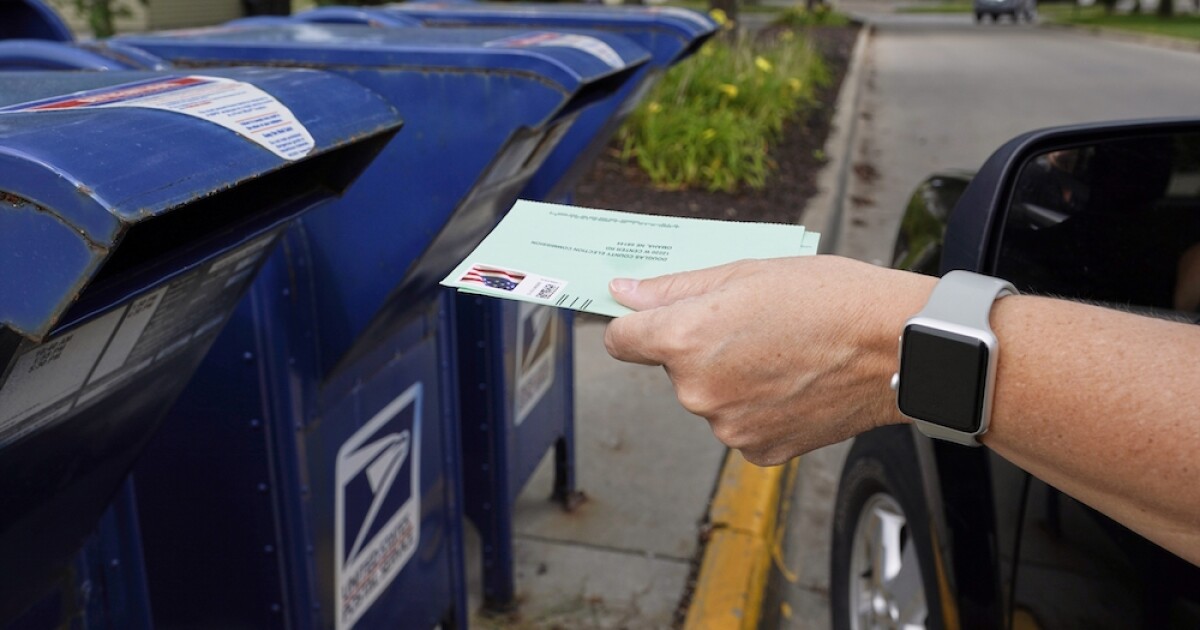
Idaho Secretary of State Phil McGrane is reminding voters to send in their absentee ballots for the May 21 primaries by May 15.
These ballots must be returned to the County Clerk Elections Office by May 21 to be counted on election day, so voters are being asked to submit them by the end of the day on May 15 to ensure they reach the office in time.
46.5% of the distributed ballots have made their way back to the clerk’s office so far. Completed ballots must be returned to the offices by mail, in person, or via an official ballot drop box by 8 pm on election day.
Other important upcoming dates for the May 21 elections are:
- Early Voting: Now through Friday, May 17 at 5 pm
- Election Day: Tuesday May 21, from 8 am to 8 pm
- Absentee Ballots Due: Tuesday, May 21 at 8 pm
The races in the May 21 primary include the races for United States Representative, State Senate, State House of Representatives, County Commissioner, County Sheriff, County Prosecuting Attorney, Judges, and other local races and measures.
More information about the May 21 primaries is available to view at VoteIdaho.gov.



Idaho
Idaho Senate introduces new bill to give local municipalities authority to control rat populations

BOISE, Idaho — A new bill in the Idaho Senate aims to let local municipalities take action to control rat populations. This, after a previous bill to combat rat infestations across Idaho, died in the House.
Rats have been spreading throughout the Treasure Valley in recent years, but previous attempts at legislation to deal with the problem have failed.
WATCH: Senior Reporter Roland Beres provides an update on the new rat bill
New bill would allow local governments to combat rats
Residents in Eagle and Boise have been tracking an alarming rise in rat populations recently.
Rep. John Gannon (D – District 17) introduced new legislation today that would essentially permit local governments to act in order to control rat populations if they want to, without creating a mandate.
Gannon said some cities complained that they did not have the authority to do the job themselves.
The bill was introduced with a dose of humor.
“I’m going to support this. It’s very late in the session, but I think this might just squeak through,” said Sen. Ben Adams (R – District 12). “Well. Unless it encounters a trap along the way.”
ALSO READ | ‘I’ve never seen something that big’: Boise neighbors finding rats in their backyards
This story was initially reported by a journalist and has been, in part, converted to this platform with the assistance of AI. Our editorial team verifies all reporting on all platforms for fairness and accuracy.
Send tips to neighborhood reporter Riley Shoemaker
Have a story idea from Downtown Boise, the North End or Garden City ? Share it with Riley below —

Penny Lee Brown, age 72, of Idaho Falls, formerly of Ririe, passed away Wednesday, March 25, 2026, at Eastern Idaho Regional Medical Center in Idaho Falls.
Penny was born October 18, 1953, in Fort St. John, British Columbia, Canada, a daughter to William and Luella Cooper Artemenko. She attended schools in Fort St. John, British Columbia, Canada. She earned her Certified Nursing Assistant Certificate from Eastern Idaho Technical College.
She married Donal A. Brown in Fort St. John, British Columbia. Their marriage was later solemnized in the Idaho Falls Temple. She was a member of The Church of Jesus Christ of Latter-day Saints.
She enjoyed attending her children’s sporting events, puzzles, collecting cat memorabilia, crafting, baking, and caring for others.
She is survived by her husband Donal A. Brown, children: Jared Brown (Krystal) of Boise, Marcus Brown (Misty) of Weippe, Idaho, Scott Brown of Idaho Falls, Douglas Brown of Idaho Falls, Jamie Brown of Williston, North Dakota, Steven Brown (Claire) of Idaho Falls. A brother Kenneth Artemenko (Nancy) of White Horse, YK, four grandchildren and one great grandchild.
She was preceded in death by her Father William Artemenko and her mother Luela Cooper and a brother Levern Artemenko.
Funeral services will be held Monday March 30, 2026, at 11:00 a.m. at The Church of Jesus Christ of Latter-day Saints Perry Ward Chapel 285 2nd West, Ririe, Idaho. The family will visit with friends on Monday from 9:30 to 10:45 a.m. at the church. Interment will be in the Ririe-Shelton Cemetery.

BOISE, Idaho (AP) — Idaho lawmakers are considering a bill that would make it a crime for transgender people to use the bathroom that matches their gender identity — even inside privately owned businesses.
At least 19 states, including Idaho, already have laws barring transgender people from using bathrooms and changing rooms that align with their gender in schools and, in some cases, other public places. The LGBTQ+ advocacy organization Movement Advancement Project’s tracking of the laws shows that three other states — Florida, Kansas and Utah — have made it a criminal offense in some circumstances to violate the bathroom laws.
READ MORE: Ohio Gov. DeWine signs bill restricting transgender students’ use of bathrooms
But none of the others apply as broadly to private businesses as the Idaho bill, which covers any “place of public accommodation,” meaning any business or facility that serves the public. The state’s Republican supermajority Senate is expected to vote on the bill this week, deciding whether to send it to Gov. Brad Little’s desk.
Felony bathroom use?
If the law is passed, anyone who enters a public facility like a bathroom or locker room designated for the opposite sex could be sentenced to a year in jail for a misdemeanor first offense, or up to five years in prison for a felony second offense. That’s a longer sentence than Idaho imposes for a first drunken driving conviction or for displaying offensive sexual material in public.
Protecting those spaces is a “matter of safety” and “decency,” said Republican Sen. Ben Toews told a Senate committee last week.
“Private spaces such as restrooms, changing areas and showers are sex-separated for a reason,” Toews said. “Individuals in these vulnerable settings have a reasonable expectation of privacy and security.”
The bill does carve out several exceptions. Athletic coaches, people responding to emergencies, people supervising inmates, custodians, and people helping children who need bathroom assistance get a pass. So does someone who is “in dire need” of a bathroom, if the bathroom they use is the only one that is reasonably available at the time.
Law enforcement groups say it’s a bad bill
Law enforcement groups including the Idaho Fraternal Order of Police and the Idaho Chiefs of Police Association oppose the bill, which they say would place officers in impossible positions, tasking them with visually determining someone’s biological sex or their level of “dire need.” The Idaho Sheriff’s Association asked lawmakers to require that people first ask any suspected violator to leave the bathroom before calling authorities, but lawmakers refused.
Heron Greenesmith, deputy policy director at Transgender Law Center, said the “dire need” exception could be especially hard to assert — and that the idea that a person can use a public restroom only in an emergency is dehumanizing.
“How does one prove that one was going to poop on the floor?” they asked.
Opponents fear vigilantism
John Bueno, a transgender student at the University of Idaho and a member of the student group Queer Inclusion Society, said the school has lots of single-use restrooms, which helps mitigate the logistical impacts of the bill. But the legislation would likely lead to more unwanted “profiling” of people, whether they are transgender or not, she said.
“It’s this cultural attitude of getting other Americans to habitually be narcing on one other and doing this sort of ‘transvestigating’ — that is what these kinds of bills promote,” Bueno said.
It all comes down to an effort to disenfranchise transgender people, Bueno said.
“This will increasingly deter queer individuals from Idaho universities and the state as a whole,” she said. “Which to be fair, is probably the primary purpose.”
Bill could impact employment opportunities
Nikson Matthews, a transgender man with a beard, told a panel of lawmakers last week that the bill would force him into the women’s restroom, where his masculine appearance puts him at risk of aggression from people who think he’s intruding.
“It creates a crime — but that is not based on conduct or harm,” Matthews said. “It is based on presence, and to justify that you have to accept that someone’s presence alone is traumatizing and harmful enough to criminalize.”
It could also make it difficult for transgender people to work, said Boise resident Laura Volgert.
“People might be able to hold it for an hour if they’re at a restaurant for lunch or at a grocery store,” she told lawmakers during a committee hearing. “They can’t be expected to hold it for a full eight-hour shift.”
That’s the point of these types of laws, said Greenesmith, to “make it untenable to go to the movies, to go to the doctor, to go to the bank.”
Proponents say that isn’t the case.
Proponents say safety and privacy is key
Suzanne Tabert, a Sandpoint resident, said the bill is about “maintaining, clear, enforceable boundaries” so that women and children can feel safe.
“If we lose the ability to protect based on biological sex, we lose our most effective tool for preventing harassment, voyeurism and other sex crimes before they occur,” she said.
She later continued, “This legislation is not about how an individual identifies, nor does it seek to target or malign the transgender community. Rather it upholds a universal standard of privacy.”
Bathrooms are not the only place where lawmakers have been placing restrictions on transgender people in the name of protecting women and girls. At least 25 states bar transgender women and girls from some women’s and girl’s sports competitions. And at least 27 states have laws restricting or banning gender-affirming care for minors.
Expanding all of these policies are priorities for President Donald Trump, too.
The only widely reported arrest of someone on charges of violating transgender bathroom restrictions was part of a protest in Florida last year.
Mulvihill reported from Haddonfield, New Jersey.
A free press is a cornerstone of a healthy democracy.
Support trusted journalism and civil dialogue.

New Hampshire may see rare Atlas V rocket launch. Here’s when to look

Monmouth County hospital among World’s Best Hospitals for 2026

Gas prices rose this week in New Mexico. Here’s why

North Dakota medical professionals gather for brain injury education

Math plan would help a generation of Ohio students | Opinion

Florida High School Football Rankings: Top 25 teams – Oct. 21

How old is Bo Nix? What to know about Oregon quarterback ahead of 2024 NFL Draft

Cleary's 21 help Le Moyne down Central Connecticut State 69-64 in OT

99th annual Pony Swim held in Virginia

Indiana Members Credit Union announced as new anchor tenant at Bottleworks District

Dem senators dodge crucial question on illegal alien accused of killing Chicago college student

EU Parliament unblocks key political hurdle in digital euro talks

Man arrested in plot to firebomb Palestinian activist’s home after undercover op

WATCH: Senate hearing goes silent after Angel Father confronts top Dem over daughter’s death

US diplomat Marco Rubio denounces settler violence, tolls in Hormuz strait
-

 Detroit, MI1 week ago
Drummer Brian Pastoria, longtime Detroit music advocate, dies at 68
-

 Movie Reviews1 week ago
‘Youth’ Twitter review: Ken Karunaas impresses audiences; Suraj Venjaramoodu adds charm; music wins praise | – The Times of India
-

 Sports7 days ago
IOC addresses execution of 19-year-old Iranian wrestler Saleh Mohammadi
-

 New Mexico6 days ago
Clovis shooting leaves one dead, four injured
-
 Business1 week ago
Disney’s new CEO says his focus is on storytelling and creativity
-

 Technology6 days ago
YouTube job scam text: How to spot it fast
-

 Tennessee5 days ago
Tennessee Police Investigating Alleged Assault Involving ‘Reacher’ Star Alan Ritchson
-

 Texas1 week ago
How to buy Houston vs. Texas A&M 2026 March Madness tickets