Hawaii
Jonathan Okamura: Alarming New Report On Hawaii Public Schools Is One More Sign Of Legislative Failure


The Kids Count Data Book for 2024 was recently issued by the Annie E. Casey Foundation based in Baltimore, which has been reporting on the well-being of American children and their families since 1990.
For those like myself who advocate for ethnic equality in Hawaii and support public education as one of the principal means for its attainment, the report’s findings are distressing, although they are not necessarily surprising or new.
The report indicates that Hawaii’s public school students are not faring well academically in attaining basic skills such as reading and math and even just showing up for classes.
While most of the report’s data is not broken down by ethnicity, I’m certain that there are significant differences in educational performance among ethnic groups in the public schools because such disparities are evident in other areas of educational attainment, such as undergraduate representation at the University of Hawaii Manoa.
Since the report is concerned with the educational achievement of K-12 students who have yet to enter the job market, its findings clearly demonstrate the perpetuation of ethnic inequality for another generation due to the ongoing failure of the Legislature to fix the chronic teacher shortage problem.
Indigenous and ethnic minority students represent about 70% of those in the public schools.
The Number Of ‘Chronically Absent’ Skyrockets
In the Kids Count report, what I found most troubling was the 39% of Hawaii students who were “chronically absent,” which means they missed 10% or more days of school in 2022. The DOE school year is 180 days, so these students were absent at least 18 days or about three and a half weeks.
The 39% figure represented more than a doubling from the 19% in 2019, prior to the pandemic, which may have had an impact on the huge increase. It can be assumed that chronic absenteeism negatively impacts a student’s ability to proceed to the next grade level and ultimately to graduate from high school and enter college or the job market.
This is one area where the report did break down its data by ethnicity. It found that 59% of Native Hawaiian and Pacific Islander students, including Micronesians, Samoans and Tongans, were chronically absent in 2022.
A figure that high, a clear majority of those students, indicates that they probably are also well represented among the 14% of Hawaii students who did not graduate on time, according to the report.
Legislature’s Misplaced Priorities
I will cite information from Waianae High School, not to belittle its students, but because more than $6 million in funds were recently appropriated by the Legislature. One might assume that those funds are going to be used to address the school’s long-term chronic absenteeism problem, but one would be wrong.
Of Waianae’s 1,900 students, 54% are Native Hawaiian or Pacific Islander, 8.7% Asian, 3.3% Caucasian and 22% Hispanic.
According to the DOE Strive Hawaii report on the school’s academic performance in 2021-2022, Waianae had a graduation rate of 81%, which refers to the percentage of 12th-graders who graduated on time with their classmates.
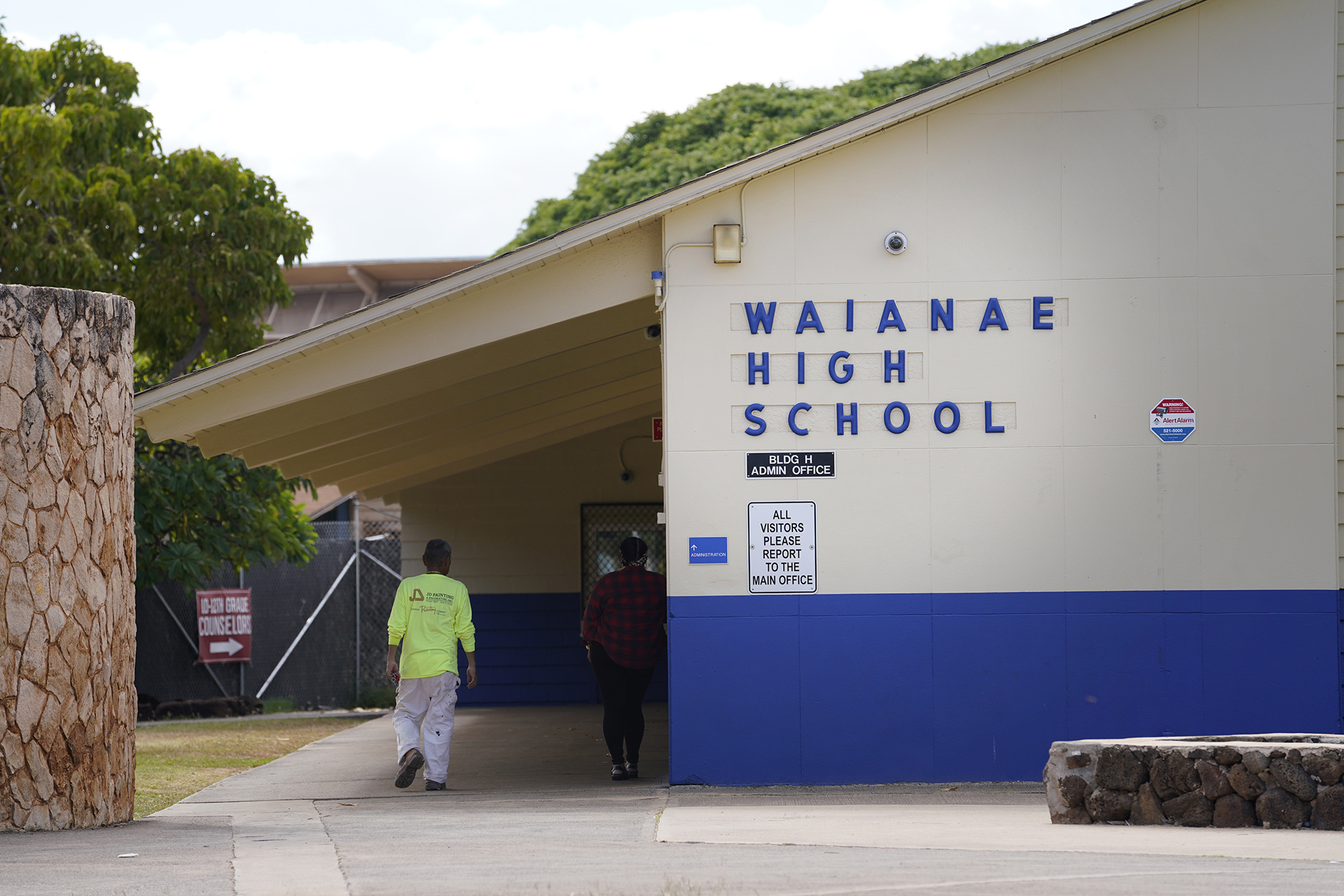
As for being chronically absent, in 2022, 58% of Waianae students missed 15 or more school days, which might be attributable to the pandemic’s after-effects, but the state average was much lower at 32%.
Despite those troubling statistics in the DOE Strive report, Rep. Cedric Gates, a Waianae graduate, announced funding last week for building a new artificial-turf football field at the school. Gates, who represents Waianae and nearby communities in the Legislature, led the $6 million legislative initiative.
He told a television news reporter, “It’s so important to get Waianae High School up to the same standards as the other high schools in the state,” but he wasn’t referring to academic standards, such as increasing its graduation rate or its college-going rate of 28%.
Gates continued, invoking the arguments used to support race-based affirmative action programs in college admissions as leveling the playing field, but literally referring to athletic fields: “It gives us a fair playing field to compete with the other schools because when you’re competing on grass and you’re transitioning over to a school with turf, it’s just a different field.”
Which Playing Field Do We Really Want To Even?
The $6 million Waianae High School received could have been used to hire more fully licensed teachers, instead of relying on unqualified emergency hires, or additional counselors to keep students on track to graduating on time or to urge them to take Early College courses available on campus.
Those teachers and counselors could have encouraged and supported more of their students to proceed on to college at UH Manoa, UH West Oahu, Leeward Community College or elsewhere so that they can compete fairly in the job market and not just in football.
Since only 13% of the Waianae community has a college education, teachers and counselors, rather than parents, can play a major role in their students’ further education.
Hiring more DOE staff to fill vacant positions obviously was not the policy priority of the Legislature.
Some might counter that the community wanted a new football field, and legislators responded positively to their wishes. But lawmakers don’t necessarily provide their constituents what they desire, such as publicly funded election campaigns that are supported by a majority of Hawaii voters.
Hiring more DOE staff to fill vacant positions obviously was not the policy priority of the Legislature, which instead allocated almost $600 million this past session for school facilities, including Waianae’s new football field.
While such new facilities won’t be completed before the primary and general elections, photos of groundbreaking or signing ceremonies for them with the governor can be prominently displayed in a legislator’s campaign advertisements and website.
Those ads reveal the personal priorities of many but not necessarily all legislators — to get themselves reelected rather than to address their constituents’ needs and desires for a more equitable and rewarding future for their children.

Sign up for our FREE morning newsletter and face each day more informed.


Here’s what you need to know about the University of Arizona
UA was established in 1885, and its main campus is in Tucson. The Wildcats once had a live bobcat named Rufus as a mascot.
The Republic
If point guard JJ Mandaquit’s job at Arizona next season looks tricky and challenging, having to glue together a lineup full of potential NBA draft picks under the pressure of playing for a returning Final Four team, it might be worth considering what his grandfather and father have been up to.
They’ve been running a roofing company … in Hilo, Hawaii. The rainiest city in the country, on the windward side of the Big Island. Where some 130 inches of rain hit buildings every year, creating slick working conditions, and where, even in drier moments, there’s high humidity and trade winds to deal with.
“I had to go on the roof a couple of times,” Mandaquit said, chuckling. “But not in the rain.”
He had other things to do. With his basketball skills overshadowing the local level of play since his elementary school years, Mandaquit left Hilo as a sixth-grader to begin a higher-level basketball journey that put him in Tucson this year.
His family came with him to Oahu, where he transferred to the Iolani School of Honolulu. His father, Jason Sr., commuted back and forth between Oahu and the Big Island while still roofing, though his mother was able to transfer from Hilo to Honolulu within her job at Hawaiian Electric.
Everyone thought that was the plan for a while.
“It was a better opportunity, better education and more opportunity,” Mandaquit said. “When we left from Big Island to Oahu, that was a huge move for my family, a lot of sacrifice that went into it. I’m super grateful to my parents. When we made that move in the sixth grade, we thought that was going to be the move, that it was just going to end there, I’d go to high school there.”
It still wasn’t enough. Mandaquit outgrew the basketball scene again. By ninth grade, he moved on to Real Salt Lake Academy, which turned into Utah Prep.
In Hawaii, he found players have also been kept from high-profile West Coast clubs because of a quirky club-ball residency rule in which players are typically allowed to play only for a club in their state or a bordering one — and Hawaii borders only an ocean. So Mandaquit said he and other locals started their own “Sons of Hawaii” club to play on the “MADE Hoops” circuit.
It still wasn’t enough. Utah was next.
“We felt it was best to get out of Hawaii and chase this dream,” Mandaquit said. “It wasn’t an easy choice to leave home, but we felt looking at the big picture, if I want to play at the high Division I level, we almost felt that it was a necessity to get out of the islands, surround myself with better competition, be somewhere that allows me to be more exposed.”
That move paid off. Mandaquit grew into a high-major prospect at Utah Prep and became a mainstay with USA Basketball junior teams. He won three gold medals at FIBA events: At the 2023 U16 AmeriCup, the 2024 U17 World Cup and, on a team led by UA coach Tommy Lloyd, the 2025 U19 World Cup.
Only a secondary recruiting target of Arizona’s before he committed to Washington in November 2024, Mandaquit jumped out at Lloyd while playing for USA Basketball last summer. Mandaquit averaged 6.1 points and 5.4 assists — with nearly a 4-to-1 assist-turnover ratio — while hitting 6 of 10 3-pointers over USA’s seven-game romp.
“I had only seen him play a few times before (last summer), but I was just so impressed with his character, but also his tenacity and the effort he played with. Just how he impacted winning,” Lloyd said. “So obviously, when we saw his name on the transfer portal, it piqued my interest right away.”
Lloyd said he considered Mandaquit out of high school, but the Wildcats were also pursuing Brayden Burries and had Jaden Bradley projected to stay through last season. Lloyd said he also took a cautious recruiting approach in 2025 because “you just didn’t know” how rev-share and NIL were going to work out, since 2025-26 was the first year schools could pay players.
So Mandaquit chose the Huskies over USC and Creighton. He started the Huskies’ first five games but wound up playing off the bench for most of his 22 appearances, averaging 5.2 points and 2.1 rebounds while shooting 28.2% from 3-point range.
Mandaquit struggled with a foot issue in the preseason and eventually missed the Huskies’ last 11 games because of it, though he has since had corrective surgery and returned to the court at Arizona.
“It was a great learning experience,” Mandaquit said of Washington. “I didn’t have the year that I wanted to have, but just going through that experience is gonna be huge for me and my future. I’ve got one year of college basketball under my belt, and the Big Ten was awesome last year.”
After he left Seattle, SI’s Huskies website wrote that UW coach Danny Sprinkle “has to be reeling by Mandaquit’s departure,” saying Mandaquit’s playing style “seemed to match Sprinkle’s hard-nosed personality.”
Instead, Mandaquit will be playing for the same coach he said he loved playing under last summer in Switzerland. Mandaquit joined a team that included former UA forward Koa Peat, incoming UA freshman Caleb Holt and No. 1 NBA Draft pick A.J. Dybantsa, among others.
They were all stars, forced together to play team ball during the world’s highest-profile junior tournament.
Gold was the expectation.
“What he was able to do with our group in such a short amount of time, I just loved,” Mandaquit said of Lloyd. It was “just the culture that he was able to build. Obviously, it’s not the easiest job as a coach to be able to manage all of the star players and egos that we had. It was just the way that he was able to get everyone to just buy in and focus on a common goal, and ultimately go and reach that goal.
“It was amazing. It was the most fun I ever had playing basketball.”
Despite their bond, Mandaquit said he couldn’t have a recruiting conversation with Lloyd until after he entered the portal this spring. But that might have been a formality anyway.
Both Lloyd and Mandaquit knew plenty about each other at that point.
“This time it was fast,” Lloyd said. “We both knew what we wanted on both sides.”
Lloyd needed a true point guard to join North Carolina transfer Derek Dixon and Holt in a reloaded backcourt that lost NBA Draft picks in Burries and Bradley.
Mandaquit wanted to be under Lloyd for more than a few weeks.
Official elapsed time between Mandaquit’s early April entry into the transfer portal and his commitment to Arizona: Ten days.
“When this opportunity came back around, I couldn’t pass it up,” Mandaquit said. “I knew this is the place that I wanted to be, and I knew I wanted to be coached by Tommy.”
During an interview at McKale Center last month, Mandaquit said he’s since arrived at Arizona to find high-character guys around him, and that coaches are pushing him the way he wants to be pushed.
“I’m loving it so far,” Mandaquit said.
As a bonus, Mandaquit’s first season with the Wildcats will also take him nearly full circle. Not to Hilo and the Big Island, but to the Maui Invitational, the prestigious early-season event that Mandaquit said he routinely watched on television even if the inter-island hop and high ticket prices kept him out of the Lahaina Civic Center to watch in person.
This time, he’ll be in the building — and soaking up the atmosphere outside it. His parents, now living back in Hilo, can make the easy flight over to watch, too.
It probably won’t rain much, if at all, Lahaina being on the leeward side of Maui and all.
But, for Mandaquit, it’s still home.
“Hawaii means everything to me,” Mandaquit said. “I try to get back there as much as possible, and I feel the support of the state behind me. I feel their love, so it pushes me to work harder.”

A 32-year-old Pahoa man on probation for auto theft pleaded not guilty Thursday to sex assault charges.
Hilo Circuit Judge Peter Kubota maintained Brandon K.C. Sanchez’s bail at $108,000 and ordered him to return to court for further proceedings on Oct. 9.
A Hilo grand jury on Wednesday returned a five-count indictment charging Sanchez with second-degree sexual assault and four counts of fourth-degree sexual assault. He was also charged with five counts of violating probation.
According to court documents filed by police, the alleged offenses took place on the evening of June 15 and the victim was a 21-year-old woman.
The woman reportedly told police she had just met Sanchez when he was a customer at the Hilo fast-food restaurant where she worked. She agreed to hang out with him and allowed him to drive her car.
Sanchez drove to Honolii, and at one point told the woman he had recently gotten out of jail and wanted to have sex with her, which led to her telling him no multiple times, according to the documents.
Sanchez allegedly then asked if she’d kiss him, to which she assented under the condition that he stop the pressure to have sex.
On the way back to Hilo, Sanchez reportedly touched the woman’s breast and genitals through her clothing, put his mouth on her breast, and slipped a finger inside her genitals — all against her will.
Documents state that Sanchez admitted to police that he touched the woman’s breast through her clothing once, but denied all other allegations.
Second-degree sexual assault is a Class B felony offense that carries a maximum sentence of 10 years imprisonment. Fourth-degree sexual assault is a misdemeanor that carries a potential one-year jail term.
Sanchez remains in custody at Hawaii Community Correctional Center in lieu of bail.
Email John Burnett at john.burnett@hawaiitribune-herald.com.

HONOLULU (HawaiiNewsNow) – A hiker was rescued after suffering a medical emergency on the Diamond Head Crater Trail Saturday morning.
The Honolulu Fire Department said crews responded at about 10:30 a.m. after a woman in her 30s became unable to descend from the top of the trail.
Firefighters climbed the trail on foot while another crew prepared a nearby landing zone for air operations.
HFD’s Air 1 helicopter inserted rescue personnel to the woman’s location, where they assessed her condition and provided basic life support.
The hiker was then airlifted to the landing zone and transferred to Honolulu Emergency Medical Services shortly after 11 a.m.
No firefighter injuries were reported.
Copyright 2026 Hawaii News Now. All rights reserved.
-

 Rhode Island2 minutes ago
Officials call off search at Lincoln Woods Beach, no one found in the water
-

 South-Carolina8 minutes ago
What happens next after Lindsey Graham’s death? South Carolina law lays out the process
-
South Dakota14 minutes ago
SD Lottery Millionaire for Life winning numbers for July 12, 2026
-
Tennessee20 minutes ago
TN Lottery Cash 3 Evening, Cash 4 Evening winning numbers for July 12, 2026
-

 Texas26 minutes ago
Arrest made in death of North Texas teen Daniel Erving found in Lake Ray Hubbard
-
 Utah32 minutes ago
Families fight to stay cool as Salt Lake City reaches record-breaking temperatures
-
Vermont38 minutes ago
VT Lottery Pick 3, Pick 3 Evening results for July 12, 2026
-

 Virginia44 minutes ago
Virginia Lottery Pick 3 Night, Pick 3 Day results for July 12, 2026

