West
Hawaii governor focuses on Maui recovery efforts, housing in State of the State address

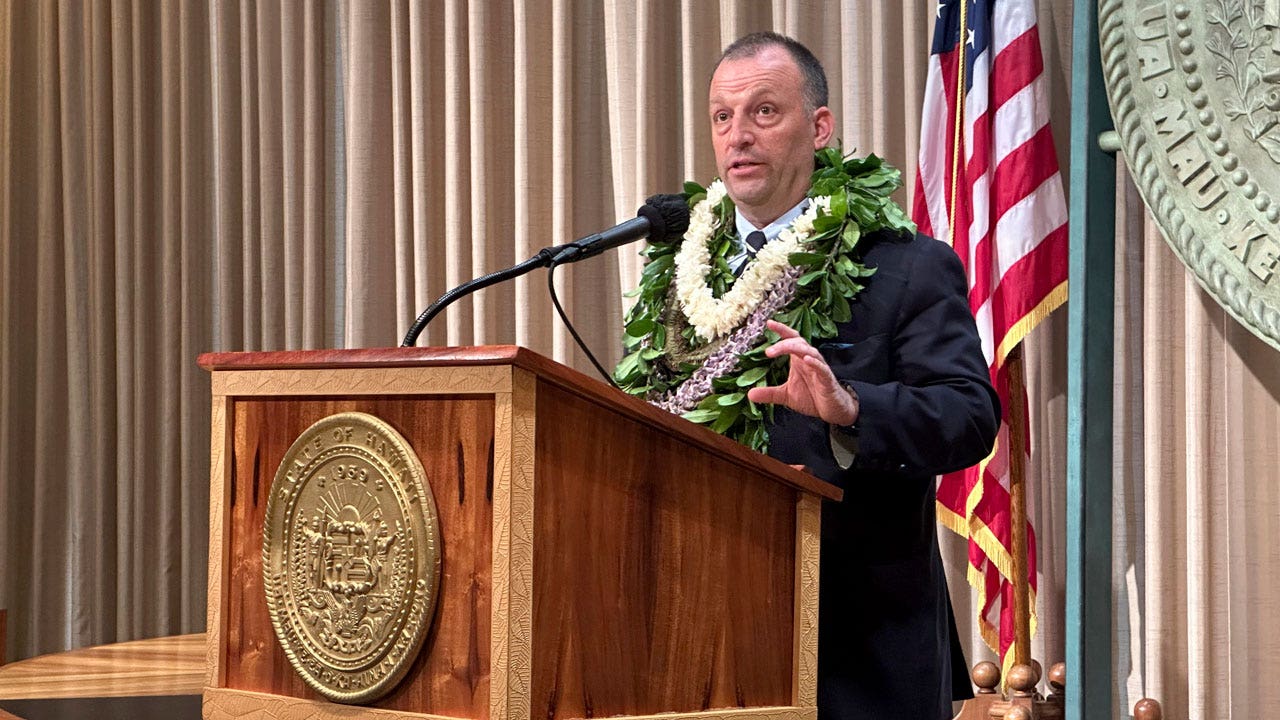
Hawaii Gov. Josh Green on Monday used his annual State of the State address to lead lawmakers and guests in a moment of silence for victims of the Lahaina wildfire and to propose aggressive steps to shift more vacation rentals into residential use to meet both Maui and the state’s acute housing needs.
Those gathered for the speech delivered a standing ovation to two Maui firefighters — Keahi Ho and Koa Bonnell — who traveled from Maui for the governor’s talk, which focused heavily on helping Maui recover from August’s deadly wildfires.
“The people of Maui have shown strength in the face of adversity,” said Green, a Democrat. “But the days ahead will not be easy and they will continue to need our support and we will be there for them as long as it takes.”
LAST HAWAIIAN PRINCESS LEAVES $100M OF HER ESTATE FOR NATIVE HAWAIIAN CAUSES
A wildfire fueled by hurricane-force winds raced through the historic coastal town of Lahaina on Aug. 8, killing 100 people and destroying thousands of homes and buildings.
Green’s acknowledgment of all those who rushed to Maui’s aid after the fire brought tears to the eyes of state Rep. Dee Morikawa, the House majority floor leader and a Democrat representing the western part of Kauai and Niihau.
“It’s just good to know that all of Hawaii is coming together for Maui,” Morikawa said after the address.
Hawaii Gov. Josh Green is seen here speaking to reporters at the Hawaii State Capitol in Honolulu on Jan. 22, 2024, after delivering his State of the State address. (AP Photo/Audrey McAvoy)
The most urgent unmet need on Maui is now stable long-term housing for some 5,000 residents who are staying in hotel rooms because they haven’t been able to find affordable places to rent on the island, one of the nation’s most expensive places to live.
Green aims for all 5,000 to move into long-term housing by March 1 in part by encouraging owners of vacation rentals to make their units available to wildfire evacuees. He told reporters authorities have about two-thirds of the needed housing units lined up so far. The Federal Emergency Management Agency and charitable organizations will be covering the rental costs.
More broadly and longer-term, Green proposed a two-year “tax amnesty” to encourage owners of vacation rentals around the state to sell to owner-occupants or long-term rental landlords. Participants would be exempt from capital gains, conveyance and general excise taxes under this two-year program.
Green told reporters afterward he was going to put “a lot of pressure” on short-term rentals because he didn’t believe they were appropriate.
HAWAII HIKERS RESCUED, CITED AFTER RUNNING OUT OF FOOD AND WATER ON MAUNA LOA VOLCANO AMID WINTER WEATHER
“I don’t want to be rude, but I do want people to realize that that market should be for our local families,” Green said. He noted that workers in a range of fields — including nurses now on strike at the state’s only pediatric hospital — are struggling because of Hawaii’s housing shortage and high housing costs.
In addition, Green said he’s asking the Legislature to put $373 million in the budget for infrastructure and housing.
“This remains our administration’s top statewide priority,” he said.
Green revisited the idea of imposing a fee on travelers to help pay for environmental upkeep after a proposal to do so died in committee last year. The governor suggested charging each family visiting Hawaii a $25 “climate impact fee” when they check in to their hotel or short-term rental. He said this would raise $68 million a year.
Democratic House leaders identified common priorities with the governor, particularly on affordable housing, mental health care and climate change.
The House Finance Committee’s chairperson, Rep. Kyle Yamashita, said he would have to look at the details of the governor’s tax amnesty plan but indicated he was open to the idea.
“At the end of the day, I think we have to look at every option to deal with this issue,” Yamashita said after the speech. “They are affecting residential areas throughout the state. And it’s something that we have to look into more deeply.”
House Speaker Scott Saiki said the House would cooperate with the governor.
“We need to solve problems in our state, and we need to find solutions that are going to be workable,” Saiki said.
Read the full article from Here

San Francisco, CA
The U.S. Government Secretly Tested Biological Weapons. The Citizens of San Francisco Paid the Price.

Here’s what you’ll learn when you read this story:
- During the early decades of the Cold War, the U.S. government conducted 239 open-air germ warfare tests around the country to assess to dangers of a possible chemical attack on civilian populations.
- One of the most infamous, known as Operation Sea-Spray, purposefully pumped aerosols of the bacteria Serratia marcescens and Bacillus globigii—both believed to be harmless to humans—over the San Francisco Bay Area.
- While the operation itself was a success, it’s likely that the test resulted in the death of one man and the sickening of at least 10 others.
San Francisco is known for its fog. Sitting at the intersection of warm air flowing from California’s interior and cool air moving in from the Pacific, low-lying fog and clouds are a common sight. But in 1950, from September 20 until September 27, a different kind of cloud descended on the city of some 800,000 people—a cloud that had been purposefully released by the U.S. government as a secret bioweapons test.
No, this wasn’t some dastardly plan by the government to conduct a macabre experiment on its own citizens. Rather, it was a measure intended to safeguard against other rival nations trying to poison an American city. The government selected San Francisco for its ideal dispersal conditions, tall buildings, and large population, and to pull this off safely, the government relied on the bacteria Serratia marcescens and Bacillus globigii—both believed to be harmless to humans.
“They needed something that was, first of all, thought to be harmless,” Matthew Meselson, a molecular biologist from Harvard, told KQED last year, “because they certainly didn’t want to kill everybody in San Francisco or Oakland. And [they also needed something] that could easily be detected by simple methods.”
Since the Second Battle of Ypres during World War I, when the German army killed thousands of French Algerian colonial troops by unleashing chlorine gas on April 22, 1915, followed by a second gas attack on Canadian troops two days later, nations had been grappling with the threat of unconventional weapons. With its illusion of geographic imperviousness shattered by the attack on Pearl Harbor on December 7, 1941, the United States moved to address its own vulnerabilities. In 1942, President Franklin Roosevelt authorized the creation of the first U.S. biological weapons program. Part of the mission of this program was to determine just how vulnerable U.S. cities could be to a biological attack.
In 1948, the Committee on Biological Warfare—led by University of Wisconsin bacteriologist Ida Balwin—suggested simulating chemical attacks through air, water, and infrastructure (such as subway systems) with non-harmful organisms to understand the threat under real environmental conditions. So, two years later, the stage was set for Operation Sea-Spray, and the entire operation almost went without a hitch. Almost.
Serratia marcescens is found naturally in water and soils, and it’s known to be harmless to humans. But it isn’t typically sprayed in the air in large quantities, and unfortunately, one of those bacteria-filled clouds descended on Stanford University Hospital on Clay Street in San Francisco. There, eleven patients developed inexplicable Serratia marcescens infections. In the case of a 75-year-old Irish American named Edward Nevin, who was recovering from prostate surgery, the bacteria found its way to his heart, killing him. Doctors at the hospital were so puzzled that they even published a scientific paper regarding the infections in October of the following year.
President Richard Nixon ended U.S. research into bioweapons in 1969, and a treasure trove of information about that research was declassified in the 1970s. It revealed that the U.S. had performed 239 open-air germ warfare tests around the country, including in the subway in New York City, on the Pennsylvania turnpike, and in the national airport in Washington D.C. According to KQED, Edward Nevin III—the grandson of the man who died during the faux attack—read these reports and decided to sue the U.S. government, even though he accurately foresaw that he’d eventually lose.
“But we still had to tell the story,” he told KQED. “To have a citizen submitted to that kind of risk is awful.”
Darren lives in Portland, has a cat, and writes/edits about sci-fi and how our world works. You can find his previous stuff at Gizmodo and Paste if you look hard enough.

Courtesy Jonathan Weiner
There’s a semi-controversy brewing in the underground about whether or not banana suits are appropriated concert attire. After the Baltimore hardcore band End It recently directed its audience to rip one such costume off of a fun-loving fan, the dividing lines have been defined — hardcore isn’t so fruit friendly, while metalcore openly encourages dressing however you want for the occasion.
Dance Gavin Dance guitarist-vocalist Andrew Wells confirmed the metalcore ethos, as the long-running band is used to seeing people in all types of garb, particularly bananas, whenever and wherever they play.
“There’s a ton of banana people in our audience,” he says, referencing the group’s recent Warped Tour DC stop that was especially yellow. “I was like, ‘Yo, banana people, you’re welcome here. You’re weird. You’re an outcast. You’re what society deems as weird because you want to dress up in a banana costume. That’s what rock is for.’
“Rock’s historically been since the dawn of time an oasis for the outcasts. You’re welcome here. Come fly your freak flag with us, and we’ll have a good time,” Wells continues. “Honestly, if I played a whole show and everyone was in a banana suit, I would be stoked. That would be sick.”
In reiterating the stance, he calls for everyone in Denver to show up in their banana best when Dance Gavin Dance takes the Fillmore on Monday, June 22. Horse the Band, Wolf & Bear and Novelists are also on the bill.
The metalcore machine — which also includes vocalist-guitarist Will Swan, drummer Matt Mingus and harsh vocalist Jon Mess — is riding high with a twofer of fresh material in 11th studio album “Pantheon,” released in September, and last month’s “Tree City Sessions 3,” another collection of revamped takes on classics and deep cuts.
Wells, who’s been with the band in some capacity since 2015, saw the “Tree City” process as an opportunity to put his spin on some of the older tracks that vocalist Tilian Pearson first laid down, such as “Bloodsucker” from 2018.
Courtesy Dance Gavin Dance
“That was a suggestion from me. I wanted to polish up my higher register and showcase what I could do on the Tilian stuff,” he explains. “That was a song Martin [Bianchini, touring guitarist] and I had written on the ‘Artificial Selection’ album, so we were able to play and record the song that we wrote.”
Looking back also allowed Dance Gavin Dance to forge forward with “Pantheon,” a more reflective album than recent releases, Wells admits.
“It was an opportunity for us as a band to revisit the roots of the band, when the band was playing to 100-cap clubs and it was just this alternative style of music that was very unique and different. Some people hated it, some people loved it, but it was this authentically post-hardcore sound, that come from these roots,” he shares.
“When we were revisiting these older songs and doing ‘Tree City’ and also writing ‘Pantheon,’ it was that full-circle moment of doing what we’re passionate about again, exploring new themes and musical territory and getting back to the roots, so to speak, especially as a collaboration,” Wells continues. “It was all of us in the same mindset together working towards the same goals.”
And in Year 21, the band is the “happiest and healthiest” it’s ever been, as he sees it.
“We’re a group of musicians who’s committed to making the best art that we possibly can,” Wells says. “There’s a perseverance to this band.”
But, he adds, they wouldn’t be anywhere if it wasn’t for the people in front of the stage, dressing up as bananas and whatever else.
“The external factor is our fans,” Wells concludes. “I think the fan’s abilities to rally and support the band and come out to shows can’t be overstated.”
Dance Gavin Dance, with Horse the Band, Wolf & Bear and Novelists, 5 p.m. Monday, June 22, Fillmore Auditorium, 1510 Clarkson St. Tickets are $60.

-

 Los Angeles, Ca4 minutes ago
L.A. Tenants Union trying to save business owner given eviction notice ‘without reason or discussion’
-

 Detroit, MI19 minutes ago
Grace Hanke crowned Miss Michigan 2026
-

 San Francisco, CA34 minutes ago
The U.S. Government Secretly Tested Biological Weapons. The Citizens of San Francisco Paid the Price.
-

 Dallas, TX37 minutes ago
3 Cowboys Entering Training Camp With Plummeting Stock
-

 Miami, FL42 minutes ago
Florida’s Alligator Alcatraz shutting down permanently, sources say
-

 Boston, MA49 minutes ago
Red Sox Star ‘Open’ to Trade Talks With Boston’s Season Spiraling
-

 Denver, CO52 minutes ago
Dance Gavin Dance weighs ins on banana-suit controversy before Denver show
-

 Seattle, WA57 minutes ago
Series win in Seattle shows how tricky this trade deadline will be for the Red Sox

