West
Drug users outside Portland daycare cause preschool children to play inside for safety: 'This is awful'

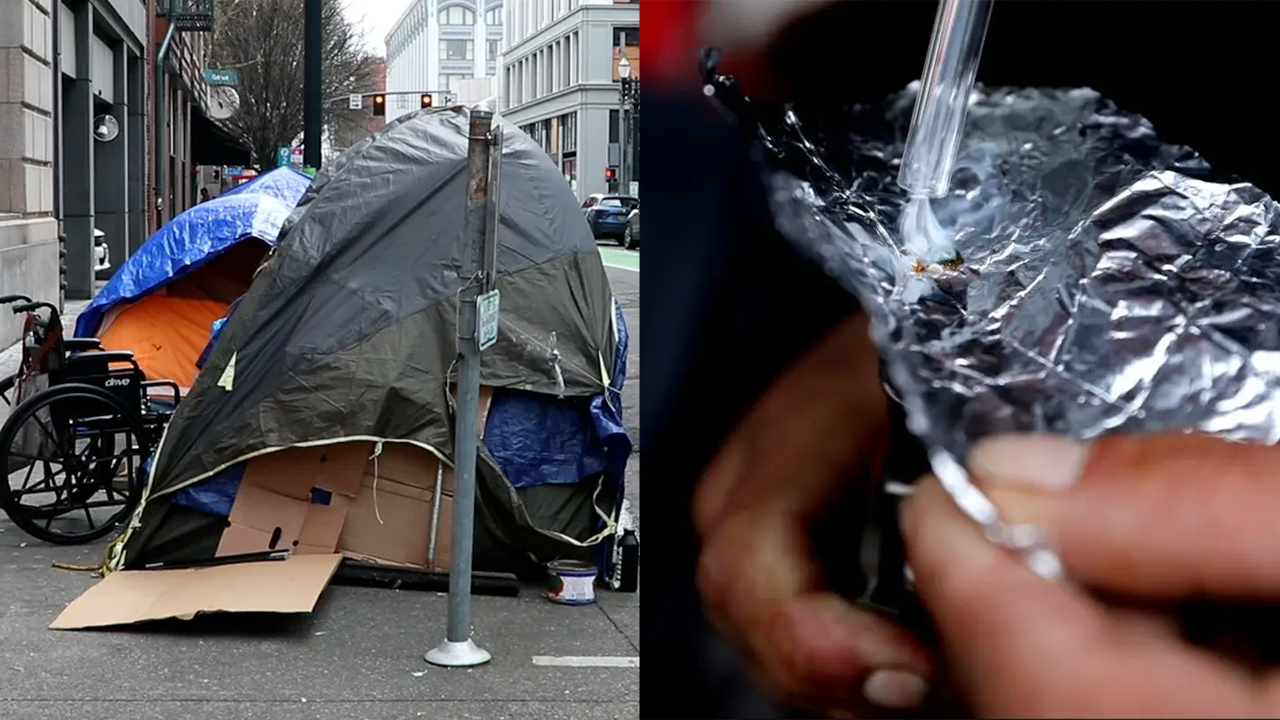
Drug addicts positioned outside a school and a daycare center in Portland, Oregon are causing children to be forced to play inside due to safety concerns, according to a recent report.
“Usually, I do mostly meth,” Violet, a local drug user who often smokes outside of the school, told NBC affiliate KGW. “And this area always has been known to be a heavy drug area,” she said, adding that “they shouldn’t have put a preschool right f—ing there.”
“We don’t want [the children] to be exposed to that because it’s their innocence that we’re defiling,” Violet added.
“Probably the next block is going to be over, and then, two blocks over are going to be the next spot soon,” Violet told KGW, explaining that drug users will find a different place to meet even if police move them away from the area near Saint James Lutheran Church on Southwest Jefferson and 10th Avenue.
ALL ROADS ‘LEAD BACK TO FENTANYL’: CITY OVERRUN WITH DRUGS SEES PROGRESS AFTER OVERWHELMED POLICE GET NEW HELP
Drug addicts posted up outside a school and a daycare center in Portland, Oregon are causing children to be forced to play inside due to safety concerns, according to a recent report. (Gary Coronado / Los Angeles Times via Getty Images and Hannah Ray Lambert/Fox News Digital)
“I mean, that sucks, but this sucks too,” another drug user told the outlet about the problem on Portland streets. “They can move if they want, or they can help us get rid of the problem.”
“It’s untenable,” local parent Kelly Forsyth said. “We often will walk over needles with our kids. They’re within ten feet, you’ll see people shooting up, passed out.”
“It feels like my kids aren’t being set up well for their future,” Forsyth said.
KGW reported that the preschoolers have been told to play inside by teachers due to safety concerns about the surrounding neighborhood.
Some local police officers in Portland spoke out against the rampant drug use around the daycare and school. “It’s really concerning for me,” officer David Baer said of the scores of drug users around Saint James Lutheran Church. “I’ve been here a long time; nothing really seems to bother me anymore, but as a parent to a 2-year-old, I was like, ‘This is awful.’”
PORTLAND SECURITY GUARD TEARS UP OVER DEADLY CONSEQUENCES SINCE DRUG LAW: ‘EVERYONE DESERVES BETTER THAN THIS’
Some local police officers in Portland spoke out against the rampant drug use around the daycare and school. (Hannah Ray Lambert/Fox News Digital)
“We want to be downtown. We want to spend time here. We want our kids to remain safe and do the things they like to do. I want the city to listen to us, and I want them to take action,” local parent Ryen Salo said.
The drug problems come as staffing at the Portland Police Bureau’s Central Precinct is down over 50%.
On a statewide level, Oregon Gov. Tina Kotek directed OSP last fall to send some troopers to Portland to help local law enforcement track and bust fentanyl dealers.
Fentanyl started taking off in Oregon around 2018. Since then, overdose deaths attributed to synthetic opioids have surged 533% in Multnomah County, according to local health officials.
Public drug use is currently “not a crime” under Oregon law, KGW reported.
The office of Portland Mayor Ted Wheeler told Fox News Digital it was “aware of the concerns regarding the Park Blocks near the St. James Child Development Center, and Mayor Wheeler empathizes with the frustrations shared,” and laid out steps it had taken to address the issue, including the Portland Police Bureau and the Oregon State Police making “numerous points of contact with the folks near the site.”
The downtown skyline and the Broadway Bridge are viewed in the early morning on Feb. 11, 2012, in Portland, Oregon. (George Rose/Getty Images)
“We are continuing to move forward immediate solutions both at the local level and through legislative action at the state level,” a spokesman said. “Through our engagement with parents at the school, St. James staff, and engaging with those loitering near the site, the Mayor’s office and our public safety partners have taken the following recent actions to address the problem:
- The Street Services Coordination Center removed numerous tents along the Daycare entrance and on Park this week and posted additional sites.
- This morning, staff from the Mayor’s office visited St. James during drop off hours and met with the daycare director and parents in-person after walking around the church and attached apartments.
- The Mayor’s staff have repeatedly engaged directly with people loitering near the entrance.
- The Portland Police Bureau and the Oregon State Police have made numerous points of contact with the folks near the site.
- The Mayor’s intent is that the 90-day Fentanyl Emergency (in-tandem with Multnomah County and the State of Oregon) will result in stronger, more responsive coordination with our public safety and behavioral health partners and ultimately durable solutions to sites like this one.
“It has to be noted that state laws do not prohibit public use and do not permit cities enacting laws to the contrary. Police are unable to make arrests without a crime. Mayor Wheeler will continue advocating that the Oregon State Legislature take swift action in changing drug use laws so that law enforcement has the tools they need to engage. This remains a top priority for our team.”
Fox News’ Hanna Ray Lambert contributed to this report.
Read the full article from Here


Summer is Wyoming’s season for turning over rocks, poking into holes and walking with a perpetual hunch looking for snakes.
Herpalogists, the zoologists who study amphibians and reptiles, are out scouring the landscape and herping, the term used when they are actively flipping rocks and searching stream beds to find Wyoming’s elusive snakes in their native habitats.
Sometimes those finds can be unexpected. The fork-tongued reptiles appear on a trail when least expected.
Recently, a foot-long “nightcrawler” suddenly moved like a snake and slithered into the rocks, its tail disappearing into the shadows. Rather than a shapeshifter, this was an elusive rubber boa, Wyoming’s tiny constrictor snake that can look like a giant worm at first glance.
These rarely seen creatures are more common in the Cowboy State than most people realize.
“I personally don’t feel that any of our snakes in Wyoming are terribly rare,” said Matt Rasmussen, vice president of the Wyoming Herpetological Society. “However, a lot of them are very rarely encountered because they spend most of their lives either underground or under rocks.”
Rasmussen said most of the secretive snakes in Wyoming only come out at night or when conditions are right — typically warmer, humid times. The rubber boa, for instance, showed up on a day when it had rained and then the temperatures spiked hot.
Rasmussen helped found the new Herpetological Society two years ago to teach others to herp. He said it’s possible to learn more about our state by flipping rocks and seeing what is beneath.
“That’s the great thing with Wyoming,” Rasmussen said. “There is so little known about the herpetofauna — the frogs, lizards, snakes, turtles, etcetera — that live here, and so little known about their distribution.”
He said Wyoming is known for “large charismatic megafauna” such as bison, elk, moose and deer rather than the harder to find animals. As a result, no widespread surveying has been done on smaller non-game species. Wyoming Game and Fish has even asked for community members to help by reporting rarely seen reptiles and amphibians.
-

The Great Basin gopher snake is a non-venomous snake found primarily in the western United States and parts of southwestern Canada. You can find these snakes in a wide range of habitats; grasslands, woodlands, and deserts. -
The plains hognose snake can be mistaken for a rattlesnake but is harmless to humans. -
The Eastern yellow-bellied racer is incredibly fast, alert, and primarily hunts during the day using their sharp eyesight. Harmless to humans but feisty and will bite and musky-spray if cornered or handled. -
The smooth green snake is completely non-venomous, quite secretive and rarely seen. The Wyoming Natural Diversity Database said they are mostly found in localized pockets within southeast and south-central Wyoming and the Black Hills area. Their habitat are moist meadows, marshes, stream edges, open woods since they can camouflage in lush vegetation. This snake feeds almost exclusively on insects and spiders such as crickets, grasshoppers and caterpillars.


Elusive, Not Rare
While most people think of the more common bullsnake or venomous rattlesnake when discussing reptiles, Rasmussen said Wyoming is home to many harmless snakes.
According to Rasmussen, a few snakes, such as the colorful pale milk snake and rubber boa, could be considered rare in Wyoming. However, he believes they are just harder to find and most people are not aware of them unless they stumble across them.
“There’s the plains black-headed snake, which we really don’t know much about their distribution in Wyoming,” Rasmussen said. “They’re just not studied and have a limited habitat.”
This tan snake with a black head is small and feeds primarily on centipedes and ant eggs. Rasmussen cautions that when found, rather than kill the strange looking snakes that are harmless, report finding them to Wyoming Game and Fish and leave them in their habitat.
In this way, Rasmussen said, herping can be fun. He encourages people to get into the action.
“There are some other really small fossorial snakes like smooth green snakes, which live along creeks in the mountains and eat caterpillars and spiders,” Rasmussen said. “Then there’s the Black Hills red-bellied snake, which is a very small snake that eats slugs, worms and snails primarily.”
People are often surprised that Wyoming is home to such a large variety of snakes. He especially likes to show off a milk snake, which is harmless and eats lizards and even baby rattlesnakes.
“It is a beautiful, almost tropical-looking animal that lives right here,” Rasmussen said. “They are just rarely encountered.”
-
The northern rubber boa is found in the northwest corner of state such as Star Valley and east into the Bighorn Mountains. They are a small, docile, non-venomous constrictors that are rarely seen since they are excellent burrowers and climbers. The Wyoming Game and Fish consider them vulnerable/secretive and track sightings to help build their statewide database. -
The pale milk snake is not a venomous coral snake and is found in the Bighorn Basin, eastern plans and southeastern corner of Wyoming. They are rare to see because they spend their life hiding under rocks, within rocky outcrops, badland scarps, ponderosa pines, and shortgrass prairies according to the University of Wyoming. Since they are so secretive, spotting one in the wild is a rare treat and Wyoming Game and Fish is asking the public to report any sightings for their database. -
The plains black-headed snake is completely harmless because it’s mouth is too small to pierce human skin and its mild venom is for small invertebrates. Due to its secretive nature, it is rare to see one but they are known to be in southeastern Wyoming in the Platte and Carbon Counties. They are very small, secretive, burrowing snakes that spend almost all of their lives underground or hidden beneath rocks and logs, typically only surfacing at night. -
The bull snake or gopher snake is completely non-venomous but does not want you to know that. When threatened, they put on a dramatic show according to the National Park Service. The bullsnake will puff up their bodies, hiss loudly, flatten their head into a triangle and vibrate their tails in dry bush to mimic a rattlesnake. (Matt Rasmussen)


A New Snake & Frog Society
Rasmussen said the new society is trying to educate the community about these fascinating creatures in the Cowboy State that don’t get much attention, such as the skink, a short-legged lizard.
“We’re a group of herpetological enthusiasts who would like to spread the word, educate and do outreach about these animals,” he said.
This outreach includes presentations with live animals, field trips and a conference in November. Wyoming’s reptiles and amphibians remain a mystery, Rasmussen encourages reporting sightings on the app iNaturalist.
“Even if you don’t know what it is, post a picture because there are tens of thousands of experts who will identify that animal,” Rasmussen said. “That’s really important, especially for our herpetofauna in the state.”
He also pointed out that some Wyoming snakes are on the protected list, including the midget faded rattlesnake. They made the list, according to Rasmussen, because people were capturing them and they became popular in among owners who like to keep small venomous snakes as pets.
Rasmussen said awareness is the best protection for Wyoming’s elusive reptiles and he is excited to prove to residents that we don’t have rare snakes, only secretive ones.
Jackie Dorothy can be reached at jackie@cowboystatedaily.com.

A suspect was arrested Saturday after a shooting near San Francisco’s Pride celebrations left one person wounded and an officer hurt during a foot chase, police said.
The San Francisco Police Department said officers were monitoring Pride events near United Nations Plaza around 3:32 p.m. when the shooting occurred.
Officers found a victim suffering from a gunshot wound and immediately began rendering aid. The victim was taken to an area hospital with injuries that were not life-threatening.
Police said officers in the area quickly located a person matching the suspect’s description, prompting a foot pursuit. During the chase, one officer suffered minor injuries.
The suspect was eventually taken into custody, and the person’s name has not been released.
Police said the investigation remains active despite the arrest.

Broncos QB Bo Nix is one of an projected four quarterbacks the Cardinals have never faced previously.
The Arizona Cardinals will take on the Denver Broncos in Week 7, facing them at State Farm Stadium. The Broncos’ starting quarterback is Bo Nix.
It will be the first time that the Cardinals face Nix in a regular-season game.
Bo Nix through 2 NFL seasons
Nix enters this third NFL season. He has led the Broncos to the playoffs twice.
He is 24-10 as a starter and 1-1 in the playoffs.
Through two seasons, he has completed 64.8% of his passes for 7,706 yards, 54 touchdowns and 23 interceptions. He has rushed for nine touchdowns in two seasons.
Nix is one of four projected starting quarterbacks the Cardinals will face for the first time ever this season. The others are:
- Jaxson Dart, New York Giants
- Tyler Shough, New Orleans Saints
- Fernando Mendoza, Las Vegas Raiders
Get more Cardinals and NFL coverage from Cards Wire’s Jess Root and others by listening to the latest on the Rise Up, See Red podcast. Subscribe on Spotify, YouTube or Apple podcasts.
-

 Wisconsin3 minutes ago
The retired college professor fighting a $313 trespassing ticket in Wisconsin thinks he’s part of a national struggle | Fortune
-

 West Virginia6 minutes ago
$450,000 announced for Clendenin Streetscape project
-

 Wyoming11 minutes ago
Many Of Wyoming’s Seldom-Seen Snakes Aren’t That Rare, They Just Like To Hide
-

 Crypto18 minutes ago
Lost your crypto access code? Be wary, there‘s a scam for that too
-

 Finance21 minutes ago
From employee perks to asset management: Hitechzone expands into finance | CTech
-

 Fitness26 minutes ago
Foundation Friday: Building bright futures & mental health through fitness
-

 Movie Reviews36 minutes ago
Hollywood Pariah Kevin Spacey Opens in a Straight to Video Movie with 25 Producers, 1 Review, No Theaters, No Press – Showbiz411
-
World48 minutes ago
Rescue Workers and Aid Arrive in Venezuela, Official Says

