Denver, CO
Bus rapid transit boosted business for some cities; others lost beloved local shops. What will happen on Colfax?


Five months after Seattle completed its three-year construction project for a new bus rapid transit line along a main thoroughfare, neighbors are beginning to take stock.
Nearly 1.5 miles of dedicated bus-only travel lanes. At least 5,000 daily riders. About $144 million spent.
More than a dozen local businesses gone for good.
“We had more businesses close because of the BRT construction than close during the pandemic,” said Nat Stratton-Clarke, the president of the Madison Valley Merchants Association in Seattle, using the common shorthand for bus rapid transit.
Across the country, Cleveland is celebrating its BRT line’s impact on businesses. The nearly 7-mile HealthLine, completed in 2008, has been deemed one of the most successful transit projects in the country. It brought in billions of dollars in investment along the corridor and transformed a part of the city that was once withering away into a bustling business district.
“For us, it was a massive catalyst,” said Baiju Shah, the CEO of the city’s chamber of commerce.
In October, Denver began construction on its own BRT project. The bus lines, which are quickly becoming one of the most popular transit pursuits in the country, create train-like systems that promise fast, frequent and reliable transportation but aren’t nearly as expensive to build as rail.
Denver city officials hope the nearly 10-mile project, which will unfold mostly along East Colfax Avenue, will improve the city’s transit options for residents, reduce greenhouse gas emissions and alleviate a congested corridor. But neighboring businesses — some of which are already feeling the pain from smashed-up pavement, intensified traffic and fewer parking spots — are worried about enduring the construction long enough to see the promised benefits.
“It’s scary for sure,” said Mike John, part-owner of Satellite Bar on Colfax. “I’m concerned about the viability of the business in the long run. But I believe in the community and the project.”
As foot traffic diminishes and drivers struggle to navigate Colfax, tens of thousands of dollars in revenue have already evaporated for some businesses. Grants from the city will soon be available, but local owners fear the limited allowances won’t do much to save small shops with shoestring budgets.
“If you get those funds, that’s great,” said Frank Locantore, the executive director of the Colfax Ave Business Improvement District. “But you can only apply once. So if the construction goes on for more than a year, which is totally planned … you could not apply the following year, even if you are experiencing similar impacts.”
“The kind of Colfax that we all want”
The Colfax BRT, a project that will cost an estimated $280 million and take nearly three more years to build, won’t be exactly like the rapid bus lines in Cleveland or Seattle.
One thing contributing to Cleveland’s success is where the line begins and ends. The BRT there connects two massive job centers in the city: downtown and the University Circle neighborhood, where Case Western Reserve University and the Cleveland Clinic are located along with parks, multiple museums and performing arts centers.
“I think the question really is, what is it connecting?” said Shah with the Greater Cleveland Partnership. “For us, it was really important because it connected two very active nodes of activity that didn’t have great connectivity.”
Denver’s project will connect downtown to I-225 in Aurora, near Children’s Hospital Colorado, the University of Colorado School of Medicine and other facilities on the Anschutz Medical Campus — a job center that’s comparatively compact.
The project will eliminate one lane of traffic in each direction between Broadway and Yosemite Street and replace them with two dedicated bus lanes in the center of the street. To keep the buses moving through intersections, drivers will be able to turn left off Colfax only at intersections with traffic signals. In that same stretch, about 300 of the 970 on-street parking spaces will be removed.

While the main portion of the project will run along East Colfax, the setup will be a little different downtown. From Civic Center Station to Denver Union Station, the buses will operate in the side-running transit lanes along 15th and 17th streets. And in Aurora, from Yosemite east to I-225, the buses will be side-running in mixed-flow traffic.
The BRT project is funded through several state and federal agencies, including $150 million from the U.S. Department of Transportation, $88 million from Denver and $14 million from the City of Aurora.
While Denver is managing the construction of the project in the city, the Regional Transportation District, metro Denver’s major transit agency, will run the buses. The line will be branded as the “Colfax Lynx.”
Improved bus stations — which will be similar to light rail stops, with up-to-date displays about arriving buses, security cameras, sheltered platforms and seating — will be installed about three to four blocks apart. Riders will be able to purchase tickets before boarding from the stations, which will be on lifted medians in the middle of Colfax.
With about 25,000 riders every weekday, the bus routes already serving East Colfax — the 15 and the limited-stop 15L — have the highest ridership of any RTD route, according to the city. The hope it that the new BRT line will reduce transit travel time along the corridor by up to 30 minutes and attract 33,000 daily riders by 2040.

Neighbors and advocates for the project see it as a chance to make Colfax feel more inviting for pedestrians — both residents and visitors.
“There’s this general idea of Colfax being gritty and unsafe and unwelcoming,” said Raych Durgin, a resident and volunteer with the advocacy group Greater Denver Transit who’s focused on the Colfax project. “The BRT project is part of constructing the kind of Colfax that we all want and that Colfax deserves. The BRT is going to make it feel like it’s more catered to people, to community, to the businesses — to everyone on Colfax.”
Durgin, a full-time transit rider, has sympathy for the businesses struggling because of the construction but hopes that, in the end, the finished project will benefit them.
That’s what happened in Cleveland, where business advocates didn’t see much negative impact to local shops simply because there weren’t many there to begin with, Shah recalls. Now, the corridor along the Healthline is booming with new businesses, he said.
Seattle, which lost at least 15 businesses along the BRT construction corridor by 2023, was up against a major roadblock in its efforts to support them. Under the Washington state constitution, the city couldn’t offer direct taxpayer-funded grants to businesses struggling because of the construction.

Denver already has a plan in place to do just that.
“Retaining the businesses along the corridor during construction is the key,” Stratton-Clarke said. “That wasn’t able to happen in Seattle.”
With Seattle’s BRT project still being new, Stratton-Clarke can’t yet tell if his own business, a still-operating vegetarian restaurant that opened 34 years ago, will ultimately benefit from the project. But even if it does, the city will be forever changed from the loss in businesses, he said.
“Small businesses are what make Seattle so unique and special,” he said. “Losing that large of a number of businesses really does have an effect.”
Stratton-Clarke suggests Denver learn from his city’s struggles by ensuring there’s a direct line of project communication between the city and businesses. In line with that advice, Denver business owners can call 720-336-0025 to be connected to the city’s “construction hotline.”
City provides a chance for grants
The city’s approach to helping businesses survive the construction has several prongs: grants, online resources like FAQs and suggestions to prepare, and staffers dedicated to answering their questions.
Denver has set aside more than $2 million in grant money for businesses impacted by the construction. Owners who can prove they lost revenue due to the project will be able to apply for the help, but only once.
If approved, businesses that typically bring in less than $100,000 in annual revenue will receive $7,500. Those who make more than $100,000 can receive $15,000. Among other requirements, businesses will have to demonstrate a 20% or greater revenue decline to be approved for a grant.
Businesses within 350 feet of the “roadway centerline” of the project will be able to apply beginning Tuesday, said Shelby Morse with the city’s Economic Development and Opportunity agency.

During the budget process last year, members of the City Council pressed the mayor’s office to add more funding, ultimately resulting in another $1.1 million for business grants.
“Is it enough? Ultimately, we’ll see whether or not it’s enough. But I think many of us are quite concerned that it is not,” said Locantore with the Colfax business district.
So far, the city is focusing construction on the west side of the Colfax corridor, along 18 blocks from Broadway to Williams Street. It will progress eastward to segments of that same size, with work happening on overlapping schedules for roughly a year and a half in each.
The other segments will be from Williams to Monroe Street, from Monroe to Niagara Street and from Niagara to Yosemite. The city estimates that construction along that final segment — along with some updates in the Yosemite-to-I-225 segment in Aurora — will be completed by the end of 2027.
Last week, construction took over Colfax between Broadway and Garfield Street, blocking off the center and south side of the street in some areas.
While city officials think there will be enough grant dollars to provide some relief for businesses through the first round of construction, they’re likely to need more next year as the project moves into new areas, Morse said.
So far, 14 businesses on Colfax have asked for help from “resource navigators” on the project, Morse said.
Satellite Bar will rely heavily on the grant it receives, John said — especially if construction forces the bar to shut its doors temporarily. Compared to the last three months of 2023, John saw a $40,000 decrease in revenue after construction began late last year, he said.
“There has been a significant drop in business,” he said.
A payoff for “everybody that makes it”
Chris Donato and his husband opened another business in the project’s path, Champagne Tiger, in August.
Donato knew construction was beginning soon, and he hoped the project would ultimately be a boon for the French-American diner’s business. But preparing also meant taking out a larger loan than they would have otherwise.
“If it doesn’t work out, we won’t have our house,” Donato said.

While Donato feels confident they have prepared for the decline in business, he’s also concerned the currently allocated grant dollars won’t be enough for many.
“So many independent restaurants don’t have money in the bank,” he said. “They have a couple weeks and if that runs out, who knows?”
Business owners along downtown’s 16th Street Mall, who were offered the same grant options, have had similar concerns during construction on that street overhaul, even as some see the vision for the project in the long term.
Derek Friedman, who owns two sports fans stores and a novelty sock store on the mall, said he never balked at the grant dollars offered. But they weren’t exactly meaningful, in his view.
“It wasn’t material to whether or not we lived or died,” he said.
Businesses in other parts of the city will be watching Colfax, which is the first of several street-level BRT corridors planned. Others, which also could adopt the Lynx branding, include projects along Federal and Colorado boulevards and another from Boulder to Longmont on Colorado 119. The state is also involved in those, since the roads are state highways.
The Colfax project has been in the works for roughly a decade. For Hilarie Portell, the executive director of the Colfax Mayfair Business Improvement District, it took some convincing for her to see the vision for it.
But now, she’s an ardent supporter.
“Nothing will change along Colfax without this level of improvement,” she said.
Even though businesses like Satellite Bar and Champagne Tiger are nervous about the construction, they still believe in the ultimate goal: an improved Colfax that is safer and easier to navigate.
While the BRT line is built, the city is also planning multiple other pedestrian improvements along the road, including more trees and better lighting.
“I’m happy the city is choosing to invest in it,” Champagne Tiger’s Donato said. “I hope there’s a big payoff at the end for everybody that makes it.”
Get more Colorado news by signing up for our daily Your Morning Dozen email newsletter.



If you use Santa Fe Drive as a part of your daily commute, you will notice full closures this weekend on a popular section, from Florida Avenue to Evans Avenue, for the installation of a pedestrian bridge.
Once the 370-foot pedestrian bridge is completed, it will connect the east and west portions of Denver’s Overland neighborhood. This bridge will be used by pedestrians and bicyclists.
The Denver Department of Transportation and Infrastructure says this closure is needed to keep the traveling public safe. Large cranes will be used to set the two spans in place. Each one weighs about 215,000 pounds and is 180 feet long.
Once the bridge is completed in 2027, it will create a safer connection for pedestrians and bicyclists. It will link neighborhoods to trails, transit, parks, and local businesses without requiring residents to cross heavy traffic.
“Our neighborhood is quartered by transportation routes, so having a safe pedestrian bridge that can take people from one side to the other is an amazing development that neighbors have been asking for for years,” Jenn Greiving, President, Overland Park Neighborhood Association, said.
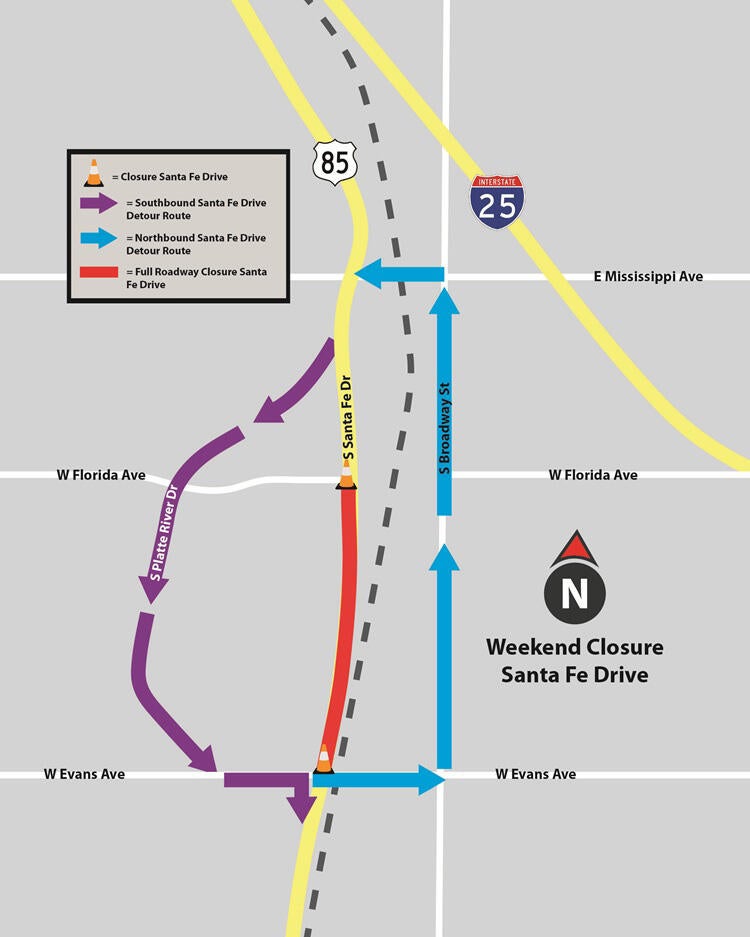
The Santa Fe Drive closure will begin at midnight on Saturday, July 11, and end on Monday, July 13, at 5 a.m. There will be detours in place. This includes:
- Southbound Santa Fe Drive Detour: Traffic will be routed to Platte River Drive to reenter southbound Santa Fe Drive at the West Evans Avenue on-ramp.
- Northbound Santa Fe Drive Detour: Access to northbound Santa Fe Drive will be at Mississippi Avenue via South Broadway Street.
- On-Ramp Closure: The West Evans Avenue on-ramp to northbound Santa Fe Drive will close at noon on Friday, July 10, to prepare for the full weekend closure and will remain closed until 5 a.m. on Monday, July 13. Traffic will be detoured to South Broadway Street to re-enter northbound Santa Fe Drive via Mississippi Avenue.
- Off-Ramp Closure: The southbound Santa Fe Drive off-ramp to West Evans Avenue will close for the full weekend period and remain closed until Friday, Sept. 11, while crews build new sidewalks and perform other concrete work at the southwest corner of the project. Detours will be posted to West Florida Avenue, West Dartmouth Avenue or West Hampden Avenue to bypass the ramp closure
During this closure, DOTI will reopen the underpass on Iowa Avenue. This is a new ADA accessible pathway that will be available between Santa Fe Drive and Acoma Street.

DENVER (KDVR) — Two officers, one now formerly of the Denver Police Department, face multiple charges relating to separate incidents in the past two months.
According to a release, now-former Denver Police Officer Gabriel Lucero was issued a citation for third-degree assault, official misconduct and false reporting, while Officer Javon Leach was cited for reckless driving and eluding.
The incident involving Lucero reportedly occurred on May 22 just before 1 a.m. in the 500 block of 16th Street. According to a release, Lucero was involved in an assault at a business, as he allegedly assaulted a person and walked away as others continued to assault the victim.
Security guards and an off-duty officer escorted him and the group out; however, Lucero reportedly identified himself as a Denver police officer and attempted to re-enter by using his police badge.
Lucero reportedly provided a false name without any other information, and further investigation verified Lucero as the person involved. Lucero was hired in 2025 and, due to his current probationary status, was fired as of Wednesday.
The incident involving Leach occurred around 1:41 a.m. on June 21, when Leach was reportedly pulling out of a parking lot on Larimer Street, attempting to drive against traffic.
Leach reportedly refused commands to stop as he left the area. Officials said he was found just seven minutes later, traveling at high speeds northbound on Park Avenue West.
He reportedly fled a traffic stop and continued to drive away, and officials deemed Leach to be the suspect following an investigation. He was placed in an off-line assignment while the case progresses, as they are considered misdemeanors.
“The Denver Police Department’s administrative review of Leach’s incident will begin once the criminal case is adjudicated, and that process includes the Denver Department of Safety and the Office of the Independent Monitor, a civilian oversight agency,” the release said.

Denver Nuggets standout forward Peyton Watson could find himself on another team before you know it.
With the Nuggets reportedly open to a sign-and-trade of Watson, could Denver really lose a core piece to their rotation?
It’s hard to imagine many teams being able to shoulder the financial weight of a Watson contract at this point because of the aprons and such, but he’s absolutely an asset to any contending team.
We’ve gone through and identified a few teams that make sense for Watson in the fall… including the one he’s already on at the moment. Hey, he might stay home, you never know!
The Clippers have been linked to Watson as a possible destination; he could help them immensely.
The Pistons have also been linked to Watson, which would help them a lot to contend for an NBA title.
Look, HYPOTHETICALLY, the Nets could move around some cap space with some player trades and such and get a deal done. They are one of the only teams in the NBA right now not in the negative with cap space.
The Grizzlies are the team with the least amount of negative cap space right now, per Spotrac. If they really wanted to pull off a Watson sign-and-trade… it would be hypothetically possible from a money standpoint.
Denver Nuggts
Look, it’s very possible Watson just stays in Denver on a brand-new deal. Who knows at this point?
-

 Los Angeles, Ca1 hour ago
Heat advisory, beach hazards in effect as Southern California sizzles
-

 Detroit, MI1 hour ago
Teen on moped hit by car after cruising through stop sign in Detroit
-

 San Francisco, CA2 hours ago
Flight of fancy: San Francisco moves to build private luxury airport terminal
-

 Dallas, TX2 hours ago
Dallas’ digital creator economy is booming. Burnout is too.
-
Miami, FL2 hours ago
I went to 2 famous Miami restaurants, a flashy steakhouse and a Cuban hot spot. Here’s how they compared.
-

 Boston, MA2 hours ago
Pedestrian struck and killed in Roxbury – Boston News, Weather, Sports | WHDH 7News
-

 Denver, CO2 hours ago
Santa Fe Drive in Denver closed this weekend for pedestrian bridge construction
-

 Seattle, WA2 hours ago
Police video shows West Seattle Bridge copper wire theft suspect’s arrest


