Colorado
Trump funding freeze includes payments to keep the Colorado River flowing
An aerial view shows the long-depleted Colorado River (L) as it flows between California (R) and Arizona, and an irrigation ditch (R) carrying river water toward Quechan tribal land on May 26, 2023 near Winterhaven, Calif.
Mario Tama/Getty Images/Getty Images North America
hide caption
toggle caption
Mario Tama/Getty Images/Getty Images North America
The first executive order President Trump signed in his second term, “Unleashing American Energy,” wouldn’t seem to have a direct impact on how much water is in the Colorado River, at least in the short term.
The order, signed the first day Trump took office, aims to “unleash America’s affordable and reliable energy and natural resources,” by ending “burdensome and ideologically motivated regulations.”
But the order also says, “All agencies shall immediately pause the disbursement of funds appropriated through the Inflation Reduction Act of 2022.”
While some of those funds were earmarked to prop up renewable energy, at least $4 billion was set aside to protect the flow of the Colorado River, which supplies about 40 million people with drinking water, is the foundation for a massive agricultural economy across the Southwest, and generates significant hydroelectric power.
The Colorado River is shrinking
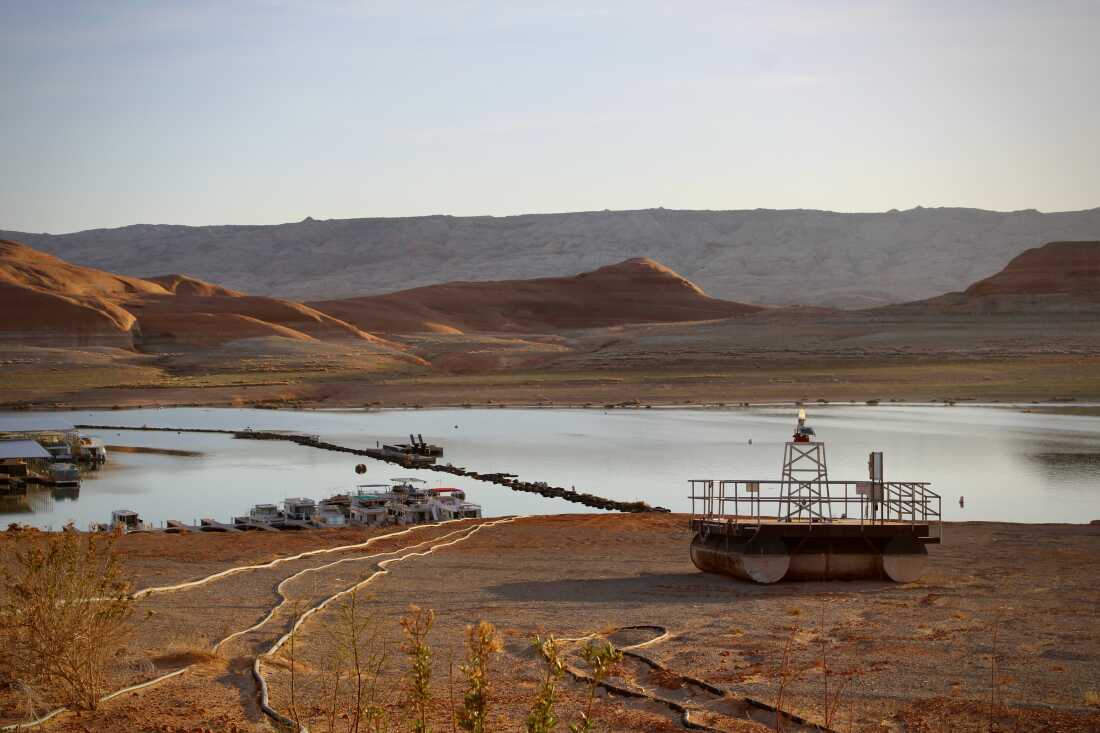
The river is shrinking due to climate change, which means the nation’s two largest reservoirs, Lake Mead and Lake Powell, created by dams on the Colorado River, have reached record low levels in recent years amid a megadrought spanning more than two decades. If water levels fall much lower, they could lose the ability to generate hydropower within the massive dams that hold them back, or even lose the ability to pass water downstream.
Docks and buoys, once floating atop dozens of feet of water, sit stranded on the shores of Lake Powell on April 9, 2023. President Trump paused funding that was designed to help conserve water and boost the nation’s largest reservoirs.
Alex Hager/KUNC
hide caption
toggle caption
Alex Hager/KUNC
The 2022 Inflation Reduction Act allowed President Biden to designate $4 billion for Colorado River programs, including big sums for programs that pay farmers, cities and Native American tribes to conserve Colorado River water and, instead, leave it in those reservoirs. The payments are compensation for money they can’t make by using their water to grow crops or for other uses.
A lot of the IRA money has already been delivered, but Bart Fisher, who sits on the board of the Palo Verde Irrigation District in California, is worried about what will happen if it goes away.
“If there’s no funding,” he said, “there will be no conservation.”
Farmers in Palo Verde use Colorado River water to grow cattle feed and vegetables in the desert along the Arizona border. Fisher said they want to be active participants in protecting the river, but they stand to lose money if they use less water and grow fewer crops.
“You won’t see any ag producer in any district willing to sacrifice revenue from their normal ag production for nothing,” he said.
The river’s uncertain future
In the current funding cycle, landowners in Fisher’s irrigation district alone are getting about $40 million in exchange for cutting back on their water use. No one knows how much funding, if any, will be delivered in the next cycle, which starts in August. Fisher said farmers are already thinking about their budgets for the next growing season.
“At the moment, it’s unnerving to think that maybe come August the first, all of our plans will need to suddenly change,” he said.
Some water experts say they are surprised to see these water conservation programs frozen by Trump’s executive order, since they do not appear to be in line with the president’s stated priorities of eliminating diversity programs and boosting domestic energy production.
“These are not woke environmental programs,” said Anne Castle, who held federal water policy roles during the Biden and Obama administrations. “These are essential to continued ability to divert water.”
Water users whose grants have been paused said they are asking the federal government for more information and getting little in the way of answers. The federal agencies in charge of Western water did not respond to NPR’s requests for comment.
Conservation programs like the one sending money to California farmers have been key in boosting water supplies in major reservoirs. That is no small feat, as leaders of the states that use Colorado River water are caught in a legal standoff about how to share it going forward. They appear to be making little progress as they meet behind closed doors ahead of a 2026 deadline.
A farm worker adjusts sprinkler heads spraying water that comes from the Colorado River Oct. 18, 2002 near El Centro, Calif.
David McNew/Getty Images/Getty Images North America
hide caption
toggle caption
David McNew/Getty Images/Getty Images North America
“Having this appropriated funding suddenly taken away undoes years and years of very careful collaboration among the states in the Colorado River Basin,” Castle said, “and threatens the sustainability of the entire system.”
In addition to those water conservation programs, the Inflation Reduction Act set aside hundreds of millions of dollars for projects aimed at keeping Colorado River tributaries clean and healthy. Conservation groups, small nonprofits, Native American tribes, and local governments were assigned federal money for a bevy of projects that included wildfire prevention and habitat restoration.
Sonja Chavez, general manager of the Upper Gunnison River Water Conservancy District, was expecting that money to make its way to her group for river improvement projects in Western Colorado.
“If there isn’t some resolution to the freeze or some additional guidance on what’s going to happen for folks,” she said, “we may have to put our entire programs on pause.”
Smaller watershed groups and their projects to restore and improve small sections of rivers are uniquely dependent on money from the federal government.
“Federal funding is critical because that’s the big money,” said Holly Loff, a grant writer in Western Colorado and the former director of the Eagle River Watershed Council. “No one can really compete with those big dollars, or very few other entities besides the federal government can fund at those levels.”
Small groups dependent on that federal funding have been scrambling to come up with contingency plans since it has been paused, and some of their leaders say the gap would be difficult to fill with money from donors or local governments.
Loff said a continued pause on funding would cause a lot of financial pain for communities near the Colorado River, such as those with economies dependent on water-based recreation, and people far away, like those who buy produce that is grown with Colorado River water.
“Our economy is going to be impacted,” she said. “It’s just far reaching. And I really can’t think of how anyone can avoid being impacted.”

Colorado
Battle with the Blue Jackets | Colorado Avalanche
Columbus Blue Jackets (18-18-7) @ Colorado Avalanche (32-4-7)
2 p.m. MT | Ball Arena | Watch: Altitude, Altitude+ | Listen: Altitude Sports Radio (92.5 FM)
After a homestand-opening win on Thursday, the Avalanche hosts the Columbus Blue Jackets for Next Gen Night on Saturday. This is the second and final regular-season matchup between the teams in 2025-26, as the Avalanche defeated the Blue Jackets 4-1 in Columbus on October 16th.
Latest Result (COL): OTT 2, COL 8
Latest Result (CBJ): CBJ 3, VGK 5
A Big Night at Ball
Josh Manson recorded the first two-goal and four-point game of his career, along with a Gordie Howe hat trick, as the Avalanche defeated the Ottawa Senators 8-2 at Ball Arena on Thursday. Manson was one of five Avs to post at least three points on Thursday, alongside Nathan MacKinnon (1g/3a), Ross Colton (3a), Brock Nelson (2g/1a) and Cale Makar (1g/2a). Additionally, Brent Burns added a goal for Colorado while Scott Wedgewood stopped 29 of the 31 shots he faced in net for the Avs. With the victory, the Avalanche extended its home win streak to 16 games.
At 10:11 of the first period, Manson opened the scoring with his third goal of the season via a shot from the point through traffic. MacKinnon doubled Colorado’s lead at 17:14 of the first period with his 36th goal of the season via a shot from the slot set up by Necas. The Avs took a 3-0 lead at 2:35 of the second period when Makar scored his 13th tally of the season via a left-circle shot after receiving a drop pass from MacKinnon. At 5:08 of the middle frame, Shane Pinto put the Senators on the board. The Senators momentarily made it 3-2 with 13:41 remaining in the second period, but the goal was disallowed after the Avs successfully challenged for offside. After the disallowed tally, the clock was reset to 13:48.
Necas gave the Avs a 4-1 lead on the power play at 11:46 of the second period with his 20th goal of the season via a sharp-angle one-timer from the bottom of the left circle set up by MacKinnon. At 12:03 of the middle frame, Burns made it 5-1 with his sixth goal of the season via a right-point shot through traffic. Nelson gave the Avs a 6-1 lead on a five-on-three power play at 14:23 of the second period with his 20th goal of the season via a right-circle one-timer set up by MacKinnon’s cross-ice feed. The Avalanche took a 7-1 lead at 16:48 of the middle frame when Manson scored his second goal of the game and fourth of the season via a one-timer from the point set up by Jack Drury’s feed. At 18:04 of the middle frame, Nelson scored his second tally of the game and 21st of the season via a right-circle one-timer set up by Ilya Solovyov’s feed from the left point. Brady Tkachuk made it 8-2 with a shorthanded goal from the doorstep at 7:03 of the third period.
Leading the Way
Nate the Great
MacKinnon leads the NHL in goals (36) and points (78) while ranking tied for third in assists (42).
All Hail Cale
Makar leads NHL defensemen in points (51) and assists (38) while ranking third in goals by blueliners (13). Among all NHL skaters, he’s seventh in assists.
Marty Party
Necas is seventh in the NHL in points (55) and tied for ninth in assists (35).
Series History
In 70 previous regular-season games against the Blue Jackets, the Avalanche has a record of 45-19-1-5.
Defeat on the Road
The Blue Jackets lost 5-3 to the Vegas Golden Knights at T-Mobile Arena on Thursday. In the first period, Columbus took a 2-0 lead after goals from Boone Jenner at 8:24 and Kent Johnson at 10:41 before Reilly Smith put Vegas on the board at 12:20. The Golden Knights took a 4-2 lead after second-period goals from Smith at 5:19, Jack Eichel at 13:07 and Mark Stone on the power play at 18:44. Kirill Marchenko scored for the Blue Jackets to make it 4-3 at 14:28 of the third period before Brett Howden gave the Golden Knights a 5-3 lead at 16:14 of the final frame.
Contributors Against Columbus
MacKinnon has posted 26 points (7g/19a) in 22 games against the Blue Jackets.
In nine contests against Columbus, Makar has registered 17 points (6g/11a).
Necas has recorded 21 points (4g/17a) in 26 games against the Blue Jackets.
Producing Offense for Ohio’s Team
Zach Werenski leads the Blue Jackets in points (46) and assists (30) while ranking tied for first in goals (16).
Marchenko is tied for the team lead in goals (16) while ranking second in points (35) and tied for second in assists (19).
Dmitri Voronkov is third on the Blue Jackets in points (28) and goals (15).
A Numbers Game
30
Colorado’s 30 five-on-five goals since December 19th (10 games) are the most in the NHL during that span.
63
The Avalanche’s 63 second-period goals lead the NHL.
3.94
Colorado’s 3.94 goals per game since December 1st lead the NHL during that span.
Quote That Left a Mark
“It was fun. I don’t think he’s ever seen that before. He’s seen me fight. He’s maybe seen me score. But I don’t think he’s ever seen—actually, nobody’s ever seen that before out of me in the NHL. So, it was a first for everybody, including myself.”
— Josh Manson on recording a Gordie Howe hat trick with his father, former NHLer Dave Manson, in attendance
Colorado
Colorado man heads to Washington, D.C., to gain support for Marshall Fire survivors
Four years after the fire, recovery is still incomplete for some Marshall Fire victims. A Colorado man is joining wildfire survivors from across the country to push lawmakers to make changes and provide support for survivors still rebuilding.
Recently, a historic $640 million settlement was reached with Xcel Energy, but the Coloradans who lost everything in the Marshall Fire might not be receiving all the money that they’re owed. Some settlements could be taxed, while others were paid in full.
“I was the fourth responding fire engine to the Marshall Fire. By the end of the night, I was triaging homes in the neighborhood that I grew up in,” said former firefighter Benjamin Carter. “I’ve seen how much the community’s hurting, and I just wanted to do whatever I could to help.”
Carter is now fighting for those who lost their homes, including his mother. He’s working with an organization called After the Fire, joining up with wildfire survivors in Oregon, Hawaii and California. This week, Carter flew to Washington, D.C., to speak with lawmakers about how they can help survivors rebuild.
In 2024, lawmakers passed the Federal Disaster Tax Relief Act, which exempted wildfire survivors from taxes on related settlements, among other tax relief. But the bill expired last week, shortly after Xcel agreed to settle over the Marshall Fire.
“If the people don’t have to pay taxes on the damages, then it helps them rebuild,” Carter explained. “Some of the smaller attorneys still haven’t received payment, so all those people will be subject to those taxes; all the attorney fees, and what the actual settlements end up being. And, of what they’re actually getting at the end of the day, that’s been a huge challenge.”
Congress has already proposed extension options. But Carter hopes that by sharing their stories, legislators will act before survivors lose anything else.
“With a lot going on in Washington and everything, the representatives don’t always know about all the issues. And so, we want to educate them on this issue and hopefully gain their support,” Carter said.
Colorado
Boebert takes on Trump over Colorado water
-
Detroit, MI7 days ago2 hospitalized after shooting on Lodge Freeway in Detroit
-
Technology4 days agoPower bank feature creep is out of control
-
Dallas, TX5 days agoDefensive coordinator candidates who could improve Cowboys’ brutal secondary in 2026
-
Dallas, TX2 days agoAnti-ICE protest outside Dallas City Hall follows deadly shooting in Minneapolis
-
Iowa4 days agoPat McAfee praises Audi Crooks, plays hype song for Iowa State star
-
Delaware2 days agoMERR responds to dead humpback whale washed up near Bethany Beach
-
Health6 days agoViral New Year reset routine is helping people adopt healthier habits
-
Nebraska4 days agoOregon State LB transfer Dexter Foster commits to Nebraska