Colorado
In Colorado’s devastatingly dry winter, hope abounds for big snows to round out the season: ‘It’s not time for panic’


Anu Koiv emerged from her Gunbarrel home in the middle of January and spotted something she hadn’t seen in the seven years she’s lived there: pink flowers blooming on a backyard viburnum shrub. In winter.
As the 72-year-old retiree was admiring the unexpected burst of color, she noticed bees dancing on the flowers. The sun was out, and temperatures in Boulder County hovered in the mid-50s.
“The weather is pulling the pollinators out of their dormancy,” Koiv said enthusiastically. “A multitude of bees.”
A few miles away in Arvada, Susan Burgmaier was headed to the outdoor pickleball courts at the Simms Street Recreation Center for a match. The weather was heavenly, and Burgmaier, 61, had been playing the game al fresco once a week for much of the fall and early winter.
“The only thing that stops us is the gazillion-mile-per-hour winds,” she said.
The warm, snow-free weather that many in the city have enjoyed for weeks — extending the active season for cyclists, hikers and runners — is bringing less joy to the high country, where the nearly $5 billion-a-year Colorado ski industry is struggling to salvage its season.
“We haven’t had many powder nirvana days this year,” said Melanie Mills, the president and CEO of Colorado Ski Country USA, a trade association representing 20 of the state’s ski areas. “Visits are down enough that they will not recover, even if the rest of the season is very snowy.”
Colorado is getting a break with this weekend’s arctic blast — with forecasts of accompanying mountain snow — but the broader dry-weather pattern that’s set to return in coming days is raising worries not only about the ski season but also about impacts this summer for Colorado’s water supply and the farms and industries it sustains.
Despite the thrill of playing pickleball outdoors on a January day, Burgmaier fears the darker implications of what’s happening with the weather.
“It’s nice to be outside, but what’s happening is not good for the environment,” she said. “That one time it snowed this season, I was thrilled. I can get my exercise shoveling — and I’m happy about it.”
State Climatologist Russ Schumacher said figuring out the ramifications of a dry and mild end of fall and start of winter is a complicated thing.
Colorado just clocked its warmest December since records started being kept in 1895, while Denver had its second-warmest final month of the year. The city broke daily temperature records seven times last month, including on Christmas Eve and Christmas Day. It also documented 21 days where the average temperature was more than 6 degrees above normal, according to the National Weather Service.
The balmy days have extended into 2026, with Jan. 4 setting a new high-temperature record of 67 degrees for metro Denver for that date.
“What makes this year so unusual is it’s been so warm for so long,” said Schumacher, who is also a professor in the Department of Atmospheric Science at Colorado State University.
In the high country, the warm temperatures have claimed the Rotary Park Ice Rink in Ouray for the season. Last week, the city announced its closure because there hadn’t been “the necessary cold days or snow pack to produce the level of ice our community deserves.”
Closer to the Front Range, Dillon Reservoir was creeping towards its latest freeze-over on record. The current record was set on Jan. 31, 1981. Denver Water, which owns and operates the Summit County lake, estimated last week that ice cover was around 60% — not sufficient for ice fishing or cross-country skiing enthusiasts.
Conditions may have briefly flipped this weekend, with a deep freeze settling over the state and heavy snow — up to 10 inches or more — forecast for many mountain locations as of late last week, according to OpenSnow.
But it will take more than that to make up for the dearth of snow so far this season.
“You need February and March to be nonstop snowstorms,” Schumacher said.

Temps on an upward march
The reasons behind the rise in temperatures and the increase in dryness are fiercely debated, with a mix of focus on the impacts coming from global climate change and those that are attributable to the weather variability that has long shaped what is experienced on the ground.
Globally, the 10 warmest years on record have occurred in the last decade, according to the World Meteorological Organization. The same group determined that the global average concentration of carbon dioxide in 2024 surged to the highest level since modern measurements began in 1957.
Carbon dioxide is a pollutant that scientists say helps lock heat in Earth’s atmosphere.
“That’s where the climate change signal really comes out,” Schumacher said.
According to a series of scientific studies published last year and collated by the Yale Center for Environmental Communication, researchers determined that climate change is complicit in the drying and warming of the American Southwest. The studies found emissions from the burning of fossil fuels are driving an ongoing 25-year shortfall in winter rains and mountain snows across the region.
Dryness has accompanied the elevated temperatures felt by Coloradans this fall and winter, with the state tallying its 34th-driest December in 130 years of record-keeping, according to the Colorado Climate Center. Much of the state is in some level of drought, according to the U.S. Drought Monitor, though a broad swath of the Eastern Plains is not.
Denver had its second-latest first accumulating snow — on Nov. 29. As of Thursday, mountain snowpack was at 56% of the median for that date, according to data collected by the U.S. Department of Agriculture’s National Water and Climate Center.
The snowpack was well below the lowest level recorded at this point in the season in records that go back to 1987.

But Schumacher said aridity in Colorado within a shorter window of time is tough to pin on global warming, given the complexity and interplay of major weather systems and cycles, like El Niño and La Niña.
“Changes in precipitation in Colorado are harder to connect to global climate change because the natural variability can be so big,” he said.
It’s not like anemic snowpacks are new to Colorado. Nearly half a century ago, during the winter of 1976-1977, the state endured one of its worst winters for snow paucity in memory, prompting then-U.S. Sen. Floyd Haskell to urge President Gerald Ford to declare Colorado’s snow-starved high country a disaster area eligible for economic relief.
Just four winters later, in 1980-1981, it happened again.
Jason Ullmann, the state engineer for the Colorado Division of Water Resources, said that despite the recent dry conditions, water storage levels across the state were in pretty good shape.
“We’re in an OK position with reservoir storage on average statewide,” he said.
But Ullmann noted that if things didn’t ramp up significantly on the storm front over the next two months or so, a different conversation could be in the offing by spring.
“It’s not time for panic — there is time for it to improve,” he said. “One of our snowiest months, March, is still to come.”

High country woes
Rick “The Pup” Ascher has seen “really good” years and some “less-than-good” years in his nearly 50 years in Summit County.
He moved to Breckenridge from Minnesota in 1979, at age 18. For the past two decades, he’s owned the ski and snowboard business Pup’s Glide Shop, just off Main Street on Ski Hill Road.
“This year started out pretty slow,” Ascher said, “and it just continued really slow.”
Snowmaking equipment, he said, has done “an incredible job of putting snow on the main trails for the general public” at Breckenridge Ski Resort, but he knows a truly successful ski season can’t be had without the real stuff coating the slopes at some point.
That’s where Ascher puts on his optimist hat.
“Records show it’s going to snow,” he said. “It always has.”
Sonja Chavez, the general manager of the Upper Gunnison Water Conservancy District, which covers Crested Butte and Gunnison, said the snow water equivalent in the Upper Gunnison River Basin was at 67% of average. Snow water equivalent is a crucial measurement of the amount of liquid water contained within the snowpack.
“Right now, I would say I’m moderately concerned,” she said. “If you talk to me in the spring and we still haven’t seen any significant snowfall, I would characterize my state of mind as highly concerned. If we go into another year with poor snowpack, or below-average snowpack, we’re going to be in a world of hurt.”
Joel Gratz, founding meteorologist of the OpenSnow reporting and forecasting service — which is relied upon by diehard skiers and snowboarders — said temperatures have been rising over the last 60 years. But blaming climate change for current conditions in Colorado, he said, is a facile calculation that fails to account for other meteorological factors at play.
A persistent high-pressure ridge over the West and a low-pressure trough over the eastern United States have been deflecting storms to the north of Colorado, he said.
And while the La Niña weather cycle now occurring over the Pacific Ocean tends to dry and warm the American Southwest, he said, its effects are felt more strongly north and south of the state.
“The atmosphere has multiple factors that create storm tracks. Sometimes they’re not in our favor, sometimes they are. And sometimes it’s a little bit of both,” Gratz said. “There is low to zero confidence that there have been any long-term changes in storm tracks or the amount of precipitation that falls here in Colorado.
“This is not climate change. This is simply bad luck.”

Ski resorts try to ‘stay nimble’
Regardless of the cause, the impacts of this season’s dismal conditions in the high country are indisputable.
Weekend traffic through the Eisenhower-Johnson Memorial Tunnels in November was down 3.6% from the previous November, according to the Colorado Department of Transportation. Traffic thinned even more in December, with 11.6% fewer weekend warriors transiting the tunnels compared to December 2024.
Room bookings in Breckenridge this season have slipped 7.8% compared to last year, with February’s numbers alone down 13% year over year, according to the Breckenridge Tourism Office.
Earlier this month, Vail Resorts reported to investors that skier visits to its destinations across North America have fallen 20% for the season. The publicly held, Broomfield-based company owns Vail, Beaver Creek, Breckenridge, Keystone and Crested Butte in Colorado, plus 32 other resorts in North America.
Chief Executive Rob Katz told investors that in the Rockies, “snowfall was down nearly 60% versus the historical 30-year average, resulting in approximately 11% of terrain being opened in December.”
Alan Henceroth, CEO of Arapahoe Basin, told The Denver Post that the season has “asked all of us to stay nimble, both on and off the mountain.” While hours have been cut, no employees have been fired or furloughed, the resort said.

Away from the busy Interstate 70 corridor, the challenges are no different. Said Andrew Sandstrom, executive director of the Gunnison-Crested Butte Tourism Association: “We’re hanging in there.”
The mostly north-facing slopes at Crested Butte Mountain Resort have meant less melting of the snow that is there. And with a 13-day ski patrol strike at Telluride Ski Resort that ended in early January, Sandstrom said Crested Butte saw “a little bit of a boost, last minute, of people shifting here.”
“Many destinations are facing similar things. The remainder of the season is certainly much more snow-dependent. Folks are deciding now, ‘Do I take a ski trip for spring break, or do I go to the beach for spring break?’ ” he said. “With the lack of snow, it’s certainly impacting us.”
Mills, the Colorado Ski Country USA head, said while skier visits are “down sizable double digits” this season, she is not giving up.
“We’re starting to see colder weather,” she said. “There’s a lot of season left, and we know that skiers and snowboarders, when it snows, they want to get out and ski. I think there is a lot of pent-up demand that will still turn out this season.
“We’re not writing it off, by any means.”

Snowpack means water for farms, cities
Nearly 10,000 feet downhill from A-Basin’s 13,000-foot peak sits Dale Mauch’s 4,000-acre farm in Prowers County, which borders Kansas. There, the 65-year-old Colorado native grows corn, hay, wheat and oats. He started farming at age 18.
Mauch credits an early January snowstorm for putting southeast Colorado in fairly good shape water-wise — for now. But he knows the Arkansas River watershed has a snow water equivalent that is just 44% of average. The river is critical to irrigating the farm fields in the area.
If the snowpack doesn’t build in the next two months, Mauch said, farmers on the Eastern Plains will have to tap big water sources — like the John Martin and Pueblo reservoirs — earlier and harder than they’d like.
“So lake water that would last you into September could be done by July,” he said. “Then your crop burns up.”
As crucial as snowpack is to a productive field, Mauch said, farmers can look to the heavens as a backup. He is hoping that monsoon rains materialize this summer.
“If you get the afternoon thunderstorms, you can have a river from rain that makes up for the lack of a river on the snow side,” he said. “Our life is hope — because you have a lot of reasons to say, ‘Why do I do this?’ ”

Nathan Elder’s life is maintaining resilience in Denver Water’s system, which serves 1.5 million people in metro Denver.
As manager of the utility’s water supply, he keeps a close eye on Denver Water’s reservoir system, which sprawls across 4,000 square miles and into more than a half-dozen counties west of Denver.
Denver Water taps all or part of 17 reservoirs — which, all told, hold a capacity of 708,000 acre-feet of water. An acre-foot, the amount of water it takes to cover an acre in a foot of water, can supply up to two single-family households’ needs for a year.
Almost all of the water the utility disperses comes from snowmelt.
Elder said the system is at 82% of capacity, which is just 4 percentage points below its normal level of 86% of capacity for this time of year.
“Our snowpack is not the worst we’ve seen for this time of the year, but it’s close to the bottom,” he said.
Elder projects Denver Water’s storage system will be at 90% of capacity at its peak on July 1.
“Denver Water plans for these types of things,” he said. “No one should go out and buy emergency tubs of water.”
But a longer-term concern for water managers is developing in terms of the quality of Colorado’s snowpack, Elder said. Because of rising temperatures, evaporation increases at the surface and desiccated soils suck up more water before it flows downhill.
“We just can’t expect our snowpack to produce as much as in past years,” he said. “We’re on a trend that we don’t want to be on right now.”
Whether counties and cities impose harsher outdoor watering restrictions on residents this summer — a common tactic during dry spells in Colorado — will likely be dictated by how snowy things get in the high country over next couple of months.
For now, pay attention to not just what is visible in the yard but what is happening underground, said Laura Swain, an assistant curator at the Denver Botanic Gardens. Roots are still growing and storing energy during the winter months, and they need moisture to remain viable.
“This is particularly important for newly planted trees and shrubs,” she said.
Native, drought-tolerant plants will handily weather the current conditions because “they are more adapted to these fluctuations,” Swain said.
“One year like this doesn’t mean a collapse, but it is a concerning trend,” she said.

‘Might as well enjoy it’
For now, the low snow levels have some people looking at the silver linings, whether at ski resorts or at the businesses that rely on summer snowmelt or among metro residents who are enjoying the outdoors unexpectedly.
Kerry O’Connor, a spokeswoman for the Breckenridge Tourism Office, said that while skiing conditions weren’t ideal on the mountain over the Christmas holidays, visitors turned their attention — and dollars — to Main Street.
“Over the holidays and through New Year’s, Main Street saw quite a nice boost of people visiting shops and local restaurants,” she said. “That was a nice side effect for our retail side of things, even though the mountain was suffering.”
David Costlow, the executive director of the Colorado River Outfitters Association, pins his hopes for the upcoming rafting season, which depends on the spring runoff, on past experience — and an optimism that is requisite for someone in his position.
“We’ve seen times like this before — 2002 was very dry. In 2003, it was very dry in December, January, February,” he said. “Then, on the Front Range, we got a three-foot snow on March 17 that changed the whole season. It kept snowing and didn’t stop until June.”
Even with a snowpack at 70% of average in the spring, Costlow said, the season would be just fine.
“You may not have raging high water, which is OK with us. You may just have a shorter season,” he said. “We will still raft.”
Finally, there’s just the simple human joy of being able to strip down to shorts and a T-shirt in the middle of winter.
Nick Roberts didn’t mind the unusually mild morning on Wednesday. Dressed in shorts and a light jacket, he prepared for a short hike on South Table Mountain in Golden.
He knew that January mid-morning temperatures in the 40s weren’t normal and could portend a dry summer to come. But he felt there was little he could do about it.
As he headed up the trail, he said: “Might as well enjoy it.”
Staff writer Elise Schmelzer contributed to this story.
Get more Colorado news by signing up for our daily Your Morning Dozen email newsletter.



As a result of a snow drought and a heat wave that have both set records, some Colorado residents face the earliest restrictions on their water use ever imposed.
Denver Water announced Wednesday that it is seeking a 20% cut in water use, asking people to turn off automatic watering systems until mid-May and restricting the watering of trees and shrubs to twice a week.
“The situation is quite serious,” said Todd Hartman, a spokesperson for the utility. “We’re in such a dire situation that we could be coming back to the public in two or three months and saying you’re limited to one day a week.”
It is the earliest in the year that Denver Water has ever issued a restriction, Hartman said.
Colorado’s snowpack peaked at extremely low levels on March 12 — nearly a month earlier than usual — then cratered during the recent heat wave that cooked nearly every state in the West.
“We already had the lowest snowpack we’ve seen since at least 1981, and now, with the heat wave conditions, we’ve already lost about 40% of the statewide snowpack” since the March 12 peak, said Peter Goble, Colorado’s assistant state climatologist. “Conditions are looking more like late April or early May.”
The water restrictions are a harbinger of what’s to come in many Western states as officials try to manage widespread drought concerns. Nearly every snow basin in the Mountain West had one of its warmest winters on record and is well behind normal when it comes to water supply, according to the U.S. drought monitor. The dwindling snowpack is likely to raise the risk of severe wildfires, hamper electricity generation at hydropower dams and force water restrictions for farmers.
Hartman said nearly every community east of the Rockies, along Colorado’s front range, is in much the same boat as Denver.
City Council members in Aurora are considering similar water restrictions; reservoirs there stand at about 58%, according to the city’s website. In the town of Erie, officials declared a water shortage emergency on March 20 after they observed a massive spike in consumption.
Gabi Rae, a spokesperson for the town, said Erie was perilously close to having taps run dry because so many residents had started watering their lawns early amid the unseasonable heat.
“We were a day away from running out of water. That’s why it was such an emergency,” she said.
Erie officials demanded that residents stop using irrigation systems altogether.
Goble said this month’s heat wave has set records in every corner of Colorado, sometimes by double digits.
“I can’t remember seeing a single heat wave that broke this many records, and seeing it across such a large portion of the country is certainly eye-popping,” he said, adding: “I’m located in Fort Collins, and we got up to 91 last Saturday. The previous record for March was 81, so we smashed that record. And it wasn’t just one day, either.”
Denver Water, which serves about 1.5 million residents in the city and its surrounding suburbs, gets about half of its water from the Upper Colorado River Basin and the South Platte River Basin. The latter’s snowpack was at about 42% of normal Tuesday, the utility reported. The Upper Colorado River Watershed was at 55%.
Systemwide, Denver Water’s reservoirs are about 80% full, which is only about 5 percentage points lower than in a typical year.
“That sounds pretty good,” Hartman said. “Except that what we’re not going to be able to rely on is that rush of water that will bring those reservoirs back up, because the snowpack is so low.”
In other words, the snowpack — a natural water reservoir — is mostly tapped already and won’t replenish reservoirs later this spring and into summer, when runoff usually peaks.
In Erie, city workers plan to aggressively police water use until sometime next week using smart meters that monitor residential usage. Rae said the city is also sending utility workers to patrol neighborhoods and look for sprinklers that are turned on.
“People have been kind of annoyed with how aggressive we were, and I don’t necessarily think they understand the ramifications if we weren’t,” Rae said. “It is an actual serious emergency situation. We were so close to reaching empty, there would literally be no water coming out of the taps — hospitals, schools, fire hydrants, your home would have no water.”
Although the limits on outdoor watering will be lifted soon, Rae expects more restrictions later this spring and summer.
Colorado
Suddenly hazy skies in Denver prompt some residents concerned about wildfire smoke to call 911

Some people who live in the Denver metro area on Thursday afternoon were making calls to 911 after skies became noticeably hazy and winds kicked up. It was due to smoke from wildfires in Nebraska moving into Colorado. A cold front also was moving through the Front Range, and there is dust in the air.
The poor air conditions led to reduced visibility downtown after 3 p.m. Several of CBS Colorado’s City Cams showed dust or smoke in the air.
Temperatures were expected to drop by as much as 20 to 30 degrees with the cold front.
The suddenly dusty skies prompted at least one fire agency to put out a plea to residents to please only call 911 “if you see flames.” That warning was put out by South Metro Fire Rescue, which shared a photo on X of an office building with haze visible outside.
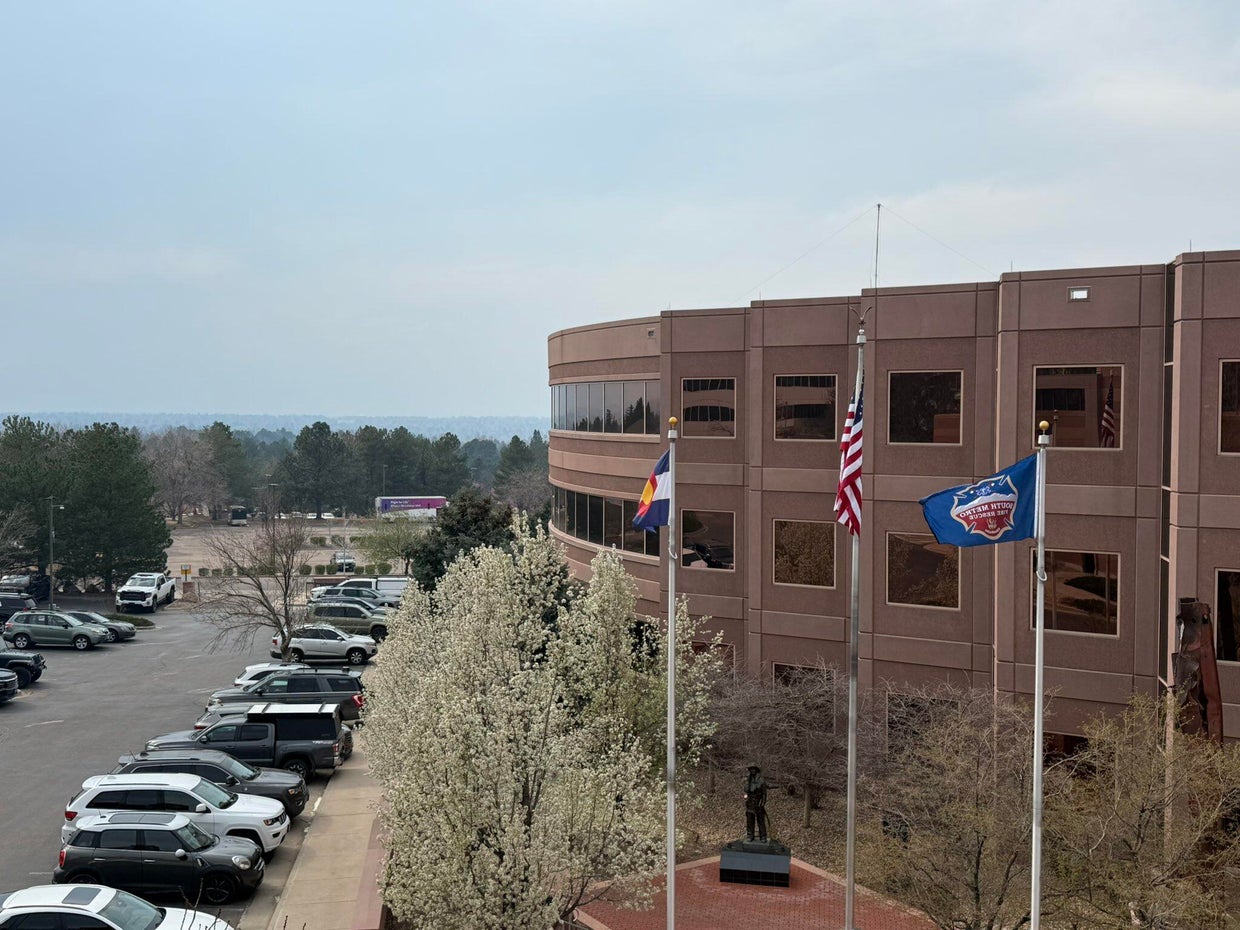
South Metro Fire Rescue said in their post that the smoke is from Colorado’s neighbor to the east. They called it a “significant haze” in the air.
Earlier this month, the Morrill Fire and the Cottonwood Fire burned a significant amount of Nebraska grassland and ranchland. They have mostly been contained by firefighters. Nebraska Gov. Jim Pillen said those two fires combined with several others have burned approximately 800,000 acres of land. On Thursday, Pillen announced that he is signing several executive actions intended to ease the burden caused by the fires.
There were no wildfires burning in the Denver metro area on Thursday afternoon.

ARAPAHOE COUNTY, Colo. (KKTV) – A homicide suspect based out of Colorado, wanted in a fentanyl-related death, is back in the state after being captured in Colombia.
The Arapahoe County Sheriff’s Office (ACSO) said 33-year-old Max Arsenault had been on the run since January 17.
Deputies said this stemmed from an incident in May 2023, where deputies responded to a call for a man named Nicholas Dorotik, who was found unresponsive.
ACSO said the cause of death was a mixed drug overdose involving meth and fentanyl, having about three times the lethal amount of fentanyl in his system.
One year later, Arsenault was arrested. He was scheduled for trial in January 2026 when deputies said he fled the country while on bond three days before the trial was set to start.
He was caught in Medellin, Colombia, on March 4, following a two-month international investigation. He has since been extradited back to Denver, where he is facing charges and awaiting trial.
Copyright 2026 KKTV. All rights reserved.

Supreme Court says local elections board must hear residency challenge

Tiger Woods charged with DUI after rollover crash in Florida

Georgia Senate passes bill for hand-marked paper ballots

Hawaii police investigate alleged gun threat at Kealakehe Intermediate

Idaho Senate introduces new bill to give local municipalities authority to control rat populations

Florida High School Football Rankings: Top 25 teams – Oct. 21

How old is Bo Nix? What to know about Oregon quarterback ahead of 2024 NFL Draft

Cleary's 21 help Le Moyne down Central Connecticut State 69-64 in OT

99th annual Pony Swim held in Virginia

Indiana Members Credit Union announced as new anchor tenant at Bottleworks District

WATCH: Senate hearing goes silent after Angel Father confronts top Dem over daughter’s death

US diplomat Marco Rubio denounces settler violence, tolls in Hormuz strait

Iran-linked hackers have breached FBI Director Kash Patel’s personal emails | CNN Politics

Live: CPAC 2026 Day 2

Video: Will ICE Change Under Its New Leader?
-

 Detroit, MI1 week ago
Drummer Brian Pastoria, longtime Detroit music advocate, dies at 68
-

 Movie Reviews1 week ago
‘Youth’ Twitter review: Ken Karunaas impresses audiences; Suraj Venjaramoodu adds charm; music wins praise | – The Times of India
-

 Sports6 days ago
IOC addresses execution of 19-year-old Iranian wrestler Saleh Mohammadi
-

 New Mexico5 days ago
Clovis shooting leaves one dead, four injured
-
 Business1 week ago
Disney’s new CEO says his focus is on storytelling and creativity
-

 Technology5 days ago
YouTube job scam text: How to spot it fast
-

 Tennessee4 days ago
Tennessee Police Investigating Alleged Assault Involving ‘Reacher’ Star Alan Ritchson
-

 Texas1 week ago
How to buy Houston vs. Texas A&M 2026 March Madness tickets