Colorado
Colorado Democrats spar over legislation as party seeks direction in Trump era


In late February, the second-ranking Democrat in the Colorado House sat before a group of her colleagues and prepared to do something she had rarely done: voluntarily kill one of her own bills.
House Bill 1020 would have put initial regulations on earned-wage services — companies that let employees access part of their paychecks early in exchange for a fee. Majority Leader Monica Duran and her co-sponsor, Denver Democratic Rep. Sean Camacho, had pitched the measure as a way to put guardrails on a financial product vital for lower-income people in a financial bind.
But Democratic critics alleged it was an attempt by financial companies, who were backing it, to draft their own regulations, and those legislators argued that the service was just a different kind of payday loan. After the bill passed its first committee, progressive Democratic lawmakers worked with a liberal think-tank, the Bell Policy Center, to draft amendments that would have imposed tighter regulations on the services.
Duran and Camacho — who denied the services were a loan — were open to the changes. But Duran said that as she reviewed the amendments, she felt the bill had slipped away from the one she’d introduced. The industry groups supporting the bill balked, and one formally filed to oppose it.
So when the bill came up for a vote, Duran and Camacho voluntarily — and acrimoniously — killed it.
House Bill 1020 was not the first business-friendly bill to be decried as anti-worker, and it hasn’t been the last to be scuttled by other Democratic lawmakers. Another — to help struggling restaurants by clipping tipped workers’ minimum wage — has been delayed until later this month because of that opposition. A third — a draft proposal to audit recent environmental, labor and health care regulations — is undergoing a full rewrite amid backlash from both Democratic lawmakers and the union and environmental groups allied with them. Its sponsors say the idea may be tabled altogether.
It’s not unusual for House Democrats — whose 43 members span the left-of-center spectrum — to disagree on policy, even to the point of semi-public conflict. Nor are the contested bills unique or particularly startling. Lawmakers of both parties often run legislation in coordination with businesses or trade groups, and this year’s bills, sponsors contend, set out to address real problems: a sagging restaurant industry, a popular but unregulated financial service, and debates over the state’s regulatory framework.
“Doing the right thing matters. How we show up to this building matters,” Duran told colleagues on the House’s Finance Committee before asking that they vote to table it. She defended the legislation as pro-worker: “This bill was for working people, to support working people, and as a fierce advocate for working families, I know firsthand how supportive this bill would have been. It is frustrating when misinformation is spread saying this bill is anti-worker.”
But the debate swirling around the direction of the Democratic Party and the chaotic uncertainty springing from the Trump administration have elevated opposition from more liberal members of the party. While some lawmakers have worked to legislate this year like any other, others have sought to close ranks and defend what they see as Democratic priorities in a tumultuous political environment, both for the party and the country.
That tone was set, in part, two weeks after the election, when Democratic lawmakers gathered in the Capitol to unveil pro-labor reforms. Near the end of their news conference, one of the bill’s sponsors called out, “Which side are you on, Democratic Party?”
“We are facing a reckoning of what type of party we want to be,” said Rep. Yara Zokaie, a Fort Collins freshman who opposed both the tipped-wage measure and Duran’s paycheck bill. “I also think that everybody wants to represent their own districts to the best of their ability. I ran on standing up for workers.”
Trying to help struggling restaurants
The debate around all three bills has been heated. During testimony Monday night, Denver City Councilwoman Shontel Lewis said that it was “appalling” that Democrats were proposing to cut the tipped minimum wage while “the federal government is in chaos.”
Rep. Alex Valdez, a Denver Democrat backing the tipped wage bill, said the rhetoric surrounding it has been “vile,” referring to crude flyers depicting another lawmaker and negative reviews left for restaurants whose owners had testified in support of the bill.
The measure — which now faces a critical and potentially fatal vote in mid-March — is intended to help struggling restaurants reeling from high costs. As written now, it would lower the specific minimum wage paid to workers who also received tips in Denver and elsewhere that exceed the state minimum.
Another sign of the tricky political dynamics: It’s backed by Denver Mayor Mike Johnston but opposed by Lewis and other City Council members, as well as lawmakers from both parties who disparage it as a pay cut and a violation of cities’ ability to set their own wage laws.
Valdez said lawmakers’ desire to respond to actions and posturing from the Trump administration had further strained an already difficult debate, which he said fundamentally turned on helping restaurants stay afloat.
“I think that’s where we see an exacerbation by the Trump administration. It’s just, ‘What can I do?’ But that isn’t always the best way to do things,” he said. “I think at least with the tipped wage (bill) — this is the culmination of a five-year process. We didn’t catch this overnight. It’s five years of conversation, and we’re still having it.”
But for other lawmakers, debate in the legislature is a statement on the uncertainty from Washington, D.C., and internal arguments over how the Democratic Party reacts to its November losses.
“I do think we are trying to figure ourselves out in this moment. Are we a party for working people or not?” said Rep. Javier Mabrey, a Denver Democrat and among the more left-wing legislators.
Even though he and labor unions are pushing a contentious effort to reform the state’s labor law, Mabrey said he felt that “labor groups, progressive advocacy groups, consumer rights’ groups are playing defense this year in a way that they did not have to play defense in my first two years.”
“It is not a DOGE bill”
The audit proposal — to have the state auditor review 10 years’ worth of environmental, labor and health regulations — fits into that feeling of defensiveness because it’s backed by business groups, legislative leadership and Gov. Jared Polis. When details of the audit bill were revealed last month, several Democrats responded with a profane, three-word response.
That reaction — further fueled by fears of deregulation at a federal level — has helped put the brakes on the proposal. Speaker Julie McCluskie, a Dillon Democrat sponsoring it, said Wednesday that the idea was about promoting good governance. But it’s now being reworked fundamentally, and it may not come at all this year, she said.
Some Democratic lawmakers had taken to calling the proposal the “DOGE bill,” referring to billionaire Trump adviser Elon Musk’s so-called “Department of Government Efficiency,” which has set about dismantling a succession of federal agencies in recent weeks.
“To be frank, we had not had enough of an initial conversation before we released the draft,” McCluskie said. “In large part because of what’s happening with the Trump administration … I think people are drawing a parallel there that is not the same. I would push back. We are trying to just, again, focus on good governance.”
“It is not a DOGE bill,” she added, emphatically.
McCluskie argued that the party can find a path forward that helps both workers and businesses. While Colorado Democrats largely held serve in November, the party’s national losses were “a moment for all of us to recognize that a lot of folks are unhappy,” the speaker said.
“I would lift up that we also have to think about the entire … ecosystem: businesses, workers, consumers, right?” she said. “You have to think about that globally, and I have always believed you can be pro-business and pro-worker at the same time.”
Stay up-to-date with Colorado Politics by signing up for our weekly newsletter, The Spot.



As a result of a snow drought and a heat wave that have both set records, some Colorado residents face the earliest restrictions on their water use ever imposed.
Denver Water announced Wednesday that it is seeking a 20% cut in water use, asking people to turn off automatic watering systems until mid-May and restricting the watering of trees and shrubs to twice a week.
“The situation is quite serious,” said Todd Hartman, a spokesperson for the utility. “We’re in such a dire situation that we could be coming back to the public in two or three months and saying you’re limited to one day a week.”
It is the earliest in the year that Denver Water has ever issued a restriction, Hartman said.
Colorado’s snowpack peaked at extremely low levels on March 12 — nearly a month earlier than usual — then cratered during the recent heat wave that cooked nearly every state in the West.
“We already had the lowest snowpack we’ve seen since at least 1981, and now, with the heat wave conditions, we’ve already lost about 40% of the statewide snowpack” since the March 12 peak, said Peter Goble, Colorado’s assistant state climatologist. “Conditions are looking more like late April or early May.”
The water restrictions are a harbinger of what’s to come in many Western states as officials try to manage widespread drought concerns. Nearly every snow basin in the Mountain West had one of its warmest winters on record and is well behind normal when it comes to water supply, according to the U.S. drought monitor. The dwindling snowpack is likely to raise the risk of severe wildfires, hamper electricity generation at hydropower dams and force water restrictions for farmers.
Hartman said nearly every community east of the Rockies, along Colorado’s front range, is in much the same boat as Denver.
City Council members in Aurora are considering similar water restrictions; reservoirs there stand at about 58%, according to the city’s website. In the town of Erie, officials declared a water shortage emergency on March 20 after they observed a massive spike in consumption.
Gabi Rae, a spokesperson for the town, said Erie was perilously close to having taps run dry because so many residents had started watering their lawns early amid the unseasonable heat.
“We were a day away from running out of water. That’s why it was such an emergency,” she said.
Erie officials demanded that residents stop using irrigation systems altogether.
Goble said this month’s heat wave has set records in every corner of Colorado, sometimes by double digits.
“I can’t remember seeing a single heat wave that broke this many records, and seeing it across such a large portion of the country is certainly eye-popping,” he said, adding: “I’m located in Fort Collins, and we got up to 91 last Saturday. The previous record for March was 81, so we smashed that record. And it wasn’t just one day, either.”
Denver Water, which serves about 1.5 million residents in the city and its surrounding suburbs, gets about half of its water from the Upper Colorado River Basin and the South Platte River Basin. The latter’s snowpack was at about 42% of normal Tuesday, the utility reported. The Upper Colorado River Watershed was at 55%.
Systemwide, Denver Water’s reservoirs are about 80% full, which is only about 5 percentage points lower than in a typical year.
“That sounds pretty good,” Hartman said. “Except that what we’re not going to be able to rely on is that rush of water that will bring those reservoirs back up, because the snowpack is so low.”
In other words, the snowpack — a natural water reservoir — is mostly tapped already and won’t replenish reservoirs later this spring and into summer, when runoff usually peaks.
In Erie, city workers plan to aggressively police water use until sometime next week using smart meters that monitor residential usage. Rae said the city is also sending utility workers to patrol neighborhoods and look for sprinklers that are turned on.
“People have been kind of annoyed with how aggressive we were, and I don’t necessarily think they understand the ramifications if we weren’t,” Rae said. “It is an actual serious emergency situation. We were so close to reaching empty, there would literally be no water coming out of the taps — hospitals, schools, fire hydrants, your home would have no water.”
Although the limits on outdoor watering will be lifted soon, Rae expects more restrictions later this spring and summer.
Colorado
Suddenly hazy skies in Denver prompt some residents concerned about wildfire smoke to call 911

Some people who live in the Denver metro area on Thursday afternoon were making calls to 911 after skies became noticeably hazy and winds kicked up. It was due to smoke from wildfires in Nebraska moving into Colorado. A cold front also was moving through the Front Range, and there is dust in the air.
The poor air conditions led to reduced visibility downtown after 3 p.m. Several of CBS Colorado’s City Cams showed dust or smoke in the air.
Temperatures were expected to drop by as much as 20 to 30 degrees with the cold front.
The suddenly dusty skies prompted at least one fire agency to put out a plea to residents to please only call 911 “if you see flames.” That warning was put out by South Metro Fire Rescue, which shared a photo on X of an office building with haze visible outside.
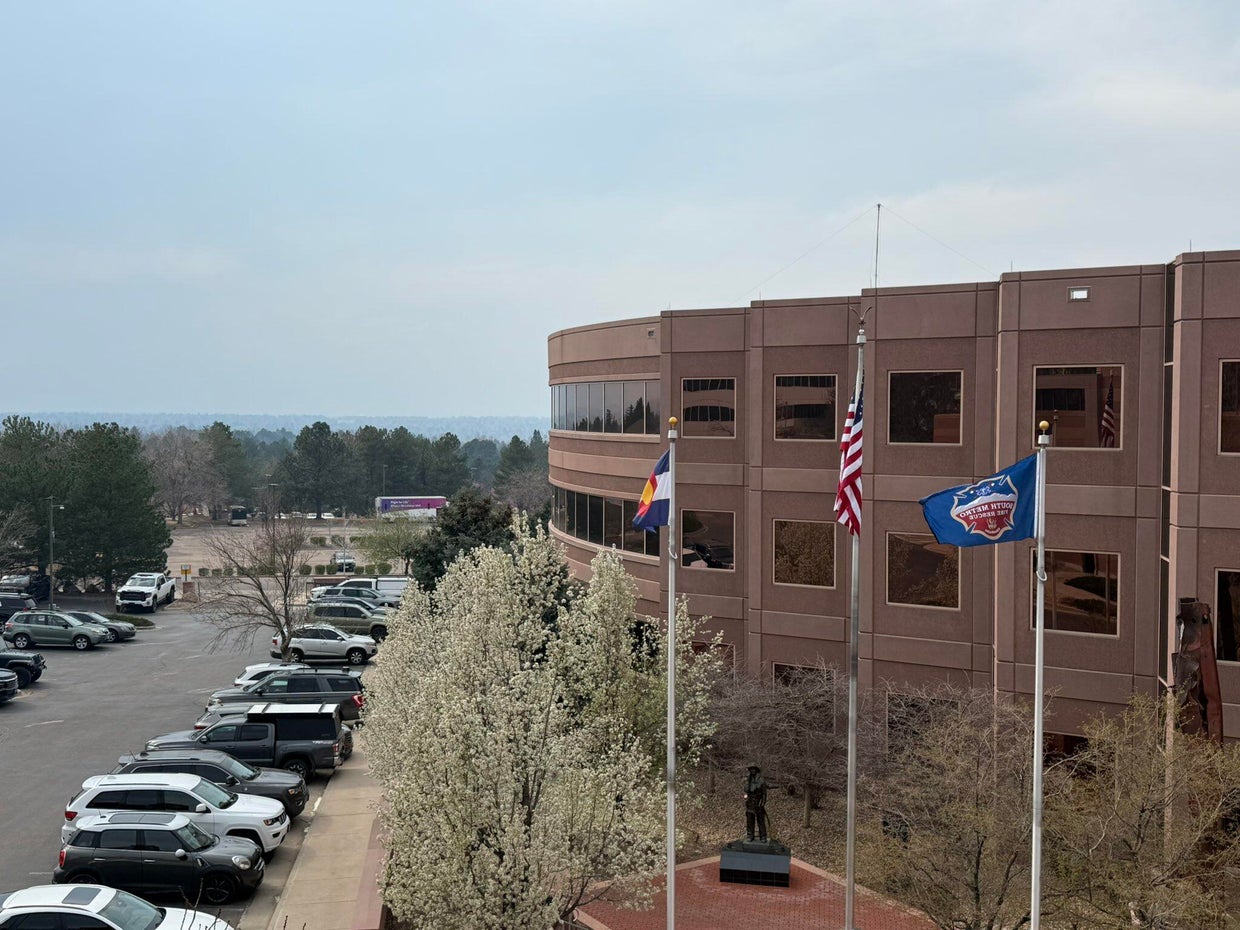
South Metro Fire Rescue said in their post that the smoke is from Colorado’s neighbor to the east. They called it a “significant haze” in the air.
Earlier this month, the Morrill Fire and the Cottonwood Fire burned a significant amount of Nebraska grassland and ranchland. They have mostly been contained by firefighters. Nebraska Gov. Jim Pillen said those two fires combined with several others have burned approximately 800,000 acres of land. On Thursday, Pillen announced that he is signing several executive actions intended to ease the burden caused by the fires.
There were no wildfires burning in the Denver metro area on Thursday afternoon.

ARAPAHOE COUNTY, Colo. (KKTV) – A homicide suspect based out of Colorado, wanted in a fentanyl-related death, is back in the state after being captured in Colombia.
The Arapahoe County Sheriff’s Office (ACSO) said 33-year-old Max Arsenault had been on the run since January 17.
Deputies said this stemmed from an incident in May 2023, where deputies responded to a call for a man named Nicholas Dorotik, who was found unresponsive.
ACSO said the cause of death was a mixed drug overdose involving meth and fentanyl, having about three times the lethal amount of fentanyl in his system.
One year later, Arsenault was arrested. He was scheduled for trial in January 2026 when deputies said he fled the country while on bond three days before the trial was set to start.
He was caught in Medellin, Colombia, on March 4, following a two-month international investigation. He has since been extradited back to Denver, where he is facing charges and awaiting trial.
Copyright 2026 KKTV. All rights reserved.

Iran-linked hackers have breached FBI Director Kash Patel’s personal emails | CNN Politics

Retired Detroit sergeant faces new sexual assault charge involving 14-year-old victim from 2002

Trump floats sending federal agents to San Francisco to tackle crime

Dallas ISD will offer free pre-K starting next school year

Norwegian Cruise Line offers a first look at Luna, new cruise ship setting sail from PortMiami – WSVN 7News | Miami News, Weather, Sports | Fort Lauderdale

Florida High School Football Rankings: Top 25 teams – Oct. 21

How old is Bo Nix? What to know about Oregon quarterback ahead of 2024 NFL Draft

Cleary's 21 help Le Moyne down Central Connecticut State 69-64 in OT

99th annual Pony Swim held in Virginia

Indiana Members Credit Union announced as new anchor tenant at Bottleworks District
Iran-linked hackers have breached FBI Director Kash Patel’s personal emails | CNN Politics

Live: CPAC 2026 Day 2

Video: Will ICE Change Under Its New Leader?

DHS shutdown breakthrough comes at cost for Republicans as funding fights nears end

Rubio joins crucial G7 talks as Iran war set to dominate second day
-

 Detroit, MI1 week ago
Drummer Brian Pastoria, longtime Detroit music advocate, dies at 68
-

 Science1 week ago
How a Melting Glacier in Antarctica Could Affect Tens of Millions Around the Globe
-

 Movie Reviews1 week ago
‘Youth’ Twitter review: Ken Karunaas impresses audiences; Suraj Venjaramoodu adds charm; music wins praise | – The Times of India
-

 Sports6 days ago
IOC addresses execution of 19-year-old Iranian wrestler Saleh Mohammadi
-

 New Mexico5 days ago
Clovis shooting leaves one dead, four injured
-
 Business1 week ago
Disney’s new CEO says his focus is on storytelling and creativity
-

 Technology5 days ago
YouTube job scam text: How to spot it fast
-

 Tennessee4 days ago
Tennessee Police Investigating Alleged Assault Involving ‘Reacher’ Star Alan Ritchson