Colorado
2025 NFL Mock Draft: Titans take Cam Ward, Colorado's stars go in the top three


• Travis Hunter heads to Cleveland, and Shedeur Sanders joins the Giants: Hunter would provide dual-threat ability for a depleted Browns squad, while Sanders could be the answer to New York’s quarterback woes.
• Titans secure the No. 1 overall pick: Tennessee is the unlikely winner of the No. 1 pick sweepstakes, and Miami quarterback Cam Ward is the team’s choice in this mock draft.
• 2025 NFL Draft season is here: Try PFF’s best-in-class Mock Draft Simulator and learn about 2025’s top prospects while trading and drafting for your favorite NFL team.
Estimated Reading Time: 3 minutes
The 2025 NFL Draft order is now set for the 18 non-playoff teams. Here is one way the first round could play out as things stand, with the Tennessee Titans kicking things off by drafting one of only two quarterbacks selected in Round 1.
1. TENNESSEE TITANS: QB CAM WARD, MIAMI (FL)
The Titans earned the No. 1 overall pick in Week 18, largely because of their shortcomings at the quarterback position this season. Ward won’t be a fit for every team. For as much as he has some heroic big-time throws, he also has some head-scratching turnover-worthy plays. But he has improved every year he’s been in college, no matter the team. Ward possesses the mentality and the confidence you want in a potential franchise passer.
2. CLEVELAND BROWNS: WR/CB TRAVIS HUNTER, COLORADO
The Browns getting the No. 2 pick means that a quarterback could be in play. I also like the idea of them exploring all options to trade down, especially if they don’t take a quarterback here (I would not). But with this being our first mock with the solidified non-playoff draft order, I didn’t want to do any trade-downs. Instead, I stay true to the big board and give the Browns the best playmaker in the draft in Heisman Trophy winner Travis Hunter.
Hunter was the third-highest-graded cornerback (90.6) and the sixth-highest-graded receiver (89.0) in the FBS. He could legitimately play on both sides of the ball in Cleveland. I would slot him in full time at cornerback with about 10-15 plays at receiver each week.
3. NEW YORK GIANTS: QB SHEDEUR SANDERS, COLORADO
Truth be told, I am not at all convinced a quarterback will be drafted in the top five this year. But until free agency proves otherwise, the Giants are so desperate for a quarterback that it would feel disingenuous not to award them one here. Sanders recorded an 83.0 PFF passing grade in all four college seasons he played in. Over the past two years, he was excellent at post-snap reads and taking care of the football. Sanders doesn’t have the strongest arm, but he plays a clean brand of quarterback — which some teams will gravitate toward.
4. NEW ENGLAND PATRIOTS: T WILL CAMPBELL, LSU
The Patriots’ Week 18 win over the Bills dropped from the No. 1 overall pick to No. 4. Shortly after their victory, they fired head coach Jerod Mayo, so their vision of how to build around quarterback Drake Maye could change. But the desire to improve what was statistically the worst offensive line should remain a constant. Campbell will be viewed as a guard by some teams, but he feels like a player who, with three years of good starting experience at tackle at LSU, should get his shot at tackle in the pros. Regardless, he’s a damn good lineman who would be an immediate starter in New England.
5. JACKSONVILLE JAGUARS: DI MASON GRAHAM, MICHIGAN
Jaguars edge defenders Travon Walker and Josh Hines-Allen bring disruptive potential, but the team’s defense lacks strong interior play to match it. Graham, who earned elite PFF overall grades of 90.0 and 90.7 over the past two seasons, is a stud run defender and a twitchy interior pass-rusher. This is a “best player available” type of pick.
6. LAS VEGAS RAIDERS: WR TETAIROA McMILLAN, ARIZONA
After trading away Davante Adams mid-season, the Raiders created a serious need for a WR1. They will likely be in the market for one in free agency, but if that fails, they should be in range for one of the top receivers in the draft. Here, they get the top receiver on PFF’s big board in Arizona’s McMillan. He’s a 6-foot-5 receiver with some of the strongest hands in the class and a unique after-the-catch mentality for a player of his size. He felt like a lone bright spot on the Wildcats’ offense this year.
7. NEW YORK JETS: CB WILL JOHNSON, MICHIGAN
Johnson was hurt for most of this season, but when he was fully healthy last year, he showed us he was one of the best coverage players in the country with top-tier NFL ability. At 6-foot-2 and 200 pounds, he has the athletic ability and fluidity to play mirror-man coverage against any receiver. Adding Johnson to a secondary with Sauce Gardner would create elite potential.
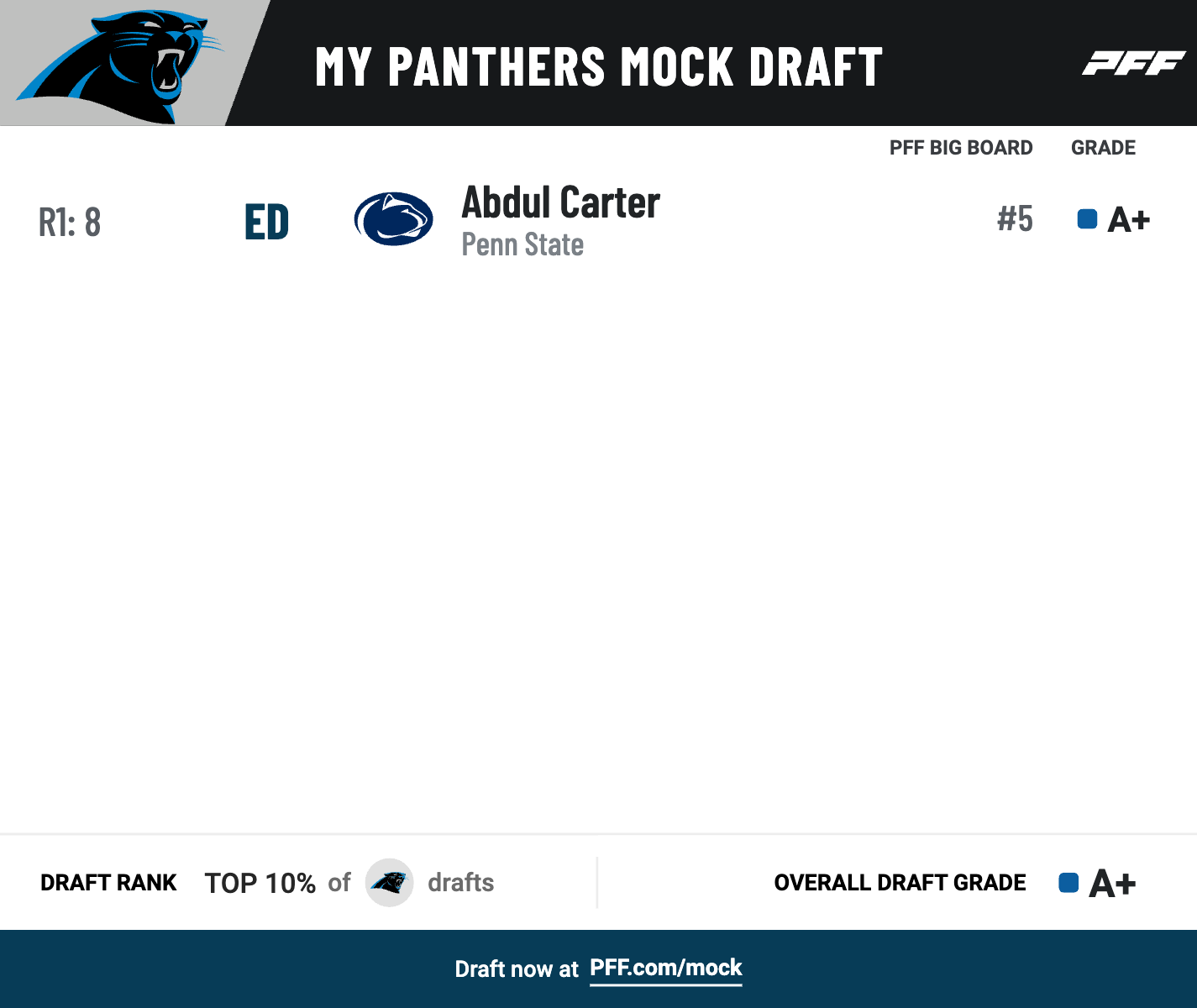
8. CAROLINA PANTHERS: EDGE ABDUL CARTER, PENN STATE
The Panthers’ win over the Falcons in Week 18 may have dropped them in the draft order, but Bryce Young capping off an incredible turnaround over the second half of this season was more important than a few draft spots (and that’s coming from a draft guy). Defense needs to be the focus for the Panthers in the draft, and pass rush is likely at the top of their list. Carter has the best burst and bend in the class, and he earned a 91.0 PFF pass-rush grade with a 23.0% pass-rush win rate in his first year as a full-time edge rusher this year. He would be a welcomed addition to Carolina’s defensive line.
9. NEW ORLEANS SAINTS: EDGE NIC SCOURTON, TEXAS A&M
It was a quiet year for Scourton based on expectations. But at Purdue in 2023, he earned a 91.0 PFF pass-rush grade with a 21.3% pass-rush win rate, thanks to a deep pass-rush tool bag with tons of different moves and counters at 6-foot-4 and 280 pounds. He is the Saints’ type as a 4-3 defensive end (depending on whether the new coaching staff has that same front).
10. CHICAGO BEARS: T KELVIN BANKS JR., TEXAS
The Bears’ offensive line was still too up-and-down this season for the front office to not make new investments. Banks is small in height and length for a tackle (might be just under 6-foot-4), so he may start his career inside at guard. That could work out flawlessly in Chicago, which seems to have more solidified talent at the tackle spots. His athletic ability is very impressive and provides him with a high ceiling, and he earned 86.8 and 88.0 PFF pass-blocking grades over the past two years.
11. SAN FRANCISCO 49ERS: EDGE JALON WALKER, GEORGIA
The 49ers could use help in the trenches this offseason, and defense is the choice here due to it being the strong position in this year’s draft. Walker is listed as an off-ball linebacker, but he is at his best when rushing the passer as an edge. At 6-foot-2 and around 250 pounds, he’s a bit light on his measurables to be a full-time edge defender, but his 18.3% and 21.0% pass-rush win rates over the past two years are proof of his consistent disruption at that size. Walker is explosive and turns speed to power easily.
12. DALLAS COWBOYS: RB ASHTON JEANTY, BOISE STATE
Is this an obvious choice? Yes. Does that change my mind? No. Jeanty enjoyed a historic season this year with more than 2,600 rushing yards. But beyond just the overall output, he was also incredibly efficient, with a 96.6 PFF rushing grade, a 99th-percentile missed tackles forced per attempt figure and a 98th-percentile yards after contact number. He is one of the best football players in the draft, and Dallas needs a player like that badly on its offense.
13. MIAMI DOLPHINS: T JOSH SIMMONS, OHIO STATE
Simmons got hurt midway through the season, so unfortunately, we haven’t seen him during Ohio State’s deep playoff run. But before he tore his ACL, he looked like one of the top offensive tackles in the draft. He has some of the best footwork in the class, with good athletic ability and smooth movements. The Dolphins just need to improve their offensive line in any way they can, and Simmons could play guard for them if Patrick Paul is a starter at offensive tackle. On 158 pass-blocking snaps this season, Simmons didn’t allow a sack and allowed just one pressure on his way to an 82.0 PFF pass-blocking grade.
14. INDIANAPOLIS COLTS: TE TYLER WARREN, PENN STATE
It’s not often that a tight end is selected in the top 20, but Warren warrants it. He’s a true all-around tight end who can block effectively in-line and make strong contested catches as a receiver. The big plus is that, at 6-foot-6 and 260 pounds, he earned a 93.3 PFF receiving grade thanks to 666 receiving yards after the catch this season as Penn State’s main mode of receiving production.
15. ATLANTA FALCONS: EDGE JAMES PEARCE JR., TENNESSEE
The Falcons’ pass rush came alive during the second half of the season, but that doesn’t mean they shouldn’t consider selecting a pass-rusher in a pass-rusher-heavy draft. Pearce gives them some burst and bend they don’t have on their defensive line right now, and he plays a natural stand-up outside linebacker spot. Though undersized at around 240 pounds, he recorded pass-rush win rates above 20% in each of the past two years.
16. ARIZONA CARDINALS: DI WALTER NOLEN, OLE MISS
Nolen is a former five-star recruit who came into his own this season. He is incredibly explosive at 6-foot-3 and 305 pounds and earned an elite 91.1 PFF run-defense grade with great flashes as a twitched-up pass-rusher (73.5 PFF pass-rush grade in 2024). The Cardinals need new juice on their defensive line, specifically in the pass-rush category.
17. CINCINNATI BENGALS: WR LUTHER BURDEN III, MISSOURI
Burden was not as productive in 2024 as in 2023, but that is more an indictment of the offense as a whole than Burden. He is an elite after-the-catch receiver who can win as a flanker and in the slot. The Jermaine Burton experiment is not going well in Cincinnati, and pending free agent Tee Higgins could be elsewhere next season. The Bengals need plenty of help on the defensive line but could use another playmaker next to Ja’Marr Chase to remain a potent offense.

18. SEATTLE SEAHAWKS: EDGE SHEMAR STEWART, TEXAS A&M
Edge rusher Boye Mafe took a nice step forward as a pass-rusher this year, but the Seahawks need more in that area. Stewart has a rare combination of size, speed and power at 6-foot-6 and 290 pounds. He earned an 88.9 PFF run-defense grade but also flashed as a pass-rusher over the past two years. If he can hone his go-to pass-rush moves, he could be a great addition for Seattle.
19. HOUSTON TEXANS: T CAMERON WILLIAMS, TEXAS
The Texans’ interior offensive line has been a major Achilles’ heel of their offense. Tytus Howard has been pushed into one of the guard spots, which has produced mixed results. They could potentially keep him there if they draft a talented offensive tackle to play opposite Laremy Tunsil. Williams is raw but extremely talented with length, power and speed. Plus, he has plenty of experience at right tackle.
20. TAMPA BAY BUCCANEERS: S MALAKI STARKS, GEORGIA
The Buccaneers will be eyeing pass-rush upgrades, but with a lot of the top pass-rushers off the board — and with this being a deep pash-rush class in Rounds 2 and 3 — I like the idea of them forming what would likely be the most talented safety duo in the league: Starks and Antoine Winfield Jr. This season has exposed Tampa Bay’s deficiencies in the secondary.
21. DENVER BRONCOS: TE COLSTON LOVELAND
Despite wide receiver Courtland Sutton‘s excellence, the Broncos have lacked any other consistent receiver presence on offense in 2024. Head coach Sean Payton has been one to emphasize the tight end position when he has a viable option. Loveland’s lack of production this year was more an indication of how poor Michigan’s passing game was than anything. When he’s healthy and in a rolling offense (see 2023), he’s a big, fluid receiver — an ideal passing weapon for Bo Nix moving forward.
22. PITTSBURGH STEELERS: CB BENJAMIN MORRISON, NOTRE DAME
Morrison hasn’t been a part of Notre Dame’s deep playoff run due to a hip injury, but he’s a fluid, fearless man coverage cornerback — something the Steelers have been searching for in their past few secondary draft picks.
23. LOS ANGELES RAMS: WYATT MILUM, WEST VIRGINIA
Rob Havenstein will be 33 years old and in the last year of his contract next season. The Rams could look to find his replacement, whether for 2025 or beyond. Milum was one of the most consistently dominant offensive linemen in 2024. He earned a 91.7 PFF overall grade with 90.0-plus grades in run blocking and pass blocking.
24. GREEN BAY PACKERS: CB SHAVON REVEL, EAST CAROLINA
The Packers‘ cornerbacks were disappointing this season. Revel represents their type of player, meeting length and speed thresholds while bringing play-making ability. He should be very high on their board, even coming off a torn ACL.
25. LOS ANGELES CHARGERS: EDGE JACK SAWYER, OHIO STATE
Khalil Mack has been productive over the past few years, even now at 33 years old. But Joey Bosa has taken a step back due to injuries, and Mack won’t be there forever. Head coach Jim Harbaugh is not one to let the trenches fade into oblivion when it comes to roster building. Sawyer has been steady, disruptive and productive over the past two seasons, something Harbaugh got a good look at when facing him multiple times in the Michigan-Ohio State rivalry.
26. WASHINGTON COMMANDERS: MYKEL WILLIAMS, GEORGIA
The Commanders are building a good-looking defense under Dan Quinn, but they still need talent and depth at edge rusher. Williams is a high-floor player who is as strong as an ox with long arms, but his pass-rush game is still developing (he might not be a high-sack player). I do like him for the Commanders, though, since they would get stouter with his presence.

27. BALTIMORE RAVENS: T JOSH CONERLY JR., OREGON
Oregon’s Conerly took a big step up in pass protection this year. He allowed just 10 pressures on 521 pass-blocking snaps while earning a 78.0 PFF pass-blocking grade on true pass sets. He is a true junior with two years of starting experience under his belt. The NFL will love the potential.
28. MINNESOTA VIKINGS: CB TREY AMOS, OLE MISS
The Vikings could lose a good chunk of their cornerback room to free agency this March. Amos brings ideal length to the position at 6-foot and 190 pounds with long arms. He forced 14 incompletions this season, tied for the seventh most in the FBS.
29. BUFFALO BILLS: CB JAHDAE BARRON, TEXAS
Barron went from a starting safety to a starting slot defender to a starting outside cornerback over the past three seasons and thrived at all three spots. This year was his most productive. As an off-zone defender, he recorded five interceptions and 10 forced interceptions with a 91.6 PFF coverage grade in 2024.
30. PHILADELPHIA EAGLES: EDGE PRINCELY UMANMIELEN, OLE MISS
The Eagles are a tough team to mock for these days due to how well general manager Howie Roseman has built the roster. However, with edge rushers Brandon Graham retiring and Josh Sweat set to hit free agency, perhaps another pass-rusher is in store for them in Round 1. Umanmielen put up great pass-rushing numbers over 2023 and 2024 (two consecutive seasons with a pass-rush win rate above 22%). He has some of the best burst and bend in the class.
31. KANSAS CITY CHIEFS: EDGE MIKE GREEN, MARSHALL
Green, even as just a redshirt sophomore, was an absolute stud for the Thundering Herd this season. He earned a 92.0 PFF overall grade, thanks to a 90.1 PFF run-defense grade and a 91.0 PFF pass-rush grade. He is still young as a pass-rusher but has a good bag of moves and an NFL-level first step.
32. DETROIT LIONS: EDGE LANDON JACKSON, ARKANSAS
As we head into the playoffs, Aidan Hutchinson still leads the Lions in sacks (7.5). It’s safe to say they need some pass-rush help this offseason. Jackon is a unique edge rusher because of his 6-foot-7 frame and 275-pound weight. Yet, he has good burst and some intriguing bend for a player with those measurables. I expect the Lions to like his profile.



After losing star guard Isaiah Johnson and forward Bangot Dak to the transfer portal, the Colorado Buffaloes will need to build around Barrington Hargress, who announced his return for the 2026 season.
Additionally, Colorado athletic director Fernando Lovo announced that the NIL budget of the men’s basketball program will be doubled for the coming offseason. Following the College Basketball Crown tournament, the Buffs have a few key players to bring back alongside Hargress for next season.
Sebastian Rancik
Despite a down year for Rancik in 2025, with Johnson gone, there’s an argument to be made that he is still the future of Colorado basketball.
Rancik was given a three-star rating by 247Sports and a four-star composite rating in the 2024 recruiting class. He chose Colorado over offers from the likes of Arizona State, Mississippi State, Nebraska and others.
In his freshman season, Rancik emerged as a star in the making. This was primarily seen in Colorado’s road matchup against the then-No. 17 Kansas Jayhawks, as he recorded 19 points and nine rebounds, despite CU’s loss.
His up-and-down season in 2025 still featured multiple standout performances. One of which was a career-high 24-point performance against the Eastern Washington Eagles in Colorado’s second game of the season.
The flashes of stardom he’s shown could become more consistent with proper development in Boyle’s system, making him not only a star in the Buffs’ future, but an NBA prospect.
Ian Inman
With Johnson out as Hargress’s fellow shooting weapon, Ian Inman is the next in line for Colorado. While he didn’t see meaningful playing time until Colorado’s road matchup against the then-No. 8 Iowa State Cyclones, Inman quickly emerged as a capable shooter.
In Colorado’s matchups later in the season, first against Texas Tech on the road, and then against Kansas State at home, Inman shot a combined 9-for-12 from three, while totalling 29 points.
If Inman can see more playing time and develop more consistency in his shooting, he could be a crucial part of Colorado’s offense moving forward.
Jalin Holland
Defensively, freshman guard Jalin Holland is the future of the Buffaloes.
Despite getting limited minutes off the bench early in the season, Holland quickly emerged as Colorado’s best defensive player. By the end of the season, he was matched up defensively with the top scoring option of nearly every team the Buffaloes played.
Holland averaged five points, 2.5 rebounds and 0.8 steals per game during the 2025 season.
One concern in Holland’s game is his foul trouble. He plays aggressively, and with energy on defense, but that playstyle sometimes leads to foul issues. He racked up 71 personal fouls during the 2025 season.
However, that’s something that can be fixed with proper development, and if Holland remains at CU, he should see meaningful playing time to hone his skillset.
The Buffaloes’ loss of Dak is a hit to their paint defense. But that is a role the Buffs could explore moving Holland into in zone defense, as he’s already shown prowess as an on-ball defender.
Sign up to our free newsletter and follow us on Facebook for the latest news.

DENVER (KDVR) — A Colorado teenager who lost her leg in a shark attack isn’t just walking again; she’s sharing the spotlight with one of her favorite hockey players.
Seventeen-year-old Annabelle Carlson took the runway Sunday at the Colorado Avalanche’s annual charity brunch, an event that raises money for community programs supported by Kroenke Sports Charities. The fundraiser, now in its third decade, is considered one of the team’s most impactful events of the year.
Carlson walked arm-in-arm with Avalanche captain Gabriel Landeskog, drawing applause from a crowd of more than 450 attendees.
Standing tall again has been a long journey for the Colorado high school student. Carlson lost her leg after surviving a shark attack during a family trip to Belize in 2024. Since then, she has undergone multiple surgeries and extensive rehabilitation.
“I think being negative about things like this — it takes such a toll on how you view yourself and how you get through things,” Carlson said. “But I’d rather see everything like, not everything you lose is a loss.”
Carlson has now returned to skiing and hopes to pick back up with playing her favorite sport, lacrosse. But it took a lot of guts and resilience to get to where she is now.
“In my eyes, she’s extraordinary,” Landeskog said. “What she’s gone through at that age, it’s not easy to do.”
The charity event highlights children who have overcome serious medical challenges, pairing them with Avalanche players for a runway walk to spotlight their strength. Players also served brunch and helped auction off team gear and game tickets.
“It was really cool to meet him,” Carlson said of Landeskog. “It’s definitely a flex. Not everyone gets to meet the Avalanche. I’m super lucky and super excited to be here.”
Having gone through some injuries of his own, including damage to his knee, which took him out of play for several seasons, Landeskog said Carlson’s attitude is remarkable.
“She’s young, she’s brave,” he said. “I feel like she’s got a better head on her shoulders than I do, so I feel like I can learn a lot from her as well.”
The team said many players stay in touch with the children and their families long after the event ends, adding that the annual brunch is a day the whole team looks forward to each year.
![++[LIVESTREAMS]TV!! New Mexico United vs Colorado Springs Switchbacks FC Live 𝖲𝗍𝗋𝖾𝖺𝗆](https://i1.wp.com/res.cloudinary.com/pgatour-prod/w_854,h_480,c_fill,f_auto,q_auto/pgatour/pages/pga-tour-live/live-header-tl.png?ssl=1 "++[LIVESTREAMS]TV!! New Mexico United vs Colorado Springs Switchbacks FC Live 𝖲𝗍𝗋𝖾𝖺𝗆")
New Mexico United vs Colorado Springs Switchbacks FC
New Mexico United vs Colorado Springs Switchbacks FC live: New Mexico United vs Colorado Springs Switchbacks FC look to seize control of thrilling New Mexico United vs Colorado Springs Switchbacks FC . Every team in the New Mexico United vs Colorado Springs Switchbacks FC has two wins apiece as we go into the final two game weeks. New Mexico United vs Colorado Springs Switchbacks FC will host New Mexico United vs Colorado Springs Switchbacks FC at New Mexico United vs Colorado Springs Switchbacks FC Park Stadium with the New Mexico United vs Colorado Springs Switchbacks FC a single point ahead of New Mexico United vs Colorado Springs Switchbacks FC in the standings and just one behind leaders New Mexico United vs Colorado Springs Switchbacks FC .

I fled hellhole LA for my dream life in the country. Look how much better my life is now

Theodore Roosevelt Presidential Library reaches final stages of construction

Trucking company opens new Ohio location through use of state tax credit

Observations from Oklahoma’s Fourth Spring Practice

Central Oregon Community College employees prepare for strike as mediation continues

Florida High School Football Rankings: Top 25 teams – Oct. 21

How old is Bo Nix? What to know about Oregon quarterback ahead of 2024 NFL Draft

Cleary's 21 help Le Moyne down Central Connecticut State 69-64 in OT

99th annual Pony Swim held in Virginia

Indiana Members Credit Union announced as new anchor tenant at Bottleworks District

Emanuel pushes back on ‘straight White man’ question, says ideas matter most in 2028

French police make two more arrests over foiled attack on Bank of America

‘What’s going on?’: US judge calls aspects of new Pentagon press policy ‘weird’

Video: Iran to Allow More Oil Ships Through Strait of Hormuz, Trump Says

Dem senator warns deportation could let Virginia woman’s illegal immigrant killer ‘escape accountability’
-

 Sports1 week ago
IOC addresses execution of 19-year-old Iranian wrestler Saleh Mohammadi
-

 Miami, FL4 days ago
Jannik Sinner’s Girlfriend Laila Hasanovic Stuns in Ab-Revealing Post Amid Miami Open
-

 New Mexico1 week ago
Clovis shooting leaves one dead, four injured
-

 South-Carolina2 days ago
South Carolina vs TCU predictions for Elite Eight game in March Madness
-

 Politics1 week ago
Schumer gambit fails as DHS shutdown hits 36 days and airport lines grow
-

 Tennessee1 week ago
Tennessee Police Investigating Alleged Assault Involving ‘Reacher’ Star Alan Ritchson
-

 Minneapolis, MN4 days ago
Boy who shielded classmate during school shooting receives Medal of Honor
-

 Science1 week ago
Record Heat Meets a Major Snow Drought Across the West