West
Bryan Kohberger selfie from days before arrest seen for first time

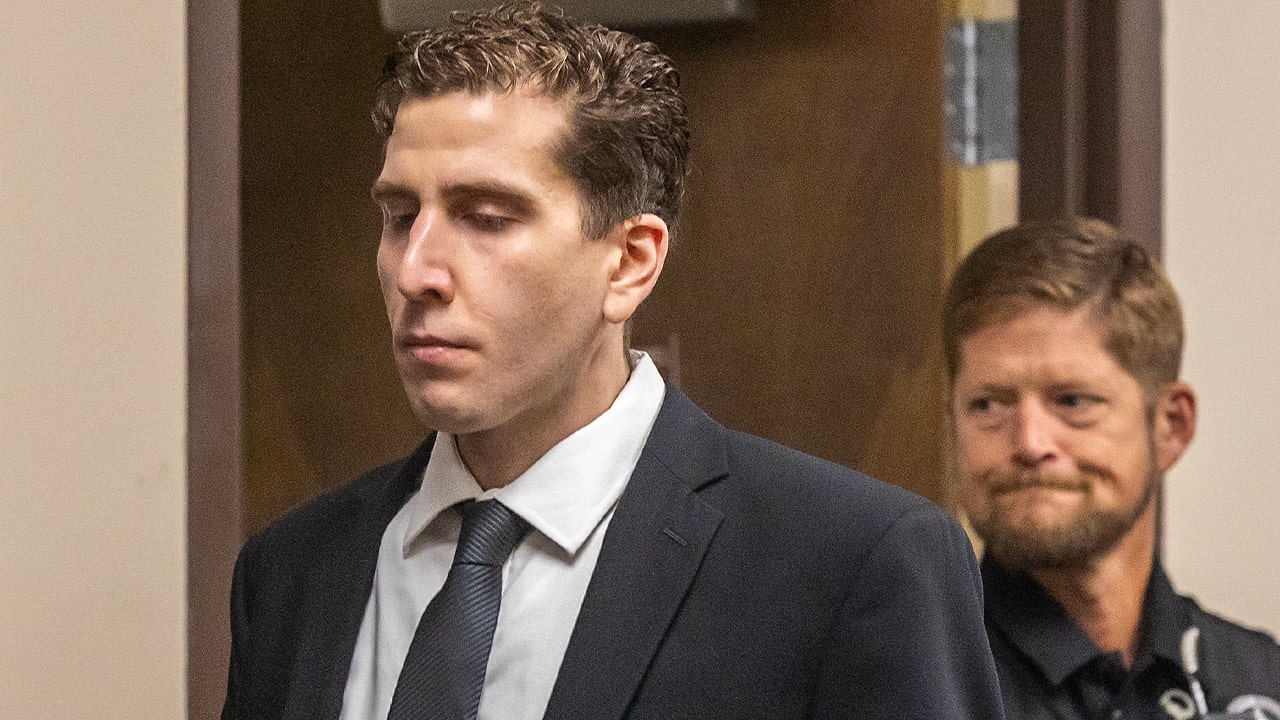
Idaho quadruple murder suspect Bryan Kohberger took a selfie in a black robe just days before he was arrested, according to a report.
Kohberger faces first-degree murder charges in the deaths of University of Idaho students Kaylee Goncalves, 21, Xana Kernodle, 20, Madison Mogen, 21, and Ethan Chapin, 20. The former Washington State University student was also charged with one felony count of burglary.
The selfie, obtained by NBC’s “Dateline,” shows a December 28, 2022 selfie of Kohberger in a black robe with a hood covering his head. “Dateline” is airing an episode on Kohberger Friday at 9 p.m.
Kohberger was arrested just two days later on Dec. 30, and was flown back to Idaho where he’s currently facing first-degree murder charges.
BRYAN KOHBERGER CASE: JUDGE DENIES PROSECUTORS’ REQUEST FOR PERSONALITY TESTING
Bryan Kohberger is seen wearing a robe in a selfie taken just days before he was arrested. (Dateline)
“Dateline” also obtained Kohberger’s cellphone browsing history, which shows he searched for dozens of pictures of female students at Washington State University and the University of Idaho. According to the report, several of the women were in bathing suits.
FOLLOW THE FOX TRUE CRIME TEAM ON X
Bryan Kohberger enters the courtroom for his arraignment hearing in Latah County District Court, May 22, 2023 in Moscow, Idaho. Kohberger is accused of killing four University of Idaho students in November 2022. (Zach Wilkinson-Pool/Getty Images)
According to the report, a review of the accounts which posted the pictures found that several individuals were either followers or close friends with Goncalves, Mogen, and Kernodle.
Timeline of Nov. 13, 2022:
- 4 a.m.: Suspect arrives at house
- Between 4 and 4:17: Time of murders
- 4:19: Roommate calls 3 victims, no one answers
- 4:22 to 4:24: Surviving roommates text each other from inside house
- 4:27: Roommate calls victims again; no one answers
- 4:32: Roommate texts Goncalves ‘Pls answer’
- 10:23: Surviving roommate texts victims; no one answers
- 11:39: Roommate calls her father
- 12 p.m.: 911 call placed from roommate’s phone
Madison Mogen, top left, smiles on the shoulders of her best friend, Kaylee Goncalves, as they pose with Ethan Chapin, Xana Kernodle, and two other housemates in Goncalves’ final Instagram post, shared the day before the four students were stabbed to death. (@kayleegoncalves/Instagram)
In the summer prior to the murders, Kohberger moved to Pullman, Washington to attend school at Washington State University.
Three witnesses told “Dateline” that Kohberger was invited to a pool party that he attended in Moscow, Idaho, according to “Dateline.”
Read the full article from Here


HONOLULU (HawaiiNewsNow) – More than $10 billion in SNAP benefits paid nationwide in fiscal year 2025 were above recipients’ eligibility or went to people who didn’t qualify for the program, according to the U.S. Department of Agriculture.
An annual analysis shows the national payment error rate was 10.62%, well above the congressional threshold of 6%.
The error rate measures how accurately states determine who is eligible for SNAP and how much they should get.
In Hawaii, the payment error rate is higher than the national average at 10.92%
“These payment error rates are further proof that state accountability is severely lacking in SNAP,” Agriculture Secretary Brooke L. Rollins said in a press release. “USDA has taken historic action to help interested states curb SNAP waste, and I hope other states, regardless of political leadership, prioritize needy families and the American taxpayer over politics.”
States above the threshold must now pay back a percentage of their benefits and submit an action plan to the USDA explaining how the errors will be addressed.
Copyright 2026 Hawaii News Now. All rights reserved.

Eagle, Idaho – Quinn Guterman never expected to leave a reality dating show with a boyfriend.
“Definitely didn’t think I’d be coming home with a boyfriend,” she said in an interview with CBS2.
But that’s exactly what happened after Guterman met Tennessee farmer Brett Maverick on FOX’s “Farmer Wants a Wife”.
Months after filming wrapped, the couple says their relationship is still going strong.
“He’s here a lot more than he’s not because I’m working full-time,” Guterman said.
Brett says the relationships formed on the show were genuine.
“The conversations are all real. None of that is staged or scripted,” Maverick said. “Anything that you did see from our side of it, they were real conversations. You just didn’t see the whole conversation.”
The pair said one of the biggest reasons their relationship developed was the amount of uninterrupted time they spent together while filming. Without phones or the distractions of everyday life, contestants filled their days with puzzles, card games, and exploring the property.
“It was a really good time to just be around each other and get to know each other better,” Guterman said. “Honestly, that’s how I feel the connections formed the most.”
Now, they’re focused on making time for one another despite busy schedules.
“We’re trying to see each other as much as we can when we can,” Maverick said.
Looking back, Guterman says the experience changed her perspective on reality television.
“My biggest surprise is that I could find love on a TV show,” she said. “That doesn’t ever seem realistic.”
Beyond their relationship, both say they also left with lasting friendships among the cast.
“We have a really tight-knit group of people,” Guterman said.
“I don’t know if that’s fairly normal for TV shows,” Maverick added. “But for us, we’re all super tight. We all enjoy being around each other. We got friends for life out of it.”
For Guterman and Maverick, what started as a television experiment has become a real-life relationship they’re continuing to build.

The Big Hole River, a blue-ribbon fishery that’s become a focal point in a years-long debate over nuisance algae growth, is poised to receive an impairment designation.
At an open-house meeting in Divide on Tuesday, the Montana Department of Environmental Quality announced that the Big Hole, a mellow freestone river critical to southwest Montana’s outdoor recreation and agriculture economies, is struggling as a result of ecologically detrimental nutrient loading.
The term DEQ is using in its discussion of the Big Hole is eutrophication, which describes the link between algae growth and excess nutrients such as nitrogen and phosphorus. When there’s too much algae in a river or lake, dissolved oxygen falls, imperiling fish and the aquatic life they feed on.
Algal growth is also unpopular with members of the recreating public because it can make wade-fishing a slipperier — and therefore more perilous — endeavor. And it drives down biodiversity in the macroinvertebrate population, which has repercussions for fish and other species higher up the aquatic food web. Andy Ulven, who leads DEQ’s water quality division, told Montana Free Press on Tuesday that a eutrophication listing would “formalize that there is an issue on the mainstem” of the Big Hole. He added that the agency proposal is still in draft stage and he doesn’t anticipate a final designation for the Big Hole until 2027 at the earliest.
The pending impairment designation is notable for a couple of reasons. In addition to establishing a new regulatory framework for the Big Hole, the designation creates a template that DEQ can use to determine if other medium-sized rivers popular with wading anglers are eligible for a eutrophication impairment.
DEQ’s Darrin Kron, who oversees the agency’s water-quality monitoring and assessment, explained that a eutrophication impairment designation would trigger regulations to reduce the inputs that contribute to poor water quality. Those standards are called Total Maximum Daily Loads, or TMDLs, and they’re often likened to a “pollution diet” for a compromised waterway.
In the case of the Big Hole, DEQ could develop TMDLs for nitrogen and phosphorus, as well as temperature-related standards to minimize new introductions of unnaturally warm water, which suppresses dissolved oxygen levels and contributes to algae growth.
Ulven anticipates that a eutrophication designation will increase the public funding that conservation groups like the Big Hole Watershed Committee and Trout Unlimited can apply for and put toward river-restoration initiatives. Projects those groups could work on — and are currently working on, if at a smaller scale — could include planting willows to add shade cover and reduce streambank erosion as well as intercepting nitrogen and phosphorus before they reach the river. Fertilizer runoff and livestock manure are common sources of nutrient pollution in agricultural valleys like the Big Hole.
The river’s algae issues have been well documented. Groups like Upper Missouri Waterkeeper, Save Wild Trout and the Big Hole River Foundation (which has since merged with Save Wild Trout) have been taking water-quality measurements and photographing summertime algae blooms on the river for six years to spur DEQ to rein in the nitrogen and phosphorus that are contributing to the algal blooms.
Guy Alsentzer with Upper Missouri Waterkeeper says the agency is playing “political hot potato” with impairment designations instead of acting with urgency to improve conditions on the Big Hole.
“It seems to be very disingenuous because it’s trying to avoid in any way, shape or form admitting that the key issue is that there are unhealthy and unnatural nutrient loading into the Big Hole River,” Alsentzer told Montana Free Press in a Wednesday morning interview. “A world-class, blue-ribbon stream for wild trout is on its knees. It has 40-year historic lows for trout recruitment.”
Alsentzer has long argued that the most proactive and scientifically sound way to reduce algal growth is to use numeric standards for nitrogen and phosphorus. But the Montana Legislature and DEQ disagree with him on this point, insisting that narrative, more subjective standards will suffice.
Last year, the Republican-controlled Legislature passed House Bill 664, which prohibits DEQ from using numeric nutrient standards. Proponents of HB 664 argued that it will result in more achievable and more affordable standards for the entities — water-treatment plants, mines and refineries, for example — that discharge nutrient-laden waters into Montana rivers.
HB 664 is the subject of an ongoing lawsuit Upper Missouri Waterkeeper filed in federal district court in January, maintaining that it doesn’t comply with the Clean Water Act, an environmental law Congress passed in 1972 to clean up polluted waterways. Alsentzer told MTFP that he anticipates the court will order a hearing on the matter at the tail end of this year and issue a ruling sometime in 2027.
Judge Brian Morris’ decision could determine whether DEQ can continue working with the eutrophication designation or whether it will be forced to return to numeric nutrient standards.
Water-quality concerns are likely to be exacerbated by the meager water supply currently in the Big Hole basin. The region received one of its worst snowpacks on record, and anxiety over a dismal summer forecast is a rare point of agreement among those who attended the Tuesday night open house.
Erik Kalsta, who ranches in the Big Hole Valley and is a longtime member of the Big Hole Watershed Committee, said he doesn’t anticipate the eutrophication-related impairment designation will drive significant changes to how he manages his land and water.
“I think the bigger worry for me is the messaging around this, especially on a bad drought year,” Kalsta told MTFP at the open house. He said he wouldn’t be surprised if the Big Hole goes dry in the next four or five weeks. That hasn’t happened since the late 1980s, and it spurred local irrigators to form the Big Hole Watershed Committee in search of cooperative water-management solutions.
“Our (irrigation) ditch right now is running about half of what it can carry,” Kalsta said. “That’s already forcing us to make choices about where we’re putting water, what kind of crops (we plant), what kind of summer we’re going to have.”
Brian Wheeler, executive director of Save Wild Trout, said the Big Hole is currently flowing at about one-quarter of its usual volume for this time of year. “It almost peaked in March, which is insane,” he added.
“If you can’t make more of it,” Wheeler said, “you can at least make sure what you have is clean.”
-

 Connecticut5 minutes ago
Workers say violent disturbances followed staffing shortages at CT youth psychiatric facility
-

 Delaware8 minutes ago
Thousands moving to Delaware County fuels need for more housing
-

 Florida12 minutes ago
Aerial photos show sprawling algal blooms. What causes them in Florida?
-

 Georgia20 minutes ago
Georgia election bill deadlines: New law delays ballot QR code removal
-

 Hawaii23 minutes ago
Hawaii overpays SNAP benefits by nearly 10% in 2025
-

 Idaho28 minutes ago
Idaho woman finds love on reality TV’s ‘Farmer Wants a Wife’
-

 Illinois35 minutes ago
Illinois man charged after Rochester sting catches phone scammer with $50K in cash
-

 Indiana38 minutes ago
New law allows alcohol at participating county fairs in Indiana

