Arizona
Senate bill promises to save Arizona’s water future. It does the opposite


Opinion: Arizona’s Senate Bill 1221 is the wrong way to fix rural groundwater problems. Lawmakers should dispense with it and work with us instead.
Like our constituents of every political persuasion, we four supervisors from four medium-sized Arizona counties are concerned about the future of water in our communities — which is nonpartisan.
For a long time, we have been advocating for a more adaptable, locally driven set of tools to manage and conserve our groundwater.
We were therefore concerned to see Senate Bill 1221 be given a hearing in the Senate Natural Resources & Water committee last week.
Rather than empowering rural communities to manage our groundwater and preserve our water future, SB 1221 would do the opposite:
It creates layers and layers of new government bureaucracy, shuts rural constituents out of the process and deprives us of the tools we need to manage and conserve our groundwater in a way that makes sense.
AMA is not ideal, but it’s better than nothing
It’s the wrong bill for Arizona and does not address or adequately minimize the precise reason we are in these situations in rural Arizona — industrial overpumping combined with inadequate conservation.
Nonetheless, as the recent uproar over the potential creation of a Gila Bend Active Management Area (AMA) shows, it is past time for the state Legislature to take action.
No one believes that a Phoenix or Tucson-style AMA is the best solution to our rural water concerns, and yet, without leadership and policymaking from our state lawmakers, AMAs are the only tool available to manage the crisis in the Gila Bend basin and the crises facing other basins throughout rural Arizona.
Even though imperfect, AMAs provide far more balanced protection of “at risk” water supplies for all residents. And, although not preferred, they are better than doing nothing.
For that reason, we invite those who were surprised or distressed to hear about a possible Gila Bend AMA to join in our advocating for rural solutions and new, balanced ways to create locally directed water management tools for rural Arizona:
You are in this position because pleas from rural communities like ours have been ignored for so long by the Legislature. Years of government inaction have brought us to this moment.
Stop pursuing SB 1221 and engage with us
Proposals brought by us and other rural local leaders that would have given us the tools and local control to address our unique needs have been blocked or ignored altogether, year after year.
Rural Arizona deserves better from its elected leaders at the Capitol.
We need real solutions that provide certainty in long-term rural groundwater planning, and empower effective management of our rural groundwater basins determined to be at-risk by the best objective data and hydrological studies from U.S. Geological Survey and the Arizona Department of Water Services.
We need new ways to protect our water supplies from drought, speculation, irresponsible development and out-of-state industrial megausers out to drain our aquifers before packing up and moving elsewhere.
Waer regulation: Has become a game of chicken
We urge our legislators at the Capitol to dispense with SB 1221 as quickly as possible. And to engage in good-faith dialogue with rural leaders and stakeholders to give us tools to effectively manage our water supply.
We who have been waging this advocacy and education battle for years recognize that this is a moment that requires bravery from our legislators. It will involve overcoming the usual political partisanship and perhaps even upsetting some big donors.
But it is also an opportunity for Arizona to lead as a state that cares about citizen consumer protection, water conservation and economic freedom.
We love our farms, our towns and our rural way of life, and we want to secure the future of water in Arizona. Water security is too important an issue to be handled with something as ineffective and bureaucratic as SB 1221.
Donna Michaels, Travis Lingenfelter, Holly Irwin and Patrice Horstman are county supervisors in Yavapai, Mohave, La Paz and Coconino counties, respectively. Reach them at web.bos.district3@yavapaiaz.gov,
Donna Michaels, Travis Lingenfelter, Holly Irwin and Patrice Horstman are county supervisors in Yavapai, Mohave, La Paz and Coconino counties, respectively. Reach them at web.bos.district3@yavapaiaz.gov, linget@mohave.gov, hirwin@lapazcountyaz.org and phorstman@coconino.az.gov.



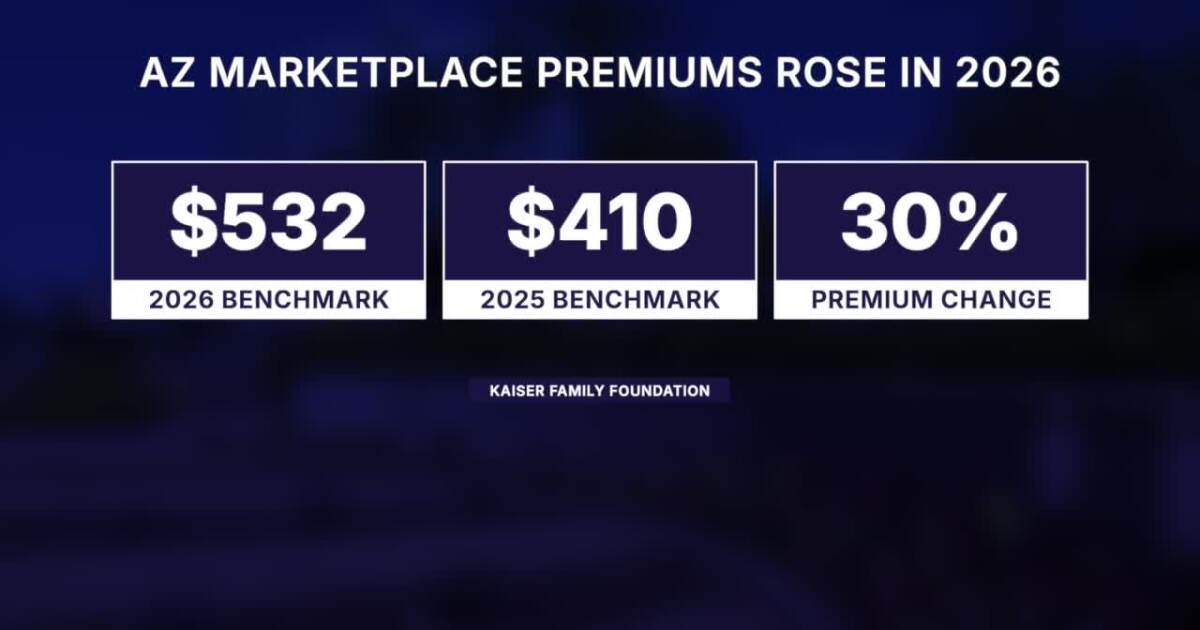
PHOENIX — Arizona’s ACA marketplace enrollment fell from 363,000 to just over 255,000 in a single year — a nearly 30% decline and the third-largest annual drop in the country.
Rising premiums and expired tax credits are driving the trend, with the average benchmark plan premium in Arizona now at $532 — up 30% from 2025.
In the player above, ABC15 Data Analyst Garrett Archer takes a look inside the numbers on how healthcare premiums are impacting health insurance enrollment.
This story was reported on-air by a journalist and has been converted to this platform with the assistance of AI. Our editorial team verifies all reporting on all platforms for fairness and accuracy.
Want more news in your community? Add ABC15 as a preferred source on Google below:

Arizona
Arizona man pleads guilty after illegally living in forest for years among ‘1,000lbs of trash’

A man in Arizona has pleaded guilty to violating federal fire restrictions and unlawfully residing in a national forest, after authorities said he spent years living at a makeshift campsite surrounded by what officials described as “approximately 1,000 pounds of trash”.
Mark Aaron Gatz was arrested on 25 June at his illegal campsite in Arizona’s Tonto national forest, according to court records. A United States Forest Service (USFS) officer wrote in documents submitted to court that Gatz had been operating an “illegal campsite” with a “hot wood burning campfire” despite fire restrictions and that he had told investigators that he had been living in the forest for about eight years.
The officer wrote that a records check found that Gatz had previously received multiple citations and was the subject of six outstanding federal arrest warrants for earlier violations, including for building fires during fire restrictions, constructing on national forest service lands, unsanitary conditions and occupying national forest as a residence.
Gatz “said that he knew about current fire restrictions but had to have fire to eat”, authorities said. The documents show that USFS officers made contact with Gatz multiple times over the last year or so, and issued him warnings as well as a violation notice for having campfires during fire restrictions.
Notes from officers’ previous encounters with Gatz earlier this year, submitted into the court docket, state that authorities observed “trash such as clothing, pans, tools, and plastic cups scattered throughout the campsite along with a structure that was four feet in height build using wood panels”.
During an encounter with Gatz in May, officers reported observing “approximately 1,000 pounds of trash” at the site, which they said included tires, plastic bags, trash bags, aluminum cans and other items. They also wrote that they found that the campfire site had been left unattended by Gatz the previous day while still hot.
In a separate report filed by law enforcement from an encounter in February, one officer wrote that “upon arrival at the camp, I was flabbergasted by the amount of debris in the area”.
Investigators said that during that encounter, the debris consisted of three ladders, six to eight totes “overfilled with debris”, five 55-gallon drums, eight tires, multiple bicycle frames, 5 gallons of motor oil, plywood and other “miscellaneous lumber”, and they wrote that trash was scattered over approximately half an acre of Forest Service land and creating what officers described as public safety concerns.
In a separate report from July 2025, officers said they observed what they described as a “large messy campsite” while patrolling the area due to complaints “from the district office abut one large messy camp”.
“There was roughly half an acre of resources ruined due to so much trash and goods on the ground for an extended period of time,” the officer wrote.
This week, after Gatz pleaded guilty, he was sentenced to time served and three years of probation, according to court records.
A representative for Gatz did not immediately respond to a request for comment.


Odds of winning the Powerball and Mega Millions are NOT in your favor
Odds of hitting the jackpot in Mega Millions or Powerball are around 1-in-292 million. Here are things that you’re more likely to land than big bucks.
The Arizona Lottery offers multiple draw games for those aiming to win big.
Here’s a look at Tuesday, July 7, 2026 results for each game:
Winning Mega Millions numbers
02-31-35-36-63, Mega Ball: 12
Check Mega Millions payouts and previous drawings here.
Winning Pick 3 Evening numbers
Evening: 4-7-2
Winning Fantasy 5 numbers
03-05-10-14-37
Check Fantasy 5 payouts and previous drawings here.
Winning Triple Twist numbers
03-06-18-23-27-32
Check Triple Twist payouts and previous drawings here.
Feeling lucky? Explore the latest lottery news and results
What time is the Powerball drawing?
Powerball drawings are at 7:59 p.m. Arizona time on Mondays, Wednesdays and Saturdays.
How much is a Powerball lottery ticket today?
In Arizona, Powerball tickets cost $2 per game, according to the Arizona Lottery.
How to play the Powerball
To play, select five numbers from 1 to 69 for the white balls, then select one number from 1 to 26 for the red Powerball.
You can choose your lucky numbers on a play slip or let the lottery terminal randomly pick your numbers.
To win, match one of the 9 Ways to Win:
- 5 white balls + 1 red Powerball = Grand prize.
- 5 white balls = $1 million.
- 4 white balls + 1 red Powerball = $50,000.
- 4 white balls = $100.
- 3 white balls + 1 red Powerball = $100.
- 3 white balls = $7.
- 2 white balls + 1 red Powerball = $7.
- 1 white ball + 1 red Powerball = $4.
- 1 red Powerball = $4.
There’s a chance to have your winnings increased two, three, four, five and 10 times through the Power Play for an additional $1 per play. Players can multiply non-jackpot wins up to 10 times when the jackpot is $150 million or less.
Are you a winner? Here’s how to claim your lottery prize
All Arizona Lottery retailers will redeem prizes up to $100 and may redeem winnings up to $599. For prizes over $599, winners can submit winning tickets through the mail or in person at Arizona Lottery offices. By mail, send a winner claim form, winning lottery ticket and a copy of a government-issued ID to P.O. Box 2913, Phoenix, AZ 85062.
To submit in person, sign the back of your ticket, fill out a winner claim form and deliver the form, along with the ticket and government-issued ID to any of these locations:
Phoenix Arizona Lottery Office: 4740 E. University Drive, Phoenix, AZ 85034, 480-921-4400. Hours: 7:30 a.m. to 5 p.m. Monday through Friday, closed holidays. This office can cash prizes of any amount.
Tucson Arizona Lottery Office: 2955 E. Grant Road, Tucson, AZ 85716, 520-628-5107. Hours: 7:30 a.m. to 5 p.m. Monday through Friday, closed holidays. This office can cash prizes of any amount.
Phoenix Sky Harbor Lottery Office: Terminal 4 Baggage Claim, 3400 E. Sky Harbor Blvd., Phoenix, AZ 85034, 480-921-4424. Hours: 8:30 a.m. to 5 p.m. Monday through Sunday, closed holidays. This office can cash prizes up to $49,999.
Kingman Arizona Lottery Office: Inside Walmart, 3396 Stockton Hill Road, Kingman, AZ 86409, 928-753-8808. Hours: 8 a.m. to 8 p.m. Monday through Friday, 8:30 a.m. to 5 p.m. Saturday and Sunday, closed holidays. This office can cash prizes up to $49,999.
Check previous winning numbers and payouts at https://www.arizonalottery.com/.
This results page was generated automatically using information from TinBu and a template written and reviewed by an Arizona Republic editor. You can send feedback using this form.
-
 Entertainment7 minutes ago
Justin Baldoni and wife break silence after ‘It Ends With Us’ legal battle with Blake Lively
-
 Lifestyle10 minutes ago
A meal with an animated Mona Lisa? Immersive dining goes high tech — but will L.A. eat it up?
-
 Politics15 minutes ago
Nexstar launches its first digital subscription service with The Hill Insider, aimed at political junkies
-
 Science22 minutes ago
Not everyone is leaving California. A new commercial battery maker just landed in Sacramento
-
 Sports25 minutes ago
Mookie Betts’ eighth-inning single gives Dodgers the win over the Rockies
-
World37 minutes ago
From sewers to swimming sites: how Europe's cities reclaim their rivers
-

 News1 hour ago
Three more people charged with damaging Reflecting Pool after Trump’s multimillion-dollar restoration | CNN Politics
-

 Los Angeles, Ca2 hours ago
Loved ones search for missing 34-year-old Southern California woman

