Arizona
Republicans want the Ten Commandments (which they ignore) in Arizona public schools


Opinion: If Republicans want to make it OK for teachers to post them, would it also be OK to talk about politicians who break them?
Republicans who control the Arizona Senate — on a party-line vote — pushed through a bill that would allow the Ten Commandments to be posted in Arizona’s public schools.
Surprisingly, a lightning bolt did not strike the Capitol dome, probably because the Almighty was convulsing with laughter.
The bill was sponsored by Republican Sen. Anthony Kern, who was among Arizona’s fake electors in the last presidential election — a wayward collective of GOP operatives being investigated by the Attorney General’s office —- who boldly broke Commandment No. 9, the one about bearing false witness.
The Good Lord must also find it humorous that those same individuals, as well as all of their MAGA brothers and sisters, daily (and nightly, and all times inbetween) break Commandment No. 1, the admonition against worshiping false gods. At least when it comes to you-know-who.
Teachers get leeway? That’s a new one
All of the Senate Democrats voted against Senate Bill 1151.
One of them, Sen. Mitzi Epstein, said, “Please take a moment to think about how you would feel as the parent of a child who has to be in a classroom who is commanded to do something that you do not believe.”
GOP senators were not swayed.
Kern said, “The progressive slide down in our country right now is because we have taken the Ten Commandments away from our schools.”
He added, “Teachers have full authority to post, to read, or not to read.”
Republicans have tried to ban books
This is interesting, giving teachers a choice.
It seems odd since these same Republicans have worked very hard to restrict what teachers can say about many subjects. Like, for instance, human sexuality, about which several of the Commandments have a thing or two to say.
These same Republicans also have endeavored to restrict the books teachers can assign and read to students. They have attempted to make teachers present a watered down version of history as it pertains to slavery and its ugly aftermath.
State superintendent: PragerU lessons are not racist
These same Republicans don’t want Arizona students to fully and honestly understand the science of climate change and what it may mean to them and their children.
But it’s OK with them if teachers want to post and read the Ten Commandments.
Trump ignores the Ten Commandments
When Donald Trump was running for president against Joe Biden in 2020, he said of Biden, “No religion, no anything. Hurt the Bible, hurt God. He’s against God … .”
I’m guessing that comment sent The Big Guy into hysterics. Particularly given Trump’s record with the Commandments.
According to the fact checkers at The Washington Post, for example, Trump totaled 30,573 untruths during his presidency — averaging about 21 erroneous claims a day.
That’s a whopping 30,573 violations of Commandment No. 9.
Then there’s the fact that Trump cheated on his first wife with his second, and has been indicted over $130,000 in hush money payments to a porn star who has said she had a sexual relationship with him.
Some would consider those fairly significant violations of Commandment No. 7, the one concerning adultery.
Then, of course, there is Commandment No. 10 and, seriously, when it comes to the former president, can anyone think of another person on earth who is more covetous of power, money, fame … everything?
Reach Montini at ed.montini@arizonarepublic.com.
For more opinions content, please subscribe.



Cardinals’ Burch shares what he learned as a rookie in 2025
Arizona Cardinals second-year player Jordan Burch says his defensive line teammates have formed a bond heading into the 2026 NFL season.
Last year in early July, Cardinals edge rusher Jordan Burch was a rookie third-round draft pick out of Oregon who was looking forward to his first NFL training camp and eventual first season.
That rookie year is behind him now, and Burch has identified what he needs to improve on heading into his second season. He said he now knows what to expect and look for, and after talking with outside linebackers coach Matt Feeney, Burch built an offseason plan with which he was comfortable.
“I don’t think anything was like a surprise,” Burch said on Thursday, July 9, at the Cardinals’ Tempe headquarters. “I kind of know what to prep for, so this offseason I can look at my old plays, and then I can call my coach and tell him, from last year to this year, what does he want to see on the field.”
Burch seeks to improve his pass rush. He played in all 17 games last season and had five solo tackles with a sack, and also broke up three passes.
Much of his position was dropping into pass coverage, so Burch looks to recognize pass catchers’ routes better in 2026. He gets help from veteran Josh Sweat, who is there to answer questions about the position they share.
“Every week, every game going against somebody good,” Burch said about takeaways from last season. “The talent of the quarterbacks. We’re playing the Rams, how quickly they get the ball out.”
Burch looks forward to building a stronger bond with his teammates, having invited some of them for dinner or to watch TV. He said he was happy with his progress as a player throughout last season.
The Cardinals open training camp Wednesday, July 22, at State Farm Stadium. It’s a week earlier than most teams because Arizona plays the Carolina Panthers in the Aug. 6 Hall of Fame Game in Canton, Ohio.
Cardinals legend Larry Fitzgerald will be among those inducted into the Pro Football Hall of Fame Aug. 8.

A new study has ranked Arizona as one of the worst states to move to for two years in a row, largely due to what it calls a poor quality of life.
The study conducted by Consumer Affairs analyzed the best states to move to in the United States, putting Arizona at the bottom of the list.
Before Arizonans get too defensive about the Grand Canyon State, Consumer Affairs used factors such as affordability, safety, economic strength and education to measure each state, leaving out factors like entertainment, retirement benefits and other considerations that may be important to people living here.
Popular states such as California and New York also landed at the bottom of the list due to their lack of affordability, even though they both have some of the best health care and education in the nation, Consumer Affairs noted.
Here’s why the study says you shouldn’t move to Arizona. Do you agree?
Why you shouldn’t move to Arizona
Arizona ranked No. 10 out of the worst states to move to, scoring especially poorly in quality of life.
Quality of life was measured by the state’s Social Progress Index, average air quality, weather, environmental protection and number of national parks. Due to Arizona’s extreme summers and Phoenix’s consistently poor air quality, it’s easy to see why Arizona ranked No. 44 in quality of life out of 50 states, even though the Grand Canyon is one of the most popular national parks in the nation.
However, Arizona also ranked poorly in other categories, sitting at No. 42 in health care and education, No. 41 in safety and No. 34 in affordability out of 50 states.
There was one category Arizona did impressively well in, ranking No. 5 in economic strength even as one of the youngest states in the country. Still, Arizona’s economic power wasn’t enough to boost its ranking.
Top 10 worst states to move to
Arizona wasn’t alone; some of the biggest states in the country were also considered the worst states to move to in 2026.
- New Mexico
- Louisiana
- California
- Arkansas
- Oklahoma
- Nevada
- Alaska
- Mississippi
- Oregon
- Arizona
Top 10 best states to move to
- Utah
- New Hampshire
- Idaho
- Minnesota
- Massachusetts
- Maine
- North Dakota
- Pennsylvania
- Iowa
- South Dakota
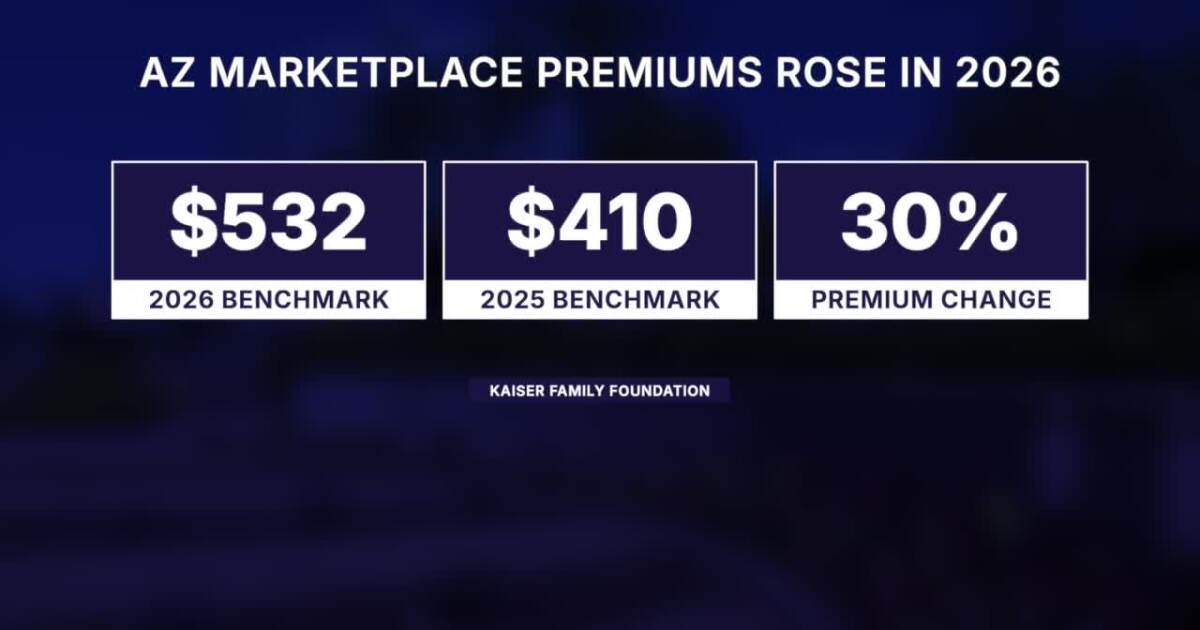
PHOENIX — Arizona’s ACA marketplace enrollment fell from 363,000 to just over 255,000 in a single year — a nearly 30% decline and the third-largest annual drop in the country.
Rising premiums and expired tax credits are driving the trend, with the average benchmark plan premium in Arizona now at $532 — up 30% from 2025.
In the player above, ABC15 Data Analyst Garrett Archer takes a look inside the numbers on how healthcare premiums are impacting health insurance enrollment.
This story was reported on-air by a journalist and has been converted to this platform with the assistance of AI. Our editorial team verifies all reporting on all platforms for fairness and accuracy.
Want more news in your community? Add ABC15 as a preferred source on Google below:

-

 Boston, MA2 minutes ago
Lawsuit: ICE detained East Boston father despite legal status
-

 Denver, CO7 minutes ago
Victor Marx wins GOP primary for Colorado governor, defeating veteran lawmaker after unorthodox campaign
-

 Seattle, WA14 minutes ago
Widower of pregnant woman who was shot to death in Seattle sues homelessness authority
-

 San Diego, CA17 minutes ago
Terrifying moment huge sea lions chase tourists off popular California beach
-

 Milwaukee, WI29 minutes ago
Milwaukee leaders condemn ICE arrests as agency ignores City mask ordinance
-

 Atlanta, GA32 minutes ago
Georgia Secretary of State opens investigation into voter registration mailers sent to deceased residents
-

 Minneapolis, MN37 minutes ago
Minneapolis chief communications officer Adam Fetcher out amid possible criminal charges
-

 Indianapolis, IN44 minutes ago
Indiana Workforce Pell Grant options limited so far

