Arizona
Preparing Arizona houses for wildfires can save them. Here’s why and what to do


Senate hearings examine response to increasing wildfire threat
Wildfire mitigation and disaster recovery were at the top of the agenda as the U.S. Fire Administration and the Department of Homeland Security testified in front of lawmakers on how to properly respond to the increasing threat.
Scripps News
Arizona home insurance costs are soaring, and a growing number of homeowners near wildfire risk areas can’t even get insurance.
Wildfires are a big driver behind the state’s growing home insurance problems.
The Southern California fires make it clear wildfires are no longer seasonal, and the devastated area’s losses likely mean higher rates for Arizona property owners.
Wildfires aren’t just a rural problem. Metro Phoenix has had its share. In 2005, the Cave Creek Complex Fire that started in north Scottsdale burned 243,950 acres.
Many homeowners in both rural and urban areas can do more to protect their homes and communities from fire.
“Fire mitigation is key for protecting homes,” said Lori Munn, deputy director of insurance in the Arizona Department of Insurance and Financial Institutions, which formed the Resiliency and Mitigation Council to address wildfire damage prevention, home insurance problems and high costs.
Pricey home insurance, frustrated homeowners
Arizona led the nation for the biggest increase in home insurance costs between 2019 and mid-2024, according to one survey.
The Resiliency and Mitigation Council is working on getting updated information on average policy costs.
Mark Perkins’ insurance premium on his Phoenix house near South Mountain skyrocketed more than 200% from $2,500 to $7,600 last year.
“They (the insurer) said there was a 35% increase in rates across the board in Arizona, and the rest was due to perceived increase in fire risk,” he said.
He said the “desert there is pretty sparse” near his house.
Perkins switched insurers and kept his costs close to what they had been the previous year.
Insurers aren’t supposed to pass costs from natural disasters outside Arizona to Arizona homeowners.
“We don’t allow insurers to use losses on a hurricane in Florida to raise rates in Arizona,” said Tom Zuppan, property insurance analyst at the Arizona Department of Insurance and Financial Institutions.
But that’s hard to regulate.
Cigarettes and campfires: 7 ways you can accidentally start a wildfire
Wildfires devastate ecosystems and communities alike and can be ignited unintentionally. Here are 7 ways you can accidentally start a wildfire.
The Republic
Homeowners jumping through ‘a lot of hoops’ for lower insurance rates
Since 1990, the number of Arizona houses in Wildland Urban Interface areas, known as WUIs, has more than doubled.
Those areas, where development and vacant land meet, are at high risk for wildfire, said Bill Boyd, deputy director of the Arizona Department of Forestry and Fire Management.
He said fire mitigation efforts are key to addressing Arizona’s home insurance problems.
New River homeowner Mark Dorsey recently “jumped through a lot of hoops” to get his insurance renewed.
He had to provide distances from his home to fire stations and hydrants, and photos of all sides of the house after cutting a lot of brush and trees to create a “buffer zone.”
“It was pretty nerve-wracking,” Dorsey said.
Some Maui and Southern California homeowners, who protected their homes with the right building materials and cleaned up weeds and other vegetation, were able to save their houses.
In the 2013 deadly Yarnell Hill Fire near Prescott, 60 homes with brush cleared around them survived while more than 500 others were destroyed. Arizona began funding wildfire mitigation work after that fire that killed 19 firefighters.
What homeowners can do to mitigate wildfire risks
Some insurers may be more willing to cover houses if the owners try to reduce wildfire risks, say insurance experts.
There’s no data yet on how effective mitigation work is in lowering rates or retaining a policy, but the Mitigation Council is also working on getting that.
Insurance and fire experts say mitigation efforts are important not just for individual property owners. Communities should work together on mitigation, they say, because embers move quickly from home to home, driving wildfires like the ones in the Los Angeles area.
Several groups and government agencies offer mitigation guidance, including Firewise USA, FEMA, the Federal Alliance for Safe Homes and local fire departments.
Kate Stillwell, co-founder of the app Firebreak Risk, which identifies homeowners’ biggest wildfire risks and provides solutions, said mitigation work can be overwhelming for property owners and expensive.
She said DYI mitigation work costing $200 or less that homeowners can do on weekends is the most popular.
Fire mitigation strategies homeowners can undertake include:
- Keep yards clear of flammable debris.
- Move firewood away from structures.
- Build with fire-resistant material, including composite, clay, metal, brick and concrete.
- Limit flammable plants and trees within 100 feet of the home, which is considered the standard space needed to defend from a wildfire.
- Trim branches that overhang a home, porch or deck.
- Get dual-paned, tempered glass windows.
- Remove flammable materials from carports.
- Keep roofs and gutters free of leaves and pine needles.
But mitigation is tough for some homeowners to maintain, and it doesn’t always help get a property insured or lower rates.
Randy Scott owns a Pinetop home and said a lot of trees near his community were cut down in efforts to stop or slow fires.
Despite those efforts, he said his community’s insurance policy wasn’t renewed in 2023. To get insurance, the annual premium quadrupled from $50,000 to $200,000. The new policy also provides less coverage.
“The previous insurer said it wasn’t renewing because of our wildfire rating,” said Scott, who is president of his community’s homeowner association. “It’s hard to have to tell residents they can’t grill on their patios or store their fireplace logs outside.”
Reach the reporter at catherine.reagor@arizonarepublic.com or 602-444-8040. Follow her on X, formerly Twitter: @CatherineReagor.



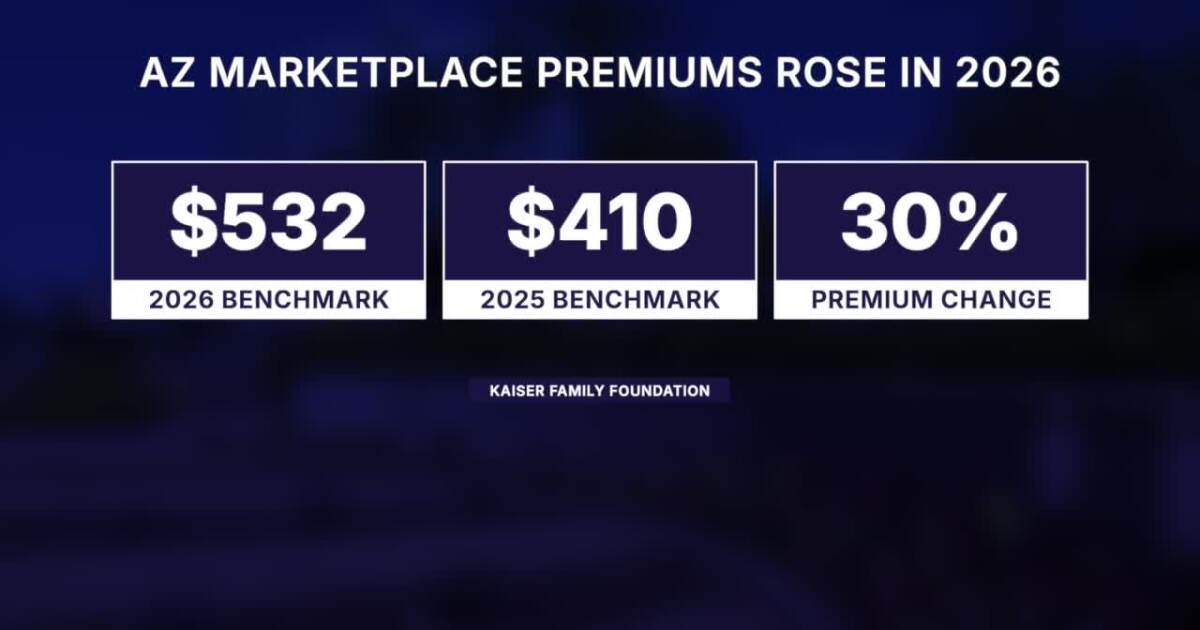
PHOENIX — Arizona’s ACA marketplace enrollment fell from 363,000 to just over 255,000 in a single year — a nearly 30% decline and the third-largest annual drop in the country.
Rising premiums and expired tax credits are driving the trend, with the average benchmark plan premium in Arizona now at $532 — up 30% from 2025.
In the player above, ABC15 Data Analyst Garrett Archer takes a look inside the numbers on how healthcare premiums are impacting health insurance enrollment.
This story was reported on-air by a journalist and has been converted to this platform with the assistance of AI. Our editorial team verifies all reporting on all platforms for fairness and accuracy.
Want more news in your community? Add ABC15 as a preferred source on Google below:

Arizona
Arizona man pleads guilty after illegally living in forest for years among ‘1,000lbs of trash’

A man in Arizona has pleaded guilty to violating federal fire restrictions and unlawfully residing in a national forest, after authorities said he spent years living at a makeshift campsite surrounded by what officials described as “approximately 1,000 pounds of trash”.
Mark Aaron Gatz was arrested on 25 June at his illegal campsite in Arizona’s Tonto national forest, according to court records. A United States Forest Service (USFS) officer wrote in documents submitted to court that Gatz had been operating an “illegal campsite” with a “hot wood burning campfire” despite fire restrictions and that he had told investigators that he had been living in the forest for about eight years.
The officer wrote that a records check found that Gatz had previously received multiple citations and was the subject of six outstanding federal arrest warrants for earlier violations, including for building fires during fire restrictions, constructing on national forest service lands, unsanitary conditions and occupying national forest as a residence.
Gatz “said that he knew about current fire restrictions but had to have fire to eat”, authorities said. The documents show that USFS officers made contact with Gatz multiple times over the last year or so, and issued him warnings as well as a violation notice for having campfires during fire restrictions.
Notes from officers’ previous encounters with Gatz earlier this year, submitted into the court docket, state that authorities observed “trash such as clothing, pans, tools, and plastic cups scattered throughout the campsite along with a structure that was four feet in height build using wood panels”.
During an encounter with Gatz in May, officers reported observing “approximately 1,000 pounds of trash” at the site, which they said included tires, plastic bags, trash bags, aluminum cans and other items. They also wrote that they found that the campfire site had been left unattended by Gatz the previous day while still hot.
In a separate report filed by law enforcement from an encounter in February, one officer wrote that “upon arrival at the camp, I was flabbergasted by the amount of debris in the area”.
Investigators said that during that encounter, the debris consisted of three ladders, six to eight totes “overfilled with debris”, five 55-gallon drums, eight tires, multiple bicycle frames, 5 gallons of motor oil, plywood and other “miscellaneous lumber”, and they wrote that trash was scattered over approximately half an acre of Forest Service land and creating what officers described as public safety concerns.
In a separate report from July 2025, officers said they observed what they described as a “large messy campsite” while patrolling the area due to complaints “from the district office abut one large messy camp”.
“There was roughly half an acre of resources ruined due to so much trash and goods on the ground for an extended period of time,” the officer wrote.
This week, after Gatz pleaded guilty, he was sentenced to time served and three years of probation, according to court records.
A representative for Gatz did not immediately respond to a request for comment.

Odds of winning the Powerball and Mega Millions are NOT in your favor
Odds of hitting the jackpot in Mega Millions or Powerball are around 1-in-292 million. Here are things that you’re more likely to land than big bucks.
The Arizona Lottery offers multiple draw games for those aiming to win big.
Here’s a look at Tuesday, July 7, 2026 results for each game:
Winning Mega Millions numbers
02-31-35-36-63, Mega Ball: 12
Check Mega Millions payouts and previous drawings here.
Winning Pick 3 Evening numbers
Evening: 4-7-2
Winning Fantasy 5 numbers
03-05-10-14-37
Check Fantasy 5 payouts and previous drawings here.
Winning Triple Twist numbers
03-06-18-23-27-32
Check Triple Twist payouts and previous drawings here.
Feeling lucky? Explore the latest lottery news and results
What time is the Powerball drawing?
Powerball drawings are at 7:59 p.m. Arizona time on Mondays, Wednesdays and Saturdays.
How much is a Powerball lottery ticket today?
In Arizona, Powerball tickets cost $2 per game, according to the Arizona Lottery.
How to play the Powerball
To play, select five numbers from 1 to 69 for the white balls, then select one number from 1 to 26 for the red Powerball.
You can choose your lucky numbers on a play slip or let the lottery terminal randomly pick your numbers.
To win, match one of the 9 Ways to Win:
- 5 white balls + 1 red Powerball = Grand prize.
- 5 white balls = $1 million.
- 4 white balls + 1 red Powerball = $50,000.
- 4 white balls = $100.
- 3 white balls + 1 red Powerball = $100.
- 3 white balls = $7.
- 2 white balls + 1 red Powerball = $7.
- 1 white ball + 1 red Powerball = $4.
- 1 red Powerball = $4.
There’s a chance to have your winnings increased two, three, four, five and 10 times through the Power Play for an additional $1 per play. Players can multiply non-jackpot wins up to 10 times when the jackpot is $150 million or less.
Are you a winner? Here’s how to claim your lottery prize
All Arizona Lottery retailers will redeem prizes up to $100 and may redeem winnings up to $599. For prizes over $599, winners can submit winning tickets through the mail or in person at Arizona Lottery offices. By mail, send a winner claim form, winning lottery ticket and a copy of a government-issued ID to P.O. Box 2913, Phoenix, AZ 85062.
To submit in person, sign the back of your ticket, fill out a winner claim form and deliver the form, along with the ticket and government-issued ID to any of these locations:
Phoenix Arizona Lottery Office: 4740 E. University Drive, Phoenix, AZ 85034, 480-921-4400. Hours: 7:30 a.m. to 5 p.m. Monday through Friday, closed holidays. This office can cash prizes of any amount.
Tucson Arizona Lottery Office: 2955 E. Grant Road, Tucson, AZ 85716, 520-628-5107. Hours: 7:30 a.m. to 5 p.m. Monday through Friday, closed holidays. This office can cash prizes of any amount.
Phoenix Sky Harbor Lottery Office: Terminal 4 Baggage Claim, 3400 E. Sky Harbor Blvd., Phoenix, AZ 85034, 480-921-4424. Hours: 8:30 a.m. to 5 p.m. Monday through Sunday, closed holidays. This office can cash prizes up to $49,999.
Kingman Arizona Lottery Office: Inside Walmart, 3396 Stockton Hill Road, Kingman, AZ 86409, 928-753-8808. Hours: 8 a.m. to 8 p.m. Monday through Friday, 8:30 a.m. to 5 p.m. Saturday and Sunday, closed holidays. This office can cash prizes up to $49,999.
Check previous winning numbers and payouts at https://www.arizonalottery.com/.
This results page was generated automatically using information from TinBu and a template written and reviewed by an Arizona Republic editor. You can send feedback using this form.
-

 Washington, D.C4 minutes ago
Police search for suspect caught on camera slashing tires in Georgetown
-

 Cleveland, OH11 minutes ago
Ohio ICAC Task Force’s “Operation Guardians’ Watch” Results in 25 Individuals Arrested and Charged for Attempting to Meet with an Underage Child to Engage in Sexual Activity
-

 Austin, TX14 minutes ago
Texas’ Goosby hosts camp to benefit heart research
-

 Alabama19 minutes ago
Alabama teen charged with stabbing mom to death issued vile threat to dad — as new pic shows bloodbath left behind
-

 Alaska26 minutes ago
Outmigration, inflation, choice schools: Alaska school closures likely to continue without changes
-
Arizona29 minutes ago
WATCH: Arizona’s health insurance marketplace is seeing dropping enrollment
-

 Arkansas34 minutes ago
ARKANSAS SIGHTSEEING: Randolph County can claim many firsts in Arkansas | Northwest Arkansas Democrat-Gazette
-

 California41 minutes ago
Toddler sustains brain injury in fall after California childcare worker threw him into the air, lawsuit says

