Arizona
Hair shows are a staple of Black culture. This Arizona competition is in its 4th year


Over the last 75 years, hair shows have become a staple of Black culture in the U.S. These events celebrate textured hair through the creative, and often sculptural, styling of centuries-old techniques like braiding and barbering.
The biggest hair shows in the country take place in cities with a much larger Black population than Phoenix — like Bronner Bros. in Atlanta, which can bring in around 30,000 people semi-annually.
But as the Black community here grows and newer Arizona residents bring the culture with them, hair shows have started to pop up in town.
The fourth annual Arizona Fantasy Expo Hair Show will return Sunday in Phoenix.
Show producer Athena Ankrah attended the third annual Fantasy Expo Hair Show in Phoenix last April, and shares what she saw.
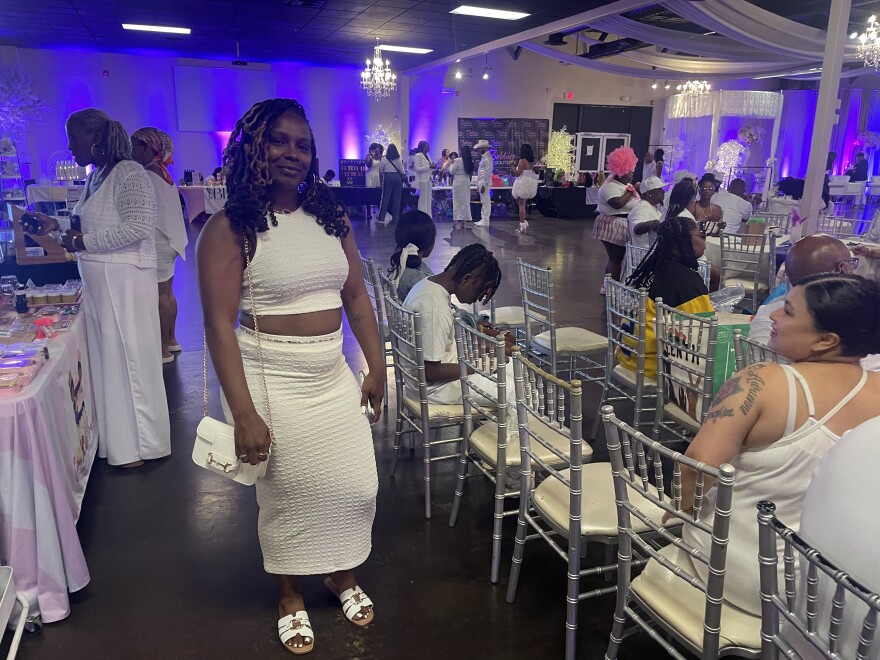
About 200 people crowd La Princesa event hall in north Phoenix on a Sunday evening in 2025. Music blasts from speakers on either side of a stage and flows into the dance floor below. There are people of all ages here. Most attendees are dressed in white, to match the all-white ball theme, but there’s no shortage of color atop models’ heads.
Lauren Jackson, 20, just graduated from a barber school in Phoenix.
We’re watching a competition between two barbers — who can shave the cleanest tapered fade the fastest — when she tells me her plans for the event she’s competing in: the loc battle.
“So I made a basketball hoop out of locs,” Jackson said.
Hair shows give local hair stylists, barbers and braiders the chance to show off their creative talents through showcases and competitions.
Some stylists had been working on their entries for more than a year leading up to the Fantasy Hair Expo. But that wasn’t the case for Jackson. The event’s organizers promoted the show at Jackson’s barber school shortly before that day.
“I’m like, OK, bet! … Mind you, this was a week before the hair show,” Jackson said.
Hair shows are a Black American tradition dating back about 75 years. The creative hair styling can be so eccentric, it’s almost performance art.
Because it’s not just the hair style on display. It’s a message conveyed through clothes, and sometimes choreography. And a chance to delight in hair textures and styles that have historically been a target of discrimination.
“A lot of us are like really creative and they’re styles that you just can’t do on a daily basis. So the hair show just kind of gives you the platform to just have fun with it, you know, just be really artistic,” Aisha Wesley said.
Wesley is a cosmetologist who organized the event with fellow cosmetologist and friend LaTricia Williams.
“I definitely think that the hair show is empowering to the community because it’s like, if nobody else accepts us, we accept us, right,” Wesley said. “I’ve had clients before that have had to come back and get their hair redone because their job was like, ‘you can’t wear that.’ You know? the hair show just kind of gives that freedom …”
“I can wear whatever I wanna wear,” Williams said.
That freedom and ingenuity was on display at the show.
Now, seeing 40 inches of dollar bills sewn into the bottom of a pixie haircut would have been enough.

But the same stylist, Cherie Nelson of Majestik Handzz Beauty Demand in Mesa, put together a whole crew of models with ’90s-inspired streetwear and exuberant hair to match.
Nelson put one model in vivid bubblegum pink afro puffs, and another with huge headphones over her ears — made entirely of braids.
And for the finale: A young woman crawls on stage, covered in wigs. She’s wearing crimped wigs from head to toe. Underneath, the leather catsuit, knee-high boots and afro wreath around her face gives her a sort of Janet Jackson lioness look.
She stalks downstage, rises to her feet and pulls the lion’s mane onto her shoulders to reveal bantu knots: sleek sectioned hair twisted into knots, a protective style dating back to Zulu women in South Africa.
The crowd is loving it.
“She went from hoodie, to a lion’s mane, to a jacket, to Catwoman – how do you do that?” the host said.
Finally, it’s time for Lauren Jackson’s event — the loc battle.
It’s all about who can craft the most creative and colorful style out of locs and accessories, with extra points for technique and details.
For the uninitiated, locs aren’t always dreadlocks. The term often refers to a more structured twist or coiling of hair rather than the Rastafari-style organic loc-ing of hair.
Loc specialists — also called locticians — can build their styles ahead of time, but on competition day they only have 30 minutes to attach everything to their model’s head and make any finishing touches.
“Y’all ready? Get set! Go!” the host exclaimed.
Anna Holly drove from San Francisco the night before to compete with her mom as her hair model.
“It was about 12 hours. But it wasn’t bad,” Holly said while laughing.
Despite the time constraint, Jackson’s entry is not insignificant.
She super-glued, painted and shaped synthetic hair onto a basketball hoop with about a foot tall backboard.
“So I bought a box of those, the sandwich bags, and I’m like, ‘well, I can use this.’ At Dollar Tree, they also had a hoop already made. So I basically wrapped the whole thing with locs,” Jackson said. “Then I took some orange loc hair and I wrapped that with the rim. And then I took some silver grayish lock hair as well for the, the net to the basketball hoop.”
“It was so hard, I’m not gonna lie. I stayed up like day and night trying to figure it out between school,” Jackson said.
And it’s functional, too — she brought a teeny tiny basketball to prove it.
“Now, if Steph Curry come out of there and shoot a 3? You won!” the host said.
Another loctician, Elisha Davis, has built a sea goddess look that’s essentially a huge halo of locs sticking straight up. It’s woven with seashells. The stylist and her model have matching glittery siren makeup. The design is minimal enough that you can really see the details.
“She sells seashells by the seashore. … Aphrodite ain’t playin’!” the host said.
And Holly is installing a replica of a famous landmark on her mother’s head.
“Is that traffic on her head, y’all? … It’s the Golden Gate Bridge!” the host said to cheers from the crowd.
Yes, the Golden Gate Bridge, made entirely of hair.
“I’m like, dang, I didn’t even know that was possible, y’all! And she had cars on the bridge!” Jackson said.
Master loctitian and cosmetologist Jai Davis is this event’s judge.
“I’m looking for detail, creativity. … I like integrity more than flash. I like skill more than flash,” Davis said.
It was a tight race. But a winner and runner-up are announced.
“This one was super, super hard, we had to go all the way down to details. We had to look at edges and fresh retwists because the creativity in this competition was so cold,” Davis said. “So, because we had to go down to detail and crispy edges. … We gon’ give it to the Golden [Gate] Bridge!”
So Jackson’s basketball hoop didn’t win.
But despite that, she said, “it was so worth it. If I can go back, I would do it all over again.”
And next time, she’ll be ready.
“Oh my God, I’m gonna do so much more next year. Oh my goodness, I can not wait for next year. ‘Cause I’m gonna do so much more,” Jackson said.


PRESCOTT, AZ (AZFamily) — Beautiful Prescott, Arizona, is home to the “World’s Oldest Rodeo,” and on this Field Trip Friday, we’re getting a look at what to expect when it opens next week!
Scott Pasmore and Gibby Parra went to check out the Prescott Frontier Days event that attracts thousands every year. There’s a wild horse race, barrel racing and bull riding — and that’s just the beginning of what you can see!
Rodeo Royalty
No rodeo is complete without Rodeo Royalty, or experienced horsewomen who help keep the sport alive. Scott and Gibby introduce you to the rodeo queens of the “World’s Oldest Rodeo.”
Anna Butler was named the 2026 Prescott Frontier Days rodeo queen, Ava Brooks was named the 2027 rodeo queen, and Ellie Weeks was named the 2027 junior queen.
Granite Mountain Distillery
Granite Mountain Distillery opened in 2025 and welcomes customers on Friday, Saturday and Sunday.
The distillery has a limited edition whiskey bottle made specially for the “World’s Oldest Rodeo.”
Master Distiller Chris Currie said the quality barrels that the distillery uses allow for the whiskey to be of such high quality.
There were only 1,888 rodeo edition bottles made. Each bottle has its own unique number to authenticity.
Red White and Brew
No one is more excited about the rodeo returning to town than all the local businesses in Prescott.
Summer is one of their busiest times of the year. It’s when many Arizona families head north from the Valley to escape the heat or to attend one of the many summer events in the historic town.
Scott and Gibby stopped by Red White and Brew to see what they’re cooking up this time of year.
“Frontier Days in Prescott is huge,” said Jennifer Collinge, general manager at Red White and Brew in Prescott. “It draws people in from all over the state, all over the country, come and visit us. We have a giant Fourth of July parade that is, I think, one of the biggest in the state. It’s just a week-long of festivities and fun; you don’t have to be involved in rodeo to enjoy it.”
If you want to go the extra mile, 20% of all sales made at Red White and Brew on Tuesday, June 30, will be donated to the Eric Marsh Foundation for Wildland Firefighters.
Whiskey River Tavern
Scott and Gibby spoke with former Prescott Mayor Greg Mengarelli about the exciting times ahead for the city.
“It’s going to be a great celebration,” Mengarelli said. “We’re already very patriotic at the rodeo, but America 250 is just up another level. It’s going to be an awesome celebration, and I hope everybody comes up to see us at the rodeo and the parade.”
He said Frontier Days is sold out, as has been the case over the past several years, and 17 foreign countries will be represented.
Check out our previous Field Trip Friday segments here.
See a spelling or grammatical error in our story? Please click here to report it.
Do you have a photo or video of a breaking news story? Send it to us here with a brief description.
Copyright 2026 KTVK/KPHO. All rights reserved.


Odds of winning the Powerball and Mega Millions are NOT in your favor
Odds of hitting the jackpot in Mega Millions or Powerball are around 1-in-292 million. Here are things that you’re more likely to land than big bucks.
The Arizona Lottery offers multiple draw games for those aiming to win big.
Here’s a look at Thursday, June 25, 2026 results for each game:
Winning Pick 3 Evening numbers
Evening: 1-4-2
Winning Fantasy 5 numbers
15-22-28-29-36
Check Fantasy 5 payouts and previous drawings here.
Winning Triple Twist numbers
06-08-38-39-40-42
Check Triple Twist payouts and previous drawings here.
Feeling lucky? Explore the latest lottery news and results
What time is the Powerball drawing?
Powerball drawings are at 7:59 p.m. Arizona time on Mondays, Wednesdays and Saturdays.
How much is a Powerball lottery ticket today?
In Arizona, Powerball tickets cost $2 per game, according to the Arizona Lottery.
How to play the Powerball
To play, select five numbers from 1 to 69 for the white balls, then select one number from 1 to 26 for the red Powerball.
You can choose your lucky numbers on a play slip or let the lottery terminal randomly pick your numbers.
To win, match one of the 9 Ways to Win:
- 5 white balls + 1 red Powerball = Grand prize.
- 5 white balls = $1 million.
- 4 white balls + 1 red Powerball = $50,000.
- 4 white balls = $100.
- 3 white balls + 1 red Powerball = $100.
- 3 white balls = $7.
- 2 white balls + 1 red Powerball = $7.
- 1 white ball + 1 red Powerball = $4.
- 1 red Powerball = $4.
There’s a chance to have your winnings increased two, three, four, five and 10 times through the Power Play for an additional $1 per play. Players can multiply non-jackpot wins up to 10 times when the jackpot is $150 million or less.
Are you a winner? Here’s how to claim your lottery prize
All Arizona Lottery retailers will redeem prizes up to $100 and may redeem winnings up to $599. For prizes over $599, winners can submit winning tickets through the mail or in person at Arizona Lottery offices. By mail, send a winner claim form, winning lottery ticket and a copy of a government-issued ID to P.O. Box 2913, Phoenix, AZ 85062.
To submit in person, sign the back of your ticket, fill out a winner claim form and deliver the form, along with the ticket and government-issued ID to any of these locations:
Phoenix Arizona Lottery Office: 4740 E. University Drive, Phoenix, AZ 85034, 480-921-4400. Hours: 7:30 a.m. to 5 p.m. Monday through Friday, closed holidays. This office can cash prizes of any amount.
Tucson Arizona Lottery Office: 2955 E. Grant Road, Tucson, AZ 85716, 520-628-5107. Hours: 7:30 a.m. to 5 p.m. Monday through Friday, closed holidays. This office can cash prizes of any amount.
Phoenix Sky Harbor Lottery Office: Terminal 4 Baggage Claim, 3400 E. Sky Harbor Blvd., Phoenix, AZ 85034, 480-921-4424. Hours: 8:30 a.m. to 5 p.m. Monday through Sunday, closed holidays. This office can cash prizes up to $49,999.
Kingman Arizona Lottery Office: Inside Walmart, 3396 Stockton Hill Road, Kingman, AZ 86409, 928-753-8808. Hours: 8 a.m. to 8 p.m. Monday through Friday, 8:30 a.m. to 5 p.m. Saturday and Sunday, closed holidays. This office can cash prizes up to $49,999.
Check previous winning numbers and payouts at https://www.arizonalottery.com/.
This results page was generated automatically using information from TinBu and a template written and reviewed by an Arizona Republic editor. You can send feedback using this form.

NOGALES, Ariz. (KGUN) — Approximately 400 Marines are working along the southern border in the Tucson sector, adding brackets and two types of wire to the border wall as part of an infrastructure improvement and barrier reinforcement mission.
Company Commander Kyle Harrison showed me the work underway in southern Arizona, where groups are operating in states bordering Mexico.
“Our purpose down here, ma’am, is primarily going to be infrastructure improvement and barrier reinforcement. So, general engineering is what we’re doing,” Harrison said.
The reinforcement work includes welding brackets onto the barrier and laying barbed wire along the wall.
“Marines, the furthest on the right, on that lift on the right, they’re actually welding the brackets onto the baller. It’s onto the barrier to the left. The next lift is going to be a group of Marines that are laying out the barbed wire,” Harrison said.
In two and a half months, the unit has put up wire across 25 miles of the wall in the Tucson sector, including in Douglas and Nogales.
“The purpose of laying the wire is just to reinforce the preexisting barrier, preexisting infrastructure,” Harrison said.
For most of the service members, this is their first time doing this kind of work. Harrison said the majority have been learning on the job.
“So vast majority of these marines have been receiving training on the job. Once they got here on site, they’ve been picking up the training and experience here,” Harrison said.
Part of that training includes obtaining the proper licenses to operate aerial lifts, which are civilian contracted equipment.
“So seeing as how it’s civilian contracted equipment, they did have to receive instruction and licensing and certification in order to run and operate them,” Harrison said.
With temperatures on the rise, units are also taking precautions to stay cool, including having medical personnel available on site.
“Hydration obviously on the front side, ma’am. Before anybody leaves the border patrol station on their way to the barrier, make sure that we have plenty of water, plenty of food, and then plenty of ice to keep everyone cool,” Harrison said.
Harrison said the unit will continue working along the border until every mile of the Tucson sector is complete.
This story was reported on-air by a journalist and has been converted to this platform with the assistance of AI. Our editorial team verifies all reporting on all platforms for fairness and accuracy.
——-
Alexis Ramanjulu is a reporter in Cochise County for KGUN 9. She began her journalism career reporting for the Herald/Review in Sierra Vista, which she also calls home. Share your story ideas with Alexis by emailing alexis.ramanjulu@kgun9.com or by connecting on Facebook.
-

 Idaho2 minutes ago
The reactor race has begun
-

 Illinois9 minutes ago
New Illinois bill aims to overhaul public defense system | The Chicago Report
-

 Indiana12 minutes ago
Driver airlifted after NW Indiana police chase ends with crash into tree
-

 Iowa17 minutes ago
Vote: Class 1A Iowa High School Softball Midseason Player Of The Year
-

 Kansas24 minutes ago
Salina Stars Unite for Final High School Stage at Kansas Shrine Bowl
-

 Kentucky27 minutes ago
Beechwood’s Tyler Fryman commits to the Kentucky Wildcats
-

 Louisiana32 minutes ago
Southern football’s Marshall Faulk visits Central Louisiana
-

 Maine39 minutes ago
Gov. Mills to decide on Maine school choice tax credit program

