Arizona
Donald Trump faces rebellion over ICE raids in Arizona


President Donald Trump is facing mounting resistance in Arizona after lifting restrictions on immigration enforcement, allowing agents to target sensitive locations like schools, churches and hospitals.
On Monday, the acting head of the Department of Homeland Security, Benjamine Huffman, released a memo that reversed the Biden administration’s policy of prohibiting U.S. Immigration and Customs Enforcement (ICE) agents from operating in or near schools, churches and other “sensitive locations.”
In a statement regarding the policy shift, a DHS spokesperson said that “criminals will no longer be able to hide in America’s schools and churches to avoid arrest.”
Yassamin Ansari, who represents Arizona’s 3rd Congressional District in the U.S. House, has emerged as a vocal critic of the administration’s actions. Speaking to Newsweek, Ansari called the policy “ridiculous” and highlighted its impact on her constituents, many of whom are deeply concerned about their families.
Photo Illustration by Newsweek/Getty Images
“There are places in the United States that should be considered safe places,” said Ansari, who is the daughter of immigrants and at 32 is the youngest woman in the 119th Congress.
“A school is one of those places; a hospital is one of those places. I have close friends who are doctors, and having to, on top of the work that they do daily to save lives, think about protecting people and their patients is outrageous.”
Ansari, who succeeded Senator Ruben Gallego, boycotted Trump’s inauguration and chose to attend a Martin Luther King Jr. Day march in her district in Phoenix.
The Arizona Democrat has been hosting listening sessions with school districts, nonprofits, local legislators and labor unions to address the growing fears in her district among immigrant communities.
“We heard from some of the schools that parents are already pulling their kids out in some cases of schools and that they’re concerned about what might happen to them or not knowing if a raid may happen in a school,” she said.
“I find all of Trump’s proposed policies on this topic to be outrageous. The reality of the matter is that Democrats, alongside Republicans, agree that we need comprehensive immigration reform and we need a secure border. None of the policies that Trump has proposed address these issues.”
Andrew Harnik/Getty
Ansari said that scammers have been preying on immigrant communities, falsely claiming to offer legal services and defrauding vulnerable families.
“There’s a lot of bad actors taking advantage of the situation. So we heard some stories of individuals alleging that they are lawyers and scamming people out of money.”
According to the American Immigration Council, roughly 13.1 percent of the state’s residents are immigrants, and about 8.6 percent of its U.S.-born residents live with at least one immigrant parent.
Arizona state Senator Lela Alston, a former Phoenix Union School District Governing Board president, said Trump’s policy will “traumatize” students.
“Sensitive location policies have been in place for more than a decade and removing them will do nothing but deter mixed-status families from receiving medical attention, going to church, attending school or carrying out their day-to-day activities,” she said in a statement.
“This despicable act, which is part of a larger effort by the Trump administration to carry out his promise of mass deportation, will not help increase public safety. It will instead lead to nearly six million kids in the U.S. living in fear everyday that they may be separated from their families.
“As a former educator, it is heartbreaking to think of how this will traumatize children.”
Across the aisle within Arizona’s Republican establishment, there is growing dissent. Tom Horne, the state’s Superintendent of Public Instruction, said that he opposes ICE raids in schools because fewer children would attend, undermining their right to an education—a right upheld by the U.S. Supreme Court’s 1982 decision in Plyler v. Doe.
“If they do that, less kids will come to school,” Horne told the Phoenix New Times.
Horne said that “it’s not [a child’s] fault their parents came here illegally” and that he is concerned that Trump’s policy will prevent undocumented students from getting an education.
Rare bipartisan opposition suggests widespread unease over Trump’s reversal of sensitive location protections, with critics accusing the administration of prioritizing fear over family and community stability.
Immigrant advocacy groups like Puente Arizona are mobilizing to protect vulnerable families. The organization has launched a hotline to monitor ICE and Border Patrol activity in the Phoenix area, dispel misinformation and protect immigrant families from being separated.
The National Parents Union hit out at the administration’s decision and described it as a “disgraceful” move that threatens the well-being of children in immigrant families.
“We unequivocally condemn the announcement that the Trump administration will allow federal immigration agencies to make arrests at schools, daycare centers, places of worship and hospitals,” the National Parents Union said in a statement.
“Law abiding individuals and their families should be treated humanely and with dignity. The decision to go after families in safe places sends a disgraceful message that threatens to emotionally scar young children whose families may be deported and other young children caught up in the crossfire.”
Monica Sandschafer, Arizona state director for Mi Familia Vota, said school raids are dangerous and inhumane.
“It will deter children from going to school, as parents will be afraid that ICE will detain their children, and it will tear families apart,” she said. “Schools have an obligation and an opportunity to protect their students, regardless of their immigration status.
“Can we imagine for a moment what it would be like for a child to live with the anxiety of suddenly losing their parents or being ripped away from the only world they’ve ever known? Have we thought about what it would be like for the non-immigrant children to show up to school and have their best friend missing, or their favorite teacher deported? This is a terrible policy for everyone.”
Meanwhile, Ansari announced plans to introduce a resolution aimed at supporting immigrant communities amid the looming threat of Trump’s renewed Muslim ban.
“My team and I are working on introducing a resolution to support immigrant communities and their contributions to our country,” Ansari told Newsweek.
The administration is in the process of determining which countries will be included in the latest iteration of the ban, a move Ansari described as harmful to the nation’s core principles.
“This legislation really intends to make a strong statement opposing Trump’s policies that harm our national security, our economy and our fundamental values as a nation,” she said.
Ansari also emphasized the need for comprehensive immigration reform, including pathways to citizenship for Dreamers and DACA recipients.
“I think the biggest issues that we have when it comes to the border is not just more resources but also just legal pathways to immigration,” she said. “And for decades in this country, one of the major challenges we faced is around Dreamers and DACA recipients, making sure that people who were raised in this country have a pathway to citizenship. That is what I believe we should be focused on.”
As Arizona grapples with the fallout from Trump’s policy reversal, the state has become a battleground for immigration enforcement.
With grassroots organizations, state officials and lawmakers rallying against the administration’s actions, the stage is set for a showdown over immigration policies.
Arizona’s rebellion is sending a message that immigration enforcement at the expense of community safety and trust will not go unchallenged.



Cardinals’ Burch shares what he learned as a rookie in 2025
Arizona Cardinals second-year player Jordan Burch says his defensive line teammates have formed a bond heading into the 2026 NFL season.
Last year in early July, Cardinals edge rusher Jordan Burch was a rookie third-round draft pick out of Oregon who was looking forward to his first NFL training camp and eventual first season.
That rookie year is behind him now, and Burch has identified what he needs to improve on heading into his second season. He said he now knows what to expect and look for, and after talking with outside linebackers coach Matt Feeney, Burch built an offseason plan with which he was comfortable.
“I don’t think anything was like a surprise,” Burch said on Thursday, July 9, at the Cardinals’ Tempe headquarters. “I kind of know what to prep for, so this offseason I can look at my old plays, and then I can call my coach and tell him, from last year to this year, what does he want to see on the field.”
Burch seeks to improve his pass rush. He played in all 17 games last season and had five solo tackles with a sack, and also broke up three passes.
Much of his position was dropping into pass coverage, so Burch looks to recognize pass catchers’ routes better in 2026. He gets help from veteran Josh Sweat, who is there to answer questions about the position they share.
“Every week, every game going against somebody good,” Burch said about takeaways from last season. “The talent of the quarterbacks. We’re playing the Rams, how quickly they get the ball out.”
Burch looks forward to building a stronger bond with his teammates, having invited some of them for dinner or to watch TV. He said he was happy with his progress as a player throughout last season.
The Cardinals open training camp Wednesday, July 22, at State Farm Stadium. It’s a week earlier than most teams because Arizona plays the Carolina Panthers in the Aug. 6 Hall of Fame Game in Canton, Ohio.
Cardinals legend Larry Fitzgerald will be among those inducted into the Pro Football Hall of Fame Aug. 8.

A new study has ranked Arizona as one of the worst states to move to for two years in a row, largely due to what it calls a poor quality of life.
The study conducted by Consumer Affairs analyzed the best states to move to in the United States, putting Arizona at the bottom of the list.
Before Arizonans get too defensive about the Grand Canyon State, Consumer Affairs used factors such as affordability, safety, economic strength and education to measure each state, leaving out factors like entertainment, retirement benefits and other considerations that may be important to people living here.
Popular states such as California and New York also landed at the bottom of the list due to their lack of affordability, even though they both have some of the best health care and education in the nation, Consumer Affairs noted.
Here’s why the study says you shouldn’t move to Arizona. Do you agree?
Why you shouldn’t move to Arizona
Arizona ranked No. 10 out of the worst states to move to, scoring especially poorly in quality of life.
Quality of life was measured by the state’s Social Progress Index, average air quality, weather, environmental protection and number of national parks. Due to Arizona’s extreme summers and Phoenix’s consistently poor air quality, it’s easy to see why Arizona ranked No. 44 in quality of life out of 50 states, even though the Grand Canyon is one of the most popular national parks in the nation.
However, Arizona also ranked poorly in other categories, sitting at No. 42 in health care and education, No. 41 in safety and No. 34 in affordability out of 50 states.
There was one category Arizona did impressively well in, ranking No. 5 in economic strength even as one of the youngest states in the country. Still, Arizona’s economic power wasn’t enough to boost its ranking.
Top 10 worst states to move to
Arizona wasn’t alone; some of the biggest states in the country were also considered the worst states to move to in 2026.
- New Mexico
- Louisiana
- California
- Arkansas
- Oklahoma
- Nevada
- Alaska
- Mississippi
- Oregon
- Arizona
Top 10 best states to move to
- Utah
- New Hampshire
- Idaho
- Minnesota
- Massachusetts
- Maine
- North Dakota
- Pennsylvania
- Iowa
- South Dakota
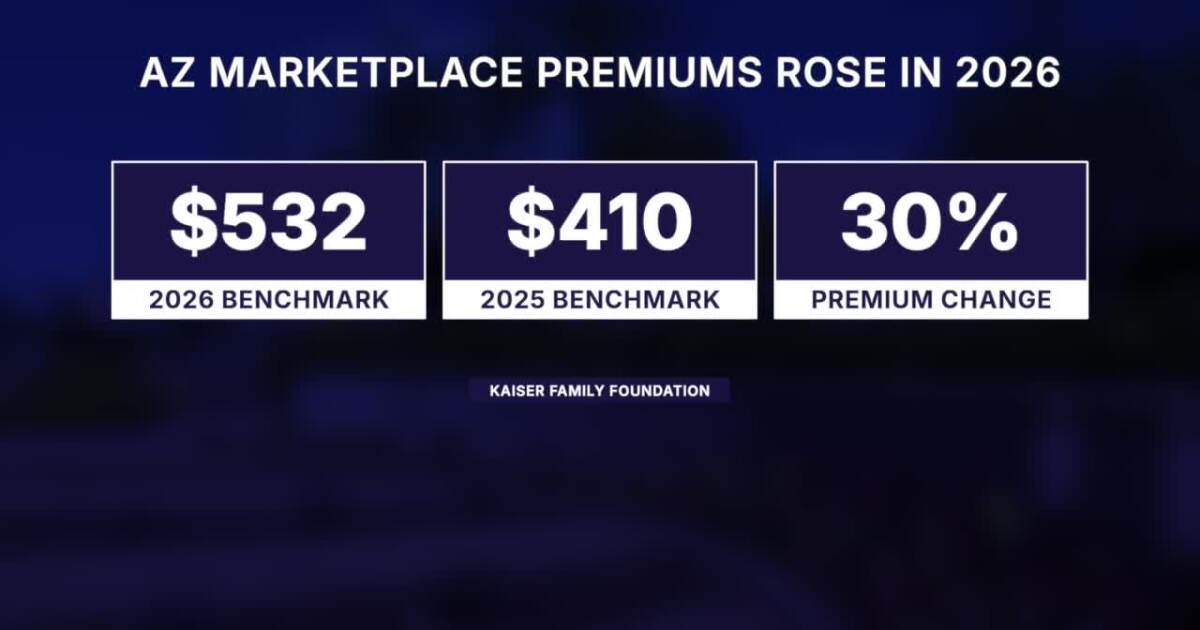
PHOENIX — Arizona’s ACA marketplace enrollment fell from 363,000 to just over 255,000 in a single year — a nearly 30% decline and the third-largest annual drop in the country.
Rising premiums and expired tax credits are driving the trend, with the average benchmark plan premium in Arizona now at $532 — up 30% from 2025.
In the player above, ABC15 Data Analyst Garrett Archer takes a look inside the numbers on how healthcare premiums are impacting health insurance enrollment.
This story was reported on-air by a journalist and has been converted to this platform with the assistance of AI. Our editorial team verifies all reporting on all platforms for fairness and accuracy.
Want more news in your community? Add ABC15 as a preferred source on Google below:

-

 Movie Reviews3 minutes ago
‘Evil Dead Burn’ Movie Review – Spotlight Report
-

 World11 minutes ago
Hoops Players’ Win Tops Big Day in NCAA Eligibility Litigation
-

 Health36 minutes ago
3 Best Peptides for Weight Loss—and the Viral One Doctors Say To Skip
-
 Lifestyle51 minutes ago
Smithsonian chief emphasizes ‘accuracy and integrity’ after White House report
-

 Technology1 hour ago
Microsoft’s carbon emissions went up 25 percent last year
-

 World1 hour ago
Jailed Catholic woman’s hunger strike highlights Iran religious persecution — US demands action
-

 Politics1 hour ago
Israel shares intelligence warning Iran plotted new assassination attempt against Trump: report
-

 Health1 hour ago
Parasitic infection causing ‘explosive’ stomach illness exceeds 1,000 cases in northern state

