Arizona
Arizona Fall League reports: Ethan Salas, Termarr Johnson, Colt Emerson and more


Here’s my third and final dispatch from my week scouting the Arizona Fall League, which included 11 games in five days, a lot of walks (the league’s walk rate so far is 12.5 percent), and some very high scores. You can also see reports on some more players in my first and second notebooks from the week.
(Note: Arizona Fall League team in brackets)
Thomas Saggese, 2B, St. Louis Cardinals (Glendale Desert Dogs)
Saggese reached the majors at the end of the year for the Cardinals and is in the AFL after a completely full season. He’s already over 600 PA in this calendar year between the minors, majors, and the AFL. It’s to his credit that he still looks so good right now, playing plus defense at second, using the whole field well at the plate, even homering on a slider one pitch after whiffing on one.
I’m sure it helps when you go from facing big-league pitching to facing AFL arms, but I would just say that if Saggese’s major-league debut concerned you at all, he’s fine.
Colt Emerson (Jill Weisleder / MLB Photos via Getty Images)
Colt Emerson, SS, Seattle Mariners (Peoria Javelinas)
I was certainly excited to see Emerson, who landed in the top 10 in my last update of the top prospects in the minors, but I only got two games from him and neither was very strong. I still love the bat control and the way his hands work, but he swung and missed quite a few times in my looks, with three strikeouts in those games, two on sliders and one on a 91-mph fastball that was up.
He can handle velocity — he doubled the other way off 95 — but it was a quiet look for me. He wasn’t challenged on defense in my looks either.
Jac Caglianone, 1B, Kansas City Royals (Surprise Saguaros)
I mentioned how tired Bryce Eldridge looked in my first AFL dispatch — which, to be clear, is not saying he’s bad in any way, but that judging him off his AFL look is probably misleading — and the same applies to Caglianone, the only 2024 first-rounder in the league so far this year.

GO DEEPER
Jac Caglianone turned heads as a two-way player in college. Can he do it as a pro?
Caglianone, the sixth pick in the MLB Draft this July, played a full college season for Florida, through the College World Series, and then played another 29 games after he signed. He’s been going since mid-February, and he looks gassed.
He’s struck out 11 times in 37 PA at this writing with a .229/.243/.286 line, striking out three times on sliders in front of me and once on a fastball. This isn’t who he is, and other than a really nice play at first base to start a 3-6 double play, I feel like he’s not getting anything from these reps.
Chase DeLauter, OF, Cleveland Guardians (Surprise Saguaros)
DeLauter, on the other hand, definitely needs these reps, as the oft-injured Guardians prospect played just 39 games this year around several injuries, including yet another fracture in his foot.
He continues to hit when he plays, including a flyout to center at 110 mph off the bat in one of the games I saw, but I have to confess I can’t buy this swing. It’s not just that it’s unconventional, but that it seems to leave him vulnerable to pitches in, or down and in, or just generally down, as he’s geared to attack pitches up and is so strong that he can hit those pitches harder than a lot of hitters can.
Maybe it’ll take major-league pitching to successfully exploit all of the weaknesses a swing like DeLauter’s presents, or maybe it’ll continue to work because DeLauter is so dang strong. He’s going to mash in the AFL, though, where there are very few pitchers who have the combination of stuff and command to attack him.
Josue Briceño and Thayron Liranzo, C/1B, Detroit Tigers (Scottsdale Scorpions)
I mentioned Briceño briefly in my first AFL notebook, and all he did after that was hit and hit. He’s not catching in Arizona as he was only listed as a first baseman, with Liranzo sent as a catcher and thus taking up the reps behind the plate, but he’s probably been the most impressive bat in the early going, hitting all kinds of pitching — left and right, all pitch types, and to all fields. It’s a very easy and quiet swing coupled with strong pitch recognition, which seems like a pretty good foundation for someone who’ll hit for average and power.
Liranzo, by the way, can really, really throw, and has gone 8 for 16 with a homer and four doubles in limited playing time. I saw one game from him, and it is such a smooth, easy, powerful swing that if he keeps the strikeout rate in check, he’s going to be a star.
Robert Hassell III, OF, Washington Nationals (Salt River Rafters)
Hassell III is repeating the AFL off a disappointing, injury-plagued year that saw him slug just .371 across three levels, mostly in Double A. Hassell was one of the five players the Nationals received in return for Juan Soto in 2022, but he hasn’t hit at all since the trade, and he hasn’t gotten any stronger in that span, so the contact he does make is weak. He does have some feel to hit and is an above-average runner, but when he squares the ball up it just doesn’t go anywhere.
Sean McLain, IF, Los Angeles Dodgers (Glendale Desert Dogs)
McLain is on Glendale with his brother, rehabbing Reds big-leaguer Matt McLain, and Sean is a good example of how AFL performance can mislead you. He hit .215/.326/.337 this year as a 23-year-old at both levels of A-ball, but he’s tearing up the AFL so far, hitting .300/.482/.450 through two weeks. He’s feasting on the weak pitching out in the desert, as he struggles with good velocity but he has a decent idea at the plate and can wait pitchers out — and there aren’t many guys in the AFL who throw gas and can find the plate without GPS.
McLain isn’t bad, just limited, and I don’t mean to pick on him — he hit some balls on the screws and made some really nice plays at third. He’s just a good illustration of how the weak pitching in the Fall League can skew our perceptions of some hitters.
Xavier Isaac, 1B, Tampa Bay Rays (Mesa Solar Sox)
I saw a lot of inconsistency from Isaac at the plate, and some pretty lousy defense at first base, where he’s playing to get reps while Tre’ Morgan is playing the outfield so both guys can get playing time. I saw Isaac whiffing on a lot of good fastballs, sliders down, even once on a changeup up, but I also saw some very hard contact on the same pitch types, so there’s some adjustment happening there if you throw him the same pitch twice in an at-bat.
I admit to being a skeptic on Isaac, who has skills that play very well against the poor pitching in the low minors — he can tell a ball from a strike and can absolutely demolish a mistake — but who has some deficiencies at the plate that I think upper-level pitchers can exploit.
Sammy Siani, OF, Pittsburgh Pirates (Scottsdale Scorpions)
Siani had another mediocre regular season in 2024, but he’s been on a tear in the AFL, and a big reason why is that he’s focused more on putting the ball in play than on trying to lift and pull the ball for power. He’s 10 for 22 through two weeks with just two strikeouts, and his swing is so much simpler now, with none of the launch-angle silliness he’d been doing over the last few seasons.
Siani was a compensation round pick back in 2019 and hasn’t hit at all in his time in the minors, with a composite .234/.343/.362 line through Double A, but he might be poised for a breakout next year if the Pirates have finally gotten through to him on the need to focus on contact over power.
Ethan Salas, C, San Diego Padres (Peoria Javelinas)
Salas is the top-rated prospect in the AFL, coming in at No. 5 in my midseason update. He comes to the AFL off a fairly full season, where he hit .206/.288/.311 as an 18-year-old in High A — he was younger than most of the high school players taken in this year’s draft. He’s off to a solid start in the AFL; I saw good at-bats and a simple swing but didn’t get any of the hard contact, nothing to really move my opinion on him in either direction.
He’s the second-youngest player in the AFL, just four months older than fellow Padres prospect Leodalis De Vries, who I only saw for one game, and both guys are playing way above their age/experience.
Brock Wilken, 3B, Milwaukee Brewers (Peoria Javelinas)
The Brewers took Wilken in the first round in 2023. This season, he suffered multiple fractures when he was hit in the face by a pitch on April 12, after which he hit just .194/.309/.360. He came back just three weeks after the injury, and it’s possible that his performance afterward reflected the quick return, but he hasn’t looked much better in Arizona, hitting .121/.216/.303 through the first two weeks.
I got a Wilken homer in the first at-bat I saw, but after that, he struggled to hit anything, good fastballs and any sort of offspeed stuff. I liked Wilken when I saw him at Wake Forest, taking him as a low- to medium-average slugger with legit power, but this wasn’t a good look, with one hard-hit ball on a slider and a lot of trouble squaring anything else up.

Termarr Johnson (Jill Weisleder / MLB Photos via Getty Images)
Termarr Johnson, 2B, Pittsburgh Pirates (Scottsdale Scorpions)
Johnson continues to show excellent ball-strike recognition, in line with his regular-season performances the last two years where he drew 101 and 85 walks, respectively, although he’s still not converting that excellent judgment into hard contact. His swing does look good, though — there’s no sign of the little hitch he would flash in high school, and he’s definitely shorter to the ball than he’s been before. He also played superb defense at second base in my looks, showing good range to his left and making a great pivot on a 5-4-3 double play.
There was some chatter among scouts about how disappointing his performance has been given the hype around his hit tool before he was drafted No. 4 in 2022, and that’s fair, but I do think he’s going to be at least an average regular at second who gets on base and plays at least above-average defense.
Adrian Pinto, OF/2B, Toronto Blue Jays (Scottsdale Scorpions)
Pinto, acquired back in March 2022 in a trade that sent Randal Grichuk to Colorado, has shown strong contact skills when healthy, and he’s in the AFL after missing four months this year due to a rib injury. He can still put the ball in play, but I saw no power at all from Pinto, who hasn’t had an extra-base hit through eight games in the desert.
He steps in the bucket and thus is way too open at contact, which can undercut any hitter’s power, and it’s more severe for Pinto given how small he is — he’s listed at 5-foot-6, 156 pounds, although that might be out of date. He also showed just average speed, which might otherwise be a way to make up for the lack of power. I see an extra outfielder ceiling here.
Alejandro Osuna, Texas Rangers, OF (Surprise Saguaros)
Osuna had something of a breakout season this year, repeating High A and then hitting .306/.379/.523 in 57 games in Double A, without a clear plus tool in his skillset. He does get the bat to the ball pretty frequently and has shown solid plate coverage in the Fall League, with a very fast bat and a really simple, repeatable swing that lines up with the high-contact results.
He doesn’t walk much but I did see him work the count well and lay off pitches aimed at getting him to chase. He might be a tweener, lacking the power for a corner or the speed/defense for center, but the hit tool is good enough to keep him in play as a potential regular.
Edwin Arroyo, SS, Cincinnati Reds (Glendale Desert Dogs)
Arroyo missed all of the 2024 regular season after undergoing surgery on his left (non-throwing) shoulder in March, so the AFL represents his first playing time since early in spring training. He looked great in the field when I saw him, but pretty rusty at the plate. He showed plus range and a plus arm at shortstop, moving well in all directions, while at the plate he made a lot of soft contact along with the occasional hard-hit single.
He seemed to have some trouble recognizing pitch types, although that resulted in as much weak contact as actual whiffs, with some defensive swings when he realized a little late what the pitch was.
Moises Ballesteros, C, Chicago Cubs (Mesa Solar Sox)
Ballesteros has continued to rake, as he’s done everywhere in the minors, showing exceptional contact skills and strong plate coverage, although I did see a few at-bats where he swung at a pitch he might have been better off letting go.
I still have a hard time seeing him last as a catcher given his body, with a listed height and weight of 5-8, 215, although I only saw him catch one game the week I was in Arizona. I’ve learned never to judge catchers in the AFL because they’re often exhausted and now have to learn to catch a motley set of pitchers who often are in the Fall League because they throw hard and can’t find the plate. (Well, except for Cleveland’s Kody Huff, who caught well because he always catches well, no matter when or who he’s catching.)
The same note on defense would apply to Atlanta’s Drake Baldwin, who’s hitting well but didn’t do much in the two games I saw from him, one of which had him at DH.
(Top photo of Salas: Norm Hall / MLB Photos via Getty Images)



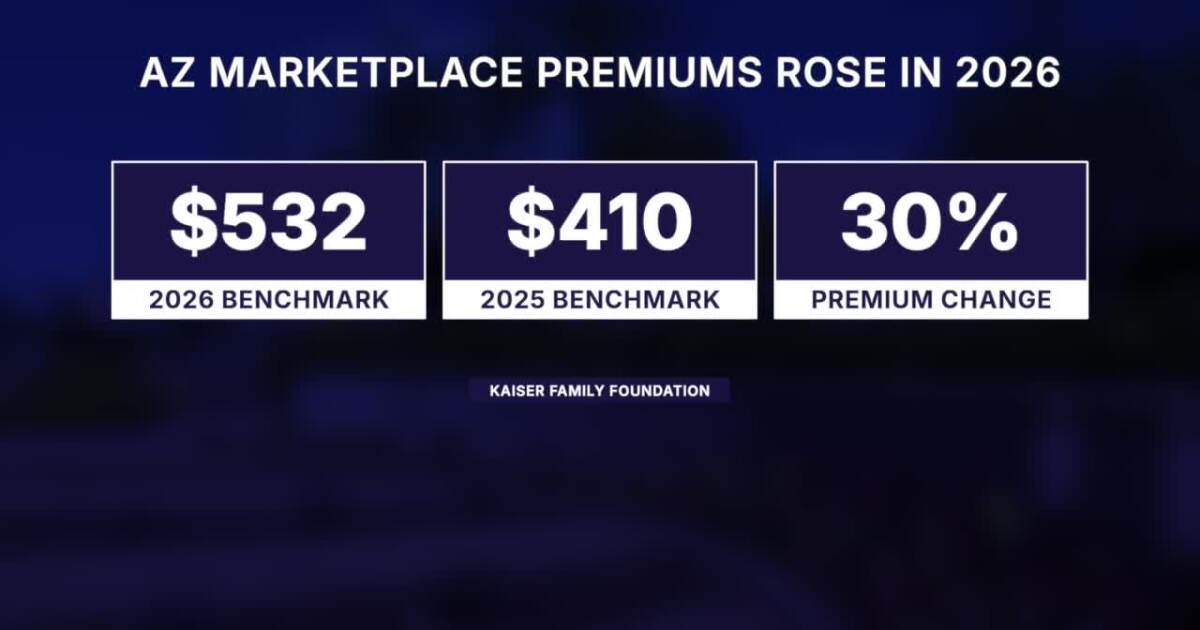
PHOENIX — Arizona’s ACA marketplace enrollment fell from 363,000 to just over 255,000 in a single year — a nearly 30% decline and the third-largest annual drop in the country.
Rising premiums and expired tax credits are driving the trend, with the average benchmark plan premium in Arizona now at $532 — up 30% from 2025.
In the player above, ABC15 Data Analyst Garrett Archer takes a look inside the numbers on how healthcare premiums are impacting health insurance enrollment.
This story was reported on-air by a journalist and has been converted to this platform with the assistance of AI. Our editorial team verifies all reporting on all platforms for fairness and accuracy.
Want more news in your community? Add ABC15 as a preferred source on Google below:

Arizona
Arizona man pleads guilty after illegally living in forest for years among ‘1,000lbs of trash’

A man in Arizona has pleaded guilty to violating federal fire restrictions and unlawfully residing in a national forest, after authorities said he spent years living at a makeshift campsite surrounded by what officials described as “approximately 1,000 pounds of trash”.
Mark Aaron Gatz was arrested on 25 June at his illegal campsite in Arizona’s Tonto national forest, according to court records. A United States Forest Service (USFS) officer wrote in documents submitted to court that Gatz had been operating an “illegal campsite” with a “hot wood burning campfire” despite fire restrictions and that he had told investigators that he had been living in the forest for about eight years.
The officer wrote that a records check found that Gatz had previously received multiple citations and was the subject of six outstanding federal arrest warrants for earlier violations, including for building fires during fire restrictions, constructing on national forest service lands, unsanitary conditions and occupying national forest as a residence.
Gatz “said that he knew about current fire restrictions but had to have fire to eat”, authorities said. The documents show that USFS officers made contact with Gatz multiple times over the last year or so, and issued him warnings as well as a violation notice for having campfires during fire restrictions.
Notes from officers’ previous encounters with Gatz earlier this year, submitted into the court docket, state that authorities observed “trash such as clothing, pans, tools, and plastic cups scattered throughout the campsite along with a structure that was four feet in height build using wood panels”.
During an encounter with Gatz in May, officers reported observing “approximately 1,000 pounds of trash” at the site, which they said included tires, plastic bags, trash bags, aluminum cans and other items. They also wrote that they found that the campfire site had been left unattended by Gatz the previous day while still hot.
In a separate report filed by law enforcement from an encounter in February, one officer wrote that “upon arrival at the camp, I was flabbergasted by the amount of debris in the area”.
Investigators said that during that encounter, the debris consisted of three ladders, six to eight totes “overfilled with debris”, five 55-gallon drums, eight tires, multiple bicycle frames, 5 gallons of motor oil, plywood and other “miscellaneous lumber”, and they wrote that trash was scattered over approximately half an acre of Forest Service land and creating what officers described as public safety concerns.
In a separate report from July 2025, officers said they observed what they described as a “large messy campsite” while patrolling the area due to complaints “from the district office abut one large messy camp”.
“There was roughly half an acre of resources ruined due to so much trash and goods on the ground for an extended period of time,” the officer wrote.
This week, after Gatz pleaded guilty, he was sentenced to time served and three years of probation, according to court records.
A representative for Gatz did not immediately respond to a request for comment.

Odds of winning the Powerball and Mega Millions are NOT in your favor
Odds of hitting the jackpot in Mega Millions or Powerball are around 1-in-292 million. Here are things that you’re more likely to land than big bucks.
The Arizona Lottery offers multiple draw games for those aiming to win big.
Here’s a look at Tuesday, July 7, 2026 results for each game:
Winning Mega Millions numbers
02-31-35-36-63, Mega Ball: 12
Check Mega Millions payouts and previous drawings here.
Winning Pick 3 Evening numbers
Evening: 4-7-2
Winning Fantasy 5 numbers
03-05-10-14-37
Check Fantasy 5 payouts and previous drawings here.
Winning Triple Twist numbers
03-06-18-23-27-32
Check Triple Twist payouts and previous drawings here.
Feeling lucky? Explore the latest lottery news and results
What time is the Powerball drawing?
Powerball drawings are at 7:59 p.m. Arizona time on Mondays, Wednesdays and Saturdays.
How much is a Powerball lottery ticket today?
In Arizona, Powerball tickets cost $2 per game, according to the Arizona Lottery.
How to play the Powerball
To play, select five numbers from 1 to 69 for the white balls, then select one number from 1 to 26 for the red Powerball.
You can choose your lucky numbers on a play slip or let the lottery terminal randomly pick your numbers.
To win, match one of the 9 Ways to Win:
- 5 white balls + 1 red Powerball = Grand prize.
- 5 white balls = $1 million.
- 4 white balls + 1 red Powerball = $50,000.
- 4 white balls = $100.
- 3 white balls + 1 red Powerball = $100.
- 3 white balls = $7.
- 2 white balls + 1 red Powerball = $7.
- 1 white ball + 1 red Powerball = $4.
- 1 red Powerball = $4.
There’s a chance to have your winnings increased two, three, four, five and 10 times through the Power Play for an additional $1 per play. Players can multiply non-jackpot wins up to 10 times when the jackpot is $150 million or less.
Are you a winner? Here’s how to claim your lottery prize
All Arizona Lottery retailers will redeem prizes up to $100 and may redeem winnings up to $599. For prizes over $599, winners can submit winning tickets through the mail or in person at Arizona Lottery offices. By mail, send a winner claim form, winning lottery ticket and a copy of a government-issued ID to P.O. Box 2913, Phoenix, AZ 85062.
To submit in person, sign the back of your ticket, fill out a winner claim form and deliver the form, along with the ticket and government-issued ID to any of these locations:
Phoenix Arizona Lottery Office: 4740 E. University Drive, Phoenix, AZ 85034, 480-921-4400. Hours: 7:30 a.m. to 5 p.m. Monday through Friday, closed holidays. This office can cash prizes of any amount.
Tucson Arizona Lottery Office: 2955 E. Grant Road, Tucson, AZ 85716, 520-628-5107. Hours: 7:30 a.m. to 5 p.m. Monday through Friday, closed holidays. This office can cash prizes of any amount.
Phoenix Sky Harbor Lottery Office: Terminal 4 Baggage Claim, 3400 E. Sky Harbor Blvd., Phoenix, AZ 85034, 480-921-4424. Hours: 8:30 a.m. to 5 p.m. Monday through Sunday, closed holidays. This office can cash prizes up to $49,999.
Kingman Arizona Lottery Office: Inside Walmart, 3396 Stockton Hill Road, Kingman, AZ 86409, 928-753-8808. Hours: 8 a.m. to 8 p.m. Monday through Friday, 8:30 a.m. to 5 p.m. Saturday and Sunday, closed holidays. This office can cash prizes up to $49,999.
Check previous winning numbers and payouts at https://www.arizonalottery.com/.
This results page was generated automatically using information from TinBu and a template written and reviewed by an Arizona Republic editor. You can send feedback using this form.
-

 Connecticut2 minutes ago
This Underrated Connecticut Town Is Getting National Recognition as One of the Best Places to Live
-

 Delaware9 minutes ago
Plans advance for Delaware city’s first Chick-fil-A restaurant
-

 Florida12 minutes ago
Summer Scheming ‘26: Florida State Seminoles
-

 Georgia17 minutes ago
Travel and Leisure listed unique experiences in each state, including GA
-

 Hawaii24 minutes ago
Three West Hawaii sex offenders arrested – West Hawaii Today
-

 Idaho27 minutes ago
Idaho Power crews respond to outage affecting 2,163 customers in Canyon County
-
 Illinois39 minutes ago
As Illinois enters 10th year under Evidence-Based Funding model, equity remains an elusive goal
-

 Indiana42 minutes ago
FAIRFIELD NATIVE AND HIS WIFE FOUND DEAD IN THEIR NEWBURGH, INDIANA HOME

