Connect with us

Alaska

As crackdown begins under Trump, Alaska advocates educate local immigrants on legal rights

Published

on

As crackdown begins under Trump, Alaska advocates educate local immigrants on legal rights


Anchorage attorneys and advocates are preparing local immigrants without citizenship for a Trump administration that, in its first few hours on Monday, pushed ahead sweeping actions on immigration.

Under former President Joe Biden, immigration surged to its highest in American history, averaging about 2 million people per year, according to the Congressional Budget Office. In an executive order on Monday, President Donald Trump declared a national emergency at the southern border to address what the order called a “catastrophic immigration crisis.”

“There’s a lot of fear,” said Anchorage immigration attorney Lara Nations. “Having information is powerful, and empowers people take control of their own life, and helps address some of the fear.”

Advertisement

Local advocates say they have set out to meet what they say is a profound need among immigrant communities: the need for information.

In Alaska, about 8% of the state’s total population is foreign-born — close to 60,000 people, according to 2023 Census Bureau statistics. That population includes people with a wide range of statuses, including those who reside in the U.S. both lawfully and unlawfully. It includes: those who have become citizens through naturalization, green-card holders on a path to citizenship, a variety of visa holders, those with temporary protected status, refugees and asylees who have fled war or persecution in their home nations, and those without documentation, according to the Census Bureau.

Some of those immigrants may be vulnerable to deportation in an administration that’s proven unfriendly to them, said American Civil Liberties Union of Alaska executive director Mara Kimmel, referencing Haitian immigrants with legal status in Springfield, Ohio, who Trump has repeatedly called “illegal” and whose status he’s threatened to revoke.

But it’s hard to say exactly who will be at risk of deportation, or how many, she said.

That’s, in part, because it’s unclear which populations the Trump administration is prioritizing taking action against.

Advertisement

Trump campaigned on the mass deportation of millions of unauthorized immigrants.

But many of the people without permanent status in the United States have permission to be here, said Nations.

That includes 2.5 million asylum-seekers awaiting their claims, hundreds of thousands of people granted humanitarian parole from countries like Cuba, Haiti, Nicaragua, Venezuela, Ukraine and Afghanistan, and the half-million undocumented people brought to the U.S. as children who are protected under an Obama-era law, according to the Pew Research Center and National Immigration Forum.

Also, it’s not clear whether some of the new policies will survive the courts. On his first day in office, Trump signed an executive order to end birthright citizenship in a move that’s already been challenged in federal court, then blocked by a federal judge on Thursday. In a statement this week, Alaska Attorney General Treg Taylor said he didn’t have a position on whether Alaska may defend or oppose the order, but said that “it is important to address the crisis at the border and stem the tide of illegal immigration.”

“The truth is, we just don’t know (what will happen),” Kimmel said of immigration under the new presidency. “And so my big message in all of this is, if people are prepared and know their rights, that’s their best defense.”

Advertisement

Since December, the ACLU of Alaska has provided advice and information at two information sessions aimed at different populations in the state. In December, the group was invited to present on knowing your rights as a non-citizen for a Pacific Islander audience at an Anchorage gathering. Last week, Kimmel and her staff gave the same presentation to a different group in Anchorage, in partnership with Spanish-speaking immigration attorneys Lara Nation and Nicolás Olano of Nations Law Group to the Latino community.

The idea was to give noncitizens practical advice about how to interact with local police and immigration police, should enforcement crackdowns become more commonplace, said Olano, a U.S. citizen who immigrated from Colombia in 1999.

Attorneys advised attendees on how to respond to escalating scenarios, ranging from routine traffic stops, to an immigration police officer showing up at your door or place of work, to an arrest. ACLU recorded the event and plans to send to Latino communities throughout the state.

The purpose is to help people “realize how immigration police (can) approach them, on a practical level, without making it so abstract,” Olano said. “Like, ‘hey, (they could) show up at your house. They (could) stop you when you’re leaving your house, so they avoid the issues of needing a warrant to get in there.’ I think that we gave practical tools to people to know what to expect, and also how to protect their rights.”

If noncitizens can take one piece of advice on exercising their civil rights, Olano said, it’s this:

Advertisement

“Just be quiet and ask for a lawyer,” he said.

Nations advises undocumented or under-documented people contact an immigration attorney to get “accurate immigration advice … about their specific situation.”

The U.S. Constitution affords noncitizens, including undocumented immigrants, virtually the same rights as citizens, Olano said. That includes the right to due process, the right to remain silent, and the right to be free from unreasonable search and seizure, according to the ACLU.

State police cannot ask a person for their immigration status in Alaska, but the same is not true for federal agents such as Customs and Border Protection at an airport or a border crossing, or Immigration and Customs Enforcement officers.

“That doesn’t mean that you have to answer them,” Olano said. “They can ask you…and you can say, ‘I’m not talking without a lawyer.’”

Advertisement

In all scenarios, attorneys advise people dealing with any law enforcement officer or federal agent to remain calm and polite, and not to run away, lie, or give false documents.

They are also suggesting that families make emergency plans for themselves, and particularly their children, in the event a parent is detained, arrested, or deported.

A longtime advocate for the Latino community, Lina Mariscol, stressed the importance of emergency plans in that situation, including child care and power of attorney for children.

“Better safe than sorry,” said Mariscol, who immigrated from Mexico in 1983, and served as the honorary consulate of Mexico in Anchorage from 2000 through 2007 (the Mexican consulate in Anchorage closed in 2015). “It’s kind of like an advance directive. If you need it right now, it’s already too late.”

In an emailed statement this week, Alaska Republican U.S. Sen. Dan Sullivan said he supported the president’s declaration of a national emergency at the southern border, and emphasized a need for legal migration.

Advertisement

Fellow Alaska Republican U.S. Sen. Lisa Murkowski in a Thursday interview said that while some of Trump’s new orders are “sending out a message…a very clear message, about where they wish to head on certain policies…the details of implementation of them are not clearly articulated.” In regards to birthright citizenship, Murkowski said the 14th amendment has “a long history, decades and decades, where that has been respected.”

Alaska Republican U.S. Rep. Nick Begich did not respond to requests for comment.

• • •


Source link

Advertisement

Alaska

‘Just-add-water living at its finest’: An Alaska bike journey rolls along

Published

on

‘Just-add-water living at its finest’: An Alaska bike journey rolls along


Forest Wagner pushes his fat bike on a drifted-in section of trail in Minto Flats National Wildlife Refuge on March 25, 2026.(Photo by Ned Rozell)

MANLEY HOT SPRINGS — It’s so quiet in these spruce hills and tamarack swamps that 27 hours and 50 miles passed between when Forest Wagner and I said goodbye to one human being at Old Minto and hello to the next near Baker.

Space is in ample supply here on these pressed-in snow trails between towns and villages of Interior Alaska.

Forest and I are out here riding these ephemeral ribbons of blue-white moving westward, with a goal of reaching Nome.

Last Saturday, when it warmed to minus 12 degrees Fahrenheit, I lurched my loaded fat bike out of my home in Fairbanks. Saying goodbye to my wife and dogs, I rumbled eastward on a boot-packed trail that after a mile led to a plowed bike path. I then rolled through the familiar University of Alaska Fairbanks campus and onward 8 miles to Forest’s cabin.

Advertisement

He handed me a mug of coffee and an egg sandwich. Then we started pedaling our fat bikes down Chena Pump Road until we reached the Tanana River.

Forest Wagner, left, and Ned Rozell pause in front of the tripod on the ice of the Tanana River at the town of Nenana. When river ice breaks up, whoever guesses the exact time the tripod falls and pulls a cable will be the winner of the Nenana Ice Classic. (Photo by Ned Rozell)

We found a trail groomed for a multi-sport winter race, turned right, and headed downstream on our home river, there half a mile wide. It was a day when the weather finally nodded toward spring. Fair-a-dise showed up with bluebird skies as the day warmed to 8 degrees Fahrenheit.

After a month of pillowy snows and crazy cold temperatures and re-telling people our new takeoff days to semi-suppressed eye rolls, we were finally unstuck from the glue of town.

If an object wasn’t hanging off our bikes, we didn’t need it. No more fiddling with the load or obsessing on the 7-day weather forecast. Just big ol’ tires humming on dry snow.

Now, five days and 145 miles later, Forest and I are digesting French toast and bacon our friend Steve O’Brien cooked for us as we wait on the dryer in the Manley washeteria. When we get a few dollar bills we will take showers.

The Tolovana Roadhouse at the mouth of the Tolovana River is open for travelers to rent a bunk in the original structure from the 1925 Serum Run lifesaving dog team mission. Ned and Forest slept here. (Photo by Ned Rozell)

It’s a good life here on the trail, just-add-water living at its finest. Eat everything in front of you, apply some sunblock and keep mashing on the pedals.

Steve O’Brien is one of the many people helping us move westward. In one of the most clutch moments, my wife Kristen and our friend Jen Wenrick appeared wearing headlamps on the packed snow ramp off the Tanana River in Nenana. They handed us burgers and fries from the Monderosa.

Advertisement

After a surprise tough day due to soft trail that had us working real hard, those burgers and Cokes were like oxygen.

There have been many other acts of kindness from Jenna and David Jonas, Steve Ketzler, Forest’s dad Joe Wagner and others. Tonic for the body and soul.

Jenna Jonas holds her daughter Juniper while her other daughter Celia looks on. Jenna and David Jonas hosted Ned and Forest at their Tanana River homestead on the first night of the bikers’ trip. (Photo by Ned Rozell)

We will meet more excellent people, including some old friends, as we ratchet toward Nome.

When my satellite tracker is on, you can see our arrow creeping across the landscape here: https://share.garmin.com/NedRozell.


Source link

Advertisement
Continue Reading

Alaska

This Day in Alaska History-March 27th, 1964

Published

on

This Day in Alaska History-March 27th, 1964


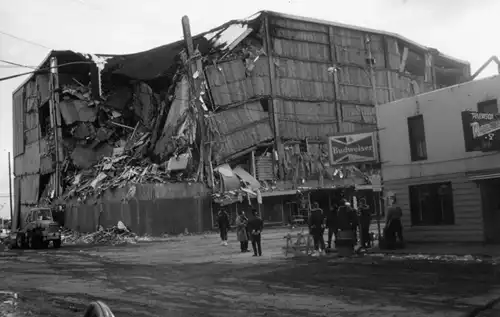
The largest landslide in Anchorage occurred along Knik Arm between Point Woronzof and Fish Creek, causing substantial damage to numerous homes in the Turnagain-By-The-Sea subdivision. Courtesy of Wikipedia

J.C. Penney Department Store at Fifth Avenue and D Street, Anchorage District, Cook Inlet Region, Alaska, 1964. Courtesy of USGS

It was on this day in 1964 that a massive 9.2 earthquake in Southcentral Alaska.

The massive quake at 5:36 pm on March 27th caused much devastation throughout the region and generated a huge tsunami that inundated many communities in the region.

The quake was the largest in the history of the United States and initially killed 15 people while the resulting tsunami killed an additional 100 people in the new state and another 13 in California as well as five in Oregon.

Advertisement

The megathrust earthquake endured for four minutes and thirty-eight seconds and ruptured over 600 miles of fault and moved up to 60 feet in places.

The deadly quake occurred 15 and a half miles deep 40 miles west of Valdez and generated a ocean floor shift that created a wave 220 feet high.

As many as 20 other smaller tsunamis were generated by submarine landslides.


Source link

Advertisement
Continue Reading

Alaska

Opinion: Alaska’s public schools were once incredible. They can be that way again.

Published

on

Opinion: Alaska’s public schools were once incredible. They can be that way again.


(iStock / Getty Images)

I grew up greeting friends and neighbors on my walk to my neighborhood Anchorage public school, just as my kids do now. It’s an essential, and value-added, part of living in our community.

In the late 1990s, when I attended Service High School, I had amazing teachers. My AP chemistry teacher left the oil and gas industry to teach. He could have earned significantly more money in another field, but teaching was competitive enough, given pensions and compensation, that he stayed in the job he loved and gave a generation of students a solid foundation in chemistry.

Now, my kids, who are in first, third and fifth grade, face a different reality. Teachers across our state are leaving in droves. Neighborhood schools across Alaska are closing. Art and music are being combined, which is nonsensical — they are not the same and they are both valuable independently. When he was in second grade, my oldest had a cohort of more than 60 students in his grade — split between two teachers. When he enters sixth grade next year, there will be no middle school sports and he will lose out on electives. Support systems and specialists to help when kids are falling behind have been cut. I’m lucky that my children have had amazing teachers, but many excellent teachers are nearing retirement age or don’t have a pension and are pursuing other careers. What happens then?

Despite skyrocketing inflation, last year was the first time in years that our schools received a significant increase in the Base Student Allocation — and that money doesn’t begin to make up for what they have lost over the years. Even that increase had to overcome two vetoes from what a recent teacher of the year calls “possibly the most anti-public education governor in the history of Alaska.” Shockingly, my own representative, Mia Costello, despite voting for the increase, failed to join the override to support education. She has failed to explain that decision when asked.

Advertisement

State spending on corrections is up 54% since 2019; meanwhile, spending on education is up only 12% in the same timeframe. Schools are now working with 77% of the funding they had 15 years ago when accounting for inflation.

When we starve our public schools of funding, Alaska families leave. No one wants their child to suffer from a subpar education and the lower test scores and opportunities that come with it. A significant number of people are working in Alaska but choosing not to raise their families here.

To the elected officials who preach school “choice” but starve public schools: our family’s choice is our neighborhood school. It’s our community. It’s where our friends are. Neighborhood public schools, which are required to accept all children, should be the best option out there. Public schools should be a good, strong, viable option for communities and neighborhoods across our great state. Once, they were.

I am thankful for those in the Legislature working to solve these problems. This includes HB 374, which raises the BSA by $630, and HB 261, which would make education funding less volatile.

It breaks my heart that across the state, dedicated teachers keep showing up for our kids while being underpaid and undervalued. Underfunding our schools is also a violation of Alaska’s constitution, which requires “adequate funding so as to accord to schools the ability to provide instruction in the standards.”

Advertisement

Not so long ago, Alaska’s public schools were adequately funded, and they produced well-educated students and retained excellent teachers. It’s up to all of us to reach out to our elected officials and urge them to make that the case once again.

Colleen Bolling is a lifelong Alaskan and mother of three who cares deeply about Alaska’s schools.

• • •

The Anchorage Daily News welcomes a broad range of viewpoints. To submit a piece for consideration, email commentary(at)adn.com. Send submissions shorter than 200 words to letters@adn.com or click here to submit via any web browser. Read our full guidelines for letters and commentaries here.


Source link

Advertisement
Continue Reading

Trending