West
Alaska faces teacher shortage as education funding debate dominates legislature

Cory Hughes moved to a remote Alaska village to teach and would happily stay and retire there if he could afford to — despite the dark winters and the fact the bathroom for his housing unit in the school’s kindergarten building has a sink that comes to his knees.
But Alaska is the only U.S. state that does not offer teachers a pension, and researchers say teacher pay and benefits have not kept up with other states. Hughes has bought a house in Ohio and he’s wondering how long he can remain in Nunapitchuk, the southwest Alaska village with a population of 525 he has come to love.
“I’ve taught for seven years, and my retirement wouldn’t even last me, like, a few months,” said Hughes, 28. “So I know that my time here is going to have to come to an end at some point, probably sooner than later.”
WHAT IS ALASKAPOX? FIRST FATALITY REPORTED FROM ANIMAL-BORNE VIRUS, LIKELY CONTRACTED FROM STRAY CAT
School funding is dominating the Legislature as lawmakers meet nearly 1,000 miles away in Juneau. Districts are facing teacher shortages and, in some cases, multimillion-dollar deficits. They say unpredictable levels of state support tied in part to Alaska’s fluctuating oil wealth make long-term planning nearly impossible.
Schools have had to cut programs, increase class sizes or have teachers and administrators take on extra roles. Hughes was tapped to help coach basketball, a sport he had not played.
Teacher turnover is nothing new, and Alaska is not alone in struggling to fill positions. But the effects can be acute in high-cost, hard-to-reach communities that rely on barges or planes for supplies, places so remote they sometimes have polar-bear patrols to keep residents safe. Eggs can cost more than $9 a dozen in some areas.
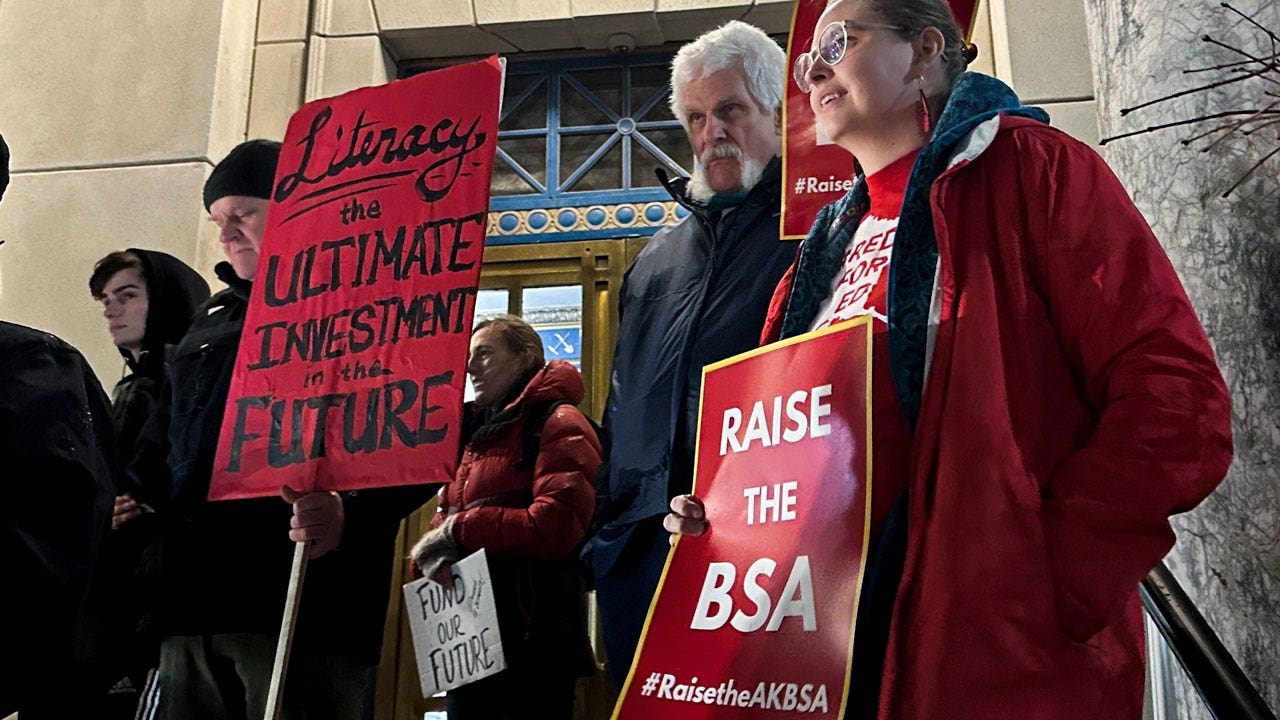
People rally outside the Alaska Capitol on Jan. 29, 2024, in Juneau, Alaska, in support of increased funding for public schools in the state. (AP Photo/Becky Bohrer)
Republican Alaska Gov. Mike Dunleavy, a former educator, is promoting charter schools and a three-year program that would test whether paying teachers annual bonuses of $5,000 to $15,000 keeps them on the job — with higher amounts going to those in the most remote districts.
Dunleavy questions whether simply bolstering state aid to K-12 schools will turn around Alaska’s dismal performance in reading and math assessments. Alaska led the country in the share of students who missed at least 10% of the 2021-22 school year, and there has been an increase in the number of kids who are homeschooled since the pandemic.
School officials aren’t necessarily opposed to the bonus idea but say districts simply don’t have the resources they need. They are seeking a large, permanent increase in the state’s per-student funding formula to counter the toll of inflation and high energy and insurance costs.
“We can’t improve things if we’re always scrambling for crumbs,” said Erica Kludt-Painter, superintendent in the fishing community of Petersburg. Her district’s budget has been augmented by federal and grant funds but is now “at the breaking point,” she said.
Alaska residents get a yearly check from the state’s oil-wealth fund, and there’s no personal state income tax. Those are often billed as perks, but lawmakers over the last decade have struggled with budget deficits tied to the volatility of oil prices. They have had little appetite for considering new taxes as the state has continued drawing down savings and relying on oil-wealth-fund earnings to help pay the bills.
Even some lawmakers sympathetic to school officials’ pleas question whether the roughly $360 million more they are seeking is politically realistic. The state provided about $1.3 billion to K-12 school districts for the current budget year. Lawmakers approved a one-time, $175 million boost, but Dunleavy vetoed half that.
Some districts, including Alaska’s largest in Anchorage, have been recruiting teachers from overseas. A group that’s been involved in past litigation against the state over the adequacy of school funding is weighing another lawsuit.
The state Senate passed a bill to reinstate pensions — nearly 20 years after lawmakers closed the system — but its prospects are unclear. Majority House Republicans have proposed legislation that includes Dunleavy’s bonus plan, charter provisions and a roughly $80 million increase in aid through the formula. The bill could come up for a vote this week amid objections the proposed funding is not enough.
“It’s not rocket science in the sense that it is a combination of compensation and working conditions that attract and keep teachers in schools,” said Dayna DeFeo, director of the Center for Alaska Education Policy Research. “We can’t just buy our way out of it, but that is definitely going to have to be a part of it.”
Hughes was seeking adventure and a “different view of the world” when he became a social studies teacher at a K-12 school in Nunapitchuk about seven years ago. He saw the central role schools play in such small communities when he was invited to a funeral at the school the day after he arrived.
He immersed himself in the predominantly Alaska Native village’s culture to avoid feeling isolated, especially during what he described as a “make or break” first year in rural Alaska. He enjoys the hunting and fishing lifestyle.
There are challenges: the school is near the top of a state list for major reconstruction needs. The village faces threats from climate change. Thawing permafrost is undermining infrastructure.
It’s unclear whether the proposed bonuses aimed at full-time teachers would apply to Hughes. While he supervises some online classes, he is currently the dean of students. He doesn’t have the degree to be an administrator and is paid as a teacher, he said.
Independent Rep. Rebecca Himschoot, a retired teacher from Sitka in southeast Alaska, said lawmakers should figure out how to pay for what districts say they need. Otherwise, schools may not be able to offer athletics, art, theater or other aspects of a well-rounded education.
“What is the school system we want to have?” Himschoot said. “Because we’re really quickly headed for the school system that doesn’t offer the opportunities that people in my generation all had.”
Read the full article from Here


SALT LAKE CITY — The United States is often considered among the best countries to go road tripping, each state offering its own unique experience. With beauties dotting the country, such as Glacier, Yosemite, Zion and Great Smoky Mountains national parks, the 50 states each offer something different to attract visitors.
And according to a new WalletHub study, Utah is the second-best state in the nation in which to pack up the car and drive.
“Taking a summer road trip can be a very exciting way to experience a new place, but with the prices of gas, food and accommodations still impacted by inflation, you’ll want to be in a state that makes this type of vacation affordable,” according to WalletHub analyst Chip Lupo.
“Safe roads are also key, and so is having plenty of worthwhile attractions to stop at along the road. The best states for summer road trips, therefore, are those that keep costs low while providing the best driving experience and most fun activities.”
Why Utah is ranked so high
Coming in as the top road-tripping state is Minnesota due to its relatively cheap cost and its high spending on parks and recreation. But Utah comes in second for its “breathtaking scenery, outdoor recreation and safe driving conditions,” according to WalletHub.
While Utah ranks 34th in the country in terms of costs, the state makes up for it in road safety. Utah ranks in the top 10 for least amount of car thefts per capita and is fourth in fewest fatalities per 100 million miles driven.
Cumulatively, Utah is the sixth safest state to road-trip in.
Also boosting its rating are its amusement parks, where Utah ranks seventh.
The top five states for road trips include:
- Minnesota
- Utah
- Louisiana
- New York
- Florida
The bottom five round out to:
- Maryland
- California
- Connecticut
- Delaware
- Rhode Island
The ‘Mighty Five’ and Utahraptor State Park
If you come for activities like amusement parks and zoos, Utah has you covered with Lagoon and Utah’s Hogle Zoo, accompanied by a plethora of water parks. However, Utah is perhaps best known for its stunning natural formations.
Boasting the second most national parks in the mainland U.S., only behind California’s nine, Utah’s five national parks make for a no-brainer trek. Starting at Canyonlands National Park, you can hit Arches National Park and Utah’s newest park, Utahraptor State Park, in a matter of 35 miles, give or take.
From Utahraptor State Park, another two hours will take you to Capitol Reef National Park, two more hours brings you to Bryce Canyon National Park and another two will land you in the second most visited national park in the country, Zion National Park.
In roughly seven hours of driving, travelers can cross five national parks off their bucket list while witnessing the scenic stretch from eastern Utah to the southwest part.
Utah also has the second-highest spending per capita on parks and recreation, and there are plenty of state parks to check out while in the desert state.
Utahraptor State Park
If you are a dinosaur enthusiast, Utahraptor State Park is a great place to stop. Officially opened to the public in May 2025, the park features one of the largest bone beds with over 5,500 fossils discovered, representing more than 10 different species at Dalton Wells Dinosaur Quarry.
Among the species is the Utahraptor, which spans 20 feet long and stands 5 feet tall, estimated to weigh 1,000 pounds.
The park also features various sites where you can see ancient tracks embedded in the sandstone, made by theropods, sauropods, ornithopods and even prehistoric crocodiles.
You can discover more at the park website.
Road trip tips
As the U.S. experiences brutal prices at the pump, which are also affecting the prices of other various services like food, it is even more important to plan ahead.
“If you want to make your money stretch, you have to ditch the luxury mindset and channel your inner 19-year-old on a broke, wild mission,” Lynn University associate professor Andrew Burnstine told WalletHub.
Here are some tips experts gave:
- Plan ahead.
- Look for local deals.
- Bring snacks from grocery stores.
- Download apps to track down cheap fuel.
- Bypass highway tourist traps.
- Use campsites instead of hotels.
- Check into hotels on the outskirts if a bed is a must.
- Keep tires inflated.
- Keep trunk light.
These are simple tips for making your trip financially less burdensome, but “even these small savings can make a visible difference by the end of a trip,” said Minnesota State University Moorhead professor Wooyang Kim, per WalletHub.
The Key Takeaways for this article were generated with the assistance of large language models and reviewed by our editorial team. The article, itself, is solely human-written.

CASPER, Wyo. — Sunday is here, and it’s the perfect day to relax, recharge and reinvigorate so that you’re ready for the upcoming week. It’s also the perfect day for some morning yoga, or to go to the carnival! From a BBQ Cook-off event to the CWFR, this is what’s happening on Sunday in the Oil City.
The Oil City Daily Event Guide is sponsored by Central Wyoming Fair & Rodeo.
Start off your Sunday in a great way with Sunrise Yoga at David Street Station, beginning at 7:30 a.m.
“Sunrise Yoga is the perfect way to start your mornings with some care for your body!” the event page states. “Yoga will start at 7:30 a.m. and go till 8:30 a.m. Each morning will have a different instructor and we will have more details on that soon.”
Happening Sunday at 7:30 a.m.

The Central Wyoming Fair and Rodeo is hosting its annual Open Class BBQ Contest on Sunday, beginning at 4 p.m.
“Celebrate great food, friendly competition, and community pride during the Open Class BBQ Contest at the Central Wyoming Fair & PRCA Rodeo as part of the 250th Celebration of America,” the event page states. “Open to the public, participants are invited to bring their best prepared BBQ meats to the Industrial Building at the Central Wyoming Fairgrounds on Sunday, July 5, 2026, for judging at 5 p.m. Contest categories include beef, chicken, fish, lamb, pork, seafood, and wild game. Entries will be judged on appearance, tenderness/texture, and taste by the committee. While this event is not a public tasting, it’s a great opportunity for BBQ enthusiasts to showcase their skills and be part of the Fair’s ‘Celebrating America’s Spirit festivities.”
Happening Sunday at 4 p.m.
Don’t see an event on the calendar? Add it! Click here, add your details and submit to let Casper know all about it.

It’s fair week! The Central Wyoming Fair and Rodeo is back at the Central Wyoming Fairgrounds, and the entire community is invited.
“The all new Amusement Midway Providers has a combined 100+ years providing safe family fun and entertainment,” the event page states. “We provide carnival rides, games, and food to fairs, festivals and celebrations across the southern states and areas of the Midwest. With all of the fun and activities, guests of all ages can enjoy the excitement. Come one, come all to the best time of your lives. Step right up adults and let your inner child out. Enjoy your children’s pure excitement as you create magical memories that will last you a lifetime. We strive to bring you the best of the best. Safety is a top priority at Amusement Midway Providers. All our equipment is well-maintained and conforms to industry standards.”
Happening Sunday at 3 p.m.
Related

-

 South Dakota6 minutes ago
Rapid City to host South Dakota Little League State Tournament
-

 Tennessee9 minutes ago
Tennessee Man Reaches For Item At Lowe’s. Then He Runs Into A Surprising New Touchscreen: ‘No Need To Wait’
-

 Texas14 minutes ago
Storms target North Texas ahead of blistering Monday game day heat
-

 Utah21 minutes ago
Utah ranked second-best road-tripping state
-

 Vermont24 minutes ago
Bolstered bloc of Vermont Republicans see bills repealed this year as a win – VTDigger
-

 Virginia29 minutes ago
10 Best Places To Call Home In Virginia In 2026
-

 Wisconsin39 minutes ago
What anonymous Big Ten coaches are saying about Wisconsin football entering 2026
-

 West Virginia44 minutes ago
Ex-WVU Guard Kerr Kriisa Arrested by FBI in Alleged Fraud Scheme

