Sports
With Winter Olympics host options fading, Salt Lake City in line for 2034 — and beyond?


SALT LAKE CITY — Lindsey Vonn was 17, awestruck by her competition and feeling the weight of her first Olympic Winter Games experience. Before she went on to become one of the most decorated alpine skiers in the history of the sport, Vonn was just a kid hoping to stay on the course when she made her Olympic debut at the 2002 Games in Salt Lake City 22 years ago. She finished sixth in the combined event and 32nd in slalom.
The impact of her experience in Utah all that time ago stuck with her throughout the ensuing years of gilded dominance. So much so that she kept coming back whenever she could. Before she retired in 2019, after a series of serious knee injuries, home was the suitcase she carried as she trotted the globe. Still, when asked where her home base was, she’d mention a series of places, and always made sure to include Utah.
Vonn, now 39, is part of the Salt Lake City-Utah Committee for the Games. And with the International Olympic Committee seemingly on the doorstep of awarding the Beehive State the 2034 Winter Games, its second Olympics, Vonn believes the model for sustainability for the spectacle held every four years is to move toward a rotational approach. And she said Salt Lake City should be atop the list.
“I think in this day and age, it’s not a feasible blueprint anymore,” Vonn told The Athletic recently. “We need to have a more sustainable option, and I think Salt Lake is the best Olympic option that is available to the world right now.”
The future of the Winter Games is clouded by governing bodies balking at being asked to spend billions of dollars on venues that will not be utilized after the three-week event comes to a close. Climate change has eradicated potential hosts from the map as snow levels drop in many countries worldwide. The IOC can no longer act with the assumption that the Winter Games are going to be a tantalizing endeavor for potential host cities, or even feasible to stage in many parts of the world.
Gone are the days when the IOC wished for cities and countries to openly compete with one another in hopes of receiving the bid. Now, the IOC features a future host commission that tours potential hosts and forwards its data and reports to the IOC executive board, who then decide whether or not to bring their suggestion to a vote at an IOC session.
The IOC’s future host commission recently spent a week in Utah on an official visit to tour venues and hear the pitch that the SLC-Utah Committee had to bring the Games back.
“This is a hidden treasure, this city and this region,” said Olympic Games executive director Christophe Dubi. “The rest of the world have memories of 2002, but this place has profoundly changed. This story needs to be told.”
A quick Google search shows the condition of former state-of-the-art Olympic venues that are now dormant homes to rodents, weeds and pooled water.
In Rio de Janeiro, the aquatic center built for the 2016 Summer Games was left as a hollowed-out stadium. The 35,000-seat Olympic Stadium erected for the Opening and Closing Ceremonies in Pyeongchang, South Korea, is now just a mound of grass in the shape of an amphitheater — an empty one. In total, South Korea spent an estimated $13 billion for the 2018 Winter Games.
In Tokyo, the gymnastics center constructed for the 2020 Summer Games is unused and surrounded by empty parking lots and gates with the same signs still hanging with directions to get in. It was paid for by the Tokyo taxpayers and cost an estimated $180 million.
A so-called “white elephant” property requires exorbitant expenses and plenty of upkeep, and it has little-to-zero value as soon as it’s finished. They are littered throughout cities around the globe. Hosting an Olympics was once perceived to be the utmost prestigious honor in sports, but residents of prospective cities have gotten wise to the waste of taxpayer money.
But it hasn’t been a waste in Salt Lake City. The venues have been maintained and used again and again for the last 22 years.
The Olympic Oval west of downtown has hosted World Cup and World Championship speed skating events. The Utah Olympic Park in Park City has remained in the rotation for World Cup and World Championship bobsled, luge and skeleton events, too. The Soldier Hollow Nordic Center, which is 45 minutes away in the Heber Valley, has continued to host cross-country ski and biathlon events. And the various ski resorts within an hour of downtown have remained stops for world-class freestyle skiing and snowboard competitions. Over 90 World Cup and World Championship Winter Olympic events have been held in Utah since 2002.
“It is really great to see that we are not looking for white elephants in the countryside — we found just used, excellent venues for the next Winter Olympic Games,” said Karl Stoss, IOC’s future host commission chair.
Deemed “climate-reliable” and boasting ready-to-go venues, Salt Lake City is the leading candidate to host the 2034 Winter Olympics, just 32 years after hosting in 2002. (Tim De Waele / Getty Images)
After the 2002 Games, the Utah Olympic Legacy Foundation assumed responsibility for maintaining and operating the venues. The foundation received a $76 million endowment after the Games. With options worldwide dwindling for the IOC, Utah’s Olympic legacy makes it not only a logical option to return in 2034, but beyond.
“We have all the infrastructure. We have all the venues. We have the right altitude. We can be economically smart with how we host a Games,” Vonn said. “It’s a much different endeavor when you have to build basically an entire Olympic Stadium for all your sports. It’s just not how it’s usually approached. With that, it’s clear why we are the best choice for 2034 and beyond.”
During the IOC delegation’s stop, Stoss said Salt Lake City and Utah are a model for other future hosts around the world.
“We have to think about how to bring winter sports to all the continents, not just here to the Americas,” Stoss said. “This will be a challenge for us to think about how we could motivate other nations and other national committees to participate in the Winter Games.”
While Salt Lake is all but confirmed to be the host in 2034, the IOC future host commission still hasn’t decided on the 2030 host. The French Alps are currently in pole position. The IOC delegation said during their visit that finding suitable hosts for the Winter Games is going to be more tenuous in the coming decades, and IOC president Thomas Bach said last year that by 2040 there will be as few as 10 countries with an appropriate climate. The IOC had to settle on Beijing for the last Winter Games, in 2022, with many of the venues anywhere from 45 to 75 miles away.
“There’s a possibility to think wider now,” said Jacqueline Barrett, future Olympic Games hosts director for the IOC, “to think how could the Olympic Winter Games here in 2034 be transformative.”
Utah’s Olympic organizers utilized the phrase “ready, willing and able” as far back as 2015. They were even standing at the ready in case a bid fell through in recent years. Everything is in place. And the reality is, from a Winter Games perspective, Utah may be 1-of-1.
Salt Lake City-Utah Committee CEO Fraser Bullock has estimated that the cost of the 2034 Games will be roughly $2.4 billion and will not be utilizing taxpayer dollars, but instead be privately funded.
The IOC likely won’t find that anywhere else in the world, and the governing body has acknowledged that it is considering the scenario of a rotational host system going forward.
“I think that’s definitely where things are going,” Vonn said.
While Utah does have a full head of steam and all the leverage with the IOC at the moment, there are issues facing the state’s residents.
Stoss said he’s read climate reports from the SLC-Utah Committee stating it could host Winter Games through 2050, but beyond that is a question, not only for Utah but the world. The Great Salt Lake is shrinking due to climate change, experts say. It’s a potential ecological disaster should the largest saltwater lake in the Western Hemisphere continue to dwindle. Despite back-to-back hefty winters to help raise water levels, the Utah legislature has spent roughly $1 billion on water conservation to help the lake.

“I think Salt Lake is the best Olympic option that is available to the world right now,” says Lindsey Vonn, the champion skier now part of the SLC-Utah Committee. (Tim De Waele / Getty Images)
On top of that, with winter storms becoming less frequent, the Wasatch Front — the towns, including Salt Lake City, that make up the growing sprawl at the foot of the white-capped Wasatch Mountains — is prone to winter inversions that trap pollutants in a thick dense smog that often hovers over the area. Part of the bid for the Games from organizers includes goals to achieve 100 percent renewable energy by 2030 and reduce CO2 emissions by 50 percent.
While taxpayer dollars aren’t currently expected to go toward paying for the cost of the 2034 Games itself, the continual growth Salt Lake City is undergoing is expected to bring more changes on the sports front. Utah Jazz owner Ryan Smith recently purchased the rights to relocate the Arizona Coyotes for an estimated $1.2 billion. The Utah legislature has passed a $1 billion taxpayer bill that will, according to Salt Lake Mayor Erin Mendenhall, transform the downtown community and help house the NBA’s Utah Jazz and the NHL team.
In a recent interview with The Athletic, Smith said his decision to bring the NHL to Utah was the same as his home state wanting to bring the Olympics back for a second go-round.
“If you think about the Olympics and the way Salt Lake bid on the Olympics, it’s very much the same way,” he said. “We’re interested. We’re ready. And we’re a partner.”
Stoss and the IOC delegation will spend the next two months working on their report on Salt Lake City and present their report to the IOC executive committee in mid-June. Stoss hopes then they’ll be greenlit to bring it to the IOC session in July in Paris to finalize the worst kept secret around: that the Winter Games are bound for Utah once more. Bullock had his best poker face on at the conclusion of the visit.
“We look forward to July 24,” Bullock said.
(Top photo of American skier Picabo Street starting a downhill run at the 2002 Winter Olympics in Salt Lake City: Olivier Morin / AFP via Getty Images)



Sports
‘Quad God’ Ilia Malinin avenges Olympic disappointment with backflip for third straight world title

NEWYou can now listen to Fox News articles!
It seems like Ilia Malinin, the “Quad God,” has done a nice job of moving on from his Olympic heartbreak.
Last month, the 21-year-old Team USA star was the overwhelming favorite to bring home the gold in the men’s free skate. But the unimaginable happened as he fell twice and dropped all the way to eighth place.
However, he has begun to avenge the loss and is now a three-time world champion.
Ilia Malinin from the United States competes during the men free skating at the Figure Skating World Championships in Prague, Czech Republic, Saturday, March 28, 2026. (AP Photo/Petr David Josek)
Malinin shouted and punched the air with relief after finishing a skate that showed he had achieved his desire to “move on” from the Olympics after days of being tormented by his mistakes.
Malinin scored 218.11 in the free skate for a total of 329.40, far ahead of silver medalist Yuma Kagiyama of Japan on 306.67. Another Japanese skater, Shun Sato, was third on 288.54.
Malinin was blunt about his Olympic performance when speaking to NBC afterward, saying simply, “I blew it,” and said it was a clear mental hurdle from start to finish.
“I just had so many thoughts and memories flood right before I got into my starting pose, and almost, I think, it maybe overwhelmed me a little bit. I’ve been through a lot in my life, a lot of bad and good experiences,” Malinin told reporters.
Gold medalist Ilia Malinin from the United States waves to spectators after the medal ceremony after the men’s free skating at the Figure Skating World Championships in Prague, Czech Republic, Saturday, March 28, 2026. (AP Photo/Petr David Josek)
LINDSEY VONN KEEPING RETURN TO SKIING ON TABLE DESPITE INJURIES: ‘I DON’T LIKE TO CLOSE THE DOOR ON ANYTHING’
“So, I just feel like it’s the pressure of especially being that Olympic gold medal hopeful. It was just something I can’t control now. The pressure of the Olympics, it’s really something different, and I think not a lot of people understand that. They only understand that from the inside and going into this competition, especially today, I felt really confident, really good,” he added. “But it really just went by so fast I did not have time to process.”
But with some pressure off, Malinin was able to show who he truly is on the ice.
Gold medalist, Ilia Malinin from the United States waves before the medal ceremony after the men’s free skating at the Figure Skating World Championships in Prague, Czech Republic, Saturday, March 28, 2026. (AP Photo/Petr David Josek)
Malinin becomes the first skater to win three consecutive men’s world titles since fellow American Nathan Chen, who achieved the feat in 2018, 2019 and 2021 after the 2020 event was canceled because of the COVID-19 pandemic.
Fox News’ Jackson Thompson and The Associated Press contributed to this report.
Follow Fox News Digital’s sports coverage on X, and subscribe to the Fox News Sports Huddle newsletter.
Sports
Ilia Malinin bounces back from Olympic nightmare to win third straight world figure skating title
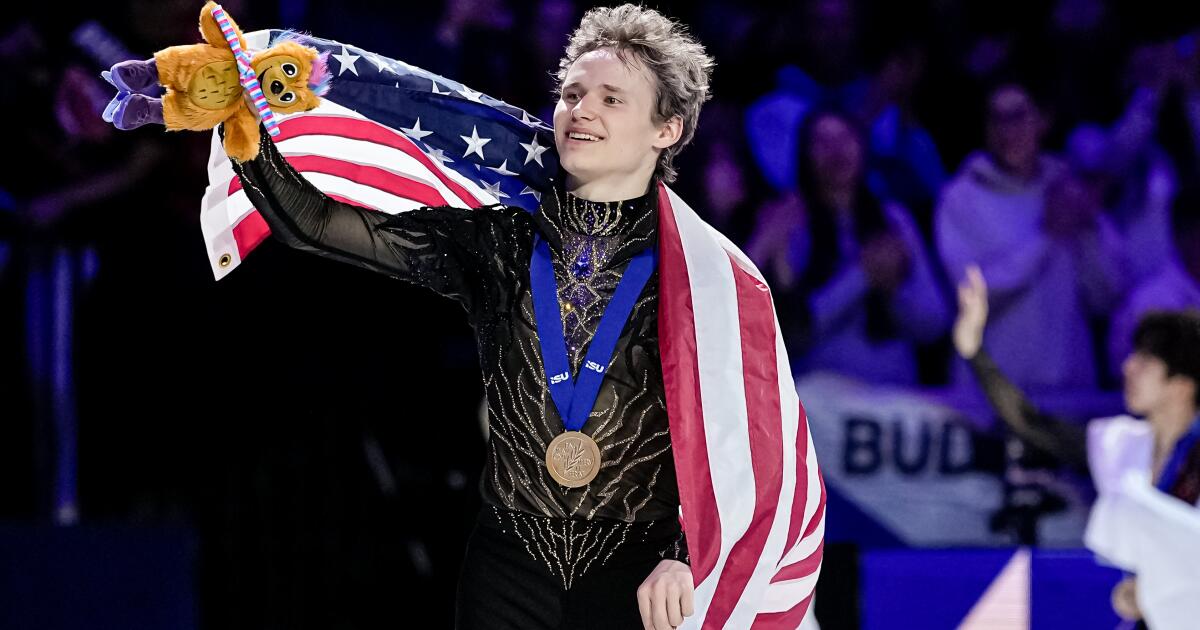
PRAGUE — Ilia Malinin is back on the top step of the podium.
Six weeks after a disastrous skate knocked the Olympic gold-medal favorite off the podium, the “quad god” reeled off one huge jump after another, and a backflip for good measure, to retain his world championship title for the third year running.
Malinin shouted and punched the air with relief after finishing a skate that showed he had achieved his desire to “move on” from the Olympics after days tormented by his mistakes.
He praised the crowd’s support, saying: “It was really challenging, really hard but with you guys I was able to make it through.” His aim, he added, had simply been to get through the free skate “in one piece.”
Skating last after leading the short program, just as he did in Milan, Malinin landed five high-scoring quadruple jumps but not his pioneering quad axel, a jump he didn’t attempt at the Olympics.
Malinin scored 218.11 in the free skate for a total 329.40, far ahead of silver medalist Yuma Kagiyama of Japan on 306.67. Another Japanese skater, Shun Sato, was third on 288.54.
Ilia Malinin performs a backflip during his free skate at the World Figure Skating Championships on Saturday in Prague.
(Petr David Josek / Associated Press)
Kagiyama beat his personal-best free skate score but still had to make do with a fourth career world championship silver in a career which includes four Olympic silvers and five total worlds medals, but no gold from either event. He still embraced Malinin after his skate and they jumped together in celebration.
In a showcase of top-level skating, there was no podium spot for France’s Adam Siao Him Fa, who had been in second after the short program but dropped to fifth overall after a fall. Estonia’s Aleksandr Selevko also fell dropped from third to sixth.
Malinin had no rematch with Mikhail Shaidorov, the skater from Kazakhstan who won the Olympic gold, because he opted against competing again this season.
That’s relatively common in figure skating for gold medal winners who face a rush of media and commercial opportunities after a grueling four-year Olympic buildup.
Malinin becomes the first skater to win three consecutive men’s world titles since fellow American Nathan Chen, who achieved the feat in 2018, 2019 and 2021 after the 2020 event was canceled because of the COVID-19 pandemic.
The last competition of the championships is the free dance portion of the ice dance event later Saturday. France’s Laurence Fournier Beaudry and Guillaume Cizeron are in the lead after Friday’s rhythm dance.

NEWYou can now listen to Fox News articles!
Tiger Woods was released from jail Friday night after he was arrested earlier in the day on a DUI charge following a car crash in Florida.
In a mugshot released hours after his arrest, Woods’ eyes appeared bloodshot, as he donned a blue polo inside the Martin County Jail in Florida.
Woods was seen leaving the jail in the passenger seat of a black SUV after his release on bail late Friday, according to The Associated Press.
Martin County Sheriff John Budensiek confirmed in a news conference that Woods was traveling at “a high rate of speed” when his vehicle collided with another car, resulting in his vehicle rolling over onto the driver’s side.
Tiger Woods was booked into Martin County, Florida, jail on March 27, 2026. (AP)
Authorities said Woods “exemplified signs of impairment.” He blew “triple-zeroes” for alcohol but refused a urine test.
“DUI investigators came to the scene here, and Mr. Woods did exemplify signs of impairment. They did several tests on him. Of course, he did explain the injuries and the surgeries that he had. We did take that into account, but they did do some in-depth roadside tests,” Budensiek added.
“We really weren’t suspicious of alcohol being involved in this case, and that proved to be true at the jail. … But when it came time for us to ask for a urinalysis test, he refused. And, so, he’s been charged with DUI, with property damage and refusal to submit to a lawful test.”
Woods was spotted on the phone after the crash, wearing navy blue shorts.
Woods was charged with DUI, property damage and refusal to submit to a test, all misdemeanor charges. No one was injured, authorities said. Woods was alone in the car and crawled out of the passenger door after the crash.
Tiger Woods was driven from the Martin County Jail after being arrested for driving under the influence following a car crash on March 27, 2026, in Stuart, Florida. (Joe Raedle/Getty Images)
VANESSA, KAI TRUMP TAKE IN TIGER WOODS’ RETURN TO GOLF AT TGL FINALS
“This could’ve been a lot worse,” Budensiek noted.
President Donald Trump commented on the arrest of his “very close friend.”
“I feel so badly. He’s got some difficulty,” Trump said. “There was an accident, and that’s all I know. Very close friend of mine. He’s an amazing person, an amazing man, but some difficulty.”
Woods has not commented on the arrest.
Tiger Woods was arrested on a DUI charge after getting into a car crash on Friday. (Associated Press)
Woods currently is dating Trump’s ex-daughter-in-law, Vanessa, whose daughter, Kai, is set to play college golf in Miami next week.
This is Woods’ second DUI arrest within the last decade. In 2017, he was taken into custody, also in Jupiter Island, after taking prescription drugs and being asleep behind the wheel of a running car at 3 a.m.
In 2021, he got into a wreck that resulted in serious leg injuries that kept him off the golf course for the entire year.
Golfer Tiger Woods stands by his overturned vehicle in Jupiter Island, Fla., Friday, March 27, 2026. (Jason Oteri/AP)
Woods made his return to competitive golf earlier this week in the TGL championship after rupturing his Achilles just before last year’s Masters (this year’s tournament is in less than two weeks). Woods has not appeared on the links since the 2024 PGA Championship, in which he missed the cut.
Follow Fox News Digital’s sports coverage on X, and subscribe to the Fox News Sports Huddle newsletter
‘Wait Wait’ for March 28, 2026: Live in Savannah with D.W. Moffett

Suno leans into customization with v5.5

Body found in search for missing American Airlines flight attendant in Colombia: mayor

Jeffries declines to break with indicted Democrat after ethics panel’s guilty verdict

Most Americans are doing one nightly activity that’s wrecking their sleep, expert says

Florida High School Football Rankings: Top 25 teams – Oct. 21

How old is Bo Nix? What to know about Oregon quarterback ahead of 2024 NFL Draft

Cleary's 21 help Le Moyne down Central Connecticut State 69-64 in OT

99th annual Pony Swim held in Virginia

Indiana Members Credit Union announced as new anchor tenant at Bottleworks District
Jeffries declines to break with indicted Democrat after ethics panel’s guilty verdict

Hundreds of thousands march through London in stand against the far right

2 students killed, 7 other people injured in Tennessee bus crash during school field trip

Dem senators dodge crucial question on illegal alien accused of killing Chicago college student

EU Parliament unblocks key political hurdle in digital euro talks
-

 Detroit, MI1 week ago
Drummer Brian Pastoria, longtime Detroit music advocate, dies at 68
-

 Movie Reviews1 week ago
‘Youth’ Twitter review: Ken Karunaas impresses audiences; Suraj Venjaramoodu adds charm; music wins praise | – The Times of India
-

 Sports1 week ago
IOC addresses execution of 19-year-old Iranian wrestler Saleh Mohammadi
-

 New Mexico6 days ago
Clovis shooting leaves one dead, four injured
-
 Business1 week ago
Disney’s new CEO says his focus is on storytelling and creativity
-

 Tennessee5 days ago
Tennessee Police Investigating Alleged Assault Involving ‘Reacher’ Star Alan Ritchson
-

 Technology6 days ago
YouTube job scam text: How to spot it fast
-

 Texas1 week ago
How to buy Houston vs. Texas A&M 2026 March Madness tickets