Sports
Washington fends off Texas in thrilling half, advances to CFP National Championship


The Pac-12 is going out with a bang.
Months after the storied conference disintegrated due to conference realignment, the Washington Huskies will play for the national championship against Michigan after defeating Texas 37-31 on Monday night.
Jalen McMillan #11 of the Washington Huskies celebrates with teammates after a touchdown during the third quarter against the Texas Longhorns during the CFP Semifinal Allstate Sugar Bowl at Caesars Superdome on January 01, 2024 in New Orleans, Louisiana. (Jonathan Bachman/Getty Images)
The Longhorns’ late rally in the fourth quarter was a valiant effort led by quarterback Quinn Ewers, but Washington was able to pull away behind Michael Penix Jr.’s dominating performance in the second half.
The Heisman Trophy finalist finished 29 of 38 for 430 passing yards and two touchdowns.
Both teams exchanged touchdowns in the first half to start the third quarter tied at 21. Washington then pulled ahead with Penix’s 19-yard touchdown pass to Jalen McMillan and Grady Gross’ two successful field goal attempts of 26 and 40 yards.
Texas clawed their way back to a six-point deficit. A string of penalties by Washington would get the Ewers within reach of the endzone, but after four attempts, including a batted down ball by cornerback Elijah Jackson, the Huskies move on in search of their first national championship since 1991 and the Pac-12’s first since 2004.
Elijah Jackson #25 of the Washington Huskies breaks up a pass to Adonai Mitchell #5 of the Texas Longhorns on the final play of the CFP Semifinal Allstate Sugar Bowl at Caesars Superdome on January 01, 2024 in New Orleans, Louisiana. (Jonathan Bachman/Getty Images)
MICHIGAN RALLIES BACK, ADVANCES TO CFP NATIONAL CHAMPIONSHIP WITH OVERTIME VICTORY OVER ALABAMA
The win comes as the Pac-12 prepares for a new look. Washington is one of 10 schools leaving the conference for other Power Five conferences next year, with the Huskies headed to join Michigan in the Big Ten.
But first, Washington will face off against the undefeated Wolverines in the CFP National Championship in Houston, Texas on Jan. 8 after Michigan outlasted Alabama in the Rose Bowl on Monday.
Michael Penix Jr. #9 of the Washington Huskies and Edefuan Ulofoshio #5 celebrate with the trophy after a 37-31 victory against the Texas Longhorns in the CFP Semifinal Allstate Sugar Bowl at Caesars Superdome on January 01, 2024 in New Orleans, Louisiana. (Sean Gardner/Getty Images)
Senior running back Blake Courm ran for his 56th career touchdown in Michigan’s opening drive of overtime to solidify Big Blue’s place in the championship and became the program’s all-time rushing touchdown leader in the process.
Fox News’ Joe Morgan and The Associated Press contributed to this report.
Follow Fox News Digital’s sports coverage on X and subscribe to the Fox News Sports Huddle newsletter.



Sports
‘Quad God’ Ilia Malinin avenges Olympic disappointment with backflip for third straight world title

NEWYou can now listen to Fox News articles!
It seems like Ilia Malinin, the “Quad God,” has done a nice job of moving on from his Olympic heartbreak.
Last month, the 21-year-old Team USA star was the overwhelming favorite to bring home the gold in the men’s free skate. But the unimaginable happened as he fell twice and dropped all the way to eighth place.
However, he has begun to avenge the loss and is now a three-time world champion.
Ilia Malinin from the United States competes during the men free skating at the Figure Skating World Championships in Prague, Czech Republic, Saturday, March 28, 2026. (AP Photo/Petr David Josek)
Malinin shouted and punched the air with relief after finishing a skate that showed he had achieved his desire to “move on” from the Olympics after days of being tormented by his mistakes.
Malinin scored 218.11 in the free skate for a total of 329.40, far ahead of silver medalist Yuma Kagiyama of Japan on 306.67. Another Japanese skater, Shun Sato, was third on 288.54.
Malinin was blunt about his Olympic performance when speaking to NBC afterward, saying simply, “I blew it,” and said it was a clear mental hurdle from start to finish.
“I just had so many thoughts and memories flood right before I got into my starting pose, and almost, I think, it maybe overwhelmed me a little bit. I’ve been through a lot in my life, a lot of bad and good experiences,” Malinin told reporters.
Gold medalist Ilia Malinin from the United States waves to spectators after the medal ceremony after the men’s free skating at the Figure Skating World Championships in Prague, Czech Republic, Saturday, March 28, 2026. (AP Photo/Petr David Josek)
LINDSEY VONN KEEPING RETURN TO SKIING ON TABLE DESPITE INJURIES: ‘I DON’T LIKE TO CLOSE THE DOOR ON ANYTHING’
“So, I just feel like it’s the pressure of especially being that Olympic gold medal hopeful. It was just something I can’t control now. The pressure of the Olympics, it’s really something different, and I think not a lot of people understand that. They only understand that from the inside and going into this competition, especially today, I felt really confident, really good,” he added. “But it really just went by so fast I did not have time to process.”
But with some pressure off, Malinin was able to show who he truly is on the ice.
Gold medalist, Ilia Malinin from the United States waves before the medal ceremony after the men’s free skating at the Figure Skating World Championships in Prague, Czech Republic, Saturday, March 28, 2026. (AP Photo/Petr David Josek)
Malinin becomes the first skater to win three consecutive men’s world titles since fellow American Nathan Chen, who achieved the feat in 2018, 2019 and 2021 after the 2020 event was canceled because of the COVID-19 pandemic.
Fox News’ Jackson Thompson and The Associated Press contributed to this report.
Follow Fox News Digital’s sports coverage on X, and subscribe to the Fox News Sports Huddle newsletter.
Sports
Ilia Malinin bounces back from Olympic nightmare to win third straight world figure skating title
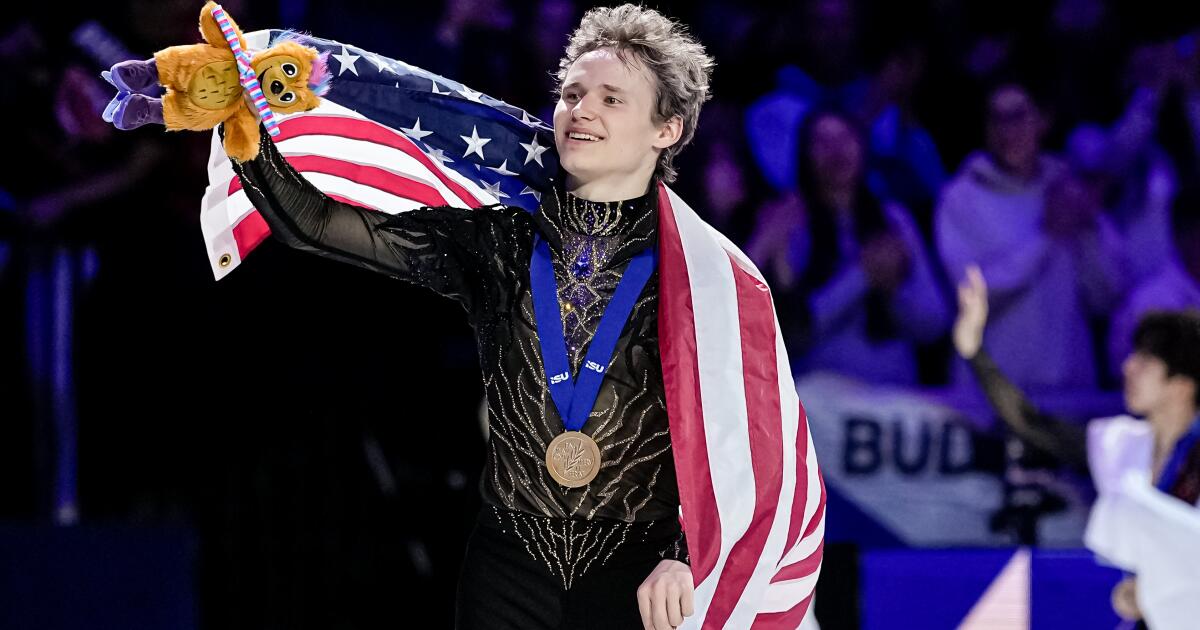
PRAGUE — Ilia Malinin is back on the top step of the podium.
Six weeks after a disastrous skate knocked the Olympic gold-medal favorite off the podium, the “quad god” reeled off one huge jump after another, and a backflip for good measure, to retain his world championship title for the third year running.
Malinin shouted and punched the air with relief after finishing a skate that showed he had achieved his desire to “move on” from the Olympics after days tormented by his mistakes.
He praised the crowd’s support, saying: “It was really challenging, really hard but with you guys I was able to make it through.” His aim, he added, had simply been to get through the free skate “in one piece.”
Skating last after leading the short program, just as he did in Milan, Malinin landed five high-scoring quadruple jumps but not his pioneering quad axel, a jump he didn’t attempt at the Olympics.
Malinin scored 218.11 in the free skate for a total 329.40, far ahead of silver medalist Yuma Kagiyama of Japan on 306.67. Another Japanese skater, Shun Sato, was third on 288.54.
Ilia Malinin performs a backflip during his free skate at the World Figure Skating Championships on Saturday in Prague.
(Petr David Josek / Associated Press)
Kagiyama beat his personal-best free skate score but still had to make do with a fourth career world championship silver in a career which includes four Olympic silvers and five total worlds medals, but no gold from either event. He still embraced Malinin after his skate and they jumped together in celebration.
In a showcase of top-level skating, there was no podium spot for France’s Adam Siao Him Fa, who had been in second after the short program but dropped to fifth overall after a fall. Estonia’s Aleksandr Selevko also fell dropped from third to sixth.
Malinin had no rematch with Mikhail Shaidorov, the skater from Kazakhstan who won the Olympic gold, because he opted against competing again this season.
That’s relatively common in figure skating for gold medal winners who face a rush of media and commercial opportunities after a grueling four-year Olympic buildup.
Malinin becomes the first skater to win three consecutive men’s world titles since fellow American Nathan Chen, who achieved the feat in 2018, 2019 and 2021 after the 2020 event was canceled because of the COVID-19 pandemic.
The last competition of the championships is the free dance portion of the ice dance event later Saturday. France’s Laurence Fournier Beaudry and Guillaume Cizeron are in the lead after Friday’s rhythm dance.

NEWYou can now listen to Fox News articles!
Tiger Woods was released from jail Friday night after he was arrested earlier in the day on a DUI charge following a car crash in Florida.
In a mugshot released hours after his arrest, Woods’ eyes appeared bloodshot, as he donned a blue polo inside the Martin County Jail in Florida.
Woods was seen leaving the jail in the passenger seat of a black SUV after his release on bail late Friday, according to The Associated Press.
Martin County Sheriff John Budensiek confirmed in a news conference that Woods was traveling at “a high rate of speed” when his vehicle collided with another car, resulting in his vehicle rolling over onto the driver’s side.
Tiger Woods was booked into Martin County, Florida, jail on March 27, 2026. (AP)
Authorities said Woods “exemplified signs of impairment.” He blew “triple-zeroes” for alcohol but refused a urine test.
“DUI investigators came to the scene here, and Mr. Woods did exemplify signs of impairment. They did several tests on him. Of course, he did explain the injuries and the surgeries that he had. We did take that into account, but they did do some in-depth roadside tests,” Budensiek added.
“We really weren’t suspicious of alcohol being involved in this case, and that proved to be true at the jail. … But when it came time for us to ask for a urinalysis test, he refused. And, so, he’s been charged with DUI, with property damage and refusal to submit to a lawful test.”
Woods was spotted on the phone after the crash, wearing navy blue shorts.
Woods was charged with DUI, property damage and refusal to submit to a test, all misdemeanor charges. No one was injured, authorities said. Woods was alone in the car and crawled out of the passenger door after the crash.
Tiger Woods was driven from the Martin County Jail after being arrested for driving under the influence following a car crash on March 27, 2026, in Stuart, Florida. (Joe Raedle/Getty Images)
VANESSA, KAI TRUMP TAKE IN TIGER WOODS’ RETURN TO GOLF AT TGL FINALS
“This could’ve been a lot worse,” Budensiek noted.
President Donald Trump commented on the arrest of his “very close friend.”
“I feel so badly. He’s got some difficulty,” Trump said. “There was an accident, and that’s all I know. Very close friend of mine. He’s an amazing person, an amazing man, but some difficulty.”
Woods has not commented on the arrest.
Tiger Woods was arrested on a DUI charge after getting into a car crash on Friday. (Associated Press)
Woods currently is dating Trump’s ex-daughter-in-law, Vanessa, whose daughter, Kai, is set to play college golf in Miami next week.
This is Woods’ second DUI arrest within the last decade. In 2017, he was taken into custody, also in Jupiter Island, after taking prescription drugs and being asleep behind the wheel of a running car at 3 a.m.
In 2021, he got into a wreck that resulted in serious leg injuries that kept him off the golf course for the entire year.
Golfer Tiger Woods stands by his overturned vehicle in Jupiter Island, Fla., Friday, March 27, 2026. (Jason Oteri/AP)
Woods made his return to competitive golf earlier this week in the TGL championship after rupturing his Achilles just before last year’s Masters (this year’s tournament is in less than two weeks). Woods has not appeared on the links since the 2024 PGA Championship, in which he missed the cut.
Follow Fox News Digital’s sports coverage on X, and subscribe to the Fox News Sports Huddle newsletter

Goodwill Central Texas launches “Swap Your Shop” Challenge

Auburn vs Alabama live score updates, highlights from Saturday’s game

6 Alaska high school track and field athletes to watch, plus top Big C Relays performances

Jenae Berry’s strongest outing as a Wildcat secures Arizona softball’s series win over Baylor

Renegade wins 2026 Arkansas Derby

Florida High School Football Rankings: Top 25 teams – Oct. 21

How old is Bo Nix? What to know about Oregon quarterback ahead of 2024 NFL Draft

Cleary's 21 help Le Moyne down Central Connecticut State 69-64 in OT

99th annual Pony Swim held in Virginia

Indiana Members Credit Union announced as new anchor tenant at Bottleworks District

Jeffries declines to break with indicted Democrat after ethics panel’s guilty verdict

Hundreds of thousands march through London in stand against the far right

2 students killed, 7 other people injured in Tennessee bus crash during school field trip

Dem senators dodge crucial question on illegal alien accused of killing Chicago college student

EU Parliament unblocks key political hurdle in digital euro talks
-

 Movie Reviews1 week ago
‘Youth’ Twitter review: Ken Karunaas impresses audiences; Suraj Venjaramoodu adds charm; music wins praise | – The Times of India
-

 Sports1 week ago
IOC addresses execution of 19-year-old Iranian wrestler Saleh Mohammadi
-

 New Mexico6 days ago
Clovis shooting leaves one dead, four injured
-
 Business1 week ago
Disney’s new CEO says his focus is on storytelling and creativity
-

 Tennessee5 days ago
Tennessee Police Investigating Alleged Assault Involving ‘Reacher’ Star Alan Ritchson
-

 Technology6 days ago
YouTube job scam text: How to spot it fast
-

 Texas1 week ago
How to buy Houston vs. Texas A&M 2026 March Madness tickets
-

 Minneapolis, MN2 days ago
Boy who shielded classmate during school shooting receives Medal of Honor