Sports
The revamped Champions League: A success or a Super League devoid of jeopardy?


At a time when some events are banning phones to ensure the audience is properly engaged in the experience, the perceived success of the new Champions League format was instead captured by the image of Aston Villa and Club Brugge players huddled around various devices anxiously checking the scores in Barcelona and Zagreb to see if they’d made the top eight and play-offs respectively.
Wednesday’s scenes at Villa Park and the Etihad Stadium had a palpable charm to them. Here was a modern twist on transistor radios being held to one ear, game-states being passed by word of mouth followed by cheers or curses, progress or elimination. This was presented as a welcome novelty, something that didn’t used to happen in the group stage the league phase has replaced. All hail the league phase!
The broadly positive reception to the new formula called to mind Harry Lime’s immortal line in The Third Man. “In Switzerland, they had brotherly love, they had 500 years of democracy and peace, and what did that produce? The cuckoo clock.” Lime perhaps wouldn’t have been so disdainful if he’d known about the Swiss model, as the new Champions League format is known.
But aside from delivering more money to the clubs, more games to the broadcasters and more revenue to itself, did UEFA’s overhaul work?
There were some great stories during the league phase, from Lille and Brest over-performing to Manchester City’s unexpected psychodrama. Lille, for instance, lost their coach Paulo Fonseca to Milan in the summer and sold their best young player, Leny Yoro, to Manchester United. They needed to go through two preliminary rounds, where they eliminated Jose Mourinho’s Fenerbahce, just to make the league phase.
When Ruben Amorim’s Sporting beat them on the Swiss model’s opening night, most people would have tipped the Lisbon side, not Lille to be the gatecrashers into the top eight. But, no. Lille bounced back to beat champions Real Madrid, then neighbours Atletico. They drew with Juventus and only lost to Liverpool after going down to 10 men.
Remy Cabella celebrates with Ngal’ayel Mukau as Lille thump Feyenoord 6-1 on Wednesday (Rico Brouwer/Soccrates/Getty Images)
But past editions of the Champions League did not lack storylines like Lille’s, so it is hard to attribute theirs to the new format.
Brest, perhaps, benefited from playing eight games and eight different opponents instead of six against three other clubs, as was the case in previous seasons. It feels a long time ago now but the momentum for their qualification to the upcoming play-off round came from a light introduction to Europe’s elite club competition.
To the neutral, their fixtures felt less Champions League and more Austrian Bundesliga or Mitropa Cup in the early months as they beat Sturm Graz and RB Salzburg, then creditably held Bayer Leverkusen to a draw before overcoming Sparta in Prague. It was a heartwarming tale, even if Brest’s Cinderella story was a bit like giving Cinders a dating app with the best possible algorithm to help her find her happy-ever-after.

GO DEEPER
The miracle of Brest, a club a world apart from Champions League opponents Real Madrid
They were trumpeted as the second-best new addition to the Champions League. The other was the buzzword of the final night simulcast.
As the competition clashed for the first time with the winter transfer window, the notion of jeopardy was roundly heralded as the Champions League’s best new signing, hyped as a prospect capable of drawing more attention than the usual cast of stars. But, make no mistake, a lot of smoke and mirrors were in use here.
Part of the jeopardy came from missing out on the top eight.
Atalanta and Milan fell out of it on Wednesday. Their punishment? Two more games on their schedule in the play-offs. Is that a penalty? Fans of clubs tend to want to see them in action as much as possible, particularly in the Champions League, so this did not seem much of a penalty. On the contrary, it could be interpreted as a bonus by anyone apart from the coach and the players who have to factor in more effort, preparation and fixture congestion.

Yunus Musah sees red in Zagreb and Milan are beaten – and condemned to play two more games (Marko Lukunic/Pixsell/MB Media/Getty Images)
At one end of the standings, Liverpool could send the kids to play PSV in Eindhoven. At the other, nine teams had already been eliminated before the final gameweek. The bulk of the remainder were either sure of qualification or almost sure of it, which meant the jeopardy was jostling for position in a table so large it felt like watching midfield overtakes in the Indy 500.
As a viewer, it was hard to keep up and stay on track.
The real drama came from the random coincidence of the new format’s introduction with the one season in Pep Guardiola’s 17-year coaching career when his team are spluttering. In the end, though, the extension of the opening phase from six games to eight allowed big clubs like City, who left it last-minute compared with Paris Saint-Germain and Real Madrid, enough rope to pull themselves out of trouble.
It used to be that 10 or 11 points was the benchmark for qualification from a six-game group. Though in 2013, 12 points weren’t enough for Napoli. This time round, in the inaugural league phase, City, Sporting and Club Brugge reached the play-offs with 11 points from two extra matches. Less from more somehow represented progress.

City diced with disaster, left it late, and still reached the play-offs (James Gill – Danehouse/Getty Images)
The tie-breakers were unsatisfactory, too.
While Brugge celebrated in defeat in Manchester, Dinamo Zagreb were downcast in victory at the Maksimir. They had beaten Milan but missed the play-offs on goal difference. It raised the question: is goal difference a fair differentiator when you’ve played a different set of fixtures to, in Dinamo’s case, City, Sporting and Brugge?
Away goals would not represent a perfect solution either, as you don’t play every team home and away.
GO DEEPER
Eighteen Champions League games, one unusual assignment: watch every match (in five-minute segments)
By playing eight different teams, there is more variety, more curiosity and less sameness. However, the new format throws up another conundrum: when is a league not a league? By not playing everyone, your club’s fixtures can feel abstract and that abstraction could be like lifting the lid on Pandora’s box. Because if home and away isn’t a thing, does it matter where these games are played? Might it open the door to UEFA Champions League fixtures in New York and Riyadh?
We should never forget the original sin of this format change was the challenge posed to UEFA by a Super League. The Swiss model is an open model. It isn’t closed to entry. But it does secure clubs more revenue — albeit not as much as some think they would make in a new competition — and the 16-team play-off round works like a safety net from elimination that keeps the under-performing elite in the competition instead of sending them down to the less lucrative, more tiring Europa League as in previous years.
So as with the illusion of jeopardy, the other trick here — a compromise, really — is that this is a Super League approximating format under UEFA branding.
“Are you not entertained?”
I’ll leave you with the image of Aleksander Ceferin, bloodied by the Super League insurrectionists, throwing his sword onto the Colosseum gravel.
Is it a thumb-up, a thumb-down, or is your fist still hovering uncertainly in the air?
GO DEEPER
Champions League play-offs draw analysed: Man City face Real Madrid, relief for Bayern, Milan and Juventus
(Top photo: Michael Regan – UEFA/UEFA via Getty Images)



Sports
Pirates star pitcher makes unfortunate history after being taken out in middle of perfect game bid

NEWYou can now listen to Fox News articles!
Jared Jones was flirting with Major League Baseball history on Wednesday night — he got it, but it was not what he originally envisioned.
The Pittsburgh Pirates pitcher retired the first 18 batters he faced, but he was taken out in the middle of his perfect game bid after six innings.
Now, the Pirates certainly have their reasons — the 24-year-old Jones hasn’t thrown more than 81 pitches in eight starts since returning May 20 after missing all of last season while undergoing ulnar collateral ligament internal brace surgery on May 21, 2025. He was yanked with 77 pitches and likely would have needed more than 100 pitches to record the 25th perfect game in MLB history.
Jared Jones of the Pittsburgh Pirates pitches during the first inning against the Atlanta Braves at PNC Park on July 8, 2026, in Pittsburgh, Pennsylvania. (Photo by Joe Sargent/Getty Images)
However, Jones left the game after getting zero run support, so when the Atlanta Braves tacked on three runs late for a 3-0 victory, Jones instead found himself in the wrong chapter of the history books.
According to Opta Stats, Jones became the first pitcher in the modern era (since 1920) to pitch at least six perfect innings and not record a win.
“It does suck. Something’s cool coming on, but I’m on what? My eighth start off of surgery? I completely understand it, and it is what it is,” Jones told reporters after the game.
Pittsburgh Pirates starting pitcher Jared Jones (17) makes his way to the field to warm up before pitching against the Atlanta Braves at PNC Park. (Charles LeClaire/Imagn Images)
JUSTIN VERLANDER ANNOUNCES HE WILL RETIRE AFTER THIS SEASON: ‘I’VE REALIZED THAT TIME HAS COME’
Jones said he didn’t entertain attempting to complete the perfect game.
“Not with the pitch count,” he said. “Not really ever expecting to go nine right now, so that was never in my head.”
Joey Bart, traded to the Braves from the Pirates on June 18, followed a double by Mike Yastrzemski with a 422-foot, two-run homer to left-center field off a slider from Dennis Santana. Drake Baldwin added an RBI single to center in the ninth for good measure.
It was the second time in less than a week that a pitcher was taken out of the game with a perfect bid through six innings — the Miami Marlins took Eury Perez out after seven innings in which he had 92 pitches. Perez, too, is in the midst of returning from injury and has surprisingly found himself right in the postseason mix.
He was pulled for Lake Bachar to start the eighth, and the Marlins allowed eight runs to the Athletics in the final two innings, but held on to win 9-8.
Jared Jones (17) of the Pittsburgh Pirates delivers a pitch during a MLB game against the Cincinnati Reds on June 27, 2026, at PNC Park in Pittsburgh, Pennsylvania. (Joe Robbins/Icon Sportswire via Getty Images)
CLICK HERE TO DOWNLOAD THE FOX NEWS APP
The Pirates are 4.0 games out of the final wild card spot, which is held by the Marlins.
The Associated Press contributed to this report.
Follow Fox News Digital’s sports coverage on X, and subscribe to the Fox News Sports Huddle newsletter.
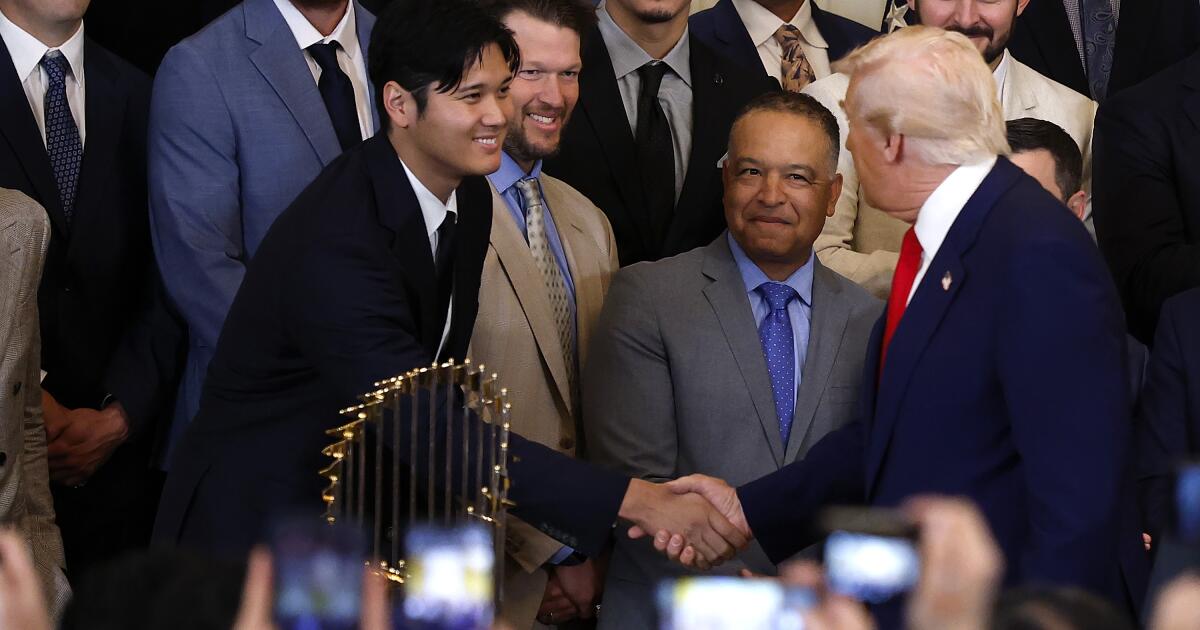
WASHINGTON — The Dodgers are scheduled to visit the White House on July 23 to celebrate their latest World Series title.
“President Trump is excited to welcome the Los Angeles Dodgers BACK to the White House to celebrate their World Series championship!,” White House spokesperson Taylor Rogers said in a statement to The Times.
The date falls on a scheduled off day in the middle of a nine-game East Coast road trip for the Dodgers. The team will play three games in Philadelphia against the Phillies July 20-22 before ending the trip with a three-game series against the New York Mets July 24 to 26.
The visit continues a tradition from the Dodgers’ two previous World Series championships. They were hosted by President Biden in 2021 and President Trump in April 2025.
After the Dodgers claimed their second consecutive World Series title with a dramatic Game 7 victory over the Toronto Blue Jays, a visit to the White House was planned, but it wasn’t until Thursday that a date was officially booked and confirmed.
Questions swirled around whether players would decline the visit this year after it did not happen during a scheduled visit to Washington in April.
Kiké Hernández said in 2018 he was unsure he would have gone had the Dodgers won the World Series the previous year. Mookie Betts said he was undecided and needed to talk it over with his family when last year’s visit was announced. After winning his first World Series with the Boston Red Sox in 2018, Betts skipped their trip to the White House the following year during Trump’s first term.
Both players, along with every returning member of the 2024 team who was with the team during its road trip, participated in the visit. The only notable absence was first baseman Freddie Freeman, who remained in Los Angeles to nurse an ankle injury.
Manager Dave Roberts, who indicated in comments to The Times in 2019 he might not go to the White House if Trump was president, also participated in last year’s ceremony.
Asked at the Dodgers’ fan festival in January about the possibility of returning to the White House, Roberts told The Times’ Bill Shaikin: “For me, I stand by: I’m a baseball manager. That’s my job.”
“I was raised — by a man who served our country for 30 years — to respect the highest office in our country,” Roberts said. “For me, it doesn’t matter who is in the office, I’m going to go to the White House. I’ve never tried to be political. … For me, I am going to continue to try to do what tradition says and not try to make political statements, because I am not a politician.”
Clayton Kershaw, who retired after last season but was on Team USA for this year’s World Baseball Classic, told The Times in the spring that he was aware Dodgers fans are split over whether the team should visit the White House again this year, but he said he is looking forward to it.
“I went when President Biden was in office. I’m going to go when President Trump is in office,” Kershaw said. “To me, it’s just about getting to go to the White House. You don’t get that opportunity every day, so I’m excited to go.”
Times deputy sports editor Ed Guzman contributed to this report.

NEWYou can now listen to Fox News articles!
All eyes were on Caitlin Clark on Wednesday night as she made her anticipated return from injury in a road matchup in Los Angeles.
But instead of a triumphant comeback, the Fever spent the entire night chasing the Sparks as Clark’s rough return fueled a 106-92 rout.
The superstar never found a groove, looking completely out of sync in her return from a back injury.
STEPHANIE WHITE GIVES CAITLIN CLARK STATUS UPDATE AHEAD OF FEVER-SPARKS, BUT HER NEXT MOVE RAISES QUESTIONS
Caitlin Clark huddles with teammates as the Indiana Fever battle the Sparks. (Photo by Katelyn Mulcahy/Getty Images) ((Photo by Katelyn Mulcahy/Getty Images))
Much of that disjointed performance falls squarely on head coach Stephanie White, who kept Clark on a ridiculously tight leash by limiting her to just 16 minutes. The stop-and-go approach could have sabotaged any chance for the phenom to establish a rhythm.
Clark finished with just 9 points, 4 rebounds and 3 assists. Her minus-16 plus-minus told the story.
The Los Angeles Sparks were severely shorthanded, taking the floor without stars Kelsey Plum and Cameron Brink.
MERCURY’S NOW-DELETED SOCIAL MEDIA POST MOCKING CAITLIN CLARK DRAWS SCRUTINY AFTER STAR’S INJURY
Yet while a depleted Sparks roster played to win, Indiana spent the night over-managing its biggest asset.
With Clark on a minutes restriction and Aliyah Boston out of the lineup, Kelsey Mitchell was forced to shoulder the entire offensive burden.
Mitchell did her part, pouring in 29 points while shooting 5-of-9 from beyond the arc.
Caitlin Clark orchestrates the Fever offense as Indiana battles the Los Angeles Sparks in primetime action. (Photo by Katelyn Mulcahy/Getty Images) ((Photo by Katelyn Mulcahy/Getty Images))
But one hot hand couldn’t stop an efficient LA squad.
The Sparks shot 45% from three-point range, going 9-of-20 from deep to cruise to the 106-92 victory.
White’s next move is to sit Clark against the Mercury on Thursday while Boston returns.
CLICK HERE TO DOWNLOAD THE FOX NEWS APP
After Wednesday’s loss to a shorthanded Sparks team, it’s fair to question whether Indiana’s cautious approach is working. The Fever dropped to 12-9.
Caitlin Clark and Dearica Hamby face off as Fever and Sparks battle at Crypto.com Arena in Los Angeles. (Photo by Tyler Ross/NBAE via Getty Images) ((Photo by Tyler Ross/NBAE via Getty Images))
Send us your thoughts: alejandro.avila@outkick.com / Follow along on X: @alejandroaveela
-

 Ohio6 minutes ago
Feeling itchy? Ohio leads nation with 6 cities on Orkin’s 2026 bed bug list
-

 Oklahoma9 minutes ago
Oklahoma’s Brent Venables named to 2026 Dodd Trophy Preseason watch list
-

 Oregon14 minutes ago
Ryan Reynolds-backed Aviation Gin shutters Oregon distillery
-

 Pennsylvania21 minutes ago
PA state rep. wants to force the York State Fair to change its name
-

 Rhode Island24 minutes ago
R.I. leading multi-state lawsuit against Trump administration housing policy – The Boston Globe
-

 South-Carolina29 minutes ago
SC is at the top for food waste in the nation. How you can make changes
-

 South Dakota36 minutes ago
Petition to clarify South Dakota proof of citizenship law shot down over technicality
-

 Tennessee39 minutes ago
Tennessee State men’s hockey cancels 2026-27 inaugural season for second straight year

