Sports
Swimming has a diversity problem. Can this generation of Olympians change that?

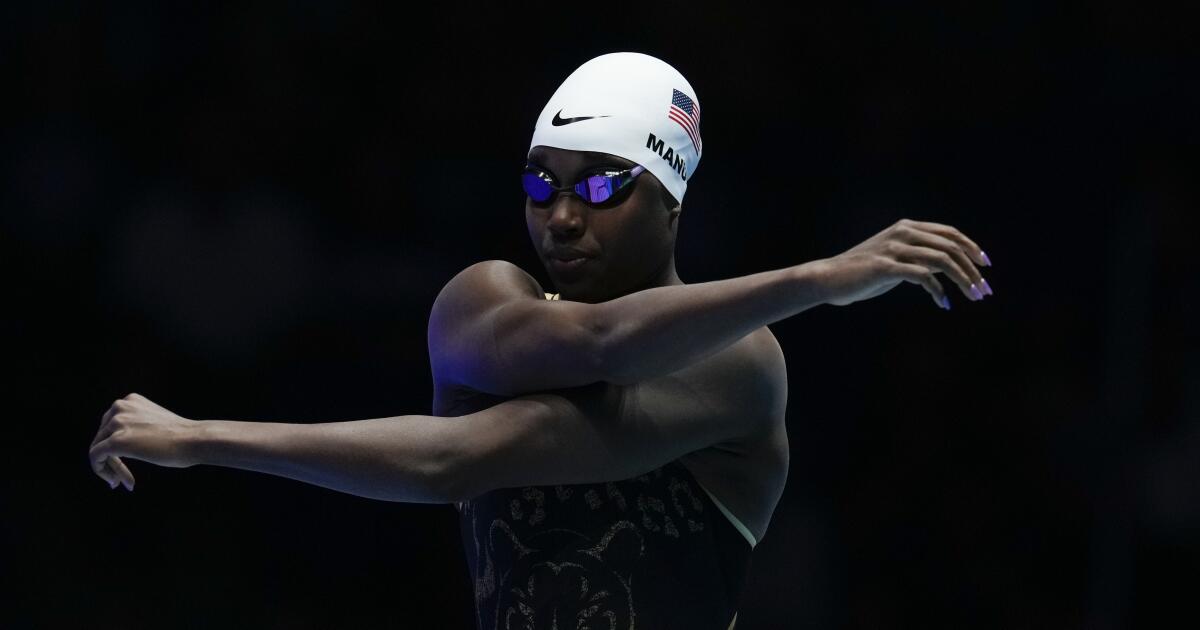
When Maritza Correia McClendon started swimming in Puerto Rico, she stood out because of her talent, not the color of her skin.
“There’s a lot of diversity in Puerto Rico,” said McClendon, who is Black and Latino, as are one in five people on the island.
Then her Guyanese-born parents moved to Florida when she was 8. Though she had become even faster in the pool, that was no longer the first thing people noticed about her.
“I remember a parent telling me, ‘What are you doing here? You should go do track or you should go on a basketball court,’” she said. “They were almost shaming me for being that outcast on that pool deck.
“That is definitely traumatizing. It’s still hard for me. I do definitely still struggle with that confidence factor.”
McClendon overcame that to become the first Puerto Rican of African descent to make the U.S. Olympic swimming team, the first Black female to win an Olympic medal for the U.S. and the first Black American swimmer to hold a world record.
2024 Paris Summer Olympic Games
In an effort to get others to follow her lead, McClendon is now among a growing number of former swimmers, coaches, officials and administrators working to make the sport more accessible and welcoming for people of color, from the grassroots level, where she was once shunned, to the Olympic team, where she shined.
The Paris Games has the opportunity to provide a big boost in those efforts when the swimming competition begins Saturday. Although only two of the 46 pool swimmers who will compete for the U.S. in Paris are Black — and none are Latino — those two, Shaine Casas, a three-time world champion, and Simone Manuel, a two-time Olympic champion and five-time Olympic medalist, have a chance to inspire a generation.
“If you’re not seeing somebody that you can relate to as a swimmer, then who’s going to be your role model?” said Steve Roush, executive director of Southern California Swimming, the grassroots affiliate of USA Swimming and the largest of the nation’s 59 local swim committees. “When you’ve seen over the last few years people like Simone Manuel, interests in the Black population say, ‘Hey, I guess we can swim. I guess there are spots for us.’ If they’ve never seen a Black on an Olympic or national team, then it’s really hard for them to think, ‘That’s what I want to do.’”
USA Swimming says less than 5% of the athletes registered with the federation are Black or Latino. Those groups account for 31% of the U.S. population. The level of representation on the Olympic team is no better. The reason for that has little to do with talent.
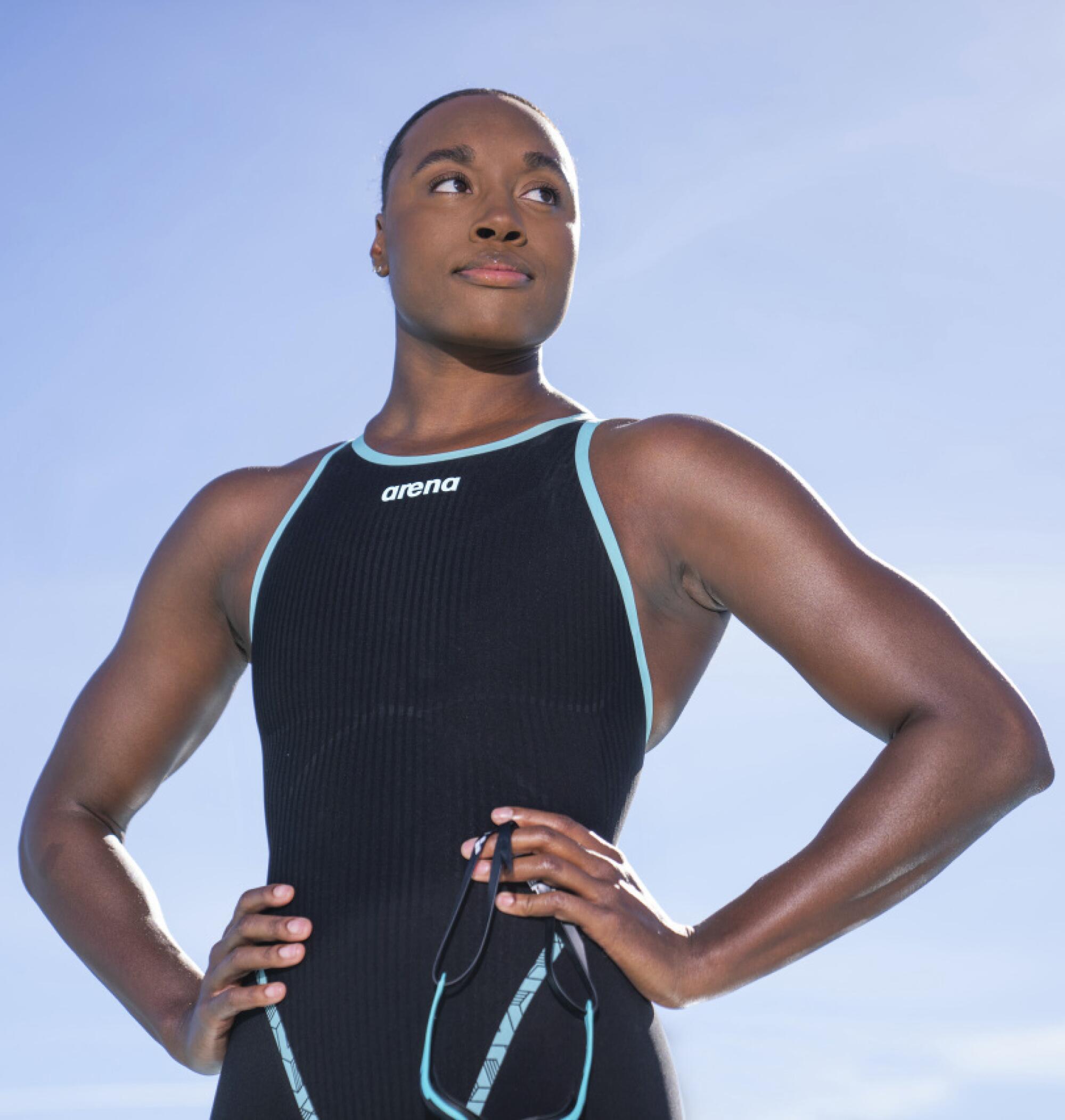
Simone Manuel will be competing in the women’s 50-meter freestyle at the Paris Games.
(Jack Spitzer / Associated Press)
“It’s not an athletic thing,” said Nic Askew, coach of the swim team at Howard University, the only HBCU to compete in the sport. “Anyone of any race and culture can be an amazing athlete in anything. But when you look at the history and the neglect, it absolutely is more social and socioeconomic.”
Until the last half of the 20th century, Black people and Latinos were commonly prohibited from using public pools and beaches. When those bans were lifted, the lack of swim facilities in inner-city neighborhoods became a new impediment to the sport.
“It’s very, very expensive,” McClendon said. “Not only for the person to learn how to swim, but also for the community to keep a pool open. The cost of the water, the chemicals, lifeguards. Every part of it tends to be very expensive.
“That’s a big hurdle. Another one is generational trauma. When our parents were growing up in segregation, they weren’t even allowed to go to the pool. So there became a fear of going to the water.”
That lack of access has had consequences that stretch beyond making an Olympic team. According to a 2021 study conducted by the USA Swimming Foundation and the University of Memphis, more than two-thirds of Black children do not know how to swim. The number is 45% for Latino children. As a result, the Centers for Disease Control and Prevention found the rate of drowning deaths among Black children aged 10-14 is 7.6% higher than whites of the same age while the rate for Latinos rose 25% between 2019 and 2022.
“Swimming,” McClendon said, “is the only sport that is also a life-saving skill.”
Yet as long as children of color don’t see themselves represented there, they will continue to believe swimming is not for them. That makes the Olympics — and especially the presence of athletes such as Casas, Manuel and Cullen Jones, the first Black American swimmer to break a world record — so important.
Casas, 24, a former world champion in the backstroke, will swim the 200 individual medley in Paris. That event begins Aug. 1. Manuel, who turns 28 next week, will swim the 4×100 freestyle relay Saturday and the individual 50 freestyle next week. She won gold medals in the 100 freestyle and the relay in Rio de Janeiro in 2016 and won a relay bronze in Tokyo three years ago.
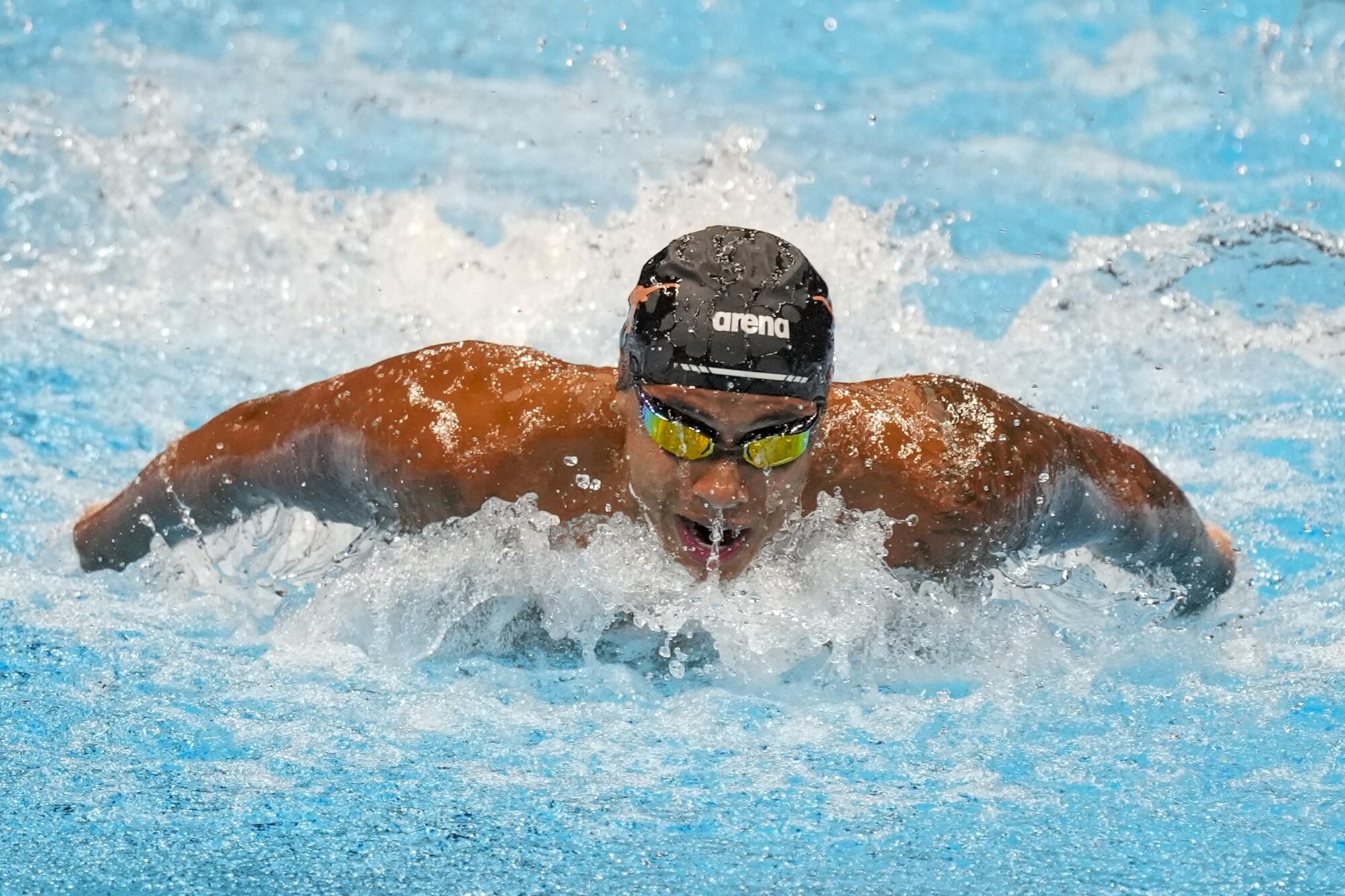
Shaine Casas swims during the men’s 200 individual medley preliminaries at the U.S. Olympic swimming trials in June.
(Michael Conroy / Associated Press)
If both can repeat their success in France, it could provide a big boost to make swimming more diverse in the U.S.
Progress is being made on other fronts as well. In Paris another barrier will fall — and another example will be created — when Anthony Nesty, a former gold medalist for Suriname and the coach at the University of Florida, becomes the first Black head coach of a U.S. Olympic men’s swim team. At the grassroots level, Roush said nearly a fifth of Southern California Swimming’s 20,000 athletes are Latino, a record for the region.
“The participation’s there,” he said. “I think we are reflective of the diverse ethnicity within Southern California. But these numbers aren’t reflective of what’s out there on the national scene.”
Making those numbers reflective of the population at large is important for a number of reasons, said Richard Lapchick, president of the Institute for Diversity and Ethics in Sport at the University of Central Florida.
Tennis, for example, shed its country club image when Serena and Venus Williams began to dominate the sport. That has not only brought more fans and more revenue to the sport, it has brought more and diverse participants as well, with the number of people playing the sport in the U.S. increasing by 33% between 2020 and 2023.
Not surprisingly that growth was most dramatic among people of color with the number of Latino players growing by 90% over that three-year period while Black participation increased by 46%.
“In any area, if you’re not raising a population that is representative of the entire country, you’re excluding [many] that could have been [great],” Lapchick said.
“Part of the reason why it would be helpful if [swimming] was more diverse, there are people who won’t pay attention to swimming because they look at it as a sport that’s exclusive rather than inclusive.”
Without the Williams sisters, we might never have gotten Coco Gauff. And without Black Olympic gymnastics champion Gabby Douglas, we might never have gotten Simone Biles. Over the next nine days, Casas and Manuel have a chance to do the same for Black and Latino swimmers. That opportunity is a fleeting one that only comes around once every four years.
“The one time historically that swimming is at the top of the media or a topic of conversation is during the Olympics,” Askew said. “But the Olympic cycle is every four years. So to be able to see athletes like Shaine and Simone now, it’s phenomenal.
“This is a space that a Black person can be at this elite level.”

Sports
Teenage golfer Miles Russell delivers his dad an all-time Father’s Day experience during US Open final round

America 250: Bobby Jones
Bobby Jones was born on March 17, 1902, in Atlanta, Georgia, and became one of the greatest amateur golfers in history. As a teenager, he reached the third round of the U.S. Amateur at age 14, showing early promise. He went on to win 13 major championships, all as an amateur, a record that still stands. In 1930, Jones achieved the
NEWYou can now listen to Fox News articles!
Miles Russell is the youngest player in the 2026 U.S. Open field at just 17 years old. Teeing it up in a major championship at that age, let alone making the cut as he did at Shinnecock Hills, made for an already unforgettable week for him and his family.
The young man had one final surprise up his sleeve for Sunday’s final round, however, that not only his family will cherish forever, but made plenty of golf fans watching the moment unfold a bit misty-eyed.
After hitting his approach shot into the par-4 18th, Russell’s caddie made his way over to the gallery. He proceeded to take off his caddie bib and hand it and Russell’s golf bag over to Russell’s father, Joe.
Miles Russell plays his tee shot on the 11th hole during the second round of the UNC Health Championship at Raleigh Country Club on May 29, 2026 in Raleigh, North Carolina. (Photo by Jordan Bank/Getty Images) ((Photo by Jordan Bank/Getty Images))
TEENAGE PHENOM MILES RUSSELL MAKES ENTIRE GOLF WORLD FEEL OLD WITH EYE-POPPING QUOTE AHEAD OF US OPEN DEBUT
According to the NBC broadcast, the entire thing was Russell’s idea. He approached USGA rules officials before teeing off on Sunday to ask them if it was okay to have his dad take over caddying duties for the final hole, and they gave him the green light.
Talk about a Father’s Day gift that may never be topped.
“It was pretty cool,” Russell said after Sunday’s final round. “Just there walking up 18, that’s when he stepped in. It was kind of a fun Father’s Day gift. Kind of cool since it was my first one. Hopefully it’s something he’ll remember for a long time.”
ZERO BS. JUST DAKICH. TAKE THE DON’T @ ME PODCAST ON THE ROAD. DOWNLOAD NOW!
Amateur Miles Russell of the United States walks across the 16th hole during the first round of the 126th U.S. OPEN at Shinnecock Hills Golf Club on June 18, 2026 in Southampton, New York. (Photo by Andrew Redington/Getty Images) (Andrew Redington/Getty Images)
Russell shot 3-over in the opening two rounds of the U.S. Open to make the cut by two shots. During Saturday’s third round, he struggled a bit en route to a 74, but backed it up with a final round score of even par.
CLICK HERE TO DOWNLOAD THE FOX NEWS APP
Miles Russell on the seventh tee during the first round of 126th U.S. Open Championship at Shinnecock Hills Golf Club on June 18, 2026 in Southampton, New York. (Photo by Tracy Wilcox/PGA TOUR via Getty Images) (Tracy Wilcox/PGA TOUR via Getty Images)
Russell qualified for this week’s U.S. Open after advancing in the final stage of qualifying in a three-man playoff vying for two spots in the field. He had Charlie Woods, Tiger’s son, on the bag as his caddie during the qualifier. Both Woods and Russell have committed to play college golf at Florida State.
In 2024, Russell became the youngest player in Korn Ferry Tour history to make the cut in a tournament, eventually finishing T-20

The Lakers will seek to use their 25th pick in Tuesday’s first round of the NBA draft on a player who fills a need on a roster that could have up to nine free agents this summer. Yet the Lakers also are aware that picking that late in the round could leave them selecting the best player available.
They probably will be in search of a center who can be a lob threat or an athletic wing who can play defense and knock down three-pointers, two positions the Lakers crave as they try to build a team around star Luka Doncic that fits best with his style of play.
Names that NBA executives and mock drafts attached to the Lakers are Kentucky center Jayden Quaintance, Texas forward Dailyn Swain and Duke wing Isaiah Evans.
The Lakers spent time in Spain looking at 20-year-old guard Sergio de Larrea, but many NBA scouts see him going later in the first round or even in the second. According to people not authorized to speak publicly, the Lakers were impressed by their workout with Purdue point guard Braden Smith. But he’s on the smaller side (6 feet) and played four years in college, leading scouts to believe his upside is not that high and that he’ll be drafted in the second round.
The Lakers don’t have a pick in Wednesday’s second round.
After the Lakers were swept by a deep and athletic Oklahoma City team in the second round of the playoffs, president of basketball operations Rob Pelinka outlined what it takes when trying to compete in the uber-tough Western Conference against the likes of the Thunder and the San Antonio Spurs, who became the second-youngest team to reach the NBA Finals.
Pelinka looked at how Thunder guard Ajay Mitchell was drafted in the second round and how he flourished in just his second season, especially in the playoffs, in which he averaged 15.1 points and 4.3 assists in 11 games.
“Depth is really important, athleticism and youth. We have a lot of components of that on our roster, but we need to add to it,” Pelinka said last month during his exit interview with the media. “I think those are some of the key North Stars that we need to look at.
“One of the players that they had who played really well, Ajay Mitchell, they got in the second round. So there’s ways to add to your roster if you commit to doing the hard work and commit to the process of adding the right pieces. … We’ll be doing that through the draft and free agency and through trades. We’ve gotta find a way to have a roster that will compete with any team in the NBA. That’s what we do here.”
The Lakers do have three tradable first-round picks — 2026, 2031 and 2033 — but the latter two can’t be moved until after the draft.
Lakers star LeBron James is an unrestricted free agent and is looking for a deal from the Lakers, while Austin Reaves is expected to opt out of his $14.8-million deal so he can sign a contract with them for up to five years and about $241 million.
Still, the Lakers have to proceed with the draft to find a player.
Texas forward Dailyn Swain, left, vies for a loose ball against Purdue guard Braden Smith during an NCAA tournament game in March.
(Godofredo A. Vásquez / Associated Press)
Swain (6-7) and Evans (6-6) are the kind of athletic wings the Lakers could use, but both might be chosen before the Lakers make their pick.
The 6-9 Quaintance could slide to the Lakers because of health concerns. He played in only four games last season at Kentucky because the team was being cautious following knee surgery after he tore an anterior cruciate ligament when he played at Arizona State.
Scouts still view him as mobile, athletic and young enough — he turns 19 next month — to develop. But, Quaintance will need to rehab his knee and probably won’t be ready for the upcoming season. When healthy, scouts said, he can be the lob threat and defender that Doncic yearns to have.
Sports
Bryce Harper hits for cycle, Kyle Schwarber blasts three homers in Phillies blowout win over Mets

NEWYou can now listen to Fox News articles!
The Phillies’ turnaround following the dismissal of manager Rob Thomson reached a new milestone when two of the franchise’s biggest stars delivered a historic performance.
Kyle Schwarber launched three home runs, including two in the third inning, while Bryce Harper completed the cycle to add yet another achievement to his accomplished career.
The offensive explosion powered Philadelphia to a 15-3 rout of the New York Mets on Saturday, as the Phillies continued their surge and received a signature performance from two of the game’s most recognizable stars.
Philadelphia Phillies’ Kyle Schwarber celebrates his home run with Bryce Harper during the third inning against the New York Mets in Philadelphia, Pennsylvania on June 20, 2026. (Chris Szagola/AP)
Schwarber’s first home run traveled 456 feet, while his second blast of the third inning measured 457 feet off Mets reliever Cionel Pérez.
He capped his night with a two-run homer in the seventh inning. Schwarber’s major league-leading home run total climbed to 28, and the performance marked the fifth three-homer game of his career.
Cristopher Sanchez allowed one earned run in six innings to lower his ERA to 1.80.
It’s his 23rd straight start at Citizens Bank Park in which he allowed two earned runs or fewer, the second-most such starts by a pitcher at the same ballpark in MLB history since 1913, trailing only Jacob deGrom’s 24 at Citi Field for the Mets from Sept. 9, 2019 to Aug. 31, 2022.
ZERO BS. JUST DAKICH. TAKE THE DON’T @ ME PODCAST ON THE ROAD. DOWNLOAD NOW!
Bryce Harper and Kyle Schwarber of the Philadelphia Phillies leave the field after defeating the New York Mets at Citizens Bank Park in Philadelphia, Pennsylvania, on June 20, 2026. (Rob Tringali/MLB Photos via Getty Images)
Schwarber is the 67th player in major league history and second this season with multiple home runs in an inning, joining Houston’s Yordan Alvarez on June 12.
Schwarber is the fourth Phillies player to hit two home runs in an inning, along with Trea Turner (Aug. 19, 2023), Von Hayes (June 11, 1985) and Andy Seminick (June 2, 1949).
Philadelphia Phillies designated hitter Kyle Schwarber hits a solo home run in the bottom of the third inning against the New York Mets at Citizens Bank Park in Philadelphia, Pennsylvania on June 20, 2026. (Mitchell Leff/Getty Images)
Meanwhile, Harper hit a solo home run in the first inning, his 16th of the year. He doubled and singled in the third, then hit a two-run triple to the gap in left-center field in the fifth for his first career cycle and the 11th in Phillies history.
CLICK HERE TO DOWNLOAD THE FOX NEWS APP
The Phillies and Mets will wrap up their three-game series Sunday night, with first pitch set for 7:20 p.m. ET.
The Associated Press contributed to this report.
-

 Crypto5 minutes ago
Commentary: Crypto bill is bad for small businesses
-

 Finance6 minutes ago
Hong Kong to roll out measures boosting offshore yuan trading in July
-

 Fitness11 minutes ago
“Don’t be a lone wolf, that’s my number one life hack”—Peloton instructor and ultra runner Susie Chan shares her weekly fitness routine and tips to get started
-

 Movie Reviews19 minutes ago
Film reviews: ‘Toy Story 5’ and ‘The Death of Robin Hood’
-

 World30 minutes ago
‘Criminal Minds’ Star Paget Brewster Tells TV Journalist to ‘Work at a Shelter’ After Mixed Review, Sparking Outrage From Other Critics
-

 News34 minutes ago
The Deadly Rise of Giant Trucks and S.U.V.s
-

 Health57 minutes ago
7 Celebrity Weight Loss Success Stories—From Adele to the Pioneer Woman
-

 Lifestyle1 hour ago
Sunday Puzzle: B to the B to the B

