Sports
Surviving and thriving in the nastiest spot on NHL ice


You gotta want it, right? That’s what they always say, “they” being the NHL players who dare tread into the lawless border between slot and crease, the coaches who send them there, and the fans in the 300-level relentlessly calling for blood.
It’s about desire. It’s about a willingness to take the punishment, and an eagerness to dole it out. It’s about fearlessness and an almost wanton disregard for life and limb. That’s where the pain is, yes — the cross-checks to the back of the head, the slashes to the ankles, the elbows to the gut — but that’s also where the goals are. They’re called the scoring areas for a reason. They’re called the dirty areas for a reason, too. Pay the price, reap the reward. A red light is worth a black-and-blue every single time.
Easy to say that, of course. A tad more difficult in practice. Ever turn your back on an angry giant with a weapon in his hand? Ever step in front of a frozen projectile traveling at triple digits?
Ever do both at the same time?
“It’s scary at first,” Nashville Predators forward Filip Forsberg said. “When you had Zdeno Chara behind you and Shea Weber shooting it at you — that’s the best of both worlds right there.”
Yes, it takes guts to work the net front in the NHL. But it’s facile, folly even, to say it’s simply about who wants it most. There’s a true art to working the net front — for the forwards trying to create havoc, the defensemen trying to prevent havoc, and the goaltenders trying to see through the havoc. It requires courage, sure. But it also requires precision timing, exquisite hand-eye coordination, uncanny instincts, physical fortitude and quick thinking.
And yes, a bit of a nasty attitude doesn’t hurt. Hey, gotta want it, right?
“It’s always chaos,” Colorado Avalanche defenseman Cale Makar said. “But you’ve just got to try and make it a little bit of controlled chaos.”
The defensemen
Let’s start not with the trespassers but those patrolling the fence line.
For defensemen protecting the crease, it’s much more complicated than simply outmuscling an intruding forward — though that’s certainly part of it. It starts with picking your battles. Or more accurately, when to battle.
Just because a forward is in front of the crease doesn’t mean it’s time to start jockeying for position. As a defenseman, you have to conserve energy for when you truly need it. So if the puck is wedged between a slew of skates and sticks in the corner, you merely keep an eye, not your whole body, on that forward lurking in the goal mouth. Otherwise, you’ll tire yourself out before the real fight begins.
Former Chicago Blackhawks coach and 21-year NHL defenseman Luke Richardson made a point of having his blueliners — particularly his smaller, more offensive-minded ones — watch video of Toby Enstrom and Kimmo Timonen, a pair of 5-foot-10 guys who protected the crease from power forwards who outweighed them by 20, 30, 40 pounds while conserving enough energy to exit the zone and maintain possession once they did, rather than just dumping the puck and going for a line change. Enstrom and Timonen would use their stick as a spacer more than a weapon. Or they’d stick their arms out and stiffen them, forcing forwards to go around them, making them expend just a little more energy and just a little more time before getting themselves planted. Every fraction of a second counts when forwards are looking for drive-by tips and screens.
Now, once the puck skitters free, or you sense that a shot is coming, it’s time to start boxing out.
But wait a second, dumb question — how do you box someone out on slippery ice?
“It’s turning your skates,” Blackhawks defenseman Connor Murphy said. “You can actually dig in more than you can in shoes because of your edges, if you turn them outwards. So you plant your feet sideways — duck-footed, or whatever it’s called — and you can be tough to move. Sometimes, if a guy’s coming at you from the side, you just kind of lean into them and wait for the right time to push off of him to get the rebound. It’s all just feel and strength, really.”
Five-foot-10 Kimmo Timonen (44) made a living boxing out much larger players, such as 6-3 Patrick Maroon (62). (Jim McIsaac / Getty Images)
Getting there first is key, too. Better to be the guy trying to stand still than the guy trying to move the guy trying to stand still. Anticipate the play, get into position, jam those skates into the ice, get a strong and wide base and dare the other guy to dislodge you.
This, of course, is where the nastiness begins — jockeying for position can mean a light shove or it can mean a full-on two-hander to the spine. Back in Richardson’s time, it got truly violent among that amorphous mass of bodies. How violent?
“As violent as I was allowed to be,” Richardson said. “(But) you would be careful who you’re up against. I might not have been as violent against Bob Probert as I was against a smaller guy that wasn’t as tough.”
It went far beyond the usual two-handed shoves in the back that you still see today.
The can-opener — wedging your stick between the forward’s legs and either dumping them to the ice or maneuvering them around like a marionette — was popular in Richardson’s time. And good luck to the knees and ankles of any forward in the 1980s who got close enough to a Ron Hextall or a Billy Smith, who’d take their big goalie paddles and chop a forward down like a lumberjack.
That stuff is all verboten today. These days, even especially aggressive cross-checks will get you two minutes. With rising slap shots screaming toward the goal mouth, a poorly timed — or well-timed, depending on how old-school you are — cross-check can put a player’s face right into the line of fire. For obvious reasons, the league doesn’t like that.
“The game has changed,” Vegas center Tomáš Hertl said. “Hockey got a lot smaller, guys got a little faster. I got into the league when it was still Chara and Weber. It was different — there were big, strong guys and they could break their stick over your back. It’s changed, but it’s still not easy in there. The next morning, you still feel it.”
Modern defensemen have to find subtler ways to hinder a forward’s ability to tip a point shot, redirect a slap pass or pounce on a rebound. A quick stick is critical. Most intentional deflections happen on the ice, so Murphy said he’s usually trying to get his stick underneath the forward’s stick and lift it off the ice. On the flip side, when a forward intentionally raises his stick as a shot is on its way, the defenseman’s instinct is to whack it down back to the ice with his own stick or use his body to angle the player away from the net. Whatever the forward’s trying to do, don’t let him do it.
Of course, the more bodies in that net-front battle, the harder it is for a referee to see what’s really going on in there.
“I wouldn’t say it’s like free game in there,” Makar said. “But you’re still going to do anything to keep the puck out of your net. If that means grabbing a guy’s stick or something, you try to do that.”
There is another option — leave the scrum entirely and try to step in front of the shot yourself. That involves unspoken communication with a defensive partner and a trust level with the goaltender. Some goalies love it when a defenseman sacrifices his body for a blocked shot. Other goalies want a clear line of sight to the puck and would prefer to handle it themselves.
So, get there first. But monitor the puck closely so you don’t waste energy. Make sure you and your defensive partner know which forward is his and which one’s yours. Then, decide if you want to fight for position or block a shot. And if you choose to fight, determine whether the forward is going for a deflection — and what type — or if he’s looking to roll off and pick up some loose change around the net. And don’t get a penalty, but be sure to get away with whatever you can.
Oh, and process and accomplish all that in a second or two. Maybe three.
“It’s instinct,” Murphy said.
“It’s fun,” Makar said.
The forwards
Washington’s Tom Wilson can’t exactly articulate what it is that makes him effective in front of the net. It all happens too fast, too chaotically, to distill into an easily digestible soundbite that accurately conveys the experience to a layperson.
“A lot happens really quickly — we’re talking tenths of a second, pucks flying,” said Wilson, a quintessential example of what seems to be a dying breed in the NHL — the power forward. “It’s a hectic game. A lot of the best players around the league are able to slow it down and make plays.”
He was talking about extraordinary tippers like Joe Pavelski and Chris Kreider. Or quick-twitch rebound guys such as Anders Lee and Sean Monahan. Or guys with an innate ability to plant themselves in just the right spot along the blue paint for redirects and tap-ins, such as Zach Hyman and Tyler Bertuzzi.
But in the anarchic area in front of the net, sometimes skill is overrated. Being an agent of chaos can be just as effective. Maybe not like Sean Avery turning his back on the play and waving his arms in front of Martin Brodeur like a basketball player guarding an inbound pass, but, well, not not like that, either.
“There are times where maybe it’s part of my job to make it a little bit crazy,” Wilson said. “I try to thrive in that environment. That’s hockey.”
This is what players mean when they say they want to “take the goalie’s eyes away.” It’s bodies in the way, it’s arms and sticks flailing, it’s planting yourself a millimeter outside the blue paint, your backside taking up as much of the goalie’s field of vision as possible.
“Goalies are so good now, so you need to do that,” Forsberg said. “You need to find any advantage, even if it’s just causing some kind of distraction.”
As for the rest of it, it’s a lot of the same things and thoughts defensemen are working through — just in reverse. Navigate the towering trees, avoid getting mauled, keep your stick on the ice, and get in the way as much as possible. For big guys like Wilson, who is 6-4, 220 pounds, it’s often about brute strength. For smaller forwards, it’s about using your lack of size to your advantage — whether that means using your lower center of gravity to knock bigger defensemen off balance or squeezing through tight spaces and finding open ice.
Utah’s Clayton Keller used to be hesitant to get too involved in the goal mouth. But once he started scoring goals from there, it got a lot less intimidating.
“For a guy like me, a smaller guy, I try to spin off guys, and that’s when you get the rebound, or sometimes you get the tips,” Keller said. “But for a smaller guy, it’s mostly about arriving at the right time and not always standing there. Being around it and getting used to it is the most important thing. That’s where a lot of the goals are scored.”

Veterans such as Corey Perry can dig into their deep bag of tricks in front of opposing goalies. (Jason Mowry / Getty Images)
Savvy forwards can take advantage of the clutter and get away with bending the rules, too. Richardson pointed to a game last February in which Edmonton’s Corey Perry flat-out slashed the stick out of the hands of Anaheim goalie John Gibson, leading directly to an Evander Kane goal. The rules can be very different for a young guy versus a crafty veteran.
“Some guys get away with things because they’ve been around a long time, and they have relationships with the referees that the young guys don’t have,” Richardson said. “You’ve got to play that card, too. If you’re a younger guy trying to earn your stripes, play fair and don’t bark at the referee.”
When Alex DeBrincat first broke into the league, he was regularly getting into physical battles in front of the net, often leading to full-blown scraps after the whistle. Despite being 5-8, tied for the shortest player in the league, DeBrincat too often went toe-to-toe with some of the league’s biggest, strongest players.
He’s a little wiser now at 27 years old.
“I was a little bit more frisky earlier in my career,” he said. “But it’s just playing hockey. I’ve done it for so long, it’s just kind of second nature. I’m not always right in front of the net, but when I am, I’m just trying to get an edge on the other guy and trying not to get pushed out of the net. Sometimes I get a little angry, but usually I’m trying to stay out of the box. I like scoring goals better than fighting.”
The goaltenders
The Boston Bruins’ Jeremy Swayman is 6-3, 195 pounds. By most standards, he’s pretty big. By modern hockey goalie standards, he’s average at best.
“I’m still growing, trust me,” he said. “We’ll get there one day.”
There are 240 forwards and defensemen who have played in the NHL this season who are 6-3 or taller. And very often, several of them are standing directly in front of him while the puck is moving along the blue line. So eight years after arriving at the University of Maine as a scrawny, somewhat short goalie, he’s still trying to see over people’s heads so he can do his job.
“As a freshman, I had to find ways to find and track that puck because these defensemen and forwards were so good at tipping pucks, so good at sifting pucks through,” Swayman said. “And obviously, the forwards in front of me are using their bodies to take away the goalie’s eyes. So I still love bobbing and weaving. I’m probably a little more physical than most goalies, too, making sure I see the puck. Because at the end of the day, I don’t care how it’s done, I just want to see the puck.”
At 6-4, Detroit Red Wings goaltender Cam Talbot tries to peer over the scrum, too. The New York Rangers’ Jonathan Quick is one of the few remaining goalies who likes to get low, coiling his body in the crease like a snake and peering through everybody’s legs. Whatever line of sight you prefer, being able to track the puck through all the traffic might be the most important skill a goalie can have.
And if that traffic backs into you a few times each possession, so be it.
“That’s what you sign up for, right?” Talbot said. “It’s their job to make it as hard on us as possible, and it’s the D’s job to help us out as much as they can.”

Goalies such as Cam Talbot rely on their defensemen as much as their defensemen rely on them. (Bruce Bennett / Getty Images)
You’d think communication between goalie and defenseman would be key, but it’s more of a luxury, really. The action’s happening too fast to truly divvy up responsibilities on the fly. There’s usually not even time for trash talk between opponents; that has to wait for the inevitable post-whistle skirmish. Talbot is more vocal than most, though, and has no trouble yelling at his teammates to get out of his way.
“They’re pretty good about it,” Talbot said. “And sometimes they come back and tap me on the pads and say, ‘Good, I didn’t want to eat that one, happy to let you take it.’”
Just as video review has made most forward-initiated contact with the goalie a thing of the past, those Hextall stick swipes have mostly disappeared, too. But if the swarm of bodies in front of the net seeps into the crease, it’s not uncommon to see a goalie take matters into his own hands and start shoving people out of his way.
And sometimes it’s not just the opponents.
“I’m color blind, so sometimes my own guys get in the mix,” Swayman said with a laugh. “Like I said, I don’t care how I get it done, I just want to make sure I see the puck.”
Shoves from behind. Shoves from ahead. Cross-checks to the back of the neck, butt-ends of sticks in the ribs, stick blades in the skates, gloves in the face. All while that hard chunk of rubber could be rocketing in — throat-high or knee-high or toe-high — at any moment.
No, it’s not glamorous at the net front. But when you do it right — whether it’s scoring a goal or stopping one — it’s totally worth it.
“It’s great in there,” Forsberg said. “OK, yeah, it’s awful sometimes. But when you get rewarded, there’s nothing better. Those are the best goals you can score. You earned those.”
(Illustration: Will Tullos / The Athletic; Photos: Maddie Meyer, Ethan Miller, Scott Taetsch, David Berding / Getty Images)



NEWYou can now listen to Fox News articles!
Tiger Woods was released from jail Friday night after he was arrested earlier in the day on a DUI charge following a car crash in Florida.
In a mugshot released hours after his arrest, Woods’ eyes appeared bloodshot, as he donned a blue polo inside the Martin County Jail in Florida.
Woods was seen leaving the jail in the passenger seat of a black SUV after his release on bail late Friday, according to The Associated Press.
Martin County Sheriff John Budensiek confirmed in a news conference that Woods was traveling at “a high rate of speed” when his vehicle collided with another car, resulting in his vehicle rolling over onto the driver’s side.
Tiger Woods was booked into Martin County, Florida, jail on March 27, 2026. (AP)
Authorities said Woods “exemplified signs of impairment.” He blew “triple-zeroes” for alcohol but refused a urine test.
“DUI investigators came to the scene here, and Mr. Woods did exemplify signs of impairment. They did several tests on him. Of course, he did explain the injuries and the surgeries that he had. We did take that into account, but they did do some in-depth roadside tests,” Budensiek added.
“We really weren’t suspicious of alcohol being involved in this case, and that proved to be true at the jail. … But when it came time for us to ask for a urinalysis test, he refused. And, so, he’s been charged with DUI, with property damage and refusal to submit to a lawful test.”
Woods was spotted on the phone after the crash, wearing navy blue shorts.
Woods was charged with DUI, property damage and refusal to submit to a test, all misdemeanor charges. No one was injured, authorities said. Woods was alone in the car and crawled out of the passenger door after the crash.
Tiger Woods was driven from the Martin County Jail after being arrested for driving under the influence following a car crash on March 27, 2026, in Stuart, Florida. (Joe Raedle/Getty Images)
VANESSA, KAI TRUMP TAKE IN TIGER WOODS’ RETURN TO GOLF AT TGL FINALS
“This could’ve been a lot worse,” Budensiek noted.
President Donald Trump commented on the arrest of his “very close friend.”
“I feel so badly. He’s got some difficulty,” Trump said. “There was an accident, and that’s all I know. Very close friend of mine. He’s an amazing person, an amazing man, but some difficulty.”
Woods has not commented on the arrest.
Tiger Woods was arrested on a DUI charge after getting into a car crash on Friday. (Associated Press)
Woods currently is dating Trump’s ex-daughter-in-law, Vanessa, whose daughter, Kai, is set to play college golf in Miami next week.
This is Woods’ second DUI arrest within the last decade. In 2017, he was taken into custody, also in Jupiter Island, after taking prescription drugs and being asleep behind the wheel of a running car at 3 a.m.
In 2021, he got into a wreck that resulted in serious leg injuries that kept him off the golf course for the entire year.
Golfer Tiger Woods stands by his overturned vehicle in Jupiter Island, Fla., Friday, March 27, 2026. (Jason Oteri/AP)
Woods made his return to competitive golf earlier this week in the TGL championship after rupturing his Achilles just before last year’s Masters (this year’s tournament is in less than two weeks). Woods has not appeared on the links since the 2024 PGA Championship, in which he missed the cut.
Follow Fox News Digital’s sports coverage on X, and subscribe to the Fox News Sports Huddle newsletter
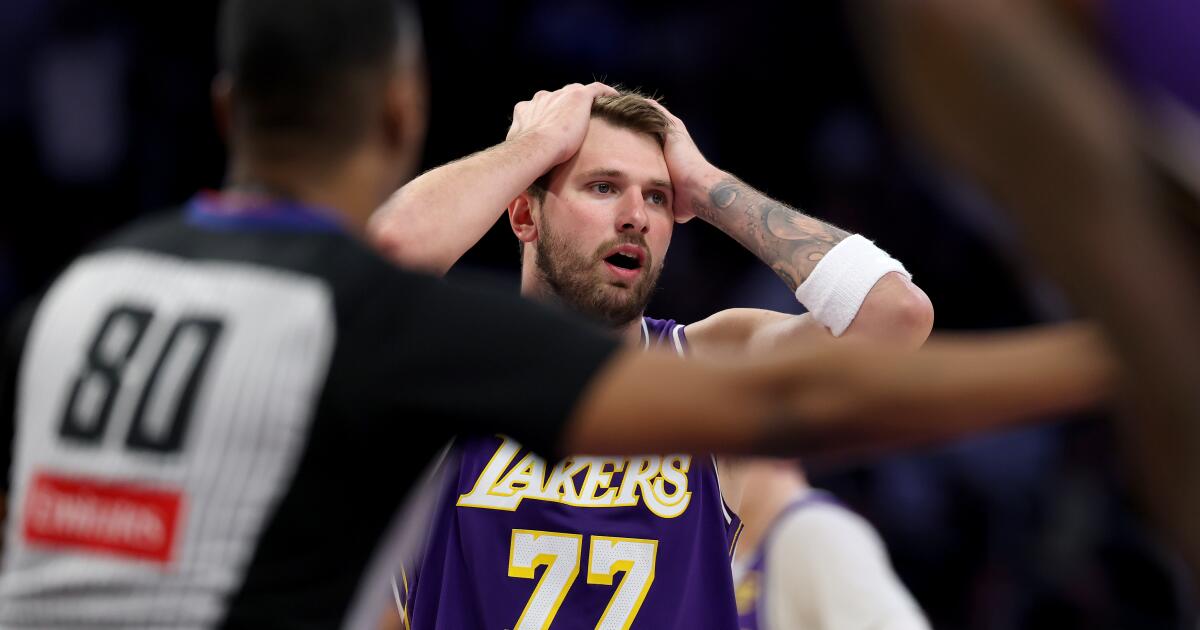
For the second time in less than a week, Luka Doncic faces a one-game suspension because of technical foul accumulation.
Only a week after Doncic’s 16th technical foul was rescinded by the NBA, the Lakers superstar picked up another one in a 116-99 win over the Brooklyn Nets on Friday and is in line to miss the Lakers’ next game against the Washington Wizards on Monday.
In the third quarter with the Lakers trailing by one against the lowly Nets (17-57), Doncic was called for an offensive foul against Nic Claxton as the Lakers (48-26) were trying to inbound the ball after a dunk by Ziaire Williams. After the Lakers turnover, Williams and Doncic appeared to exchange words with Doncic pushing Williams aside with one hand. Williams then flailed his arms behind him and slapped Doncic in the throat.
“He was yelling in my face three times,” said Doncic, who finished with 41 points, eight rebounds and three assists in the win. “I just wanted to get out of there. … I didn’t even talk. I just wanted to get out of there. And they said I pushed. My push was exaggerated, which was obviously not [the case].”
Both were assessed technical fouls with 5:12 remaining in the third quarter, and Williams’ hit was reviewed for a possible flagrant, although it was not upgraded.
The NBA requires players to sit out for one game without pay after their 16th technical foul of the season. But Doncic avoided that fate after the NBA rescinded the foul that would have forced him to the bench for a critical road game last week. Lakers coach JJ Redick said the Lakers will try to appeal Doncic’s latest foul but he did not see what happened on the play.
Last week, Doncic avoided a suspension after the NBA rescinded the foul that would have forced him to the bench for a critical road game against the Eastern Conference-leading Detroit Pistons. Doncic is slated to miss Monday’s game against the Wizards, who have lost 17 of their last 18 games and have the third-worst record in the Eastern Conference (17-56).
Lakers star Luka Doncic reacts to a referee’s call during the second half Friday against the Brooklyn Nets at Crypto.com Arena.
(Allen J. Schaben / Los Angeles Times)
Doncic picked up his first 16th technical foul last week against the Orlando Magic after getting into an argument with Orlando forward Goga Bitadze. Doncic claimed Bitadze directed a vulgar comment about Doncic’s family in Serbian toward the Lakers star guard. Bitadze refuted the story, saying it was actually Doncic who said the curse word out loud first and that he was only repeating what he heard.
The NBA rescinded both fouls upon review the following day.
Doncic, the NBA’s leading scorer, has scored 30 points or more in 12 consecutive games, the longest such streak in his career. He has 43 30-point games this season, tying Elgin Baylor and Jerry West for sixth-most in a season by a Lakers player. He has scored 40 points or more in the last 12 games.
Against the Nets, Austin Reaves finished with 26 points, eight rebounds and five assists and LeBron James had 14 points, eight assists and six rebounds.
Before the game, Redick said the Nets game would be like playing on the road since the Lakers had spent almost two weeks away from Crypto.com Arena and had returned home in the wee hours of Thursday morning from Indianapolis.

Lakers guard Austin Reaves celebrates after shooting a three-pointer against the Nets in the second half Friday.
(Allen J. Schaben / Los Angeles Times)
The challenge was to find the energy to play, which wasn’t a problem for Doncic, who had 24 points in the first half. Doncic was nine for 15 from the field in the first half and four for six from three-point range in 20 minutes. He finished shooting 15 for 25 from the field as the Lakers shot 54% from the floor. They shot 44% (11 for 25) from three-point range.
That the Lakers were facing a Nets team with the second-worst record in the NBA didn’t matter.
That the Lakers were facing a Nets team had lost nine of its last 10 games didn’t matter.
That the Lakers were facing a Nets team that’s last in the league in scoring (106.3 points per game) didn’t matter.
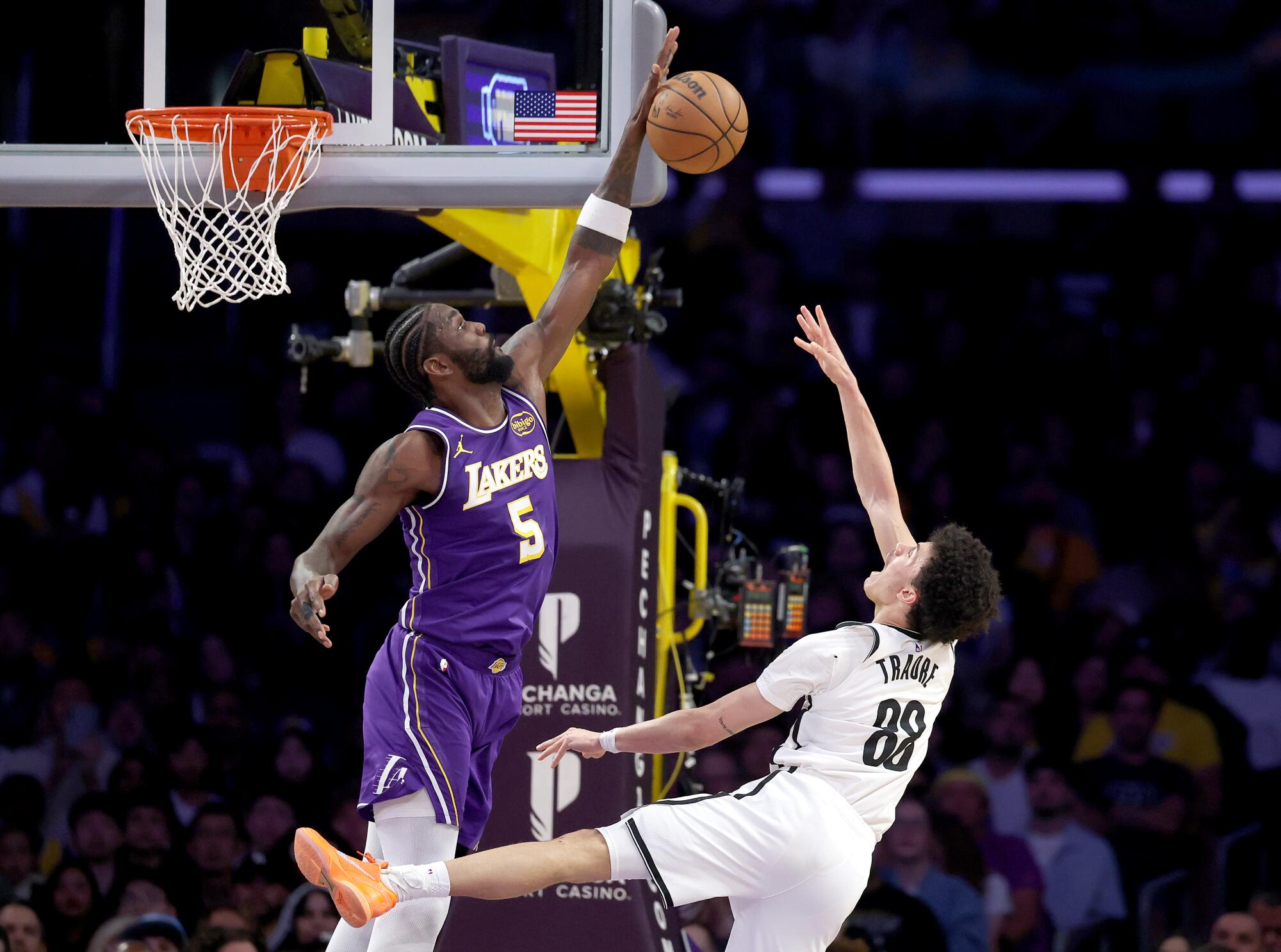
Lakers center Deandre Ayton, left, blocks a shot by Brooklyn Nets guard Nolan Traore in the first half Friday.
(Allen J. Schaben / Los Angeles Times)
What mattered to the Lakers was finding a way to win as the regular season winds down.
“I felt like we were a step slow,” Redick said. “And I told the guys at halftime, ‘This is our seventh game of the road trip. Anytime you come back, there’s a day in between, that’s just you’re in another city until you can get adjusted to the time zone and you get a couple days break.’ So the next two [off] days will be good for us.”
Notes: Lakers broadcast analyst Stu Lantz missed Friday night’s game against the Nets because of health issues. Derek Fisher, who won five NBA titles with the Lakers, took over Lantz’s role for the game. Public address announcer Lawrence Tanter also missed the game because of a health matter. Jason Barquero filled in for Lantz. “The entire Lakers organization is wishing Lawrence all the best in his recovery, and we look forward to welcoming him back soon,” the team said in a statement.


NEWYou can now listen to Fox News articles!
Tiger Woods was involved in a car crash on Jupiter Island in Florida on Friday, according to multiple reports.
The Martin County Sheriff’s Office told ESPN that the crash happened on Jupiter Island. Woods’ condition was not immediately known.
Woods competed in the TGL championship earlier this week with his girlfriend, Vanessa Trump, and her daughter, Kai, in the stands. It was his return to competitive golf after rupturing his Achilles last year, just ahead of the Masters.
Tiger Woods of Jupiter Links Golf Club looks on before the match against the Los Angeles Golf Club at SoFi Center on March 23, 2026, in Palm Beach Gardens, Florida. (Adam Glanzman/TGL/TGL Golf via Getty Images)
The 15-time major winner, five of which have come at Augusta, was noncommittal about playing at this year’s Masters. President Donald Trump said on “The Five” on Thursday that he would be at Augusta but not play.
Woods has had trouble behind the wheel in the past. In 2021, he got into a wreck that resulted in serious leg injuries that kept him off the golf course for months.
This is a breaking story. Check back for more updates.

Video: Humpback Whale Stranded Off German Coast Is Freed by Rescuers

‘The Madison’ adds to Taylor Sheridan’s ‘Yellowstone’ legacy — ‘Marshals’ not so much

Bluetti’s Sora 500 solar panel is incredibly powerful for its size

Russian man who assaulted woman during Barron Trump FaceTime call sentenced to 4 years

Dem senators dodge crucial question on illegal alien accused of killing Chicago college student

Florida High School Football Rankings: Top 25 teams – Oct. 21

How old is Bo Nix? What to know about Oregon quarterback ahead of 2024 NFL Draft

Cleary's 21 help Le Moyne down Central Connecticut State 69-64 in OT

99th annual Pony Swim held in Virginia

Indiana Members Credit Union announced as new anchor tenant at Bottleworks District
Dem senators dodge crucial question on illegal alien accused of killing Chicago college student

EU Parliament unblocks key political hurdle in digital euro talks

Man arrested in plot to firebomb Palestinian activist’s home after undercover op

WATCH: Senate hearing goes silent after Angel Father confronts top Dem over daughter’s death

US diplomat Marco Rubio denounces settler violence, tolls in Hormuz strait
-

 Detroit, MI1 week ago
Drummer Brian Pastoria, longtime Detroit music advocate, dies at 68
-

 Movie Reviews1 week ago
‘Youth’ Twitter review: Ken Karunaas impresses audiences; Suraj Venjaramoodu adds charm; music wins praise | – The Times of India
-

 Sports7 days ago
IOC addresses execution of 19-year-old Iranian wrestler Saleh Mohammadi
-

 New Mexico5 days ago
Clovis shooting leaves one dead, four injured
-
 Business1 week ago
Disney’s new CEO says his focus is on storytelling and creativity
-

 Technology6 days ago
YouTube job scam text: How to spot it fast
-

 Tennessee4 days ago
Tennessee Police Investigating Alleged Assault Involving ‘Reacher’ Star Alan Ritchson
-

 Texas1 week ago
How to buy Houston vs. Texas A&M 2026 March Madness tickets