Sports
Ranking MLB’s worst contracts: Not all megadeals are worth the cost


Stephen Strasburg retired, Patrick Corbin’s deal with the Washington Nationals finally expired and Chris Sale roared back to form in a major way.
That means there are changes to the annual rankings of MLB’s worst contracts. With Black Friday deals in the past and baseball’s hot stove on the verge of heating up, risk-averse executives often point to the league’s underwater contracts as justification for trusting internal development or otherwise standing pat with mediocre rosters.
Such reasoning can amount to an excuse, of course. But there’s no denying free agency can be a gamble. Even lesser deals without massive publicity don’t work out. Think Jeimer Candelario in Cincinnati or Mitch Haniger in San Francisco and now Seattle. In the case of Pittsburgh’s Ke’Bryan Hayes, even the en vogue pre-arbitration extension isn’t looking like a wise investment for a notoriously penny-pinching ownership.
Elsewhere, big-money deals to shortstops like Carlos Correa and Dansby Swanson are fine for now, but hints of injuries or regression leave room for serious concern about the future.
Some deals, however, are already outright flops with higher salaries and much higher stakes.
Those stand alone as the worst contracts in the league.
Original deal: Five years, $100 million
Remaining years:
2025: $20 million
2026: $20 million
Castellanos was fresh off the best season of his career when the Phillies signed him in March 2022. In the three years since, Castellanos’ time with the Phillies has provided doses of nearly every emotion. Frustrations have been offset by heroic moments, colorful quotes and charming shots of Castellanos celebrating with his son.
Despite being part of thrilling playoff runs, the Phillies have yet to win it all with Castellanos aboard. And his tenure has ultimately not been worth near his salary. Castellanos has been worth only 1.4 fWAR over the past three seasons. His first year was a struggle. His 29 homers in 2023 seemed like a step in the right direction. But even when the power shows up, Castellanos has remained free-swinging and prone to severe slumps. Despite playing 162 games in 2023, Castellanos was worth 0.4 fWAR. His 105 wRC+ was only a tick above league average. Over the past three years, his minus-28 defensive runs saved is the worst total among all MLB outfielders.
Now there are whispers of the Phillies trying to trade Castellanos as they look to retool their roster. But the question looms: Will they have any takers?
Original deal: Six years, $162 million
Remaining years:
2025: $27.833 million
2026: $27.833 million
2027: $27.833 million
2028: $27.833 million
Rodón’s big-money deal looked like a disaster after he posted a 6.85 ERA in 2023, his first year in the Bronx. Rodón made small steps toward redemption this past season, throwing 175 innings with a 3.96 ERA and averaging 10 K/9. Although Rodón was much improved from that disastrous 2023, he has a long way to go to live up to the high AAV the Yankees will pay him for four more seasons.
Rodón was worth only 1.7 fWAR this past season and lasted only 3 1/3 innings in his lone World Series outing. The good news is that Rodón had a 2.91 ERA in the second half and saw his strikeout numbers return to near-elite levels after the All-Star break. However, the 31 home runs Rodón surrendered in 2024 tied for the second-highest total in the majors.
Original deal: 11 years, $280 million
Remaining years:
2025: $25,454,545
2026: $25,454,545
2027: $25,454,545
2028: $25,454,545
2029: $25,454,545
2030: $25,454,545
2031: $25,454,545
2032: $25,454,545
2033: $25,454,545
When the San Diego Padres signed Bogaerts at Winter Meetings in 2022, it was immediately a polarizing decision. On one hand, it was another aggressive move to bring another All-Star to San Diego. On the other hand, 11 years is an awfully long time. Bogaerts is only two seasons into this contract, and though he’s still an above-average player, there are already signs of decline.
In 2024, Bogaerts’ wRC+ fell to 95, below the league average of 100, for the first time since 2017. He homered only 11 times in 111 games. And worse from a value standpoint, Bogaerts has already moved away from shortstop, playing 85 games at second base this past season. Bogaerts returned to shortstop in September, but he’s never graded well at the position. Going forward, the Padres are also paying Manny Machado more than $39 million annually through 2033, so they must hope Bogaerts can fend off further decline as he enters his age-32 season. San Diego will pay him until he is 40.
-
The Rangers’ gamble on Jacob deGrom hasn’t paid off. (Tim Heitman / Imagn Images)
Original deal: Five years, $185 million
Remaining years:
2025: $40 million
2026: $38 million
2027: $37 million
2028: $37 million (mutual option)
The Rangers have already paid Jacob deGrom $70 million for only nine starts. The deal has so far been a predictable money pit for a pitcher who has not surpassed 92 innings since 2021.
When healthy, deGrom has still looked like one of the best pitchers in the sport. He returned from the second UCL reconstruction of his career and allowed only two earned runs in three starts with the Rangers this past season. Over his 41 innings with the Rangers, he has a 2.41 ERA and has averaged 13 K/9.
Getting deGrom back on the mound this season was a positive step, even if it took longer than initially hoped. Although deGrom enters the offseason healthy, he is now 36, and the Rangers are paying him top-shelf money for several more seasons.
Original deal: 12 years, $426 million
Remaining years:
2025: $37,116,666
2026: $37,116,666
2027: $37,116,666
2028: $37,116,666
2029: $37,116,666
2030: $37,116,666
With all the money left on the table, there’s a real argument for Trout to be No. 1 on this list. But because he is Mike Trout and because, when healthy, he’s still had a 134 OPS+ over the past two seasons, we will resist such a harsh assessment for now. Still, 2025 could be a crucial year for Trout to prove he’s still among the game’s stars.
Trout’s career path has come to mirror Ken Griffey Jr.’s in ways good and bad, an all-time talent who keeps succumbing to injuries. Even if Trout keeps hitting, his speed and defense may never again be the tools they once were. While the Angels wrestle with even bigger problems, they’ve also discussed Trout moving away from center field and spending more time at the outfield corners or DH. We’ve got a long way to go before 2030.
Original deal: Six years, $140 million
Remaining years:
2025: $22.5 million
2026: $25 million (opt-out)*
2027: $25 million
(*If Story opts out after 2025, the Red Sox can opt back in by activating an additional $25 million in 2028.)
It was still April when Trevor Story dove for a ball and landed awkwardly. As Story grimaced, Red Sox nation groaned. The left shoulder dislocation cost Story the majority of the year, and now three years into a deal marred by injuries, the Red Sox must hope there’s still something left in Story’s bat.
In only 163 games over the past three years, Story has a mere .296 on-base percentage and an 89 OPS+. He made a surprise return from the shoulder injury and hit .270 with two home runs in September, providing a small glimpse of hope. But after all the injuries, the chances of Story taking his opt-out after this coming season are slim. As the Red Sox look to return to contention, they must hope Story can stay healthy and find his form of old even as he enters his age-32 season.
Original deal: 13 years, $325 million
Remaining years:
2025: $32 million
2026: $29 million*
2027: $25 million*
2028: $25 million (club option)*
(*Marlins will pay $10M.)
If you watched the MLB postseason, you know Giancarlo Stanton can still change a baseball game. We are still witnessing a potential Hall of Famer with majestic power. There’s still a place for him on the Yankees. But the harsh truth is he’s not worth anywhere near his enormous salary these days. For as much as playoff heroics — seven home runs and a 1.048 OPS — might have calmed some of the outcry, Stanton has been worth only 1.3 fWAR over the past three seasons.
Although his power still looms large, he hasn’t had an on-base percentage over .300 since 2021. Mostly a DH, Stanton played 33 games in the outfield last season and was worth minus-3 defensive runs saved. Stanton is 35 and already among the slowest players in the league. FanGraphs estimated Stanton’s production to be worth $6.2 million this past season, but the Yankees will pay him much more for the next three years.
Original deal: Six years, $140 million
Remaining years:
2025: $25 million
2026: $24 million
2027: $24 million
The Story contract still looks good in comparison with Báez. The two shortstops signed for identical amounts in the 2021-22 offseason. Báez has played far more games (360), which has only elevated the reasons for dismay. Over the past two years, Báez’s 56 wRC+ is the fourth worst among players to receive at least 500 plate appearances. Although he’s still capable of magical plays in the field, he was worth minus-4 defensive runs saved and minus-1 outs above average in 2024.
Báez finally underwent hip surgery in August. Tigers president of baseball operations Scott Harris said Báez is expected to “have a fighting chance to be ready for Opening Day,” and it seems he is in Detroit’s plans once again in 2025. He may be a mere platoon player next season, and it is still difficult to envision Báez finishing this contract as the Tigers improve their trajectory. Perhaps the oddest part: The notoriously strikeout-prone Báez has actually cut his K-rate sharply since coming to Detroit, from 33.6 percent in 2021 to 23.9 percent last season. In turn, however, Baez’s power has been zapped and his ability to hit fastballs has greatly diminished.
-

Kris Bryant has produced -1.4 fWAR in three seasons with the Rockies. (Isaiah J. Downing / USA Today)
Original deal: Seven years, $182 million
Remaining years:
2025: $27 million
2026: $27 million
2027: $27 million
2028: $27 million
Javier Báez’s contract is an albatross. The Yankees declined their option on Anthony Rizzo. And still no member of the once-great Cubs core is struggling more than Kris Bryant. The player who won an MVP at 24 has played only 159 games over three seasons with the Rockies. His performance at the plate has declined in each of those three seasons. A negative WAR player over the past two years, Bryant has battled plantar fasciitis and multiple back issues. Now dealing with severe arthritis, Bryant has indicated he hasn’t had any thoughts of retirement. At the same time, he’s well aware of how rough the situation has become.
“I’m not going to sugarcoat it, it’s been terrible,” he told reporters in September. “It’s been terrible on me, physically and emotionally. I feel like I’ve let a ton of people down.”
Original deal: Seven years, $245 million
Remaining years:
2025: $38 million
2026: $38 million
The good news here: There are only two seasons left. But even though there are longer deals worth more money, no one is getting less bang for their buck than the Angels for Anthony Rendon. The third baseman who was among the toasts of the 2019-20 free-agent class has never played more than 58 games in a season for the Angels. This past season he hit a grand total of zero home runs in 206 at-bats. FanGraphs had him as a negative WAR player for the first time in his career.
Worse, Rendon’s not-so-subtle disinterest leaves almost no room for hope. Rendon will be paid handsomely, and eventually the Angels will be able to move on from what will go down as one of the worst contracts in MLB history.
Might that day be coming sooner rather than later?
“When Anthony has played, he hasn’t been productive,” Angels general manager Perry Minasian said in September. “He’s going to have to come in and earn it. There are no handouts. We’re starting to create some depth. … The best players are going to play.”
Honorable mention
José Berríos, Toronto Blue Jays: Four years, $86.9 million remaining, with an opt-out after 2026
Robbie Ray, San Francisco Giants: Two years, $50 million remaining
Lance McCullers Jr., Houston Astros: Two years, $35.4 million remaining
DJ LeMahieu, New York Yankees: Two years, $30 million remaining
Jung Hoo Lee, San Francisco Giants: Five years, $105.2 million remaining, with an opt-out after 2027
Jordan Montgomery, Arizona Diamondbacks: One year, $22.5 million remaining
Starling Marte, New York Mets: One year, $20.75 million remaining
(Top photo of Anthony Rendon and Mike Trout: Kevork Djansezian / Getty Images)



NEWYou can now listen to Fox News articles!
All eyes were on Caitlin Clark on Wednesday night as she made her anticipated return from injury in a road matchup in Los Angeles.
But instead of a triumphant comeback, the Fever spent the entire night chasing the Sparks as Clark’s rough return fueled a 106-92 rout.
The superstar never found a groove, looking completely out of sync in her return from a back injury.
STEPHANIE WHITE GIVES CAITLIN CLARK STATUS UPDATE AHEAD OF FEVER-SPARKS, BUT HER NEXT MOVE RAISES QUESTIONS
Caitlin Clark huddles with teammates as the Indiana Fever battle the Sparks. (Photo by Katelyn Mulcahy/Getty Images) ((Photo by Katelyn Mulcahy/Getty Images))
Much of that disjointed performance falls squarely on head coach Stephanie White, who kept Clark on a ridiculously tight leash by limiting her to just 16 minutes. The stop-and-go approach could have sabotaged any chance for the phenom to establish a rhythm.
Clark finished with just 9 points, 4 rebounds and 3 assists. Her minus-16 plus-minus told the story.
The Los Angeles Sparks were severely shorthanded, taking the floor without stars Kelsey Plum and Cameron Brink.
MERCURY’S NOW-DELETED SOCIAL MEDIA POST MOCKING CAITLIN CLARK DRAWS SCRUTINY AFTER STAR’S INJURY
Yet while a depleted Sparks roster played to win, Indiana spent the night over-managing its biggest asset.
With Clark on a minutes restriction and Aliyah Boston out of the lineup, Kelsey Mitchell was forced to shoulder the entire offensive burden.
Mitchell did her part, pouring in 29 points while shooting 5-of-9 from beyond the arc.
Caitlin Clark orchestrates the Fever offense as Indiana battles the Los Angeles Sparks in primetime action. (Photo by Katelyn Mulcahy/Getty Images) ((Photo by Katelyn Mulcahy/Getty Images))
But one hot hand couldn’t stop an efficient LA squad.
The Sparks shot 45% from three-point range, going 9-of-20 from deep to cruise to the 106-92 victory.
White’s next move is to sit Clark against the Mercury on Thursday while Boston returns.
CLICK HERE TO DOWNLOAD THE FOX NEWS APP
After Wednesday’s loss to a shorthanded Sparks team, it’s fair to question whether Indiana’s cautious approach is working. The Fever dropped to 12-9.
Caitlin Clark and Dearica Hamby face off as Fever and Sparks battle at Crypto.com Arena in Los Angeles. (Photo by Tyler Ross/NBAE via Getty Images) ((Photo by Tyler Ross/NBAE via Getty Images))
Send us your thoughts: alejandro.avila@outkick.com / Follow along on X: @alejandroaveela
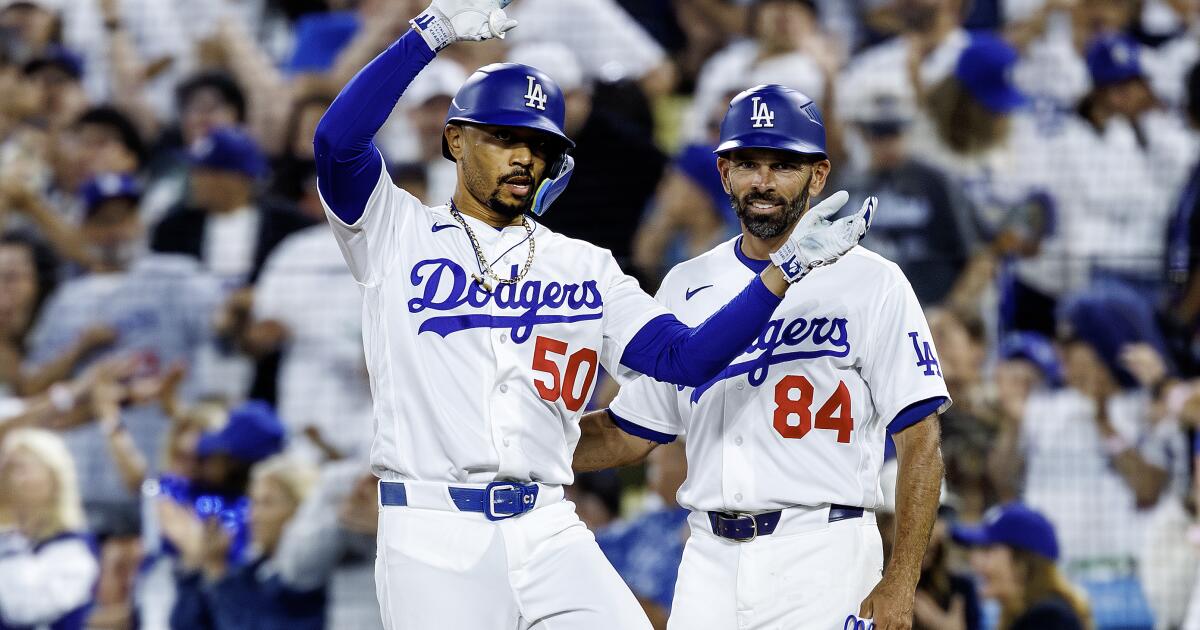
Mookie Betts’ first hit this series against the Rockies couldn’t have come at a more opportune time. With the crack of the ball against his bat, Tommy Edman scored from third, giving the Dodgers the lead.
And as Betts reached first, he pointed to Freddie Freeman, whose single put Edman in scoring position. It had taken a team effort to overcome another middling start from Roki Sasaki, and Betts, who had little to show before his game-winning hit, took the chance to highlight the joint contribution in the Dodgers’ 4-3 rubber-match win over Colorado (38-56).
“It feels great,” Betts said of his nine-pitch battle. “Helping the boys win, that’s really all it is. We play the game to win, and coming through in a big moment is kind of what, when you’re a kid, playing in the backyard, getting that hit is what you always strive to do, and fortunately, I was able to do it.”
Given a three-run lead in the first inning, brought to the Dodgers by a wild pitch and Kyle Tucker’s two-run, line-drive single to left field, Sasaki seemed set up for success.
Still, he gave away the lead as quickly as it came. In the second inning, he left a fastball too far over the plate, and third baseman Kyle Karros drove the ball over the left-center wall. The slider he dealt two batters later to second baseman Edouard Julien also crossed the zone too far over the plate, and Julien rounded the bases with another homer. In the third, a sacrifice fly by Mickey Moniak evened the scored, 3-3.
Sasaki’s troubles this season have been hard to pin down since his last win on May 23, as Sasaki tries to claw back the triple-digit velocity that’s escaped him as of late.
Against the Rockies, his fastball topped out at 99.1 miles per hour before steadily dropping to 98. He had managed five strikeouts in his six innings when manager Dave Roberts replaced him with Jack Dreyer, though the three earned runs couldn’t be ignored.
But Roberts also acknowledged the possibility that the pitcher had been tipping his pitches, possibly since he was playing in Japan, and Sasaki has tried to address it after a three-inning, six-run start last week. Even if he had fully self-corrected, his control issues remain. In the third inning, he walked the tying runner, Brett Sullivan.
“I’ve been working on a lot of things like the tipping stuff,” Sasaki said through interpreter Kensuke Okubo. “Also, I need to make quality pitches.”
Sasaki regained some of his confidence in the fourth when he worked out of a two-base jam with two strikeouts and a flyball to right, something that didn’t go unnoticed by Roberts.
“You can see the demeanor walking off the mound, the confidence,” Roberts said. “For me, it was more of let him end on a high note, feeling good about his outing, and then go from there.”
The Dodgers’ problems were compounded by Alex Call wasting the team’s two challenges in his at-bat in the first inning when the team had already taken the lead. And maybe it would’ve been excusable if Call had driven in the runners on first and second, but instead he ended the inning on a strikeout, stranding both. Roberts called the situation an “outlier” and didn’t feel as though he needed to have a conversation with Call regarding the situation.
After the three-run first, the Dodgers (61-33) remained hitless until Max Muncy laced a double down the right-field line in the sixth, though to little avail. As the innings ticked forward, Colorado’s chances seemed to increase. The Rockies hold the best league batting average (.297) in the eighth and ninth innings (the Dodgers are fourth with .268). And the Dodgers relievers, within the same constraints, have a 3.83 ERA — not bad, but not in the top 10 either.
Third baseman Max Muncy can’t get his glove on a line-drive double by Kyle Karros in the fourth inning.
(Gina Ferazzi/Los Angeles Times)
So when Alex Vesia struggled against the Rockies in the eighth inning and Muncy suffered a throwing error, Colorado seemed in position to score with the bases loaded and one out. Vesia struck out TJ Rumfield and Edgardo Henriquez (4-0), his replacement, retired Karros on a fly ball to right.
After Betts’ single allowed the Dodgers to take the lead, Tanner Scott (13) shut down the Rockies with back-to-back strikeouts, avoiding the team’s eighth series loss of the season.
“Didn’t feel great,” Roberts said. “Fortunately, we won a series, but that’s not the kind of way you want to do it.”
Sports
Justin Verlander announces he will retire after this season: ‘I’ve realized that time has come’

NEWYou can now listen to Fox News articles!
One of the greatest pitchers in the history of baseball will be hanging up his cleats after this season.
Three-time Cy Young Award winner Justin Verlander announced on Wednesday that the 2026 season will be his last.
Amid an injury-riddled season with the Detroit Tigers, Verlander decided it’s time to go.
Detroit Tigers pitcher Justin Verlander watches from the dugout during a game against the Chicago White Sox at Comerica Park in Detroit June 21, 2026. (David Rodriguez-Munoz/USA Today Network via Imagn Images)
“This season has challenged me in ways I haven’t experienced before, both physically and mentally. I’ve always believed that as long as I could compete at the level I expect of myself, I’d keep playing. I never wanted to retire because of a milestone, a number, or a date on the calendar. I wanted the game to tell me when it was time. Over the last several months, I’ve realized that time has come,” Verlander said in a social media post.
“While I’m fully committed to giving my team everything I have for the rest of this season, I’ve decided this will be my last. It’s fitting that I get to finish where it all started – with the Detroit Tigers, the organization that drafted me and gave me my first opportunity.”
Verlander inked a one-year deal with the Tigers, with whom he spent his first 12½ seasons before being traded to the Houston Astros, in the offseason. In Houston, he returned to dominance, winning both of his World Series titles and two of his Cy Young Awards.
“Baseball has given me more than I could have imagined. It taught me discipline, resilience, and the value of continuing to adapt and evolve. I’ve been fortunate to play with and against incredible players, for outstanding organizations, and compete in-front of fans who deeply appreciate the game,” Verlander added in his announcement.
Justin Verlander of the Houston Astros celebrates after the Astros defeated the Philadelphia Phillies in Game 6 of the 2022 World Series at Minute Maid Park Nov. 5, 2022, in Houston, Texas. (Mary DeCicco/MLB Photos via Getty Images)
PHILLIES STAR SAYS ‘BS RULE’ IS KEEPING HIM FROM BEING NAMED ALL-STAR IN FRONT OF HOME CROWD
“To every teammate, coach, player, clubhouse attendant, and fan who has been part of this journey – thank you. It’s been a privilege to share the field with you. To my family, especially my wife Kate, thank you for standing beside me through every season, every rehab, and every high and low. I couldn’t have done this without you. It’s time for the next chapter. But first, I’m excited to finish this season the only way I know how – with everything I’ve got.”
Verlander is the active leader with 3,554 strikeouts, which is good for eighth all-time. He needs 21 to surpass Don Sutton and 87 to pass Tom Seaver.
The 43-year-old made his MLB debut in 2005 and won the American League Rookie of the Year Award the following season in what was just a small glimpse of what was to come.
Verlander was a Cy Young Award finalist on four other occasions, consistently near the top of the leaderboard in just about every pitching stat. MLB Commissioner Rob Manfred gave Verlander a legend’s exemption to this year’s Midsummer Classic, making him a 10-time All-Star.
One could argue that Verlander should have at least one more Cy Young Award on his mantle, but he is on the fast track to Cooperstown and very much in the conversation to join Mariano Rivera as the only player unanimously elected to the Hall of Fame.
Verlander’s best season came in 2022, when he pitched to a career-best 1.75 ERA along with a 0.829 WHIP. However, that came after he missed the entire 2021 season due to Tommy John surgery for an injury he suffered after pitching just one inning in the abbreviated 2020 season.
Houston Astros starting pitcher Justin Verlander throws against the Boston Red Sox during the first inning Aug. 22, 2023, in Houston. (AP Photo/Michael Wyke)
CLICK HERE TO DOWNLOAD THE FOX NEWS APP
He won his first Cy Young Award in 2011, when he was also awarded the MVP Award, and his second in 2019. Verlander’s 11 seasons between his first and final Cy Young Awards are the second-most behind Roger Clemens, who had 18 seasons between his first and seventh.
Verlander led the majors in innings and WHIP four times while recording the most strikeouts in three seasons.
Follow Fox News Digital’s sports coverage on X, and subscribe to the Fox News Sports Huddle newsletter.
-

 Wisconsin1 minute ago
New Wisconsin AD Shawn Eichorst: Badgers Need ‘Texas Swagger’ And Less Humility
-

 West Virginia6 minutes ago
West Virginia retailers told to allow people to purchase soda with SNAP benefits
-
 Wyoming13 minutes ago
Wyoming women escape black bear attack on their tents in the Big Horn Mountains
-

 Crypto16 minutes ago
Binance maintains commitment to EU, seeking more licences in Asia
-

 Finance21 minutes ago
How Banreservas mobilised diaspora capital
-

 Fitness28 minutes ago
I’d Fallen Into an Exercise Rut—Until Trail Running Reminded Me How Joyful Movement Could Be
-

 Movie Reviews36 minutes ago
Movie review: Supergirl is a blast
-

 World41 minutes ago
Trump Says He Thinks He Will Remove Syria From US Terrorism Sponsor List

